
Spanish transcript translation
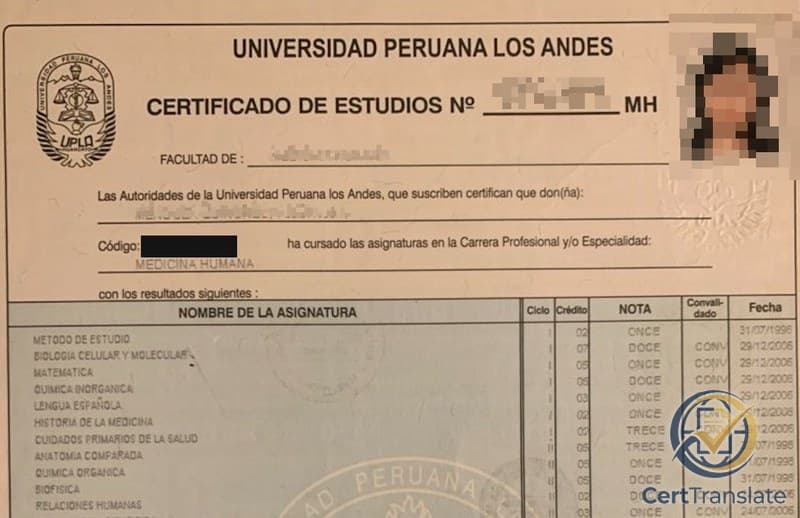
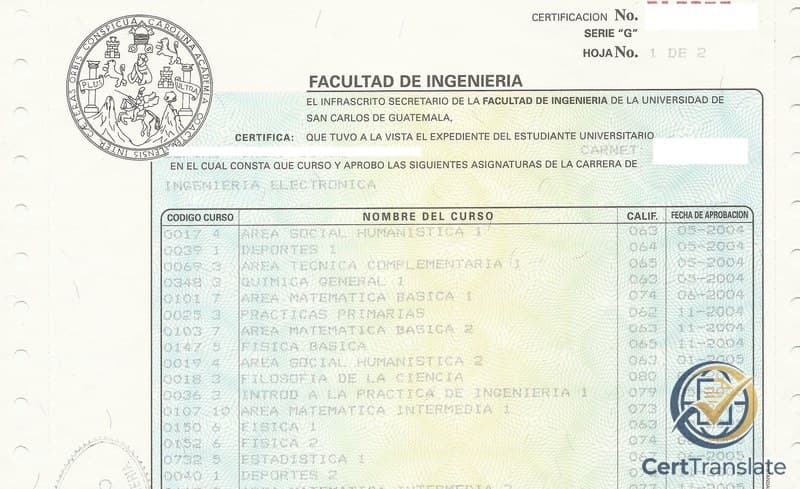
Analítico and boleta specialists · Grading-scale preservation · WES-ready layout
$24.95· 2-6 pagesWES-ready
Translate my Spanish transcriptSpanish transcript translation — formats, prices, samples →Exact, line-by-line English translation for WES and ECE, universities, licensing boards, and employers.
Ready within 24 hours
Exact academic record
Courses, grades and table structure preserved
Credits · grading scales · legends · seals
Certified package
Signed and Stamped Certificate of Accuracy
Company letterhead · translator signature · company stamp

One physical page, billed once. Unlike services that split dense pages into 250-word billing blocks.
We check your files and confirm the total before you pay




Your finished package
Your delivery includes the source-document scan, a complete English translation, and a signed and stamped Certificate of Translation Accuracy.
Files checked and total confirmed before payment
Each pair below is its own page, built around that country’s grading scales, term structure, and registrar marks. Same $24.95 flat page rate on all of them.
Analítico and boleta specialists · Grading-scale preservation · WES-ready layout
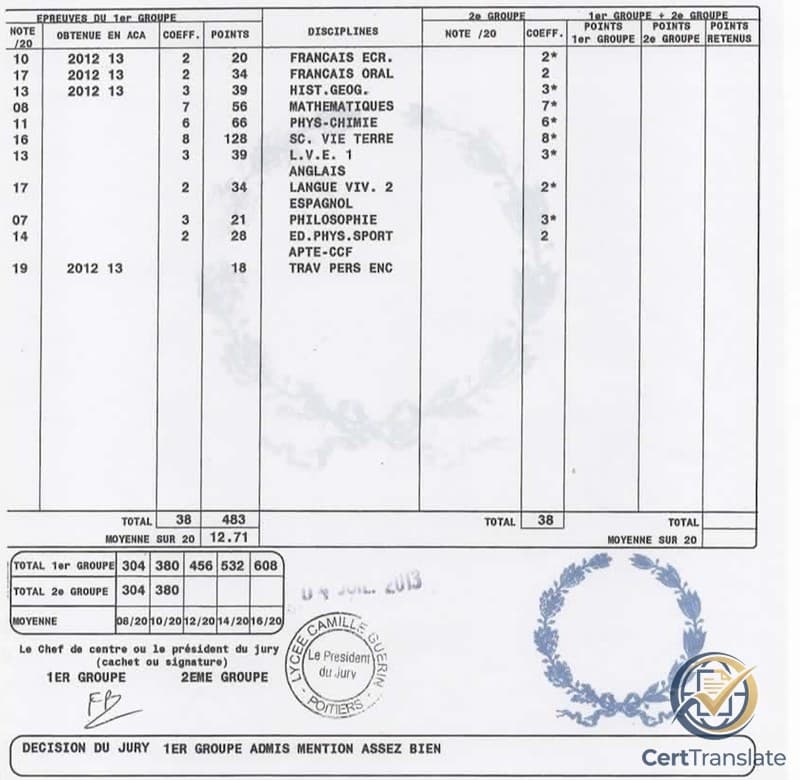
Relevé de notes expertise · 0–20 scale preserved · ECTS credits intact
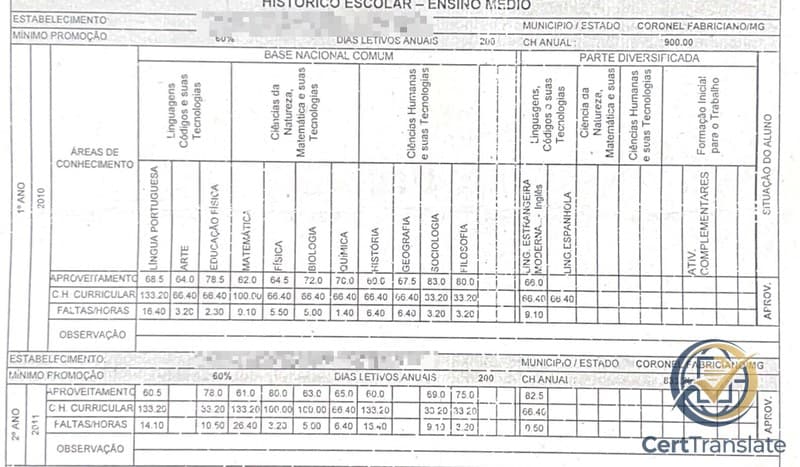
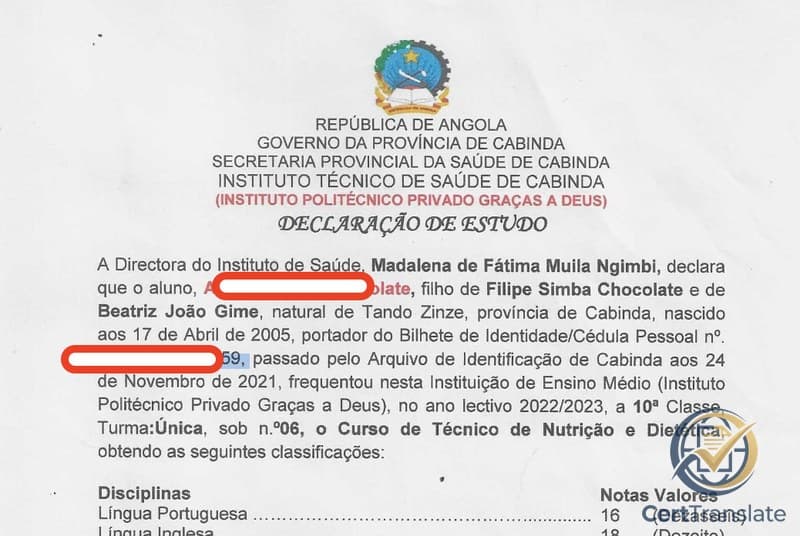
Native Portuguese speakers · Histórico escolar & registo académico · Brazil & Portugal grading systems
Real transcript casework
These are anonymized orders. Each case shows what the academic record held and the translation decision we made.
Seal over data
We read the covered characters from the surrounding layers, translated both, and recorded the overlap in a note.
Read the case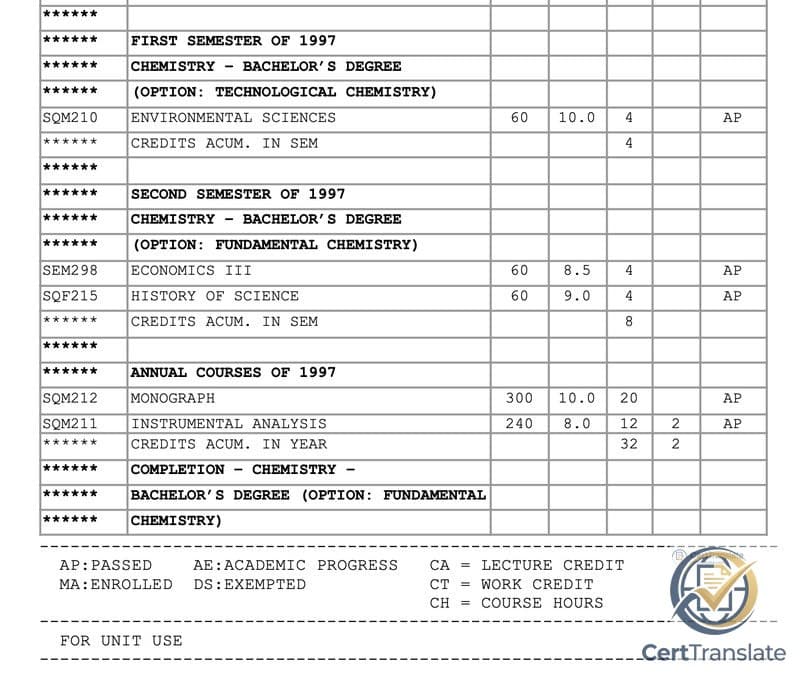
Table rebuilt
We rebuilt the printed course table row for row and transcribed the handwritten dates rather than rounding them.
Read the caseGrading legend
We kept each mark in the form the registrar issued it and translated the legend that explains the scale.
Read the caseHow it works
Upload once. We check the files and confirm the total before payment. Then our team translates, reviews, and certifies the complete package to the AcceptReady™ standard we publish.
Send every page, front and back, including the grading legend and any registrar annex. Partial records are the most common reason an evaluation stalls.
An academic translator rebuilds each course table row by row. A second reviewer checks marks, credit values, term labels, and the legend against the source.

Corrections are free at this stage. Your approved file is delivered as a searchable PDF, so a reviewer can jump to any course row instead of scrolling for it.

One physical page means one billed page.
No 250-word cap and no dense-page rebilling.
Certified price
$24.95/ page
No payment until file review
Cost
A certified transcript translation costs $24.95 per physical page. Most academic records run two to six pages, so a typical file lands between $49.90 and $149.70, confirmed before you pay.
Start my transcript order| Length of your record | Certified total |
|---|---|
| 2 pages | $49.90a single year or a short secondary record |
| 4 pages | $99.80a typical undergraduate transcript |
| 6 pages | $149.70a multi-year record with its grading legend |
| 7 or more pages | $24.95 per pagelong programmes and combined school-plus-university records |
Where the page cap shows up
A transcript page can carry 600 words of course rows. Services that define a page as 250 words bill that single sheet as two or three, so a six-page record can arrive priced like fifteen. We bill the six pages you uploaded.
Transcripts are word-dense — pages packed with course titles, grades, and credit hours. Most services cap a “page” at 250 words and re-bill anything denser as extra pages, so one transcript page can be billed as two or three. Move the sliders to see your real cost at our flat $24.95/page rate (no word cap) versus a typical capped provider.
Typical — most birth, marriage and death certificates
A capped provider counts a “page” as 250 words or less, so one dense physical page is billed as two. We bill the page you actually send.
1 page × $24.95 — flat, no word cap
380 words ÷ 250 = 2 billed pages × $24.95
You keep $24.95 on this document.
Get your exact priceComparison estimate only, based on a 250-word page definition at a representative $24.95 per-page rate. Your final price depends on the actual document.
This is an estimate. Upload your document to confirm the exact page count and total before you pay — no card required.
Client reviews
Nisha R.
Newark, NJ
“My transcript had semester pages and a separate annual summary. They labeled everything clearly and WES accepted the file with no rework.”
WES evaluation · Multi-page file
No rework requested
Daniel A.
Atlanta, GA
“They caught that one page with registrar notes was missing and asked for it before translation. That saved me from a delay later.”
Licensing board · Missing page caught
Delay avoided
Olha K.
Denver, CO
“Fast turnaround and accurate grading legend translation. My attorney used it for an employment-based filing without issues.”
Employment filing · Grading legend
Attorney filed as delivered
Questions before ordering
If your document does not match one of these situations, send it anyway. Support replies in 15–30 minutes during support hours.
A certified transcript translation costs $24.95 per physical page. A four-page record is $99.80 and a six-page record is $149.70. There is no word cap, however dense the course table, and we confirm the total before you pay.
Records of one to three pages are usually delivered within 24 hours of a clear upload. Longer multi-year files, dense course tables, and older print take more time, and we name the delivery window before work begins.
Credential evaluators ask for a complete, word-for-word English translation of every page, and that is what we deliver alongside the source scan and a signed Certificate of Translation Accuracy. If a receiving authority rejects the translation for a translation-related reason, we revise it free. If it is still rejected, we refund the translation cost.
No, and a translator should not. Recalculating marks onto a US scale is part of a credential evaluation, which agencies such as WES and ECE perform. We reproduce each mark exactly as the registrar issued it and translate the legend that explains the scale.
Yes, in full, and it stays with the grades it explains. Without the legend a reviewer cannot tell whether a 5 is the highest mark or a failing one, which is why an omitted legend is a common cause of follow-up questions.
By the physical page you upload, at $24.95 each, no matter how many course rows a page carries. This is where a 250-word page cap costs the most: it can turn one dense sheet into two or three billed pages.
We translate academic transcripts from 65+ languages into English. The pairs with a dedicated page are listed above. If yours is not there, upload the record anyway — the rate and the process are the same.
That is the receiving institution’s rule, not ours, and some evaluators do require a sealed copy sent by the school. Our translation travels with the copy you upload, so order the school copy and the translation in parallel rather than in sequence.
Most credential evaluators ask for both, because the transcript proves the coursework and the diploma proves the award. Send them in one order and the institution, dates, and programme names stay consistent across the two files.
Credential evaluators and universities generally require certification, not notarization. Some licensing boards ask for both, so we add notarization for $19.95 per order without changing the translated text.
Yes. You can read the finished translation and request unlimited free corrections before we certify it. If an authority later asks for a translation-related change, we correct the certified file at no charge.
Older academic records are routine work for us and we rebuild the table structure as printed. If a mark, course code, or date is too weak to read safely, we ask for a better image instead of guessing.
Four things, and you can check all four yourself. Compare any line of the original academic transcripts with the translation, including the text inside stamps. Put the two documents side by side — same page count, same order, course tables, grades, and totals where the reviewer expects them. Read the Certificate of Accuracy for the complete-and-accurate statement, the competence statement, the signature, date, and company stamp. Then confirm the wording matches what your receiving office publishes. Those four checks are the AcceptReady™ standard, and CertTranslate publishes it in full. Read the AcceptReady™ standard.
Most frequent problems we correct
These four come up again and again on academic records, both in files we translate and in translations clients send us to review.
Our check: We copy each mark exactly as issued and translate the legend beside it, because converting marks is the evaluator’s work and an unrequested conversion invites a query.
Our check: We ask for the legend before work starts, since without it a reviewer cannot tell whether a 5 is the top mark or a failing one.
Our check: We rebuild the table row for row, so course, mark, and credit stay on one line exactly as the registrar presented them.
Our check: We check page numbering and registrar marks before starting, because evaluators reconstruct the whole programme rather than its last year.
The standard behind these checks
AcceptReady™ is CertTranslate's published standard for certified translations: complete word-for-word translation, mirrored page layout, signed and stamped Certificate of Accuracy on letterhead, and matched to the receiver's published requirements.
How to check each one yourselfChecked before certification. If an authority later requests a translation-related correction, revisions remain free.
Start my translationCommon filing contexts
A transcript is the evidence behind the award, so it goes wherever someone needs to see the coursework itself — a credential evaluator, an admissions committee, a licensing board, or an attorney building a petition.
The key is consistency: the name, the institution, and the programme dates should match the diploma and the passport filed alongside it.
The evaluator reads course rows, credits, and the grading legend, then produces the US comparison from them.
Admissions committees check prerequisites course by course, which is why the table structure has to survive translation.
Nursing, medical, and engineering boards count clinical or contact hours directly off the record.
The transcript supports the qualification claim, usually filed together with the diploma and an evaluation.
Document glossary
The parts of an academic record that decide how a certified translation is built, whatever language the original is in.
Indian academic records often include both semester marksheets and year-end summaries, and both sections must be translated when submitted together.
Course titles are translated exactly and not generalized because evaluator decisions can depend on subject-level details.
Grade scales, pass-classification tables, and back-page legends are preserved as written and not converted into U.S. GPA terms.
Registrar signatures, controller office seals, and institution identifiers are translated and labeled for traceability.
India is a Hague Apostille Convention member, and apostille is generally the legalization path when non-U.S. authorities request authenticated academic records.
This is one of our most frequent academic workflows, so we apply a checklist specifically for marksheet sequencing and legend completeness.
Chinese transcripts often combine Chinese text with partial English fields, but partial bilingual content still requires full certified translation for consistency.
Pinyin name formatting is checked against passport spelling to reduce cross-document identity mismatches.
Course names and credit units are translated exactly, and institutional stamps are fully labeled rather than ignored.
If annual and term-level summaries appear together, each section is translated with explicit headings so evaluators can follow chronology.
China is a Hague Apostille Convention member, so apostille is commonly used when legalization is requested for non-U.S. destinations.
Korean transcripts frequently include course category markers, credits, GPA summaries, and ranking notes that must remain distinct in translation.
Department and program names are translated with source fidelity so admissions reviewers can evaluate specialization accurately.
If the transcript includes separate language for disciplinary notes or completion status, those entries are translated in full rather than summarized.
Semester and cumulative records are labeled clearly to prevent evaluator confusion about which values are term-specific versus final.
South Korea is a Hague Apostille Convention member, so apostille is the standard legalization route for most Hague destinations.
Our review process checks that all seal lines and registrar fields are represented, even when they appear in side columns or footer blocks.
Ukrainian transcripts can include ECTS references, local grade descriptors, and institutional formatting that differs from U.S. transcripts.
We preserve original grade symbols and legends so evaluators can apply their own equivalency methods instead of relying on translator interpretation.
Course names and module descriptions are translated precisely, especially in technical programs where wording affects outcome.
If records include both annual and semester structures, each structure is translated and clearly labeled in sequence.
Ukraine is a Hague Apostille Convention member, so apostille is generally used when legalization is required outside USCIS workflows.
When institutions have undergone naming changes, source names are preserved and contextual translator notes are added only when necessary.
Nigerian tertiary transcripts may contain English primary text plus institution-specific abbreviations, legends, and registrar coding that still require structured rendering.
We standardize layout in the translated copy while preserving source labels so receiving offices can cross-reference lines quickly.
Course codes, grade keys, and credit calculations are transferred exactly and never reinterpreted into alternate scoring systems.
Registrar remarks, issuance statements, and seal descriptions are included because these details are often used in authenticity review.
Nigeria is not a Hague Apostille Convention member, so legalization usually requires consular authentication rather than apostille.
“Transcript rejections usually come from structure loss, not language fluency. If semester, annual, and legend sections are not clearly separated, evaluators cannot map the record correctly.”

Reference library
Guidance and source links last rechecked .
Ready when you are
Upload the full record, both sides, with the grading legend and any registrar annex. We confirm the page count, price, and delivery time before you pay.
No payment until file review
