
Student Visa Translation Requirements and Document Checklist
Form I-20 and Form I-539 · Transcripts, Diplomas, and Funding Records Translated in 24 Hours

Reviewed by Reviewed by Michael Chen, Lead Immigration Packet Translator
12 years in certified translation · ATA member since 2015 · High-volume reviewer of transcripts, diplomas, and multilingual funding records
“The recurring student filing mistake is translating the diploma but not the transcript, or rewriting the grading scale into a U.S. GPA instead of preserving what the original record actually says.”
Your instant price
Student Visa (F-1, J-1, M-1)Review before payment · acceptance guarantee




What Documents Need Translation for a Student Visa?
Student cases often depend on Form I-20, Form DS-2019, and the DS-160 visa application, while applicants already in the United States may also use Form I-539 for change or extension requests. In that process, student visa translation is usually needed for the academic, identity, or financial documents behind those forms.
As of February 28, 2026, the Department of State describes F-1 and M-1 student visas and J-1 exchange visas through the consular process, USCIS describes Form I-539 for change or extension requests, and DHS/ICE manages the SEVIS record framework. F-1 visa translation requirements most often start before the interview because the transcript and diploma packet may already be needed for I-20 issuance or change-of-status review.
The checklist below covers the records most often translated for F-1, J-1, and M-1 cases. If any of these documents are not in English, they should be translated before the school deadline, status filing, or visa interview so the packet stays review-ready.
Academic transcript
I-20 support, DS-160, admissions support
Student visa transcript translation is one of the most common needs because schools and visa-stage reviewers often want the full academic history in English.
Diploma or degree certificate
I-20 support, DS-160, admissions support
Diploma translation usually works best when it is prepared with the transcript so the degree title and course history stay aligned.
Passport biographic page
DS-160, visa interview, I-539 support
Passport translation helps keep names, birth dates, and identity details consistent across the visa application and any later USCIS filing.
Financial sponsor bank statements
I-20 funding, F-1 or M-1 interview
I-20 supporting document translation often includes sponsor bank records when the applicant needs to prove tuition and living-expense funding.
Sponsor employment letters or income evidence
I-20 funding, J-1 or F-1 support
Sponsor salary letters, employer confirmations, or income records may need translation when they support the funding explanation for the case.
Scholarship, assistantship, or government sponsorship letters
I-20, DS-2019, visa interview
Funding awards, scholarship letters, or sponsor-program documents may need English translation when they are issued in another language.
Vaccination or school health records
School entry, transfer, program support
The visa forms themselves are in English, but schools or programs may still ask for translated vaccination or health-related records during enrollment or transfer.
In most cases, student visa transcript translation is the most common gap in these packets. Applicants often know they need the diploma, but the transcript is what usually carries the course list, grading scale, issue dates, and other details the school or reviewer actually compares.
F-1 visa document translation also reaches beyond academic records. I-20 supporting document translation often includes sponsor bank statements, income letters, scholarship notices, and assistantship awards when those records explain how the applicant will fund the program.
In practice, university admissions translation and visa translation overlap, but they are not always identical. A school may accept one set of academic translations for admission, while the visa-stage packet still needs passport, funding, or additional support records translated before the interview or change-of-status filing.
Check What Documents You Need Translated — Free, 2 Minutes →
Common Languages for Student Visa Document Translation
Chinese, Korean, Hindi, and Spanish are common source languages in student visa translation because transcripts, diplomas, and sponsor funding records often come from schools and families outside the United States.
If your documents are in Chinese or Korean, our certified Chinese translation services and certified Korean translation services regularly support transcript packets, diploma translations, and funding records used for I-20, DS-2019, and visa-stage preparation.
Hindi records are also common in F-1 and M-1 work, especially where the application packet includes transcripts, degree certificates, sponsor bank statements, or employment letters. In mixed-language files, the main priority is keeping names, dates, and academic terms consistent across the full packet.
How to Get Your Student Visa Documents Translated — Step by Step
Identify the academic and funding packet first
Start with the checklist above and gather every non-English transcript, diploma, passport page, bank statement, sponsor letter, scholarship record, and other support document tied to the I-20, DS-2019, DS-160, or I-539 stage.
When F-1 visa translation requirements are still moving, it is usually better to translate one extra support document than to discover later that the school or interview packet still needs it.
Upload scans, photos, or PDFs in any format
Clear scans and phone photos are acceptable as long as the full page is visible, including reverse sides, transcript legends, stamps, annexes, and sponsor-document attachments.
If the packet includes a diploma plus transcript, or bank statements plus employment letters, upload the full set together so the translated evidence stays complete.
We assign native speakers with academic-record experience
Your files go to translators who regularly handle transcripts, diplomas, sponsor funding records, and immigration support materials used for student filings.
That matters because student visa translation depends on exact handling of names, dates, grading terms, degree titles, and funding details across multiple documents.
Translation and certification are prepared together
Every visible source-language element is translated, including transcript legends, seals, structured tables, scholarship terms, and handwritten notes.
The final packet includes the English translation and the signed Certificate of Accuracy expected with non-English supporting records.
Review and delivery before the school or interview deadline
Before delivery, we review names, dates, degree titles, transcript completeness, funding references, and visible-page coverage across the packet.
Most short documents are delivered within 24 hours as PDF files, with optional hard-copy mailing available if the applicant or school representative wants a physical file.
Many applicants wait until the I-20, SEVIS, or interview deadline is already close before translating supporting documents. Starting earlier usually prevents rush pressure around transcripts, sponsor records, and other items that still need review under F-1 visa translation requirements.
Files are handled through encrypted upload channels, access is limited to production staff, and deletion policies are available for sensitive academic, identity, and financial records.
Translation Cost for a Student Visa
Flat per-page rate — no surprises, no hidden fees.
Certified Translation
Starting Rate
Standard Turnaround
1-2 Days
(Typically 24h)
Pay only after you review the quote
Cost by Document
Always Included — No Extra Cost
Student visa translation is priced by page, not by visa class. Our $24.95 base rate includes human translation, the signed certification statement, and revision support if USCIS or the visa stage raises a translation-format issue. F-1 visa translation requirements often cost more only because transcripts and funding packets add pages, not because the certification format changes. Many immigration translation providers charge $30-$60 per page for similar work. Exact pricing is confirmed after document review and before payment, and our full translation pricing is available on the pricing page.
View full pricing detailsMistakes That Delay Student Visa Applications
1Translating the diploma but not the transcript
Consequence
This is one of the most common student-packet gaps. The diploma alone rarely explains the full academic history, and the missing transcript can slow school review, I-20 preparation, or the later visa packet.
Our Solution
Translate the diploma and transcript together so the degree title, dates, and course history stay aligned.
2Using machine translation or self-translation
Consequence
Machine output and self-prepared translations often fail on certification language, structured transcript formatting, or the handling of stamps and annotations.
Our Solution
Use a third-party translator who provides the full English translation and a signed Certificate of Accuracy for official review.
3Leaving out the certification statement
Consequence
A translated page without certification is incomplete because the receiving authority still needs the translator to attest that the English version is complete and accurate.
Our Solution
Confirm that every delivered translation includes the signed certification statement and company identification.
4Converting the grading scale or rewriting the degree
Consequence
A translation should preserve the original grading terms and degree title. Turning the record into a U.S. GPA or a U.S. degree label can create confusion about what the source document actually says.
Our Solution
Keep the translation faithful to the original wording and let the school, evaluator, or reviewing authority interpret equivalency separately.
5Waiting until the school or interview deadline is already close
Consequence
Student packets often move on short timelines once the admission or interview window opens. If the transcript, sponsor bank records, or scholarship documents still need translation late in the process, the packet becomes a rush job.
Our Solution
Start the translation work before the I-20 or interview deadline is close so the academic and funding records can be checked together.
Our Student Visa Translation Track Record
Student visa packets are a steady part of our USCIS and admissions-related translation workload, especially transcript packets, diploma translations, sponsor funding records, and school-support files prepared for F-1, J-1, and M-1 cases.
Experience
Every student visa translation order is reviewed for names, dates, transcript completeness, degree titles, sponsor references, certification completeness, and visible-page coverage before delivery.
Quality Assurance
We support mixed-language student packets across 100+ source languages, from one-page degree certificates to multi-document files that combine transcripts, funding records, scholarship letters, and health or transfer records.
Coverage
The strongest student visa translation work is not just line-by-line accuracy. It is deadline-aware, school-aware, and checked so academic records, identity records, and funding evidence stay consistent from the first school request to the visa review stage.
Real translation cases for Student Visa (F-1, J-1, M-1) filings
Anonymized translations we've delivered for Student Visa (F-1, J-1, M-1) packages. Each case names the source-document quirk and the translation decision that kept the packet clean.
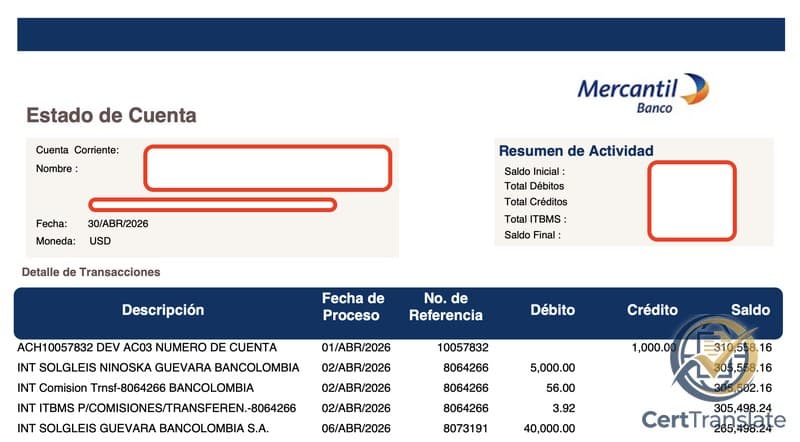 RecentJul 2026field-semanticsPanama
When a University Required the Account Type a Translation Dropped
A one-page Panama Estado de Cuenta was translated into English for a US university's proof-of-funds review. The initial draft collapsed the source field 'Cuenta Corriente' to a bare 'Account' label, dropping the account type. The university flagged the missing content because its proof-of-funds policy requires the account type — checking or savings — to be identified on the certified translation. We re-issued the translation with 'Checking Account' restored; the rest of the document was unchanged and accepted.
Handled by Natalia Vega, Iberian & Latin American Legal TranslatorF-1 / I-20 proof-of-funds review at a US university (specific institution not named by client)Read case →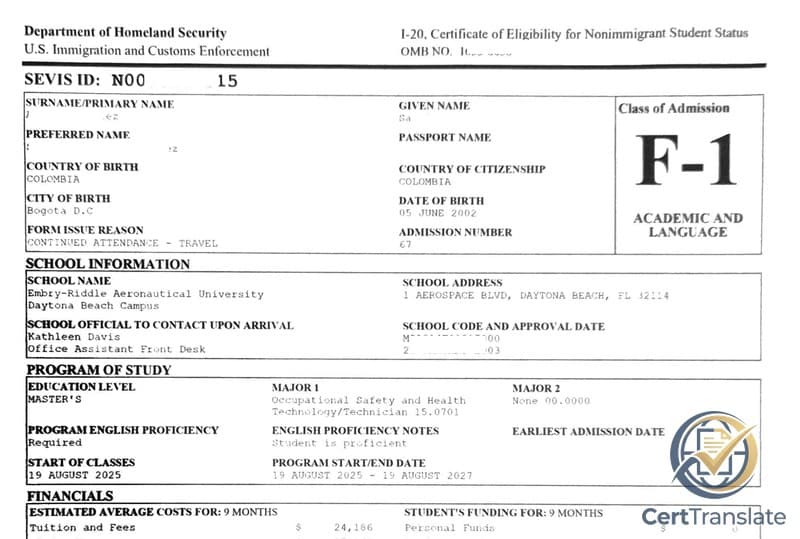 May 2026Reverse-Direction Federal FormsUnited States
When a U.S. I-20 Needs Translation Into Spanish, Not Out of It
A Colombian F-1 student at a U.S. university needed his Form I-20 translated from English into Spanish for presentation to a financial sponsor abroad — the reverse of the direction most certified translations flow. We rendered the form's labels, instructions, and attestations into natural Spanish while keeping every U.S. legal citation (8 CFR references, visa class "F-1", SEVIS, CIP program codes) verbatim in English, because those identifiers have no meaning if translated. A single Translator's Note documented the scope (page 1 of a 3-page form, as received).
Handled by Mateo García, Senior Immigration Translation SpecialistClient's home country (Spanish-speaking jurisdiction)Read case →
Other Immigration Translation Guides
Credential evaluation translation
Many student packets start with the same transcript and diploma translation work later used for WES, ECE, or other academic evaluation requests.
Work visa translation
Academic records first translated for F-1, J-1, or M-1 history often reappear later when a student moves into H-1B or another employment-based filing.
USCIS translation guide
Use the broader USCIS guide if you want the general certified-translation rules first before focusing on transcripts, diplomas, and sponsor records.
Need documents for multiple filings? Upload everything in one order at the same $24.95/page rate so names, dates, academic records, and funding evidence can be checked together.
Frequently Asked Questions About Student Visa Translation
How much does translation cost for a student visa?
Student visa translation starts at $24.95 per page. Many F-1, J-1, and M-1 packets fall between $99.80 and $299.40 depending on how many transcripts, diplomas, funding records, and supporting documents need certified translation.
What documents need translation for a student visa?
Any non-English document submitted with the case should be translated in full. Common examples are transcripts, diplomas, passport pages, sponsor bank statements, sponsor employment letters, scholarship notices, and other academic or financial support records.
How long does translation take for student visa filings?
Most short student visa documents are delivered within 24 hours. Larger transcript sets, sponsor funding packets, or multi-document files may take longer, but timing is confirmed before payment.
Will my translations be accepted by USCIS or at the visa interview?
Official reviewers generally accept complete certified translations that include the English rendering and a signed certification statement from a competent translator. Our student visa translation workflow is built around that standard, but USCIS, the school, or the consular officer always makes the final decision.
Can I translate my own documents for a student visa?
Self-translation is a common risk in student cases. Official review expects foreign-language evidence to come with complete English translation and third-party certification, and self-prepared versions often create questions about completeness, neutrality, or omitted page elements.
What is the difference between certified and notarized translation for a student visa?
Certified translation and notarized translation are different services. USCIS and visa-stage review usually focus on the certification statement, while notarization is only added if another receiving authority or school specifically asks for it.
Do I need an apostille for a student visa?
Usually no. Student visa packets generally focus on complete English translation and certification rather than apostille, although another institution outside the visa process may separately ask for apostille on the same original record.
Do I need to translate my I-20 or DS-2019?
Usually no. Form I-20 and Form DS-2019 are generally issued in English. The translation work usually applies to the supporting documents behind those forms, such as transcripts, diplomas, or sponsor funding records.
Should I translate both the diploma and transcript for F-1?
Often yes. F-1 visa translation requirements commonly work best when the diploma and transcript are translated together because the school or reviewing authority may compare the degree title, field of study, dates, and course history side by side.
Ready to Get Your Student Visa Documents Translated?
Most short student visa documents are translated and certified within 24 hours, and every order includes the Certificate of Accuracy expected for foreign-language supporting records.
Use the checklist above if you already know the documents in your F-1, J-1, or M-1 packet, or start with the requirements checker if you want to confirm the full set before ordering.
Lead Immigration Document Translator
CertTranslate provides certified translation services only. We do not provide legal advice, immigration consulting, or representation. For questions about your immigration case, consult a licensed immigration attorney.