
1
Universal requirement
All state licensing boards require certified English translations of foreign credentials. No self-translation.
Government agency requirements
State licensing boards require certified translations for foreign professional credentials. Medical: ECFMG. Nursing: CGFNS. Engineering: NCEES. Each has specific translation and evaluation requirements. A certified translation is the starting point for all licensing pathways.
Certified translation ready in 24 hours
Requirements coverage
Covers all three major professions: medical, nursing, engineering
Submission guidance
Explains ECFMG, CGFNS, and NCEES pathways

We check your files and confirm the total before you pay
Not sure what your state board needs? Free requirements check



This page explains licensing board translation requirements. Verify with your specific state board.
On this page
State Licensing Boards document workflow
Across all professional licensing pathways — medical, nursing, engineering — state boards require certified English translations of foreign educational credentials. This typically includes academic transcripts, diplomas, degree certificates, and supplemental professional certificates or training records.
The U.S. has no federal translator licensing or certification requirement. Any competent professional translator can provide a certified translation with a signed certification statement. However, some boards give preference to ATA-certified translators, and some accept ATA-certified translations without additional notarization. For maximum acceptance, a certified translation with a signed Certificate of Accuracy meets all state board standards.
The translation is the input to a two-step process. Step one: the evaluation body (ECFMG, CGFNS, NCEES, or a NACES member) uses the translation to assess your foreign credentials against U.S. standards. Step two: the state licensing board reviews the evaluation report and any additional state-specific documents. The translation is the foundation for both steps.
All state licensing boards require certified English translations of foreign credentials. No self-translation.
Medical → ECFMG. Nursing → CGFNS. Engineering → NCEES. Each has its own evaluation process and requirements.
Individual state boards may have additional requirements beyond the federal evaluation bodies.
Each profession has a distinct credential evaluation pathway. The translation requirements are similar — certified, complete, word-for-word — but the evaluation process, the evaluation body, and the accepted evaluators differ significantly.
For medical professionals, ECFMG certification is the gateway to U.S. medical residency. International medical graduates (IMGs) must have their medical school credentials verified and translated. Some states are creating alternative licensing pathways for IMGs, but certified translation of credentials remains a universal requirement.
For nursing, CGFNS provides credential evaluation services accepted by most state boards. Some state boards approve additional evaluators. California's Board of Registered Nursing has its own "Certified English Translation" form that it requires foreign-educated nurses to provide to their translator.
Each profession has a different primary evaluation body and state board process.
| Profession | Primary evaluation body | Translation and evaluation details |
|---|---|---|
| Medicine (IMGs) | ECFMG (Educational Commission for Foreign Medical Graduates) | Medical school transcripts and diploma must be translated. ECFMG verifies credentials for residency eligibility. Some states creating alternative IMG pathways. |
| Nursing | CGFNS (Commission on Graduates of Foreign Nursing Schools) | Nursing program records translated. CGFNS evaluates for board approval. California BRN has its own translation form. TOEFL/IELTS may be required. |
| Engineering | NCEES (National Council of Examiners for Engineering and Surveying) | Engineering degree transcripts translated. NCEES evaluates non-ABET degrees. State boards may approve specific evaluation companies (Florida, Texas). |
| Pharmacy | FPGEC (Foreign Pharmacy Graduate Examination Committee) | Pharmacy degree transcripts translated. FPGEC administers equivalency exam and credential review. |
| Dentistry | State dental boards + credential evaluation | Dental school transcripts translated. Most state boards accept NACES-member evaluations. |
| Accounting (CPA) | State boards of accountancy + NACES evaluators | Accounting degree transcripts translated. State boards specify approved evaluators (WES, ECE, etc.). |
A certified translation from a professional translator works for all evaluation bodies and state boards. The same translation can be used across multiple states if applying in more than one.
The process involves two stages: credential evaluation by a profession-specific body, then state board application. Translation is required at stage one.
Medical: ECFMG. Nursing: CGFNS. Engineering: NCEES or state-board-approved evaluator. Check your specific state board's website for approved credential evaluation services.
Translate your complete academic record: transcripts, diplomas, degree certificates, and any professional training records. Each document must be word-for-word with a signed Certificate of Accuracy.
Send your certified translations to the appropriate evaluation body. Some bodies accept direct uploads; others require translations to be sent as part of a sealed institutional package. Check your evaluation body's submission process.
The evaluation body issues a report assessing your credentials against U.S. standards. This report, along with your application materials, is submitted to the state board.
Submit the evaluation report, certified translations, and any state-specific forms to your state board. Some states have additional requirements: California BRN has its own translation form, Texas requires board-approved evaluators.
01
about 24 hours for standard academic records
02
several weeks to months
03
4–8 weeks
04
4–8 weeks
05
varies widely by state and profession
Licensing board rejections can delay your career by months. Most issues are preventable with proper translation.
What happens
Evaluation body cannot determine course equivalency.
Why it happens
Translator omits courses, credit hours, or supplemental pages. Medical and engineering transcripts are often multi-page with dense tabular data.
Safer approach
We translate every page, every course, every grade — including supplemental sheets, back pages, and institutional notes.
What happens
Evaluation body cannot determine the original grading system.
Why it happens
Translator converts foreign grades to U.S. GPA. This is the evaluation body's job, not the translator's.
Safer approach
We preserve original grading scales exactly. ECFMG, CGFNS, and NCEES have their own conversion methodologies.
What happens
Board returns the application as incomplete.
Why it happens
Applicant translates their own transcript to save money. No state board accepts self-translation.
Safer approach
Every translation is performed by a professional translator with a signed Certificate of Accuracy.
What happens
California Board of Registered Nursing returns the translation.
Why it happens
California BRN has its own "Certified English Translation" form that must be completed by the translator.
Safer approach
We are familiar with state-specific form requirements and complete them when applicable.
Anonymized translations we've delivered into State Licensing Boards packages. Each case shows the source-document issue and how it was handled.
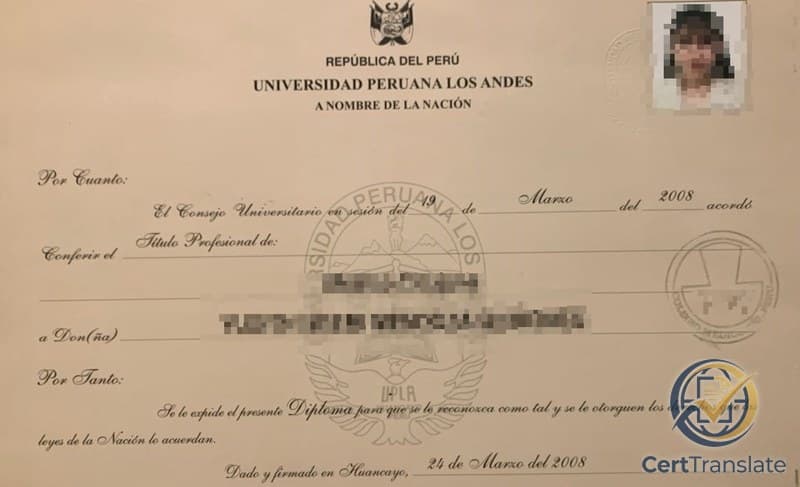
A Peruvian Diploma de Título Profesional (Médico Cirujano) from Universidad Peruana Los Andes carried its legal weight on the reverse. The back held the university registration entry, the General Secretary's authentication, and a Regional Health Directorate registration stamp. We translated both sides into English and rendered every seal, stamp, and signature line, so nothing on the back was dropped. The certified Spanish-to-English translation was delivered for the client's USCIS filing.
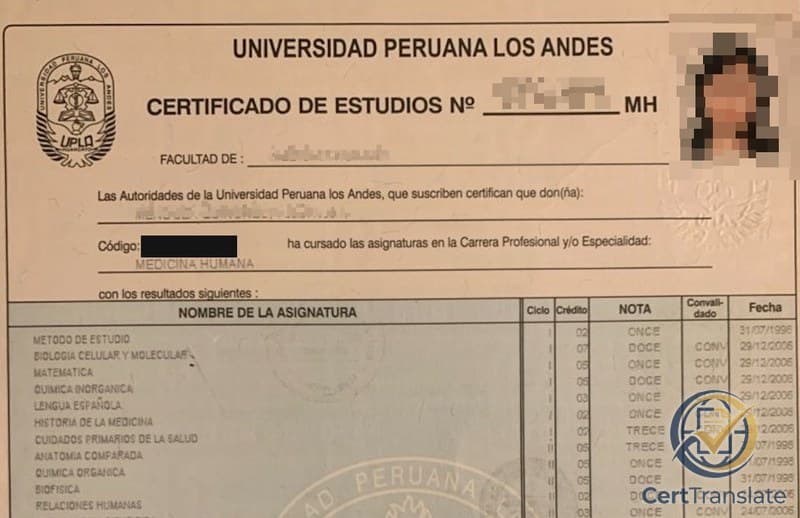
A Peruvian Certificado de Estudios from Universidad Peruana Los Andes recorded every grade as a Spanish word — ONCE, DOCE, DIECIOCHO — on Peru's 0-to-20 vigesimal scale, with a Convalidado (validated-credit) column across two numbered sheets. We rendered each grade as the English word plus its numeral, explained the scale and the 11/20 pass mark, and kept both sheets complete. The certified Spanish-to-English translation was delivered for the client's USCIS filing.
Verified customer reviews
Daniel R.
“Maria translated my Mexican birth certificate and marriage certificate for a family-based USCIS filing and caught a surname-order issue before submission. The packet was accepted without a translation problem.”
Birth Certificate + Marriage Certificate
→ USCIS family petition
Professional credential translation typically covers multiple documents: transcript, diploma, and possibly training certificates.
Our certified translation
True flat rate — no word-count multipliers, no per-page surprises.
Typical for this case
$49.90–$249.50
Transcript: 2–8 pages. Diploma: 1–2 pages. Combined: 3–10 pages.
Pay only after you review the quote
Potential additional costs
These external-provider requirements are included only to help you plan the State Licensing Boards workflow.
Typical end-to-end scenarios
Yes. All state licensing boards require certified English translations of foreign credentials. The translation must be performed by a professional translator with a signed Certificate of Accuracy.
Medical: ECFMG. Nursing: CGFNS. Engineering: NCEES or state-board-approved evaluator. Pharmacy: FPGEC. Dentistry: typically NACES-member evaluators. Accounting: state-board-specified evaluators (often WES or ECE).
A certified translation is required but usually not sufficient on its own. Most professions also require credential evaluation by a recognized body. The translation is the input to the evaluation process. Some state boards that evaluate internally may accept translation alone.
Yes. A certified translation works for every state board and every evaluation body. If you are applying for licensure in multiple states, you do not need separate translations.
About 24 hours for most academic transcripts and diplomas. Medical school transcripts with many pages may take slightly longer. We recommend starting the translation before anything else — the evaluation body cannot begin without it.
Yes. California's Board of Registered Nursing has its own "Certified English Translation" form that the translator must complete for foreign-educated nursing applicants. We are familiar with this form and include it when applicable.
Requirements were checked against the official guidance linked below. Confirm the current instructions for your program before submitting.
| Official source | What we verified | Official guidance |
|---|---|---|
| Official sourceEducational Commission for Foreign Medical GraduatesECFMG — certification requirements for international medical graduates | What we verified
| Open source |
| Official sourceCommission on Graduates of Foreign Nursing SchoolsCGFNS — credential evaluation for foreign-educated nurses | What we verified
| Open source |
| Official sourceNational Council of Examiners for Engineering and SurveyingNCEES — credentials evaluation for engineering licensure | What we verified
| Open source |
State Licensing Boards application translation
Certified translation of your professional credentials in 24 hours. Accepted by ECFMG, CGFNS, NCEES, and state licensing boards nationwide.
Certified translation
Signed and stamped Certificate of Accuracy with secure digital delivery.
We are not affiliated with any state licensing board, ECFMG, CGFNS, or NCEES.