
Acta de divorcio
Divorce certificate or Civil Registry record
A short official certificate is enough, if that is the document you need.
Sentencia de divorcioActa de divorcioCertificado de divorcio
Certified English translation for USCIS, spouse and fiancé(e) petitions, naturalization filings, courts, and other marital-history review.
Ready within 24 hours
Complete submitted record
Finality and court structure preserved
Case caption · ruling · finality · seals · registration notes
Certified package
Signed and Stamped Certificate of Accuracy
Company letterhead · translator signature · company stamp

We check your files and confirm the total before you pay




Your filing package
You get three files: a scan of your Spanish record, the full English translation, and a signed and stamped Certificate of Translation Accuracy.
Files checked and total confirmed before payment
Documents we translate
Have one document? That is enough to start. Upload the Spanish divorce record you want translated. We confirm the page count, the price, and the delivery time before you pay.
Acta de divorcio
A short official certificate is enough, if that is the document you need.
Sentencia de divorcio
We translate short court rulings and full multi-page judgments alike.
Related records
Escritura pública, certificado de firmeza, civil records with margin notes, apostilles, and related pages.
Real Spanish-language casework
The first case is a divorce record. The other two are civil records. They show two things we check in divorce packets as well: how far an apostille reaches, and what to do with a digital-only record.
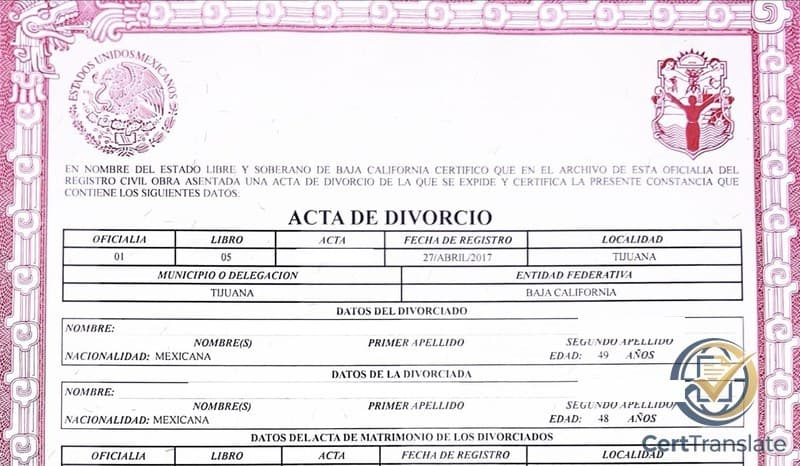
Mexico · three-date chronology
We labeled three dates apart: the judge’s ruling, the ejecutoria, and the later registry entry. A translator’s note set them in order for USCIS.
Read the case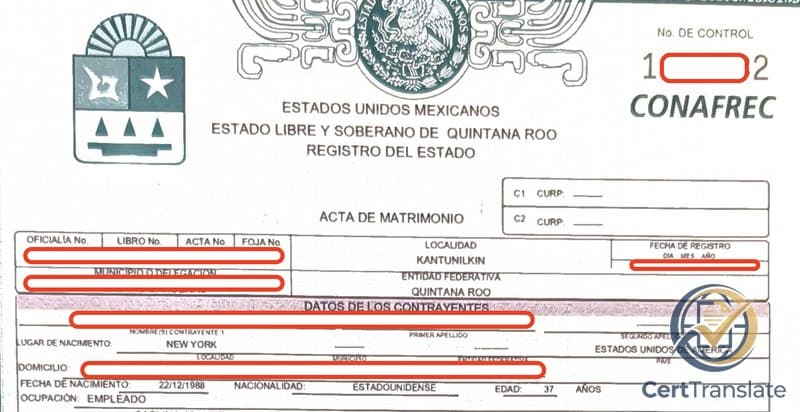
Mexico · apostille scope
We split the packet into two certified files. The apostille stayed with the short-form acta it covered. The long form got its own certificate.
Read the case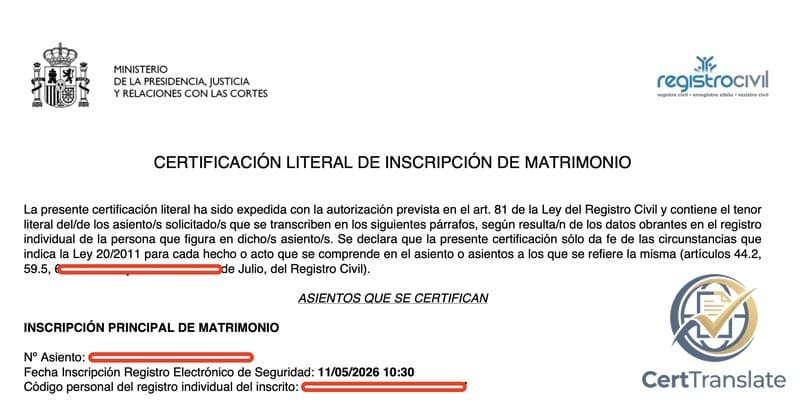
Spain · electronic record
We kept the electronic-signature reference and the verification block. A translator’s note then explained the digital-only record to USCIS.
Read the caseCountry-specific evidence
Which record counts as proof depends on the country. So does the office that issues it. We name the record you actually hold, instead of forcing every divorce into one decree template.
Mexico issues an acta de divorcio through the Civil Registry. A family-court decree usually backs that entry. Some mutual divorces are handled at the registry, with no court decree at all.
A Mexican record can carry three dates: the ruling, the ejecutoria, and the day the registry wrote it down. We label all three. They are not copies of one date.
If you hold the official acta, upload it first. Add the sentencia when your USCIS notice, attorney, or receiving office asks for the court judgment too.
In Colombia, a contested divorce comes from a family judge as a sentencia. An uncontested one can be signed at a notary as an escritura pública.
U.S. visa reciprocity guidance does not accept a divorce note on a birth or marriage record in place of the sentencia or escritura. The English version shows which route was used.
The Dominican acta de divorcio comes from the Civil Registry after the ruling is final, filed, published, and read out. Each step can show up as its own line.
For immigrant and K-visa use, records issued before July 1, 2025 may need the Acta Inextensa. Newer records use one unified format and drop the extract and inextensa labels.
Spain records divorce two ways: a Civil Registry certificado de divorcio, or a marriage certificate with the divorce noted in the margin. A final court sentencia also counts as proof.
A Spanish record issued online may carry a verification code instead of a wet seal. We copy the code and translate the registry or court wording around it.
How it works
Upload the record first. We name the document, confirm the full page set and the price, then translate, check, and certify it.
Send the acta, sentencia, escritura, finality page, back sides, and apostille. Add any USCIS checklist or RFE that names what they asked for.
A Spanish specialist translates the court or registry layout. A second reviewer checks names, case numbers, ruling dates, finality, and the registry entry.

Ask for fixes before we certify. You then get the source copy, the full English translation, and the signed and stamped Certificate of Translation Accuracy.
How much does a Spanish divorce decree translation cost?
No 250-word cap on dense court pages.
Certified price
$24.95/ page
No payment until file review
Client reviews
Gabriela N.
Las Vegas, NV
“They translated my Mexican divorce decree and kept all of the custody language intact. That was important for my later marriage filing.”
Mexico · Sentencia with custody terms
Full record kept intact
Rafael C.
Tampa, FL
“My Colombian decree was several pages and another service wanted to do only the last page. CertTranslate translated the complete judicial record.”
Colombia · Multi-page sentencia
USCIS packet completed
Elena D.
Newark, NJ
“The Dominican court wording was complex, but the English version was clear and complete for my attorney to use.”
Dominican Republic · Court and registry wording
Attorney-ready English copy
Questions before ordering
The translation rule is always the same: file the Spanish evidence with a full certified English translation. Which divorce record you need underneath depends on the country and the filing.
The price is $24.95 per physical page, with no word cap. A short acta runs one or two pages. A court sentencia can run several. We confirm the count before you pay.
Most one- to three-page orders arrive within 24 hours. For longer sentencias, and for files with dense handwriting, we confirm a delivery time before we start.
Your package holds the source copy, a full English translation, and a signed and stamped Certificate of Translation Accuracy. If USCIS raises a translation issue, we revise it free. That does not replace holding the right record in the first place.
It depends on the country and on what you were asked for. Mexico often uses an official acta. Colombia usually needs the original sentencia or escritura. Upload both if you have them, and we will name them before you pay.
Translate the whole document you are filing, not a loose signature page. If your evidence is a short official acta, translate that acta in full. Do not buy an unrelated court file.
Use the date the form asks for, if the record backs it up. On a Mexican acta the ruling, ejecutoria, and registry dates can all differ. The translation labels each one instead of picking for you.
USCIS generally asks for a certified English translation, not a notarized one and not an apostille. A court, consulate, or foreign office may set its own rules, so follow that recipient’s checklist.
For immigrant and K-visa use, Dominican records issued before July 1, 2025 may need the Acta Inextensa. Newer actas use one unified format and drop the extract and inextensa labels.
Not under the U.S. visa reciprocity standard. Colombia needs the original sentencia or notarial escritura. A divorce note on a birth or marriage record does not replace it.
No. Translation makes the record readable. It does not decide whether a U.S. state recognizes the divorce. That can turn on state law, jurisdiction, notice, and how the case ran abroad. Ask the receiving office or a lawyer.
What we check before certification
These issues come up again and again in Spanish marital-history packets. The translation should show the order of dates and the record type, not leave the officer to work them out.
Our check: We label each Spanish date by what it says on the page, and keep them in order. If the record itself is hard to follow, we add a translator’s note.
Our check: We name the record and the office that issued it. Mexico’s acta, Colombia’s sentencia, and a notarial escritura each prove the divorce a different way.
Our check: We check every page you send, back sides and finality pages included. For Colombia, we flag a margin note that arrives without the divorce record behind it.
Our check: Before we certify, we cross-check both spouses, the expediente number, the juzgado or tribunal, and every date that repeats.
The standard behind these checks
AcceptReady™ is CertTranslate's published standard for certified translations: complete word-for-word translation, mirrored page layout, signed and stamped Certificate of Accuracy on letterhead, and matched to the receiver's published requirements.
How to check each one yourselfChecked before certification. If an authority later requests a translation-related correction, revisions remain free.
Start my translationCommon USCIS contexts
USCIS reads divorce evidence to see whether an earlier marriage ended lawfully, and whether both people were then free to marry again.
Send the Spanish record together with its certified English translation. The translation must not replace the source, shorten it, or quietly fix it.
Proof that an earlier marriage ended supports the current marriage in a family-based case.
Both parties must show that prior marriages ended and that they are legally free to marry.
USCIS asks for divorce decrees, or other records showing that an earlier marriage ended lawfully.
Which civil record counts, and whether it needs a stamp, follows the destination’s own checklist.
Document glossary
These terms often show up together, but they name different documents, offices, or stages of the divorce.
Reference library
Guidance and source links last rechecked .
Ready when you are
Send what you have: the acta, sentencia, escritura, finality page, or apostille. We confirm the record type, the page count, the price, and when it will be ready.
No payment until file review
