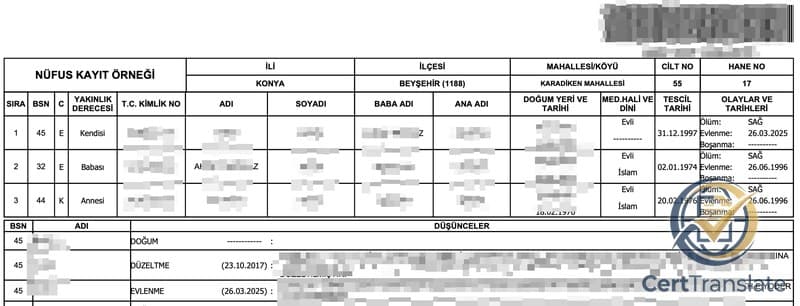
If your records are in Turkish and you are filing with USCIS, a U.S. court, or a university, you need Turkish translation services that include every visible element from the source document.
Every Turkish file is assigned to a native Turkish speaker, and your certified Turkish translation is handled by a specialist in civil records, legal documents, and academic credential workflows.
Turkish to English translation is detail-sensitive: characters such as ç, ğ, ı, İ, ö, ş, and ü change names, nüfus kayıt örneği records include family registry numbers, and oğlu or kızı should be translated and noted rather than dropped.
Most Common Turkish Documents We Translate
Turkish-language documents are most frequently submitted with Form I-485 (Adjustment of Status), Form I-130 (Petition for Alien Relative), Form N-400 (Application for Naturalization), and Form I-751 (Petition to Remove Conditions on Residence). These Turkish translation services focus on records most often needed for USCIS filing packets, green card submissions, and WES, ECE, or other NACES credential review.
Birth and population registry records (nüfus kayıt örneği / doğum record)
Turkish birth certificate translation is one of the most common request types for USCIS petitions and identity-verification workflows.
Turkish family and birth registry records often include a family registry number and household details that should be reproduced exactly rather than summarized.
For filing guidance, review our certified birth certificate translation page before submission.
Marriage certificate and family records
Marriage records are commonly required for spouse petitions, legal name-history checks, and court workflows.
Turkish translation for USCIS has to keep family registry references, spouse details, and any kinship wording consistent across the full packet.
See our certified marriage certificate translation page for packet-level requirements.
Divorce and court records
Turkish legal files are often multi-page records with court language, procedural dates, and status updates that should be translated completely.
Court and civil-registry terminology should be translated by legal function, not reduced to a rough English shortcut or partial summary.
Our certified divorce document translation page covers full decree handling for submission.
Passport and identity records
Identity records anchor spelling consistency for names, birth dates, nationality, and registry or identity numbers across all translated documents.
Characters such as dotted İ and dotless ı must stay exact, and identity numbers should be copied digit by digit because even a small mismatch can create confusion across the filing packet.
Use our certified passport translation page for USCIS-ready formatting expectations.
Diploma and degree records
Turkish diploma translation is often required for admissions, licensing, and employment verification.
Turkish degree titles such as Lisans, Yüksek Lisans, and Doktora should stay visible in translation with the right academic context instead of being flattened into generic English labels.
WES, ECE, and other NACES evaluators often need exact degree-title wording and issuing-institution detail, and our certification-ready Turkish diploma translation preserves that structure for formal review.
Academic transcript and supplements
Academic supporting records require line-level translation of courses, grades, credit systems, institutional headers, and annexes.
WES, ECE, and NACES credential evaluators usually need the full transcript detail, not only the diploma title page, for proper review.
Visit our certified transcript translation page for course-by-course submission guidance.
Court and administrative support records
Turkish packets can also include residence records, military or civil-status support records, court extracts, and administrative notes for immigration or legal use.
These files often place important details in stamps, side notes, or abbreviated authority labels that must be translated fully for official review.
If your packet includes mixed document categories, start with the free requirements checker before ordering.
What Makes Turkish Translation Different
Turkish translation quality for official use depends on exact character handling, family-registry detail, and correct academic terminology. These are the issues that most often affect acceptance.
Turkish characters must be preserved exactly
Turkish uses letters such as ç, ğ, ı, İ, ö, ş, and ü, and the dotless ı versus dotted İ distinction can change a name entirely.
If a translator normalizes those characters carelessly, the translated packet can stop matching the source record accurately.
We preserve Turkish spelling in the source context and verify final English-facing identity spelling against passport evidence when needed.
Family registry records carry identity detail beyond a simple birth line
Turkish registry extracts often include family registry numbers, household context, and civil-status information that reviewers expect to see fully rendered.
Summarizing those records instead of mirroring the structure can hide distinctions the receiving authority needs to evaluate.
We preserve the field structure and translate the registry layout in a way that remains readable for U.S. reviewers.
Kinship markers and name particles should be translated and noted
Turkish names may include markers such as oğlu or kızı that indicate son-of or daughter-of relationships.
If the translator drops those markers silently, the record can lose legal or family-context detail that matters in official review.
We translate and note those elements instead of removing them for convenience.
Academic records require system-aware degree terminology
Turkish higher education uses degree titles such as Lisans, Yüksek Lisans, and Doktora, and those should not be flattened into one generic English label.
If the system context is ignored, evaluators may misread the level or type of credential.
We preserve the original degree title and translate the record with the right academic context.
How We Translate Your Turkish Documents — Step by Step
Step 1 — Upload your document
Upload scans, photos, or PDFs of your Turkish records. If pages are old, handwritten, or include stamps, registry notes, or attachments, send every page so readability can be confirmed before translation starts.
Step 2 — Native-speaker assignment
Your file is assigned to a native Turkish translator matched to document type and official-use context. We do not route high-stakes civil, legal, or academic records to general translators outside this language pair.
Step 3 — Translation and certification
We translate all visible content including text, seals, signatures, annotations, and structured fields. Turkish characters are preserved, family registry numbers are checked carefully, and document function is identified before certification. You receive a signed Certificate of Accuracy with your final translation.
Step 4 — Two-person quality review
A second native Turkish reviewer verifies names, dates, characters, registry numbers, kinship markers, academic terminology, and completeness. This review stage catches subtle issues that commonly trigger official follow-up requests.
Step 5 — Delivery
Certified PDF delivery is typically completed within 24 hours for standard files. Expedited turnaround and hard-copy mailing are available when your deadline is tight.
Secure Process
100% Confidentiality
Your files are transmitted over 256-bit SSL encryption. We never use Google Translate, DeepL, or any machine translation tool for official documents. Files are deleted within 30 days, or sooner on request.
Turkish Translation by Country
Türkiye (Turkey)
Most current Turkish requests involve civil, identity, legal, and academic records issued in Türkiye for immigration and official U.S. use, and Turkish birth certificate translation remains one of the most common packet types.
Türkiye is a Hague Apostille Convention member, and under the HCCH status table the Convention entered into force for Türkiye on 29 September 1985 after ratification on 31 July 1985, so Turkish public documents generally use apostille instead of embassy legalization when the receiving country is also a Hague member.
That apostille step does not replace certified translation: USCIS, courts, and universities still require a complete English translation of Turkish characters, names, registry numbers, seals, annotations, and kinship wording.
If you are following older instructions or filing in a non-Hague destination, confirm whether you need translation only, translation plus apostille, or consular legalization before submission.
How Much Does Turkish Translation Cost?
Our Turkish translation services use the same $24.95/page base rate as every other supported language. No language-based surcharges.
Optional add-ons
- Notarization (+$19.95)
- Expedited turnaround
- Hard-copy mailing
Exact price is confirmed after document review and before payment.
Many certified translation providers charge $30-$60 per page. Our certified Turkish translation workflow at $24.95 includes the Certificate of Accuracy, unlimited revisions, and USCIS acceptance guarantee.
Mistakes That Get Turkish Translations Rejected
Using machine translation for official Turkish records
Google Translate and DeepL often flatten Turkish characters or misread dotted İ and dotless ı in names and place names.
A common failure is producing a spelling that no longer matches the source record or passport evidence while also oversimplifying registry language.
These errors can trigger a USCIS RFE (Request for Evidence), so we use native human translators and second-pass native QA on every certified file.
Using a bilingual friend or family member without proper certification
A bilingual friend or family member may understand the record, but that does not create the independent certified translation USCIS and many institutions expect.
Informal translation usually omits a compliant Certificate of Accuracy and misses packet-level checks for Turkish characters, registry structure, and identity numbers.
Every delivery includes a signed Certificate of Accuracy prepared for official submissions and reviewed for record-to-record consistency.
Confusing dotted İ and dotless ı in names
Turkish names can change meaning and spelling when dotted and dotless i characters are mixed up.
If the translator normalizes those letters into plain English spelling too early, valid records can look inconsistent across the packet.
We preserve the source spelling exactly and then align identity rendering with passport evidence where appropriate.
Omitting family registry numbers, seals, or side notes
Rejections often happen when only the main text is translated and registry numbers, apostille details, or side notes are left out.
Turkish civil records often place essential context in structured fields, seals, and annotations that must appear in the final English version.
We require full visible-content translation including numbers, seal descriptions, and annotation lines.
Flattening Lisans or Yüksek Lisans into generic English labels
Academic titles should reflect the actual Turkish system in which they were issued.
Replacing them with an over-generic label without context can mislead WES, ECE, or other evaluators reviewing the credential.
We preserve original academic terminology and translate it with system-aware context instead of guessing at equivalency.
Submitting translation without complete certification
USCIS expects complete translation plus a signed certification statement from a competent translator.
Text-only translation without compliant certification language can cause avoidable filing delays or rejection by the receiving authority.
Every delivery includes a signed Certificate of Accuracy prepared for official submissions.
Our Turkish Translation Track Record
Turkish is one of our steadier Middle Eastern and Eastern Mediterranean language pairs. Our workflow includes dotted-İ and dotless-ı QA, family registry number checks, and document-function review before certification. We cover immigration, legal, and academic records from Türkiye, including Turkish birth certificate translation, Turkish diploma translation, court records, and transcript packets.
Our Turkish translation services are processed with character-level QA, family registry number review, and document-function checks before certification. This reduces avoidable USCIS and evaluator follow-up requests.
What Turkish-Speaking Customers Say
“They translated my Turkish birth and marriage records with every field and registry number preserved. USCIS accepted everything on first submission.”
Elif M.
Paterson, NJ • Birth + Marriage Records • USCIS family petition
January 2026 on Google
“My diploma and transcript translation for credential evaluation was clear and accurate. They handled the Turkish degree titles correctly and the evaluator accepted it without revisions.”
Burak T.
Houston, TX • Diploma + Transcript • Credential evaluation
December 2025 on Trustpilot
“Fast and complete translation of Turkish civil records with stamps and side notes. Our attorney approved the packet immediately.”
Zeynep D.
New York, NY • Civil Registry Records • Legal filing
November 2025 on BBB
“They caught a character mismatch in my surname before delivery and saved us from filing a confusing packet.”
Murat K.
Chicago, IL • Passport + Civil Records • Green card application
October 2025 on Google
Other Languages We Translate
Arabic
Regional immigration and court packets sometimes combine Turkish and Arabic records.
German
Work, study, and civil histories often include both Turkish and German documentation.
Italian
European civil and academic packets may combine Turkish and Italian records.
Russian
Cross-border employment and education histories can include Turkish and Russian documentation.
Same $24.95/page base rate for every language.
Frequently Asked Questions About Turkish Translation
How much does certified Turkish translation cost?
Certified Turkish translation starts at $24.95 per page. That base rate includes certified Turkish translation by a native speaker, a signed Certificate of Accuracy, and revision support if a receiving authority requests a formatting adjustment. Final cost depends on page count, document complexity, and optional services such as notarization, expedited turnaround, or hard-copy mailing. To avoid cost surprises, upload all pages together, including reverse sides and attachments, so pricing can be confirmed before payment. This is especially useful when one packet includes Turkish birth certificate translation, passport pages, and academic support records. A pre-payment page audit is the fastest way to confirm scope and keep your filing timeline predictable.
How long does Turkish document translation take?
Most Turkish document translation orders are delivered within 24 hours. Turnaround depends on page volume, scan quality, handwriting density, and whether the file includes registry extracts, apostille pages, or academic supplements. If your deadline is strict, request expedited handling at upload so your order can be prioritized. To keep timing predictable, submit all related records in one batch and include the passport spelling used in your forms. That helps resolve character-level spelling and terminology questions early, rather than during final review, and reduces the chance of avoidable filing delays when the packet is time-sensitive. Include your filing date in the order note if timing is critical.
Will my Turkish translation be accepted by USCIS?
Your Turkish translation is generally accepted by USCIS when the filing includes a complete English translation and a signed certification statement from a competent translator. Our workflow is built around that requirement: native-speaker translation, full visible-content coverage, two-person quality review, and certification-ready output. USCIS makes the final decision, but if a translation-format issue is raised, we provide prompt corrective revisions under our guarantee. For best results, submit original-language copies and certified translations together, then verify names, dates, and document numbers against your USCIS forms before filing. A packet-level consistency review before submission is one of the best ways to reduce avoidable follow-up requests and timeline delays. If your packet includes family registry records, upload them together so numbering stays aligned.
Are your Turkish translators native speakers?
Our Turkish translators are native speakers. Native expertise matters because Turkish translation services for official use require exact handling of Turkish characters, family registry numbers, kinship markers, and academic terminology such as Lisans or Yüksek Lisans. Translators must identify document context first, then apply accurate English equivalents without flattening meaningful distinctions. If your packet includes civil and school records together, mention that during upload so names, dates, and terminology can be aligned across the full file set. That improves first-pass acceptance reliability and reduces avoidable revisions caused by inconsistent handling across documents. It also keeps identity fields stable across every certified page.
Do I need my Turkish documents notarized?
Turkish documents often do not need notarization for USCIS. Some courts, schools, licensing agencies, and state offices may still request notarization as an additional procedural step. Requirements vary by destination, so confirm whether the receiving authority requires certification only or certification plus notarization. We can add notarization when needed without changing translation content. If the same packet will be used in multiple destinations, tell us at intake so delivery format can be prepared correctly in one cycle. Confirming this before payment usually prevents avoidable reprocessing, duplicated fees, and timeline delays. That is especially helpful when one translation will be reused for both USCIS and a state-level procedure.
Can I translate my own Turkish documents for USCIS?
You can translate your own Turkish documents, but USCIS expects a third-party certified translation. Even fluent bilingual applicants often miss details such as dotted İ, dotless ı, family registry numbers, side notes, and seal text when they translate informally. Turkish official records also require format-aware terminology choices that self-translation rarely handles consistently across a full packet. Professional workflow adds independent QA and compliant certification language. If speed is your concern, upload clear scans and request standard 24-hour processing. That route is usually faster than correcting a rejected filing later because of preventable translation issues and extra review cycles. If you drafted your own version, share it only as reference material.
What if my Turkish document is handwritten or hard to read?
Hard-to-read Turkish documents can still be translated if the scan is usable. Turkish translation services for official use often involve older registry extracts with handwritten notes, administrative updates, or faded seals. Accuracy depends on image quality and complete page coverage. We regularly handle faint stamps, side annotations, and abbreviated official references. When a segment is unclear, we mark it transparently and verify context before certification instead of guessing. For best results, upload high-resolution scans, include both sides of each page, and avoid cropped margins where official marks often appear. If multiple versions exist, send all copies so reviewers can cross-reference difficult sections during QA. Intake screening can identify pages that should be rescanned before production begins.
Do I need an apostille for my Turkish documents?
You need an apostille for Turkish documents only if the receiving authority requires it. Apostille is different from certified translation: apostille confirms document origin, while translation converts the content into English for USCIS, courts, or universities. Under the HCCH status table, the Apostille Convention entered into force for Türkiye on 29 September 1985 after ratification on 31 July 1985, so apostille is commonly used instead of embassy legalization when the destination is also a Hague member. Apostille does not replace complete translation of Turkish characters, names, registry numbers, seals, or annotations. If you are following older instructions or filing in a non-Hague destination, confirm whether you need translation only, translation plus apostille, or consular legalization before submission.

How do you handle Turkish characters, oğlu or kızı, and registry numbers?
We preserve Turkish characters and registry details exactly. That matters because dotted İ and dotless ı can change a name, while oğlu or kızı can carry family-context meaning that should not disappear in English output. Family registry numbers must also match the source record digit by digit. If those details are simplified carelessly, valid records can look inconsistent across a packet or lose identity detail that reviewers expect to see. Our translators keep the source spelling visible, translate and note kinship markers where needed, and run a second-review check on registry numbers across every uploaded page. If you have prior USCIS filings or identity records with established spellings, upload them so the final translation stays consistent with your case history.
Will WES accept your Turkish diploma or transcript translation?
WES usually accepts Turkish diploma or transcript translation when it is complete and properly formatted. The key issue is not just language accuracy but educational context: Turkish credentials may use titles such as Lisans, Yüksek Lisans, and Doktora, and that distinction should stay visible in English. We translate the diploma, supplement, transcript, grade scale, seals, and institutional headers as issued rather than converting them into a U.S. academic template. That same approach is also useful for ECE and other NACES evaluators. Before ordering, check whether your evaluator wants translation only, translation plus original-language copies, or a sealed-school submission so nothing important is omitted.
Ready to Get Your Turkish Documents Translated?
Your Turkish documents are translated by native Turkish speakers with character-level QA, family registry number review, and full certification support.
We handle civil, legal, and academic records for USCIS, courts, and universities with fast turnaround and strong two-person QA.
Start your order now or call to confirm requirements before payment.

Aylin Demir
Native Turkish speaker · Born in Istanbul, Turkey • Language pair: Turkish <> English