
Court Proceedings: Court Translation Requirements and Document Checklist
Federal and State Court Filings · 24-Hour Rush Available · Civil, Family, and Evidence Packets Translated and Certified

Reviewed by Reviewed by Michael Chen, Lead Immigration Packet Translator
12 years in certified translation · ATA member since 2015 · Reviewer of identity records, court papers, and multilingual filing packets
“The court mistake I see most often is a party ordering only the main page of an exhibit and forgetting the attachments, stamps, or prior order that gives the document legal meaning.”
Your instant price
Court ProceedingsReview before payment · acceptance guarantee




What Documents Need Translation for Court Proceedings?
Court proceedings can involve civil, family, probate, or evidence packets, and any non-English document in that filing should be translated before the judge, clerk, or attorney has to work with it.
As of February 28, 2026, federal courts continue to operate under the Federal Rules of Evidence, while state and local courts follow their own evidence and filing rules. That means certified translation for court is usually expected, but translator affidavits, notarization, or local formatting details can still vary by venue.
The checklist below covers the records most often translated for federal and state filings so you can scope the packet before a hearing date or filing deadline gets too close.
Birth certificate or civil identity extract
Family court, probate, adoption
Birth certificate translation for court is common when identity, parentage, age, or place of birth must be proved in English.
Marriage certificate or civil status record
Divorce, support, inheritance
Marriage certificate translation for court is often needed in divorce, support, probate, and name-change disputes where civil status affects the case.
Divorce decree, custody order, or adoption order
Family court and civil proceedings
Divorce document translation for court helps the court review prior marital status, custody terms, or adoption history without relying on informal summaries.
Passport, national ID, or name-change record
Identity verification, caption consistency
Identity-document translation may be needed when names, dates, or country-issued ID details have to line up across pleadings and exhibits.
Police report, arrest record, or foreign judgment
Criminal, family, protective-order, civil support
Legal document translation for court often includes police reports, foreign judgments, and court dispositions that must be translated page by page, including handwritten notes, stamps, and seals.
Medical records or evaluation reports
Injury, guardianship, hardship, custody
Medical record translation for court is often needed when treatment notes, evaluations, or discharge records support damages, hardship, or best-interest analysis.
Financial records, bank statements, or support evidence
Support, damages, probate, ownership
Bank statement translation for court is common when foreign-language financial records support income, asset ownership, damages, or support calculations.
Court certified translation usually works best when the full exhibit is translated at once. Judges and attorneys need the caption, signatures, side notes, attachments, and issuing information together rather than as partial extracts.
A court admissible translation is not just about literal text. The court or clerk may also expect a separate certification or translator affidavit, and some state venues ask about notarization or other filing formalities before the packet is accepted.
In federal practice, the Federal Rules of Evidence shape the evidentiary context, but local rules and attorney preferences still control how exhibits are assembled and filed. A federal court certified translation is strongest when the document set, certification, and filing deadline are planned together instead of as a last-minute rush order.
Check What Documents You Need Translated — Free, 2 Minutes →
Common Languages in Court and Legal Document Translation
Spanish, Chinese, and Arabic are common source languages in court-document translation because family records, police documents, judgments, and medical exhibits often arrive from foreign authorities or older multilingual files.
If your records are in Spanish, our certified Spanish translation services regularly support family-court and civil-case packets with birth records, marriage records, police reports, and financial exhibits.
Chinese and Arabic records also appear frequently in legal-document packets, especially when the file includes identity documents, business records, judgments, or annotated exhibits that have to stay complete in English.
How to Order Certified Translation for Court Filings
Identify the court, the deadline, and the exact exhibit list
Start by confirming whether the filing is in federal court, state court, or a local family or civil court.
Then list every non-English exhibit, affidavit, civil record, or support document the attorney, clerk, or self-help materials say may be used in the case.
Upload the complete packet before production starts
Send the full document set, not just the pages with the most text, so the translated filing stays complete.
That includes reverse sides, stamps, attachments, prior orders, and any handwritten notations that may matter to the case.
Tell us if the venue wants an affidavit, notarization, or rush handling
Court translation moves more smoothly when the format question is handled up front instead of after delivery.
If the clerk, judge, or attorney asked for a translator affidavit, notarization, or a same-week deadline, flag that at order time.
We assign a legal-document translator and complete QA review
Your packet is routed to translators used to captions, exhibit labels, seals, stamps, and structured legal records.
Before delivery, names, dates, document titles, and visible annotations are checked across the set so the English version stays consistent.
Receive the certified file and send it for filing review
Most short exhibit packets are returned as PDFs within 24 hours, with the certification statement included.
If an attorney or clerk wants a different affidavit format, that can be handled before the filing date closes in.
Interpreter services and document translation are different things. If a hearing also needs spoken interpretation, clarify that separately because courtroom interpreting is arranged under different court rules and service channels.
Files are handled through encrypted upload channels, access is limited to production staff, and deletion policies are available for sensitive legal and medical records.
Court Translation Cost and Rush Deadline Planning
Flat per-page rate — no surprises, no hidden fees.
Certified Translation
Starting Rate
Standard Turnaround
1-2 Days
(Typically 24h)
Pay only after you review the quote
Cost by Document
Always Included — No Extra Cost
Certified translation for court is priced by page rather than by case type. Our $24.95 base rate covers human translation, the signed certification statement, and revision support if a translation-format issue is raised. Pricing for court-document packets usually rises when the file includes handwriting, multi-page police or medical exhibits, or a separate affidavit format requested by counsel or the clerk. Many providers charge $30-$65 per page for similar legal-document work. Exact pricing is confirmed after document review and before payment, and our full translation pricing is available on the pricing page.
View full pricing detailsMistakes That Delay Court Filings or Hearings
1Uploading only the main page of a legal exhibit
Consequence
Captions, attachments, prior orders, and back pages often carry the legal context. If they are missing, the translated exhibit may be incomplete or less useful in court.
Our Solution
Upload the full document set, including attachments, reverse sides, and visible stamps, before the translation starts.
2Assuming interpreter services replace document translation
Consequence
A spoken interpreter helps in court, but that does not turn a foreign-language exhibit into an English filing. The court may still need a separate written translation of the documents themselves.
Our Solution
Plan interpretation and document translation as separate services so the filing packet and the hearing are both covered.
3Using self-translation or machine output for evidence
Consequence
Self-prepared or machine-generated versions often fail on certification language, structured legal wording, and the treatment of annotations, which makes the exhibit easier to challenge.
Our Solution
Use a professional court certified translation with a separate certification or affidavit format when the venue expects it.
4Ignoring local affidavit or notarization preferences
Consequence
Some venues accept a standard certification, while others want an affidavit, a notarized statement, or attorney-specific formatting. If that is discovered late, the filing window gets tighter.
Our Solution
Ask the clerk or attorney about local preferences before ordering, then flag those instructions with the translation request.
5Waiting until the filing deadline is already close
Consequence
Court deadlines are strict, and a rush legal packet can become more expensive and harder to review if several exhibits still need translation at the last minute.
Our Solution
Start translation as soon as the exhibit list is known so the packet can be reviewed before filing or hearing prep begins.
Our Court Translation Track Record
Court-related packets are a recurring part of our legal-document workload, especially foreign civil records, police papers, medical exhibits, judgments, and identity documents attached to federal and state filings.
Experience
Every court-document order is reviewed for names, dates, captions, exhibit labels, certification completeness, and visible-page coverage before delivery.
Quality Assurance
We support mixed-language legal-document packets across 100+ source languages, from single civil records to multi-exhibit files with judgments, police reports, medical notes, and financial evidence.
Coverage
Strong court-document translation is not only literal sentence conversion. It is exhibit-aware, deadline-aware, and formatted so the receiving court or attorney can work with the file immediately.
Real translation cases for Court Proceedings filings
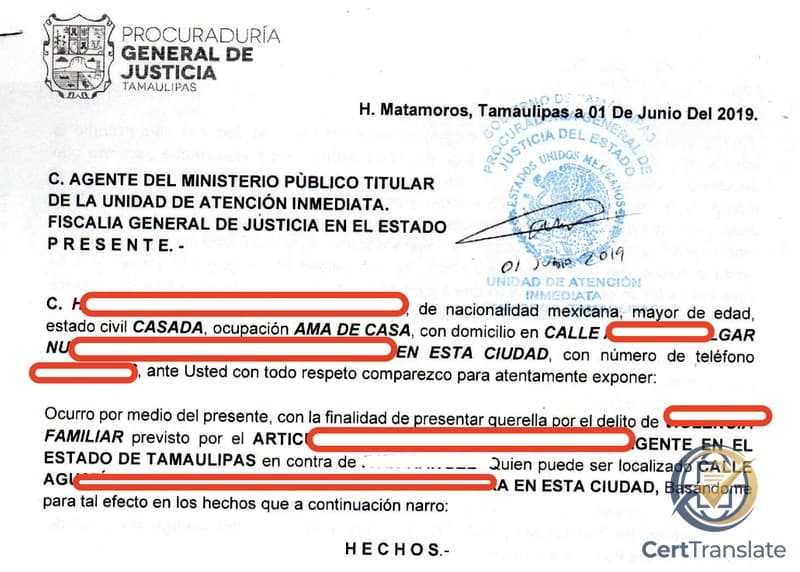
Anonymized translations we've delivered for Court Proceedings packages. Each case names the source-document quirk and the translation decision that kept the packet clean.
Other Immigration Translation Guides
Family petition translation
Family and civil cases often overlap with the same marriage, divorce, birth, and identity records first gathered for an I-130 packet.
Asylum translation
Some asylum and humanitarian cases later rely on translated police reports, medical records, and court-stage evidence in addition to USCIS filing documents.
Apostille translation guide
Use the apostille guide when the same civil or court document also needs outbound authentication for another country in addition to English translation.
Need one packet for court and another for immigration or family use? Upload everything together at the same $24.95/page rate so civil records, judgments, and support exhibits can be checked as one set.
Frequently Asked Questions About Court Translation
How much does translation cost for court documents?
Translation for court documents starts at $24.95 per page. Many family, probate, and exhibit packets fall between $49.90 and $249.50 depending on page count, handwriting, and whether affidavits or rush handling are needed.
What documents usually need translation for court proceedings?
Common documents include birth certificates, marriage and divorce records, passports, foreign judgments, police reports, medical records, financial exhibits, and other non-English evidence attached to a filing.
Will a court accept certified translation for court filings?
Courts often accept certified translation for court filings, but the clerk, judge, or attorney may also ask for a translator affidavit or notarization depending on the venue. The receiving court always decides the final format.
What is the difference between certified and notarized translation for court?
Certified translation and notarized translation are different services. Court translation usually starts with the translator certification, while notarization is an added formality used only if the court, clerk, or attorney specifically asks for it.
Can I translate my own documents for court?
Self-translation is risky for court use because the receiving court may want an independent translator certification or affidavit. A separate legal document translation for court is usually safer than relying on a party-prepared version.
How long does translation take for a court filing?
Most short exhibit packets are delivered within 24 hours. Larger police, medical, or multi-exhibit files may take longer, but timing is confirmed before payment so you can plan around the filing deadline.
Do I need an interpreter and a document translation for the same case?
Sometimes yes. A spoken interpreter handles live communication in court, while a written translation prepares the non-English documents themselves for filing or attorney review.
Do I need an apostille for court documents?
Usually no for U.S. court use. Apostille authenticates the original document for cross-border use, while court admissible translation focuses on making the contents readable in English for the receiving venue.
What if my exhibits are in multiple languages?
That is common in cross-border cases. We can translate multi-language packets together so names, dates, exhibit labels, and certification language stay consistent across the full set.
Ready to Get Your Court Documents Translated?
Most short exhibit packets are translated and certified within 24 hours, and every order includes the Certificate of Accuracy used for third-party translated documents.
Use the checklist above if you already know which exhibits are going into the filing, or start with the requirements checker if you want to confirm the packet before ordering.
Lead Immigration Document Translator
CertTranslate provides certified translation services only. We do not provide legal advice, immigration consulting, or representation. For questions about your immigration case, consult a licensed immigration attorney.