



What do you do when a seal on a transcript covers the student's name or the issuance date?
TL;DRA Universidad de San Carlos de Guatemala (USAC) engineering transcript arrived with a round seal covering the student's surname and a second stamp covering the month in the issuance date. We reconstructed the surname from the visible characters ("…PINO"), preserved the obscured month as an ambiguity rather than guessing, and documented every partially covered field in Translator's Notes. The certified translation was delivered for the client's credential evaluation.
Case Specifications
- Document
- University certification of coursework (transcript)
- Foreign Name
- Certificación de cursos — Facultad de Ingeniería, USAC
- Country
- Guatemala
- Languages
- Spanish → English
- Submitted To
- Credential evaluation (WES-type)
What We Received
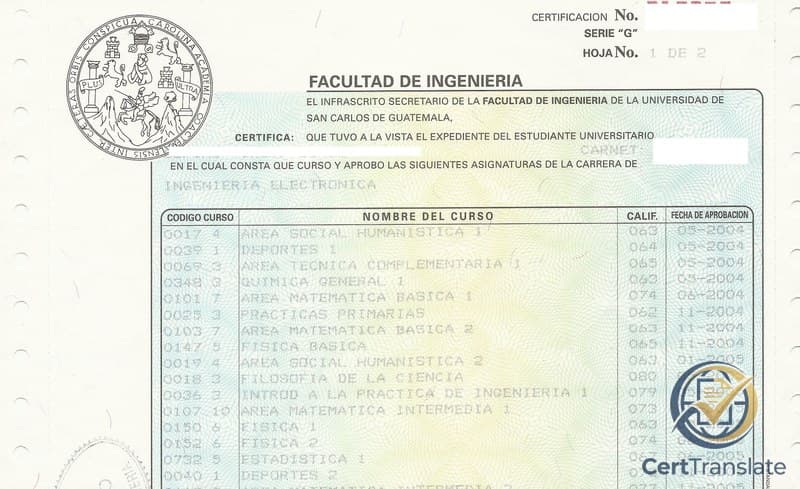
A client submitted a two-page certification of coursework (Certificación de cursos, Serie "G," Nos. 217255 and 217256) issued by the Faculty of Engineering of the Universidad de San Carlos de Guatemala (USAC) — a certified Spanish translation of a university transcript needed for credential evaluation. The document records fifty-three courses completed between 2004 and 2009 in the Electronic Engineering degree program.
On both pages the university's round institutional seal sits squarely over the top-left of the header. The seal covers most of the student's first surname, leaving only the last four characters — "…PINO" — visible to the right of the seal. The second surname and given names are fully legible.
At the foot of each page, a second round "Secretaría Académica" stamp covers the month in the issuance date. The visible portion reads "…IO CINCO DE DOS MIL NUEVE" — only the year (2009) and the day ("CINCO" — five) are unambiguous. The month is obscured, and the visible "-IO" ending fits two Spanish months: julio (July) or junio (June).
Why a Seal Covering the Name on a Transcript Is Not Simply "Illegible"
In a certified transcript translation, the student's legal name and the issuance date are the two fields a credential evaluator uses to match the document to the applicant's file. If either is reported as "illegible" without further work, the evaluator typically pauses the case and requests a clearer scan or a re-issued document — for a USAC transcript, that can run weeks.
At the same time, a translator who simply guesses at the covered letters introduces a worse problem: the translation asserts a name the evaluator cannot verify against the original. That apparent inconsistency is a standard credential-evaluation flag.
The correct middle path is to report only what is actually readable, reconstruct only where reconstruction is supported by other evidence on the document, and document every step in a Translator's Note — treating partially obscured text as a transparent record rather than a guess dressed up as a fact.
How We Handled It
For the first surname, we cropped the header at the maximum usable resolution and read the four characters visible to the right of the seal — "…PINO" — letter by letter rather than pattern-matching the whole word. A common Guatemalan surname matching that ending is "Espino," and the surname's overall stroke count fit a six-letter word. We rendered the name as "ESPINO" in the translation and flagged the reconstruction in a Translator's Note, so any reviewer sees exactly what was visible and exactly what was inferred.
For the issuance date we took the opposite approach. The visible text read "…IO CINCO DE DOS MIL NUEVE" — the year is 2009, the day is five, the month's last two letters are "-IO." Both julio (July) and junio (June) end in "-IO," and nothing else on the page breaks the tie. Guessing one or the other would have introduced a fact the original does not support. The rendered date was "July 5, 2009" with a Translator's Note stating that the month is obscured by a round stamp, that the visible ending is "-IO," and that the original should be verified against the physical document for July versus June.
A third signature-and-seal pairing on each page sat in the left-hand margin alongside the course list — an oval stamp reading "CONTROL ACADÉMICO — Facultad de Ingeniería" with a signature written vertically next to it. This is the Faculty's Academic Records endorsement, separate from the Secretary and Dean blocks at the foot of the page, and it is easy to miss on a first read. We reproduced it as a third signature block in the translated footer, labeled "ACADEMIC RECORDS," with a note indicating its position in the original.
"The student's first surname is partially obscured by the round institutional seal of the Universidad de San Carlos de Guatemala on both pages of the original. The visible portion reads "…PINO"; the surname has been reconstructed as "ESPINO" based on the visible characters. The issuance date in the closing paragraph is also partially obscured by a round stamp on both pages; the visible portion reads "…IO CINCO DE DOS MIL NUEVE." Based on the visible "-IO" ending, which fits either "julio" (July) or "junio" (June), the date has been rendered as "July 5, 2009" — the month should be verified against the original physical document. The "credits approved" figure (232) is faintly printed against the document's security background and was read with some difficulty; it should be verified against the original."

The transcript is printed dot-matrix on pre-printed security stock — a guilloche pattern in green and tan behind every field. Some numeric figures, including the "credits approved" total, sit faintly against the security pattern. We read each faded figure at 4× crop resolution rather than at full-page zoom, and flagged the one figure that was genuinely borderline rather than transcribing it as certain.
The remainder of the layout was reproduced as an English mirror of the original: the four-column course table with all fifty-three rows, the grading scale (0–60 FAILED / 61–100 PASSED), and the three distinct signature blocks per page (Control Académico, Secretary, Dean).
The Outcome
The certified translation was delivered to the client with each obscured field reported exactly for what it is — part visible, part documented in a Translator's Note. A credential evaluator can see at a glance which entries are confirmed from the original and which require verification against the physical document.
We handle a steady stream of USAC and Latin American university transcripts where round institutional seals overlap printed header text. Treating each obscured field as a Translator's Note item — rather than a bare "[illegible]" — has been the consistent pattern across these orders.
What This Means for You
A certified translation with Translator's Notes that separate "visible in the original" from "reconstructed from context" gives a credential evaluator a workable document even when a seal covering the name on a transcript sits on top of key header fields. Do not ask a translator to guess at a covered name or date, and do not accept a translation that simply marks those fields "illegible" with no further work — both extremes create problems downstream. The professional middle path is partial reconstruction from the visible characters, ambiguity preserved where reconstruction is not supported, and every step of the reasoning documented in the Translator's Certification block.
Have a similar situation?
We handle Latin American university transcripts with seal-covered fields regularly.
Related Cases & Resources
Sources & References
- WES Required Documents·World Education Services·Verified 2026-05-28
Explore the Hub
Documents
Languages
Accepted By
All identifying information has been removed from document images. The student's name, student ID, and document numbers have been masked. Case details are shared with client permission. No personal data is stored or displayed on this page.