
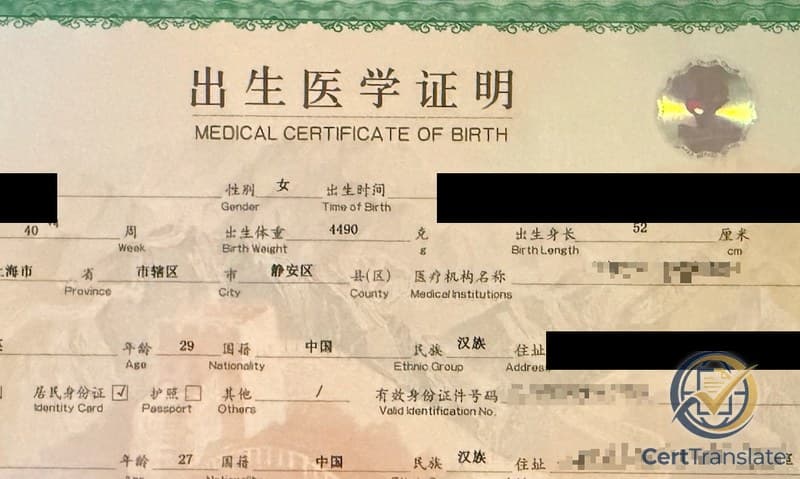
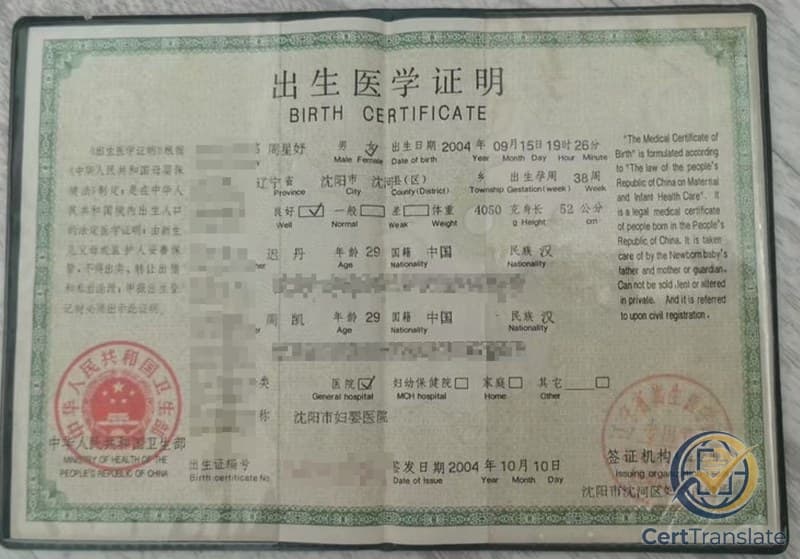
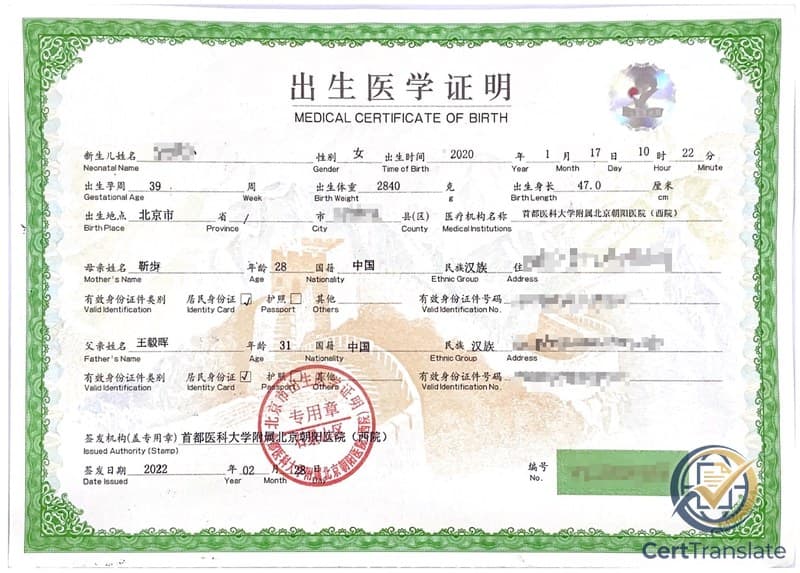
Birth certificate
zh出生证明
Chinese birth certificate translation is frequently required for family-based immigration, green card filings, and identity verification.
Signed & stamped Certificate of Accuracy
Word-for-word · exact structure preserved
Chinese → English
Certified Chinese-to-English translations for USCIS, WES, courts, universities, and other official uses.
Ready within 24 hours
Chinese expertise
Word-for-word, same structure
Simplified + Traditional · passport romanization · red seals
Certified package
Signed and Stamped Certificate of Accuracy
Letterhead · translator signature · company stamp

We check your files and confirm the total before you pay




If your records are in Chinese and you are submitting to USCIS, a U.S. court, or a university, you need Chinese translation services that reproduce every visible element of the source document.
Every Chinese file is assigned to a native Chinese speaker who works with official records daily, and your certified Chinese translation is handled by a specialist in civil, hukou, and academic files.
Chinese to English translation depends on script and romanization accuracy: Simplified and Traditional Chinese require different handling, and personal names must match passport spelling exactly to avoid identity mismatches in immigration packets.
Matched to your language pair and document type.
On company letterhead with translator credentials.
Complete translation of everything visible in the source.
Objective translation errors are corrected at no cost.
Included for most 1–3 page orders.
Translation-related rejection: free revision, then refund.
Searchable, email-ready, and print-ready.
Chinese-language documents are most frequently submitted with Form I-485 (Adjustment of Status), Form I-130 (Petition for Alien Relative), Form N-400 (Application for Naturalization), and Form I-751 (Petition to Remove Conditions on Residence).
zh出生证明
Chinese birth certificate translation is frequently required for family-based immigration, green card filings, and identity verification.
Signed & stamped Certificate of Accuracy
Word-for-word · exact structure preserved
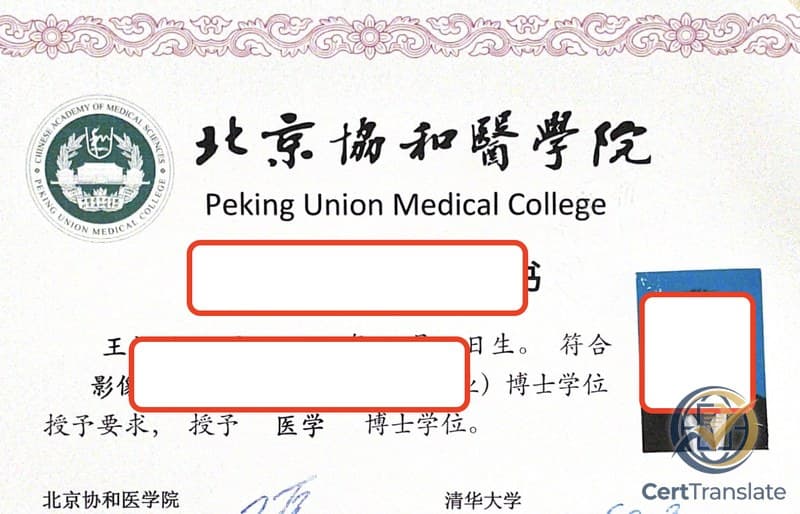
zh毕业证书 · 学位证书
Chinese diploma translation is commonly required for admissions, employment verification, and credential evaluation services.
Signed & stamped Certificate of Accuracy
Word-for-word · exact structure preserved
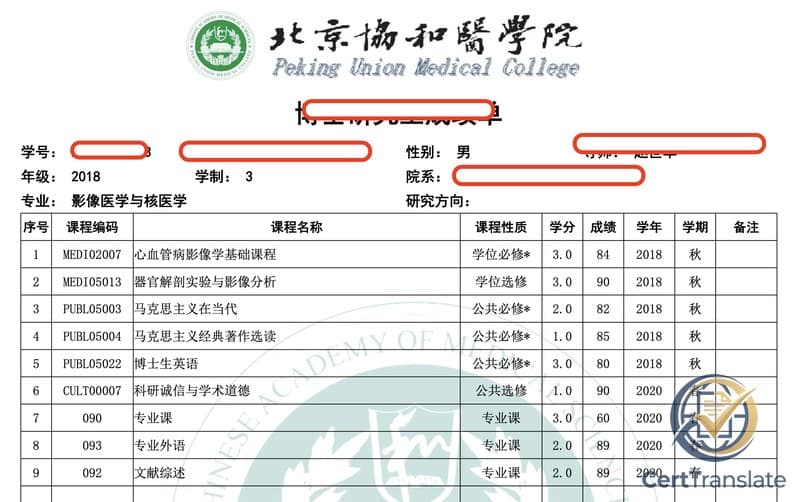
zh成绩单
Transcripts require line-level translation of courses, credits, grading labels, and institutional signatures.
Signed & stamped Certificate of Accuracy
Word-for-word · exact structure preserved
结婚证
离婚证 · 民事调解书 · 民事判决书
死亡证明 · 死亡医学证明书
户口本 · hukou
护照 · 身份证
公证书

Chinese records reviewed by Michael Chen — ATA member since 2015 · Certified Chinese↔English translator
Chinese translation accuracy is determined by script handling, name romanization, and document-format context. These are the issues that most often separate accepted files from delayed files.
Mainland records typically use Simplified Chinese, while many records from Taiwan and Hong Kong use Traditional Chinese.
Character variants can change reading certainty, especially in names, issuing authorities, and older records copied across systems.
We identify script system at intake and assign the translator accordingly so terms are read correctly from the first pass.
Chinese names can map to multiple romanization systems depending on region and document era.
Mainland passports usually follow Hanyu Pinyin, while older Taiwanese records may reflect Wade-Giles or other historical patterns.
If romanization is inconsistent, USCIS may treat records as belonging to different people, so we align name rendering with passport evidence and include notes when needed.
Hukou fields describe household relationships and registration status in a structure unfamiliar to U.S. forms.
Literal one-word substitution can remove legal context and create confusion for case reviewers.
We preserve the formal field structure and use translator notes where a direct equivalent does not exist.
Official red stamps on Chinese documents are not decorative; they identify issuing office and document validity context.
Even when seal text uses stylized or classical characters, it must be translated or explicitly described in the certified output.
Missing seal details are a frequent reason packets require clarification or re-submission.
Surnames such as 欧阳 (Ouyang) or 司马 (Sima) must stay as one family-name unit in translation.
Incorrect splitting can change identity interpretation across records and create mismatch against passport pages.
Our reviewers run final surname-order checks across all documents before certification is completed.
Chinese diplomas often separate degree title (学位) and field of study (专业), and both must be translated clearly.
Over-simplifying these fields can lead to evaluator follow-up requests or delays in credential review workflows.
We preserve original terms and provide context notes where U.S. equivalence is not one-to-one.
Upload scans, photos, or PDFs of your Chinese documents. If text is faint, handwritten, or partially stamped, send every page anyway so we can evaluate readability before production starts.
Your file is assigned to a native Chinese translator based on script and document type. We do not route civil or legal Chinese records to general translators who only occasionally handle this language pair.
We translate all visible elements including body text, seals, signatures, annotations, and document metadata. Name romanization is checked against passport spelling, script-specific terms are rendered in filing-ready English, and every delivered file includes a signed Certificate of Accuracy.
A second native Chinese reviewer verifies identity fields, date consistency, script interpretation, and terminology. This extra review catches subtle issues such as surname order and seal-language omissions before delivery.
Certified PDF delivery is typically completed within 24 hours for standard files. Expedited turnaround and hard-copy mailing are available when deadlines are tighter.
Secure Process
100% Confidentiality
Your files are transmitted using 256-bit SSL encryption. We never use Google Translate, DeepL, or any machine translation tool for your documents. Files are deleted within 30 days, or sooner on request.
“They translated our household registration pages and birth certificate with clear field structure and perfect name consistency. USCIS accepted everything on first submission.”
Jing W.
San Jose, CA • Hukou + Birth Certificate • USCIS family petition
January 2026 on Google
“My diploma and transcript translation was accepted by the credential evaluator with no rework. They kept degree title and major wording accurate and easy to review.”
Yifan L.
Boston, MA • Diploma + Transcripts • Credential evaluation
December 2025 on Trustpilot
“Our marriage certificate translation was fast and very precise. The team caught a romanization mismatch before delivery, which saved us from a filing delay.”
Mei C.
New York, NY • Marriage Certificate • Green card application
November 2025 on Google
“Excellent quality on notarial certificates and older stamped records. They translated every seal and annotation, and our attorney approved the packet immediately.”
Alex Z.
Seattle, WA • Notarial Certificates • Legal filing
October 2025 on BBB
Anonymized Chinese-to-English orders. Each case shows the exact translation problem and how we solved it for the receiving authority.
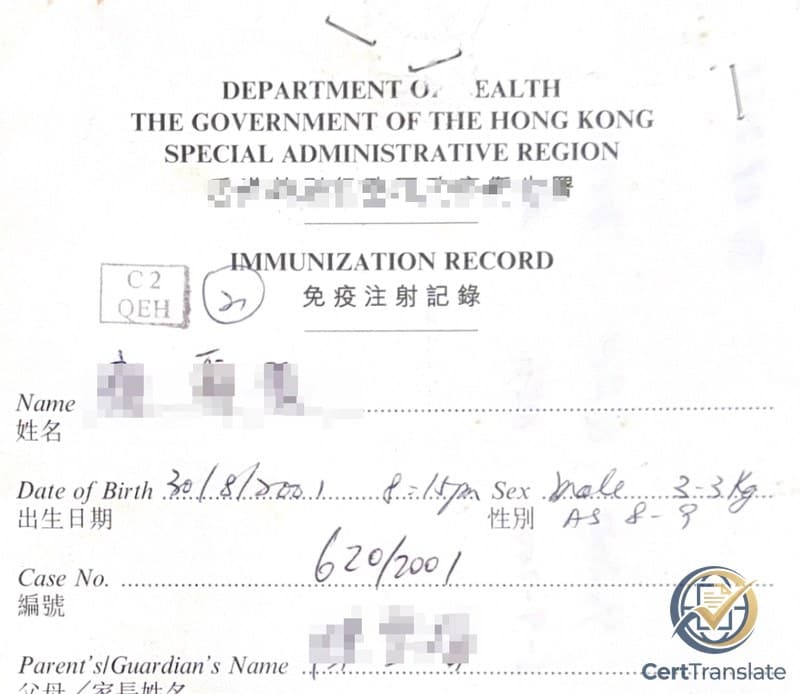
A client submitted a bilingual Hong Kong Department of Health immunization card for a US university medical clearance. The clinic name 柏立基母嬰健康院 is the Robert Black Maternal and Child Health Centre — named after Sir Robert Black, governor of Hong Kong 1958–1964. We used the official English form so the identity block matched the same centre's English mention on the card's reverse. The certified translation was delivered for the filing.
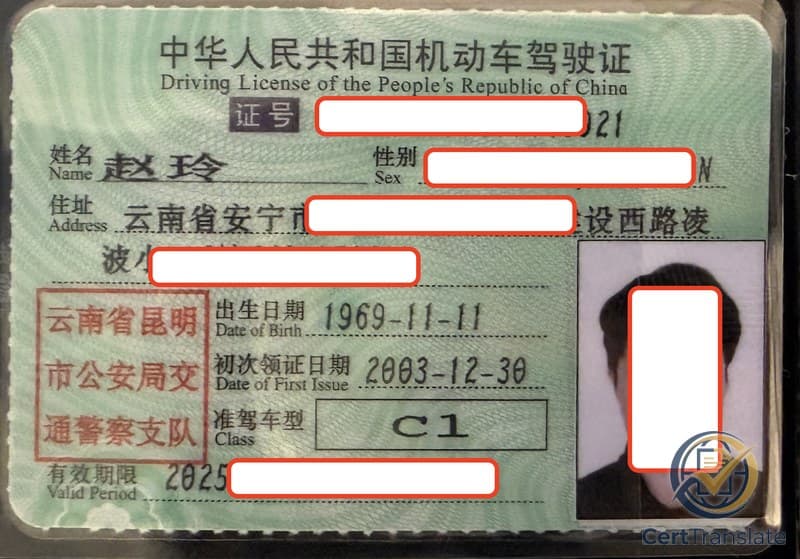
A PRC driver's license listed its Valid Period as '至 长期' ('until Long-term') on the main page, while the supplementary page (副页) carried a clause requiring an annual medical certificate within 30 days of December 30 every year after 2039 — the PRC's standard ≥70-year-old rule. We translated both pages as one certified file, rendered '长期' as 'Long-term' rather than 'never expires', and reproduced the supplementary clause literally with a Translator's Note pointing the reader to it.

A Chinese PhD recipient submitted two paired one-page certificates — 毕业证书 (Graduation Certificate, confirming program completion) and 学位证书 (Degree Certificate, conferring the doctoral title) — for WES credential evaluation. Translating either as a generic 'diploma' would have hidden the distinction between the two certificates, which the Chinese higher-education system documents separately. We translated the Graduation Certificate with its distinct English title and added a Translator's Note explaining the two-certificate convention, and the certified translation was delivered for the evaluation packet.
Chinese is one of our highest-volume language pairs. Our workflow includes passport-aligned romanization checks, chop/seal coverage, and a two-person native-speaker review before certification. We cover civil, legal, and academic records from Mainland China, Taiwan, Hong Kong, and Singapore.
Our Chinese translation services are routed through a script-aware workflow with passport-aligned romanization checks, full seal coverage, and two-person native review before certification. This process is designed to reduce avoidable USCIS and evaluator follow-up requests.
Mainland submissions often include birth records, marriage certificates, household registration pages, and notarial certificates.
Documents generally use Simplified Chinese and Hanyu Pinyin passport conventions, which must stay consistent across all translated files.
Mainland China is a Hague Apostille Convention jurisdiction, so apostille is now used for many cross-border filings; translation and apostille serve different legal purposes and are not interchangeable.
For immigration packets, review our USCIS page and certified birth certificate translation guidance before filing.
Taiwan records typically use Traditional Chinese and may show romanization patterns different from mainland standards.
Older passports and civil documents can contain historical romanization variants that require explicit consistency handling.
Taiwan records are typically authenticated through legalization channels rather than standard Hague apostille workflow, so requirements should be confirmed with the receiving authority before filing.
If your packet includes both Taiwan and mainland documents, submit them together to keep naming conventions aligned.
Hong Kong records may include Traditional Chinese and English together, but all Chinese content should still be fully translated for official submission.
Document layouts and issuing-office terminology differ from mainland formats, so jurisdiction-specific wording matters.
Hong Kong operates within Hague Apostille Convention practice, so apostille is commonly requested for non-USCIS cross-border use while certified translation remains the language-conversion requirement.
If your case involves court or civil filings, include every page and attachment to prevent partial translation issues.
Singapore documents can include bilingual elements and administrative terminology that differs from PRC and Taiwan formats.
Even when part of the document is already in English, all Chinese text must be translated to preserve completeness for official review.
Singapore is a Hague Apostille Convention member, so apostille is generally available for international authentication when required by the destination authority.
Tell us the receiving authority and we confirm whether notarization is needed alongside the certified translation.
Our Chinese translation services use the same $24.95/page base rate as every other supported language. No language-based surcharges.
Optional add-ons
Exact price is confirmed after document review and before payment.
Many certified translation providers charge $30-$60 per page. Our Chinese-certified workflow at $24.95 includes the Certificate of Accuracy, unlimited revisions, and USCIS acceptance guarantee.
Google Translate and DeepL often fail on legal terminology, seal text, and structured civil fields in Chinese documents.
A common error is rendering 出生证明 as proof of birth instead of the legal equivalent birth certificate, while also missing chop text in red seals.
These errors can trigger a USCIS RFE (Request for Evidence), so every file is handled by native human translators and a second native reviewer.
USCIS expects a complete English translation and a signed certification statement from a competent translator.
Users who submit text-only translation without certification frequently face avoidable delays.
Every delivery includes a signed Certificate of Accuracy prepared for official submission workflows.
When one record uses Zhang and another uses Chang for the same surname, reviewers may treat the documents as inconsistent.
This issue appears often when older records and modern passports use different romanization systems.
We align final spelling to passport evidence and add precise translator notes when historical variants appear.
Partial translation that ignores seals or side annotations is a common reason for follow-up requests.
Chinese official documents frequently place critical authority information outside the main body text.
Our process requires full visible-content translation, including stamp descriptions and annotation lines.
Assuming script variants are interchangeable can cause misread names or authority titles in legal records.
Differences are especially important in personal names, archival documents, and institutional terminology.
We identify script at intake and route each file to the correct native specialist before translation starts.
Hukou fields are often condensed in informal translations, which removes legal context reviewers expect to see.
Incomplete field translation can trigger requests for re-translation of specific household pages.
We preserve full field structure and relationship labels to keep family-based packets internally consistent.
Submitting your Chinese documents to a specific country? Check translation requirements by country
Your Chinese documents are translated by native Chinese speakers with script-aware quality control and passport-matched romanization checks.
We handle Simplified and Traditional Chinese records for USCIS, courts, and universities with fast turnaround and full certification support.
Start your order now or call to confirm requirements before payment.
Michael Chen
Native Chinese speaker · Senior team translator • Language pair: Chinese <> English