

CertTranslateCertTranslate
Native Translators Available

Certified Spanish Translation Services

Native Spanish Speakers · Country-Specific Legal Terminology · USCIS Accepted · 24-Hour Delivery

Certified & USCIS Approved
Human Experts Only
24-Hour Turnaround

Last updated: February 2026

BBB A+
4.9/5 (2,400+)
BBB business profileATA member directory listingU.S. Department of State directory listingGoogle Maps business profile
Natalia Vega

Natalia Vega

Native Spanish speaker · Born in Puerto RicoLanguage pair: Spanish ↔ English

When I review a Spanish document packet, I check every name, date, and registry number for consistency across all files. One mismatched character in a CURP or surname can trigger an RFE — I catch those before the packet leaves our office.
View translator profile →
Compliance Requirements

If you are filing with USCIS, a U.S. court, or a university and your records are in Spanish, you need Spanish translation services that produce a complete certified English version of each record.

Every Spanish file is assigned to a native Spanish speaker who grew up with regional document formats and legal language, so your certified Spanish translation is handled by a specialist rather than a generalist.

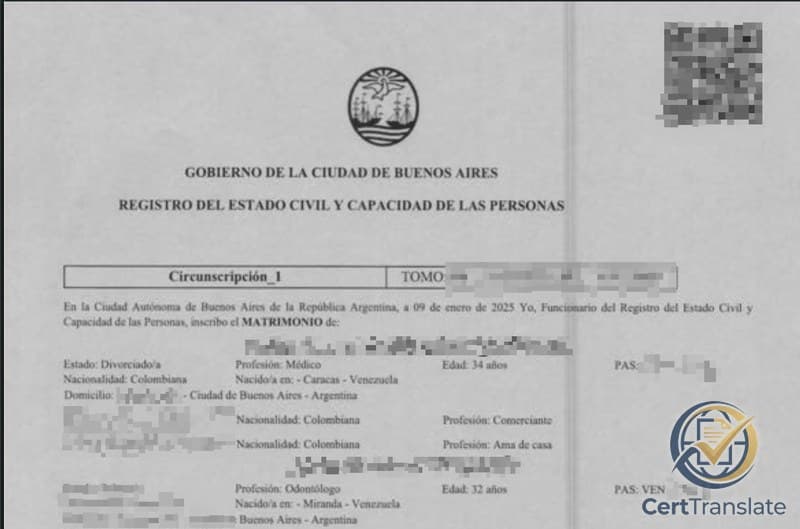
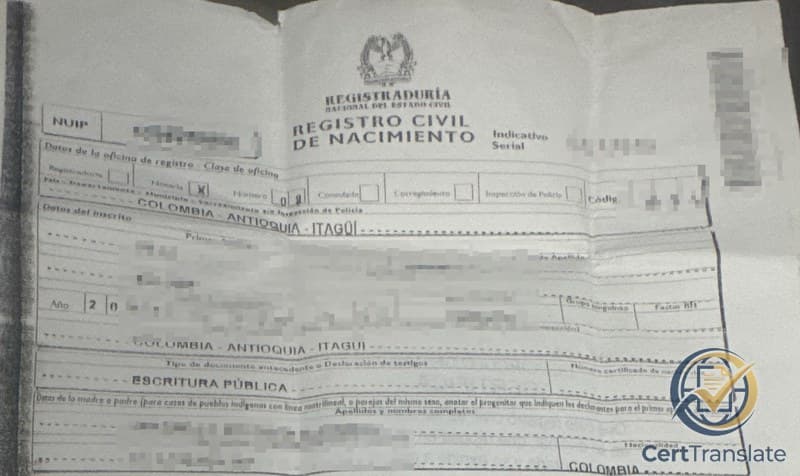
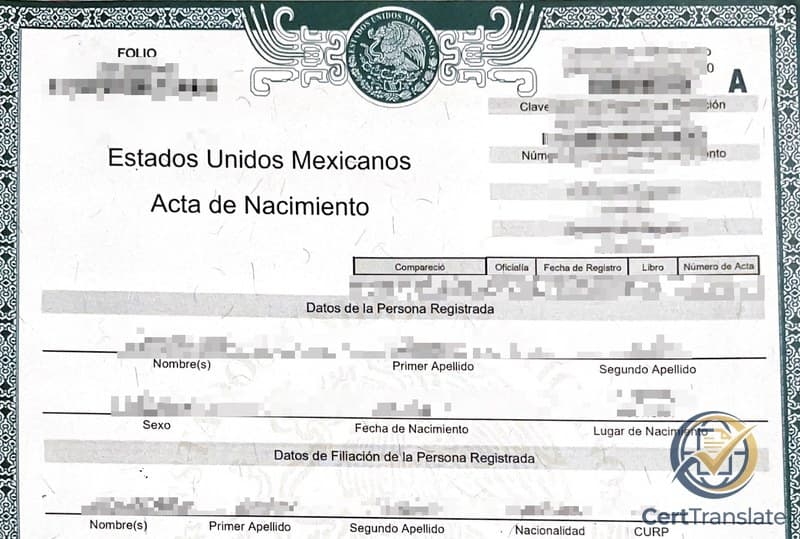
Spanish to English translation is never one-size-fits-all: a Mexican acta de nacimiento, a Colombian registro civil, and a Cuban civil record may look similar at first glance but use different terminology, seals, and administrative references that change how the translation should be rendered.

Most Common Spanish Documents We Translate

Spanish-language documents are most frequently submitted with Form I-485 (Adjustment of Status), Form I-130 (Petition for Alien Relative), Form N-400 (Application for Naturalization), and Form I-751 (Petition to Remove Conditions on Residence). These Spanish translation services focus on the records most often needed for USCIS translation requirements and green card application packets.

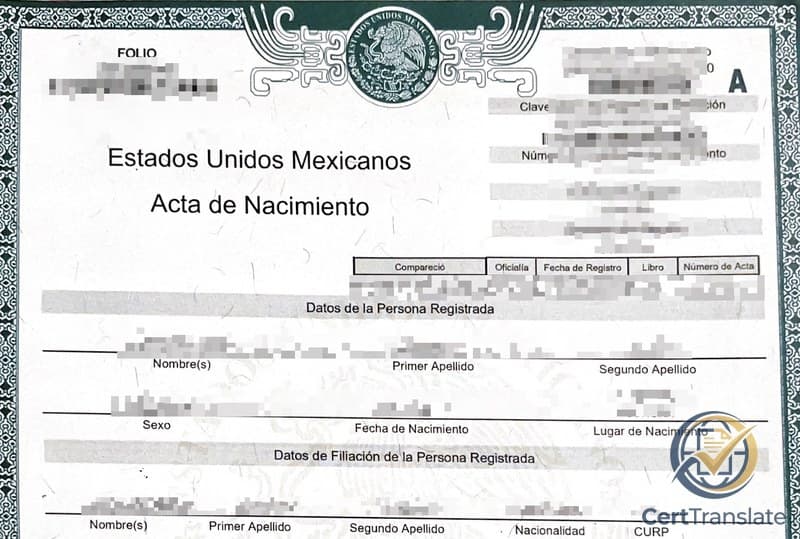
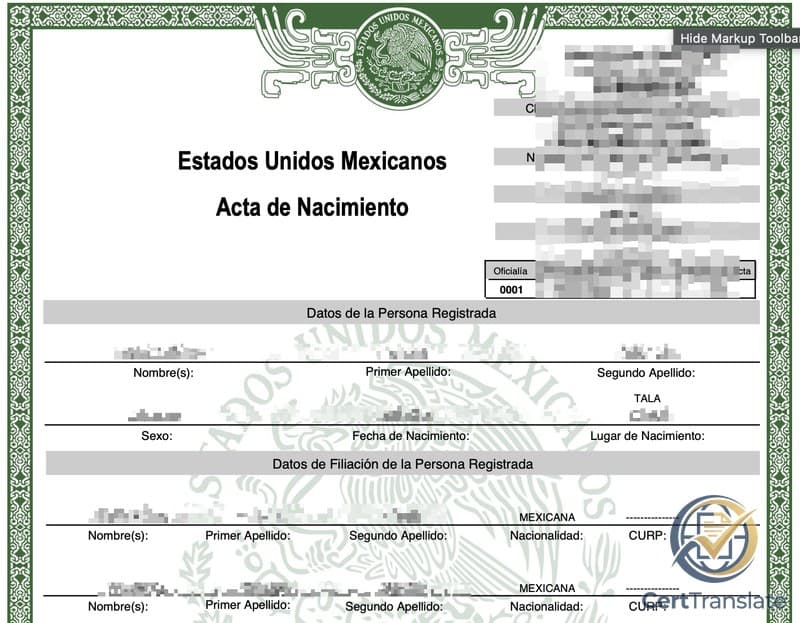
Birth certificate (acta de nacimiento / registro civil de nacimiento)

Spanish birth certificate translation is the highest-volume request for adjustment of status, family petitions, and naturalization support files.

Mexican formats commonly include CURP and civil registry metadata that must be reproduced exactly as printed, while Colombian versions often include notaria details that must be translated rather than abbreviated.

If you need this document, use our dedicated Spanish birth certificate translation page for country-specific guidance on Mexican, Colombian, Salvadoran, Guatemalan, and Cuban records.

Spanish birth certificate translation
02

Marriage certificate (acta de matrimonio)

Spanish marriage certificate translation is frequently required for spouse-based petitions, name-consistency review, and supporting evidence in USCIS family cases.

A common issue is mismatch between surnames used before and after marriage across passport, visa, and civil records; we translate each form exactly and flag visible differences without rewriting names.

For country-specific guidance on Mexican, Colombian, Dominican, Peruvian, and Cuban marriage records, use our dedicated Spanish marriage certificate translation page.

Spanish marriage certificate translation
03

Divorce decree (sentencia de divorcio)

Divorce records are often multi-page and include judicial findings, dates of enforceability, and references to prior civil acts that must remain intact in English.

Spanish decrees from different countries can vary in court naming conventions, and legal terms do not always map one-to-one into U.S. legal vocabulary, so terminology needs careful equivalence rather than literal shortcuts.

Use our certified divorce document translation page when you need full decree coverage, not only the final page.

certified divorce document translation
04

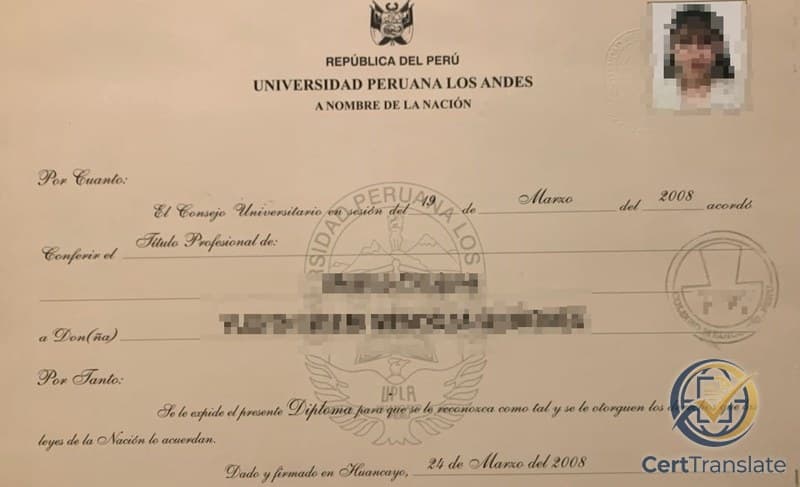
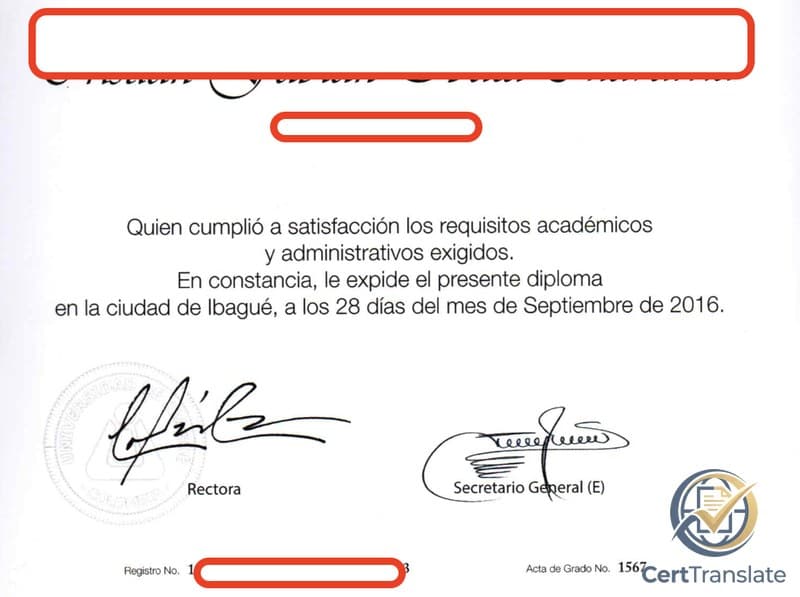
Diploma / degree (titulo universitario)

Spanish diploma translation is commonly required for admissions, licensing, and employment verification.

Degree labels like Licenciado or Ingeniero should be translated with context so evaluators understand the credential type without forcing a false U.S. equivalency.

WES, ECE, and other NACES evaluators typically expect exact degree-title wording and issuing-institution details, which we preserve in every certified diploma translation.

certified diploma translation
05

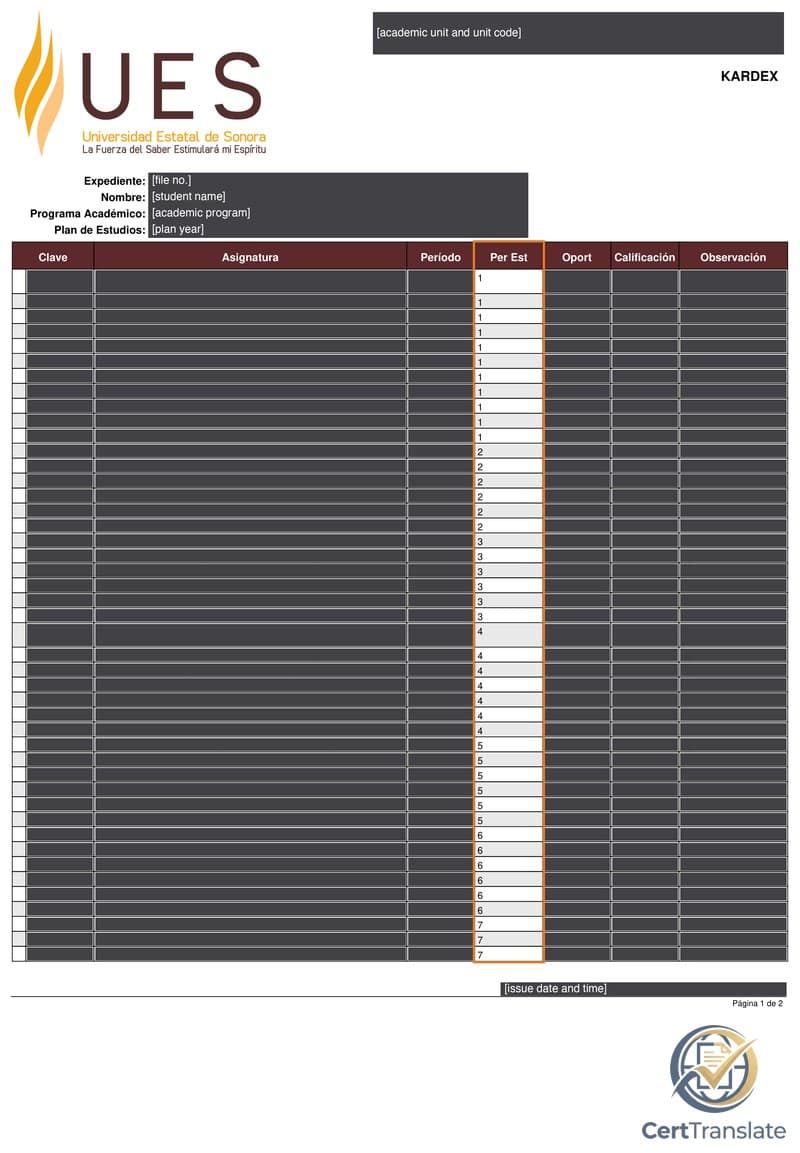
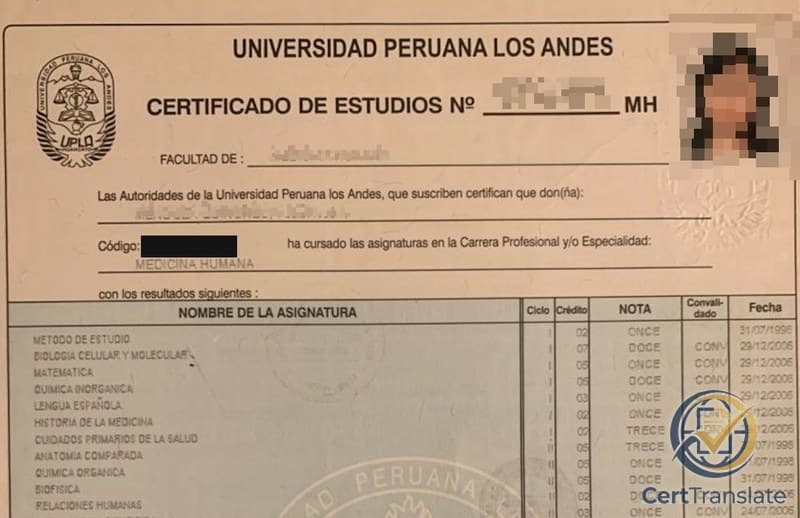
Academic transcripts (certificado de notas / historial academico)

Transcript translation requires line-level accuracy for course titles, grading scale references, and institutional seals.

Many Latin American records use country-specific grading conventions; we translate the original scale exactly and avoid silent GPA conversion for WES, ECE, and NACES submissions.

See our certified transcript translation page if your evaluator requires complete course-by-course rendering.

certified transcript translation
06

Passport and identity records (pasaporte / cedula)

Identity documents support name, date-of-birth, and nationality consistency across immigration packets.

Spanish identity cards may include abbreviations, diacritics, and administrative codes that look minor but can trigger inconsistencies if omitted.

Our certified passport translation page covers common USCIS-ready formatting expectations.

certified passport translation
07

Criminal record certificates (carta de antecedentes penales)

Background certificates are requested for immigration and licensing contexts, often with strict date validity windows.

Terminology around judicial status, pending proceedings, and registry scope differs across Spanish-speaking countries, so jurisdiction language must be translated precisely.

Spanish translation for USCIS background checks should include every status annotation, so use the requirements checker if you are unsure whether your filing needs a current certificate or a historical one.

requirements checker for criminal record translation
Translation Challenges

What Makes Spanish Translation Different

Spanish translation quality depends on country-level legal context, not only language fluency. These are the issues that most often separate accepted files from delayed ones.

01

Country-level legal terminology shifts inside the same language

Spanish is used across 20+ countries, and official document wording changes by jurisdiction even when the document type looks similar.

A translator must recognize whether the text originates from Mexico, Colombia, El Salvador, Cuba, or another registry system before selecting equivalent legal terms in English.

If country context is ignored, USCIS officers may see inconsistent field rendering and request additional evidence.

02

Registry identifiers must be copied exactly

Mexican civil documents often include CURP and structured registry references that function as identity anchors in the packet.

One incorrect character in a registry string can create a mismatch against other records and trigger a manual review.

Our workflow includes character-by-character verification for alphanumeric fields before certification.

03

Handwritten and legacy civil forms require experienced reading

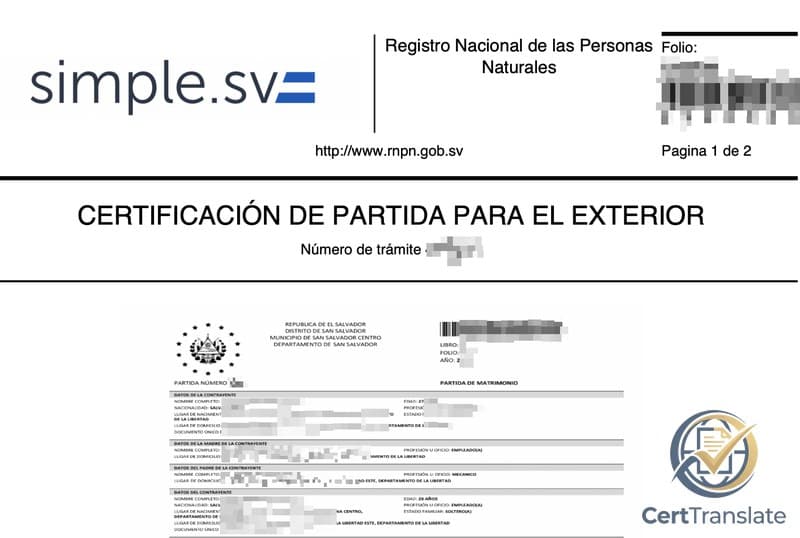
Salvadoran and Guatemalan records are often submitted as scans of older handwritten forms with marginal notes and faint seals.

Handwriting interpretation is not guesswork: we cross-check names, dates, and registry fields against surrounding text patterns and official format conventions.

This reduces rejection risk from unreadable or incompletely translated content.

04

Nicknames and diminutives must be documented, not normalized

Some records contain family-use naming forms like Panchita instead of Francisca in annotations or supporting statements.

Silent normalization creates discrepancies across affidavits, IDs, and civil records.

We translate what appears in the source and, when needed, add a precise translator note to preserve identity clarity.

05

Degree terminology does not always map directly to U.S. labels

Terms like Licenciado or Tecnico can represent different academic levels by country and institution.

Over-simplifying to a single U.S. degree title can mislead evaluators and create avoidable follow-up requests.

We preserve the original title and provide a context note when equivalency is not one-to-one.

06

Apostille and legalization context affects submission strategy

Spanish-language documents come from both Hague Convention member countries and non-member systems.

Applicants often confuse translation with legalization steps; both can be necessary but they are not interchangeable.

We keep translation scope exact and help you identify when apostille or consular legalization may also be requested by the receiving authority.

How We Translate Your Spanish Documents — Step by Step

1

Step 1 — Upload your document

Send a clear photo, scan, or PDF. If your document is faded, handwritten, or printed on colored paper, upload it anyway. Our Spanish team reviews these formats daily and confirms readability before production begins.

2

Step 2 — Native-speaker assignment

Your file is assigned to a native Spanish speaker matched to your document type, such as civil registry, court order, or academic record. We do not route Spanish legal records through generalist translators who only occasionally handle this language pair.

3

Step 3 — Translation and certification

We translate every visible element: body text, stamps, seals, signatures, and margin notes. Country-specific terms are rendered with legal accuracy, identity fields are checked against source formatting, and every delivered file includes a signed Certificate of Accuracy.

4

Step 4 — Two-person quality review

A second native Spanish reviewer verifies names, dates, registry numbers, and terminology consistency. This review stage is designed to catch the subtle mismatches that most often cause USCIS delays.

5

Step 5 — Delivery

We deliver your certified translation as a submission-ready PDF by email, usually within 24 hours for standard files. Expedited turnaround and hard-copy mailing are available when your deadline is tighter.

Secure Process

100% Confidentiality

Your files are transmitted using 256-bit SSL encryption. We never use machine translation tools for your documents. Files are deleted within 30 days, or sooner on request.

Start Your Spanish Translation Order
Check USCIS Requirements First

Tiene dudas sobre su caso? Llame y le ayudamos en espanol.

Global Acceptance

Spanish Translation by Country

Mexico

Most requests involve birth certificates, marriage records, divorce decrees, and criminal history certificates for USCIS filings.

Mexican civil records often include CURP, registry office identifiers, and structured references that must be translated exactly as issued.

Mexico is a Hague Apostille Convention member, so apostille is the usual authentication path; certification and apostille are separate requirements and are not interchangeable.

For identity-heavy filings, we recommend reviewing certified birth certificate translation before submission.

Colombia

Colombian documents frequently include notaria references and numbering conventions that should remain visible in translation.

Civil and judicial records may include formal institutional titles that require precise legal equivalents in English.

Colombia is a Hague Apostille Convention member, so apostille is typically accepted for international use; translation should preserve all notarial details so the packet remains internally consistent.

Users filing immigration petitions should cross-check with the USCIS page for current filing workflow context.

El Salvador

Older Salvadoran records are commonly handwritten and can include legacy formats with compact abbreviations.

These documents require careful reading of seals, registrar notes, and handwritten marginal updates that are easy to miss in low-quality scans.

El Salvador is a Hague Apostille Convention member, so apostille is usually available; incomplete rendering of handwritten sections still remains a frequent USCIS rejection driver.

Birth and marriage record guidance is available on our dedicated document pages.

Guatemala

Guatemalan civil records often appear as registry extracts with formatting that differs from Mexican or Colombian equivalents.

Applicants may submit mixed packets with municipal and national records; terminology consistency across those files is critical.

Guatemala is a Hague Apostille Convention member, and when scans include stamps or partial overlap, we preserve all readable text and mark unclear elements transparently instead of guessing.

Use the free requirements checker when you are unsure which pages need full translation.

Cuba

Cuban records can reference historical institutional names or administrative structures that changed over time.

Translations should preserve the original wording and clarify context with neutral notes when terms may be unfamiliar to U.S. reviewers.

Cuba is not listed as a Hague Apostille Convention member, so embassy or consular legalization is often required in addition to certified translation for non-USCIS destinations.

If your packet includes older records, submit them together so naming and date conventions stay consistent across all translations.

How Much Does Spanish Translation Cost?

$24.95/ page
Up to 250 words per page

Our Spanish translation services use the same $24.95/page base rate as every other supported language. No language-based surcharges.

Document
Birth certificate (acta de nacimiento)
Typical Pages
1-2 pages
Estimated Cost
$24.95
Document
Marriage certificate (acta de matrimonio)
Typical Pages
1-2 pages
Estimated Cost
$24.95
Document
Divorce decree (sentencia de divorcio)
Typical Pages
3-8 pages
Estimated Cost
$74.85
Document
Diploma / degree (titulo universitario)
Typical Pages
1 page
Estimated Cost
$24.95
Document
Academic transcripts (certificado de notas)
Typical Pages
2-4 pages
Estimated Cost
$49.90

Optional add-ons

  • Notarization (+$19.95)
  • Expedited turnaround
  • Hard-copy mailing

Exact price is confirmed after document review and before payment.

Many certified translation providers charge $30-$60 per page. Our Spanish-certified workflow at $24.95 includes the Certificate of Accuracy, unlimited revisions, and USCIS acceptance guarantee.

Estimate Your Order
USCIS Guaranteed
SSL Secure
100% Confidential
Critical Warnings

Mistakes That Get Spanish Translations Rejected

Using machine translation for legal records

Google Translate and DeepL often mishandle legal terms and registry language in Spanish civil documents.

A frequent example is rendering acta de nacimiento as act of birth instead of the legal equivalent birth certificate.

That wording can trigger a USCIS RFE (Request for Evidence), so every file is translated by a human native Spanish speaker and reviewed by a second native reviewer.

Asking a friend or family member to translate

A bilingual contact may understand everyday language but usually cannot provide a compliant professional certification statement.

USCIS expects a complete translation with signed Certificate of Accuracy from a competent translator.

Without that, you risk delay and re-submission even if the wording is mostly understandable.

Name and identifier mismatches across documents

Spanish records often include compound surnames, accents, and abbreviations that must be consistent across every translated file.

If one page drops part of a surname or a registry character, your packet may be treated as internally inconsistent.

Our QA process compares core identifiers across all submitted pages before delivery.

Incomplete translation of stamps, margins, or reverse sides

Rejections frequently happen when only the main body text is translated and official marks are omitted.

Spanish civil records often include crucial metadata in seals, side notes, and endorsements that appear outside the central text block.

We translate every visible element and describe seals even when partially legible.

Wrong regional legal terminology

A translator unfamiliar with country-specific legal usage can choose terms that sound correct but are jurisdictionally wrong.

Mexican and Colombian civil terminology, for example, may use different institutional wording for similar functions.

We assign translators who handle that country context regularly, which reduces avoidable terminology disputes.

Missing Certificate of Accuracy

Some users submit translated text without a signed certification statement.

Even a precise translation can be delayed if certification format is missing or incomplete.

Every delivery includes a signed and dated Certificate of Accuracy prepared for immigration and official-use workflows.

Our Spanish Translation Track Record

Spanish is one of our highest-volume language pairs. Our workflow includes character-level CURP verification and a two-person native-speaker review before certification. We cover civil, legal, and academic records from 20+ issuing countries across Latin America, the Caribbean, and Spain.

Our Spanish translation services are designed for first-pass acceptance: native-speaker assignment, two-person review, complete certification package, and fast revision support if a receiving authority requests a format adjustment.

4.9/5.0
TrustScout Rating
2,400+
Verified Reviews
240,000+
Documents
23+
Languages
Client Testimonials

What Spanish-Speaking Customers Say

They translated my Mexican birth certificate and marriage certificate in less than a day. USCIS accepted both with no issues, and the CURP and names matched perfectly across every page.

Daniel R.

Houston, TX • Birth + Marriage Certificates • USCIS family petition

January 2026 on Google

My Colombian divorce decree had many legal references and notary details. The translation was complete, clearly formatted, and accepted by my attorney and the court without revisions.

Marcela V.

Miami, FL • Divorce Decree • Court filing

December 2025 on Trustpilot

I needed Spanish academic transcripts for university evaluation. They translated course titles and grade information exactly and delivered a certified PDF the same day.

Luis A.

Los Angeles, CA • Academic Transcripts • Credential evaluation

November 2025 on Google

What stood out was the reviewer quality. They asked one clarification question before finalizing, which prevented a surname mismatch that would have delayed our green card packet.

Carolina M.

Orlando, FL • Civil documents bundle • Green card application

October 2025 on BBB

Frequently Asked Questions About Spanish Translation

How much does certified Spanish translation cost?

Spanish translation services start at $24.95 per page for up to 250 words. That base rate includes certified Spanish translation, a signed Certificate of Accuracy, and revision support if the receiving authority asks for a translation-format adjustment. Final cost depends on page count and optional add-ons such as notarization, expedited turnaround, or hard-copy shipping. The fastest way to avoid surprises is to upload all pages at once, including reverse sides and attachments, so pricing is confirmed before payment. If you are comparing offers, confirm that certification is included in the quoted price and not billed separately after checkout. You can also request a pre-payment page count check so your final invoice matches your filing plan.

How long does Spanish document translation take?

Most standard Spanish documents are delivered within 24 hours, and many single-page records are completed sooner. Turnaround depends on page count, scan quality, handwriting density, and whether your packet includes multi-page legal records such as divorce decrees. If your deadline is urgent, request expedited service when uploading your files so the team can prioritize scheduling. To keep delivery fast, submit all pages in one batch and provide any existing English spelling used in your passport or USCIS forms. That upfront context reduces revision cycles and helps you file on time. If you have a USCIS receipt deadline, include that date so production and review can be scheduled around it.

Will my Spanish translation be accepted by USCIS?

Spanish translation for USCIS is generally accepted when the submission includes a complete English translation and a signed certification statement from a competent translator. Our Spanish workflow is built around that requirement: full rendering of visible content, two-person native-speaker review, and certification-ready output for filing packets. Acceptance decisions always belong to USCIS, but if a translation-format issue is raised, we provide corrective revisions quickly under our guarantee. For best results, submit the original-language copy and the certified translation together, and verify that names and dates match your USCIS forms before mailing. A quick packet review before filing is the safest way to prevent avoidable requests for evidence.

Are your Spanish translators native speakers?

Our Spanish translators are native speakers with formal immigration, legal, and academic translation experience. This native-speaker model keeps certification-ready Spanish translation consistent across mixed-country packets from Mexico, Colombia, Central America, the Caribbean, and Spain. A native translator identifies jurisdiction-specific legal registers and preserves them with the correct U.S.-facing equivalents instead of flattening regional meaning. For added accountability, the lead translator and reviewer can be tied to your file when a receiving authority asks for clarification. If your case includes records from multiple countries, list each issuing country when uploading so terminology and naming conventions stay aligned from start to finish. That preparation step reduces avoidable review questions before filing.

Do I need my Spanish documents notarized?

In many USCIS cases, notarization is not required when you already have a proper certified translation with a signed Certificate of Accuracy. Some courts, schools, and state agencies may still request notarization as an additional formality, especially for local procedural rules. Because requirements vary by destination, the practical next step is to confirm whether the receiving authority asks for certification only or certification plus notarization. We can add notarization when needed without changing the translated text itself. If your packet serves multiple destinations, tell us upfront so we can prepare the correct delivery format the first time. Asking this question before ordering usually saves one full revision cycle and a second submission.

Can I translate my own Spanish documents for USCIS?

You can translate your own Spanish documents for USCIS, but USCIS expects a certified third-party translation with a signed accuracy statement. Even fluent applicants often miss seals, side notes, registry references, and reverse-side content that seem minor but affect filing review. A professional workflow adds objective quality control through independent review and formal certification language tied to translator accountability. If timing is your concern, upload clear scans and request standard 24-hour processing so you can keep speed without risking omissions. If you already drafted a version, submit it as reference only and let a certified translator finalize the filing copy.

What if my Spanish document is handwritten or hard to read?

Handwritten or low-contrast Spanish records can still be translated, but quality depends on image clarity and full-page coverage. We regularly handle older civil forms from Central America and the Caribbean that include handwritten annotations, faded seals, and compressed legal text. When a segment is unclear, we identify it transparently and confirm context before certification rather than guessing. To improve accuracy, send the highest-resolution scan you have, include both sides of the page, and avoid cropped edges. If multiple copies exist, upload all versions so the reviewer can cross-reference difficult lines before delivery. A quick phone confirmation is available if one handwritten field affects your filing deadline.

Do I need an apostille for my Spanish documents?

You need an apostille for Spanish documents only when the receiving authority specifically requires international authentication under the Hague Convention. Apostille is different from certified translation of Spanish documents: apostille authenticates the document origin, while translation renders the text into English for USCIS, courts, or universities. Countries such as Mexico, Colombia, El Salvador, and Guatemala use apostille workflows, while non-member jurisdictions may require embassy or consular legalization instead. The safest next step is to ask your receiving authority whether they require translation only, translation plus apostille, or full legalization before you submit. If you are filing to multiple destinations, list each destination so we can map the correct order of steps.

Do you translate documents from all Spanish-speaking countries?

We translate documents from all Spanish-speaking countries, including Mexico, Central America, South America, the Caribbean, and Spain. Country coverage matters because civil registries use different templates, legal terms, and institutional naming conventions even within the same language. Our process starts by identifying issuing country and document format so terminology stays jurisdiction-accurate in English. If your immigration packet includes records from multiple countries, send them together to keep name formatting and legal terminology consistent across the entire submission set. You can use the free requirements checker first if you are unsure which files to upload. The earlier we see the full packet, the easier it is to keep cross-document terminology fully aligned.

Is there a difference between translating a Mexican and a Colombian birth certificate?

Yes, and the difference is operationally important. Mexican birth certificates commonly include CURP and registry metadata that need character-level precision, while Colombian records often include notaria and civil-registry references that require accurate legal labeling in English. Treating both formats as interchangeable can create field inconsistencies across a USCIS packet. Our translators preserve each country format as issued, then render terminology with the proper U.S.-facing legal equivalents. If you have mixed-country family documents, upload everything together so surname order, date style, and registry language are aligned before certification is finalized. This single-country identification step is one of the most effective ways to reduce avoidable USCIS follow-up requests.

Ready to Get Your Spanish Documents Translated?

Your Spanish documents are translated by native Spanish speakers, delivered fast, and prepared in a certification format used for USCIS, court, and academic submissions.

Our Spanish team handles country-specific formats across Latin America, the Caribbean, and Spain, so your packet stays accurate from first page to last page.

Order now or call to confirm requirements before you pay.

Natalia Vega

Natalia Vega

Native Spanish speaker · Born in Puerto RicoLanguage pair: Spanish ↔ English

USCIS Guaranteed
SSL Secure
100% Confidential