CertTranslateCertTranslate
Native Translators Available

Certified Japanese Translation Services

Native Japanese Speakers · Hepburn Romanization · USCIS Accepted · 24-Hour Delivery

Certified & USCIS Approved
Human Experts Only
24-Hour Turnaround
Yuki Tanaka

Yuki Tanaka

Native Japanese speaker · Born in Osaka, JapanLanguage pair: Japanese <> English

A koseki has no direct U.S. equivalent, so field-by-field accuracy matters more than simplified explanation. I preserve every relationship entry and date exactly, then align romanization with passport spelling so USCIS can review the record without identity confusion.
View translator profile →

Last updated: February 2026

Compliance Requirements

If your records are in Japanese and you are filing with USCIS, a U.S. court, or a university, you need Japanese translation services that include every visible element from the source document.

Every Japanese file is assigned to a native Japanese speaker, and your certified Japanese translation is handled by a specialist in civil records, legal documents, and academic credential workflows.

Japanese to English translation requires more than fluency: kanji, hiragana, and katakana can appear together, names must align with passport Hepburn spelling, and era dates such as Heisei or Reiwa need accurate Gregorian handling.

Most Common Japanese Documents We Translate

Japanese-language documents are most frequently submitted with Form I-485 (Adjustment of Status), Form I-130 (Petition for Alien Relative), Form N-400 (Application for Naturalization), and Form I-751 (Petition to Remove Conditions on Residence). These Japanese translation services focus on records most often needed for Japanese translation for USCIS filings, green card packets, and WES, ECE, or other NACES credential review.

Family register and birth-related records (戸籍謄本 / 出生関連記録)

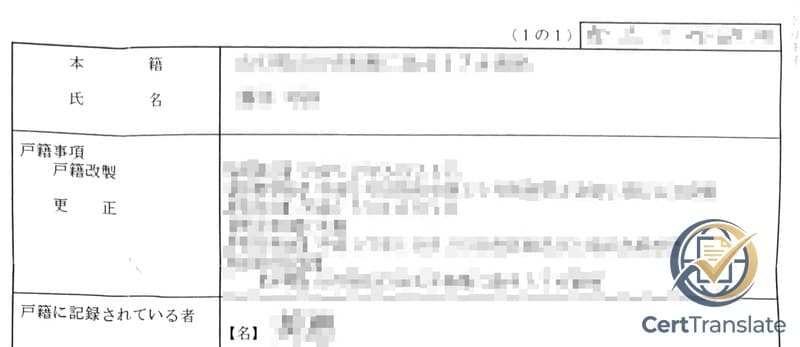
Japanese birth certificate translation usually involves koseki extracts or family registry records used to document birth facts, identity, and family relationships for immigration and legal review.

Because the koseki does not map neatly to a single U.S. document type, each field must be translated with structure preserved instead of summarized.

For filing guidance, review our certified birth certificate translation page before submission.

certified birth certificate translation
02

Marriage certificate and family relationship updates (婚姻届受理証明書 / 戸籍記載)

Marriage-related Japanese records are commonly required for spouse petitions, legal name-history review, and court workflows.

These records may be reflected through koseki entries or municipal certificates, so format context matters when translating relationship changes.

See our certified marriage certificate translation page for packet-level requirements.

certified marriage certificate translation
03

Divorce records (離婚届記載事項証明書 / 判決書)

Divorce files may include municipal acceptance records, family register updates, or court judgments depending on the case.

Terminology and documentary weight differ across those formats, so translations must preserve source context precisely.

Our certified divorce document translation page covers complete decree handling for submission.

certified divorce document translation
04

Passport and identity records (旅券 / 在留カード関連記録)

Identity records anchor romanization consistency for names, dates, and nationality across all translated documents.

Hepburn spelling used in passports should guide final English rendering when other records show alternative readings or kanji ambiguity.

Use our certified passport translation page for USCIS-ready formatting expectations.

certified passport translation
05

Diploma and degree records (卒業証明書 / 学位記)

Japanese diploma translation is often required for admissions, licensing, and employment verification.

Japanese degree labels such as 学士, 修士, and 博士 should be translated precisely, with field and conferral information kept intact.

WES, ECE, and other NACES evaluators expect exact degree-title wording and issuing-institution detail, and our certification-ready Japanese diploma translation preserves that structure for formal review.

certified diploma translation
06

Academic transcript (成績証明書)

Academic records require line-level translation of courses, grades, credit units, institutional headers, and signatures.

Course-by-course detail matters for WES, ECE, and NACES credential evaluators, and Japanese grading context must be translated without unauthorized conversion.

Visit our certified transcript translation page for course-by-course submission guidance.

certified transcript translation
07

Municipal certificates and legal extracts (住民票 / 各種証明書)

Japanese packets can also include municipal residence, identity, and legal support records for immigration or court matters.

These files often use compact administrative labels and seals that must be translated completely for official review.

If your packet includes mixed document categories, start with the free requirements checker before ordering.

requirements checker for Japanese support records
Translation Challenges

What Makes Japanese Translation Different

Japanese translation quality for official use depends on script interpretation, era-date handling, and exact family-register field rendering. These are the issues that most often affect acceptance.

01

Japanese names can have multiple valid readings

Kanji names are not always self-pronouncing, and the same characters can map to different English spellings depending on the person and their passport.

If a translator guesses the reading instead of following passport evidence, the record can look inconsistent across a USCIS packet.

We anchor final spelling to passport or official romanized evidence and verify name consistency across every uploaded page.

02

Three scripts can appear in one document set

Japanese official records may combine kanji, hiragana, and katakana within the same file.

That means accurate translation depends on more than dictionary lookup: the translator must know how script choice changes function and pronunciation context.

We interpret script in field context first, then render terminology and names in clear English without flattening structure.

03

Era dates must be converted carefully

Official documents may use era names such as Heisei or Reiwa instead of Gregorian years.

Incorrect conversion can create timeline discrepancies across forms, passports, and supporting records.

We preserve the original date reference and provide accurate Gregorian context in the translated output.

04

Koseki records have no direct U.S. equivalent

A koseki functions as a family registry rather than a single one-purpose certificate, so its legal meaning depends on field structure.

Over-summarizing the record can remove relationship or status information reviewers need to see.

We translate koseki entries field by field and keep relationship structure visible for official review.

05

Academic degree titles do not map one-to-one automatically

Japanese degree terms such as 学士, 修士, and 博士 carry specific academic meaning that should be translated consistently with issuing context.

Flattening them into vague English labels can trigger evaluator follow-up questions about degree level or credential equivalency.

We preserve the source title, field structure, and conferral context so credential reviewers can assess the document accurately.

06

Vertical text and hanko impressions must still be fully rendered

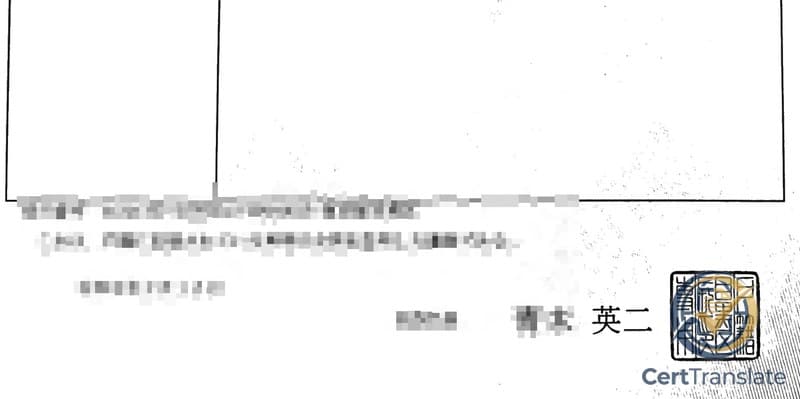
Japanese official documents often use vertical layout, side annotations, and personal or institutional seals that carry legal significance.

If those elements are skipped because they sit outside the main horizontal reading flow, the English translation becomes incomplete.

We translate all visible content and describe seal or hanko impressions clearly in certification-ready output.

How We Translate Your Japanese Documents — Step by Step

1

Step 1 — Upload your document

Upload scans, photos, or PDFs of your Japanese records. If pages include seals, handwritten notes, or era-date formatting, send every page so readability can be confirmed before translation starts.

2

Step 2 — Native-speaker assignment

Your file is assigned to a native Japanese translator matched to document type and official-use context. We do not route high-stakes civil or legal records to general translators outside this language pair.

3

Step 3 — Translation and certification

We translate all visible content including text, seals, signatures, annotations, and structured fields. Names are checked against passport spelling, era dates are handled carefully, and koseki-style records are rendered field by field. You receive a signed Certificate of Accuracy with your final translation.

4

Step 4 — Two-person quality review

A second native Japanese reviewer verifies names, dates, script interpretation, field structure, and completeness. This review stage catches subtle issues that commonly trigger official follow-up requests.

5

Step 5 — Delivery

Certified PDF delivery is typically completed within 24 hours for standard files. Expedited turnaround and hard-copy mailing are available when your deadline is tight.

Secure Process

100% Confidentiality

Your files are transmitted over 256-bit SSL encryption. We never use Google Translate, DeepL, or any machine translation tool for official documents. Files are deleted within 30 days, or sooner on request.

Global Acceptance

Japanese Translation by Country

Japan

Most Japanese requests involve koseki extracts, identity documents, Japanese birth certificate translation equivalents, and academic credentials issued in Japan for immigration and official U.S. use.

Japan is a Hague Apostille Convention member, so apostille is commonly used instead of embassy legalization when a receiving authority asks for authentication of a Japanese public document.

That apostille step does not replace certified translation: USCIS, courts, and universities still require a complete English translation of all visible content, including seals, hanko impressions, and era-date references.

For filing context, review our USCIS page, certified birth certificate translation guidance, and diploma translation page before submission.


How Much Does Japanese Translation Cost?

$29.95/ page
Up to 250 words per page

Our Japanese translation services use the same $24.95/page base rate as every other supported language. No language-based surcharges.

Document
Koseki or family relationship records
Typical Pages
1-4 pages
Estimated Cost
$29.95
Document
Marriage certificate / family update records
Typical Pages
1-2 pages
Estimated Cost
$29.95
Document
Divorce records
Typical Pages
2-6 pages
Estimated Cost
$59.90
Document
Diploma / degree records
Typical Pages
1-2 pages
Estimated Cost
$29.95
Document
Academic transcript
Typical Pages
2-6 pages
Estimated Cost
$59.90

Optional add-ons

  • Notarization (+$19.95)
  • Expedited turnaround
  • Hard-copy mailing

Exact price is confirmed after document review and before payment.

Many certified translation providers charge $30-$60 per page. Our Japanese-certified workflow at $24.95 includes the Certificate of Accuracy, unlimited revisions, and USCIS acceptance guarantee.

Estimate Your Order
USCIS Guaranteed
SSL Secure
100% Confidential
Critical Warnings

Mistakes That Get Japanese Translations Rejected

Using machine translation for koseki or official records

Google Translate and DeepL often mishandle field relationships, era dates, and name readings in Japanese official documents.

A common failure is flattening a koseki into oversimplified English while dropping relationship detail or guessing a name reading that does not match passport Hepburn spelling.

These errors can trigger a USCIS RFE (Request for Evidence), so we use native human translators and second-pass native QA on every certified file.

Using a bilingual friend or family member without proper certification

A bilingual friend or family member may understand the document, but that does not create the independent certified translation USCIS and many institutions expect.

Informal translation usually omits a compliant Certificate of Accuracy and misses packet-level checks for name readings, era dates, and koseki structure.

Every delivery includes a signed Certificate of Accuracy prepared for official submissions and reviewed for record-to-record consistency.

Guessing a kanji name reading instead of using passport evidence

Japanese names can have multiple valid readings, and a guessed reading can conflict with passport spelling even when the kanji is correct.

That mismatch can create identity friction across filings.

We anchor final English spelling to official romanized evidence and verify consistency across the packet.

Incorrect conversion of Heisei or Reiwa dates

Era-date errors can shift the year and create timeline discrepancies across forms and supporting documents.

These are avoidable but high-impact mistakes in official review.

We preserve the original era notation and provide accurate Gregorian context in the final translation.

Incomplete translation of seals, hanko, margins, or side notes

Rejections often happen when only central text is translated and official marks, vertical text, or side annotations are omitted.

Japanese records can place essential status or authentication detail in seals, hanko impressions, and marginal notes outside the main body text.

We require full visible-content translation including seal descriptions, annotation lines, and layout-aware rendering.

Submitting translation without complete certification

USCIS expects complete translation plus a signed certification statement from a competent translator.

Text-only translation without compliant certification language can cause avoidable filing delays or rejection by the receiving authority.

Every delivery includes a signed Certificate of Accuracy prepared for official submissions.

Our Japanese Translation Track Record

Japanese is one of our highest-volume East Asian language pairs. Our workflow includes passport-aligned Hepburn romanization checks, gengo-to-Gregorian date QA, and field-by-field koseki review before certification. We cover family registry, legal, and academic records issued in Japan, including municipal certificates, Japanese diploma translation, and transcript packets.

Our Japanese translation services are processed with passport-aligned romanization checks, era-date control, full-page completeness review, and two-person native QA before certification. This reduces avoidable USCIS and evaluator follow-up requests.

4.9/5.0
TrustScout Rating
2,400+
Verified Reviews
240,000+
Documents
23+
Languages
Client Testimonials

What Japanese-Speaking Customers Say

They translated my koseki records with full field detail and correct passport spelling for names. USCIS accepted the packet without questions.

Aya N.

Los Angeles, CA • Koseki + Family Records • USCIS family petition

January 2026 on Google

My Japanese transcript and degree translation for credential evaluation was precise and clearly formatted. The evaluator accepted everything without revisions.

Kenji M.

Boston, MA • Transcript + Degree • Credential evaluation

December 2025 on Trustpilot

Excellent work on marriage records and passport pages. They caught one romanization issue before delivery and saved us time on our filing.

Mai T.

Seattle, WA • Marriage + Passport • Green card application

November 2025 on Google

Fast and complete translation of municipal records with seals and handwritten notes. Our attorney approved the packet immediately.

Ryo S.

Chicago, IL • Municipal Records • Legal filing

October 2025 on BBB

Frequently Asked Questions About Japanese Translation

How much does certified Japanese translation cost?

Japanese translation services start at $24.95 per page for up to 250 words. That base rate includes certified Japanese translation by a native speaker, a signed Certificate of Accuracy, and revision support if a receiving authority requests a formatting adjustment. Final cost depends on page count, document complexity, and optional services such as notarization, expedited turnaround, or hard-copy mailing. To avoid cost surprises, upload all pages together, including reverse sides and attachments, so pricing can be confirmed before payment. This is especially useful when one packet includes Japanese birth certificate translation equivalents, passport pages, and municipal family records. You can request a pre-payment page audit for budget clarity and scheduling confidence.

How long does Japanese document translation take?

Most standard Japanese documents are delivered within 24 hours, and many one-page records are completed sooner. Turnaround depends on page volume, scan quality, handwriting density, and whether files include multi-page koseki material, dense annotations, or academic records with detailed supplements. If your deadline is strict, request expedited handling at upload so your file can be prioritized. To keep timing predictable, submit all related records in one batch and include passport spellings used in your forms. This helps resolve name, date, and terminology consistency early, rather than during final review, and reduces the risk of avoidable filing delays for time-sensitive cases. Include your filing date in the order note for scheduling clarity.

Will my Japanese translation be accepted by USCIS?

Japanese translation for USCIS is generally accepted when the filing includes a complete English translation and a signed certification statement from a competent translator. Our Japanese workflow is built around that requirement: native-speaker translation, full visible-content coverage, two-person quality review, and certification-ready output. USCIS makes final decisions, but if a translation-format issue is raised, we provide prompt corrective revisions under our guarantee. For best results, submit original-language copies and certified translations together, then verify names, dates, and passport spellings against your USCIS forms before filing. A packet-level consistency review before submission is one of the best ways to reduce avoidable follow-up requests and timeline delays.

Are your Japanese translators native speakers?

Our Japanese translators are native speakers with formal experience in immigration, legal, and academic workflows. Native expertise matters because Japanese translation services for official use require precise handling of koseki structure, script interpretation, era dates, and passport-aligned romanization. Translators must identify document format and official-use context first, then apply accurate English equivalents without flattening important distinctions. If your packet includes multiple record types, mention that during upload so names, dates, and terminology can be aligned across the full file set. This improves first-pass acceptance reliability and reduces avoidable revisions caused by mixed-format inconsistencies in one filing packet. It also keeps names and family-status fields consistent across every translated page.

Do I need my Japanese documents notarized?

In many USCIS filings, notarization is not required when you already submit a proper certified translation with a signed Certificate of Accuracy. Some courts, schools, licensing agencies, and state offices may still request notarization as an additional procedural step. Requirements vary by destination, so confirm whether the receiving authority requires certification only or certification plus notarization. We can add notarization when needed without changing translation content. If the same packet will be used in multiple destinations, tell us at intake so delivery format can be prepared correctly in one cycle. Confirming this before payment usually prevents avoidable reprocessing and timeline delays.

Can I translate my own Japanese documents for USCIS?

You can translate your own Japanese documents, but USCIS expects a certified third-party translation with a signed accuracy statement. Even fluent bilingual applicants often miss critical details such as koseki field structure, seal text, era-date conversion, and passport-consistent name spelling. Japanese official documents also require format-aware terminology choices that informal translation rarely handles consistently. Professional workflow adds independent QA and compliant certification language. If speed is your concern, upload clear scans and request standard 24-hour processing. That route is typically faster than correcting a rejected filing later because of preventable translation issues and extra review cycles. If you drafted your own version, share it only as reference material.

What if my Japanese document is handwritten or hard to read?

Handwritten or low-contrast Japanese records can still be translated, and Japanese translation services for official use often involve older family and municipal extracts with handwritten notes. Accuracy depends on image quality and complete page coverage. We regularly handle faded seals, side annotations, and compact administrative references. When a segment is unclear, we mark it transparently and verify context before certification instead of guessing. For best results, upload high-resolution scans, include both sides of each page, and avoid cropped margins where official marks often appear. If multiple versions exist, send all copies so reviewers can cross-reference difficult sections during QA. Intake screening can identify pages that should be rescanned before production begins.

Do I need an apostille for my Japanese documents?

You need an apostille for Japanese documents only when the receiving authority requires Hague Convention authentication. Apostille is different from certified translation: apostille confirms document origin, while translation converts the content into English for USCIS, courts, or universities. Japan is a Hague Apostille Convention member, so apostille is commonly used instead of embassy legalization for Japanese public documents when authentication is required. Apostille does not replace complete translation of koseki fields, seals, hanko impressions, or era dates. The safest next step is to confirm whether your destination requires translation only, translation plus apostille, or another legalization step before submission in advance.

How do you handle koseki and Japanese family registry records?

We handle koseki records by translating them field by field rather than compressing them into a simplified summary. That matters because a koseki functions as a family registry and often contains relationship, status, and event information that has no one-line U.S. equivalent. If those fields are paraphrased too loosely, USCIS or legal reviewers may miss information they need to verify identity and family connections. Our workflow preserves structure, translates each relationship entry clearly, and aligns all names with passport spelling where relevant. If your packet includes koseki plus municipal certificates, upload them together so terminology and family relationships remain consistent across the full translated set.

How do you convert Japanese era dates like Reiwa and Heisei?

We convert Japanese era dates by preserving the original gengo notation and then rendering the correct Gregorian equivalent in the English translation. That matters because dates written as Reiwa or Heisei can create timeline confusion if the year is converted incorrectly or stripped of context. Our workflow checks the era name, year count, and document context before certification so the translated record stays consistent with passports, forms, and other supporting evidence. This is especially important in koseki records, municipal certificates, and academic documents that mix era dates with Western dates. If your packet includes several records from different time periods, upload them together so date handling stays consistent across the full set.

Ready to Get Your Japanese Documents Translated?

Your Japanese documents are translated by native Japanese speakers with passport-aligned romanization checks, era-date control, and full certification support.

We handle civil, legal, and academic records for USCIS, courts, and universities with fast turnaround and strong two-person QA.

Start your order now or call to confirm requirements before payment.

Yuki Tanaka

Yuki Tanaka

Native Japanese speaker · Born in Osaka, JapanLanguage pair: Japanese <> English

USCIS Guaranteed
SSL Secure
100% Confidential