
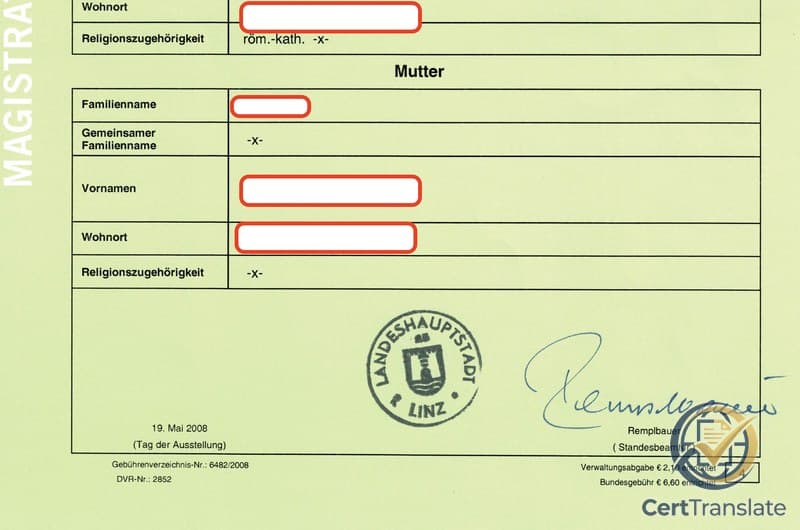
Austria · False friend
Issued by a “Magistrat” — but not a magistrate
The Austrian municipal office was rendered as city administration, with the false friend documented in a note.
Read the caseUrkundeDiplomMagister
German diploma translations for WES and ECE keep Diplom, Magister, Staatsexamen, and modern Bologna awards distinct while preserving whether the issuer is a Universität, Fachhochschule, or another institution type.
Ready within 24 hours
German academic records
Degree title and document structure preserved
Diplom/Magister/Staatsexamen · institution type · supplements
Certified package
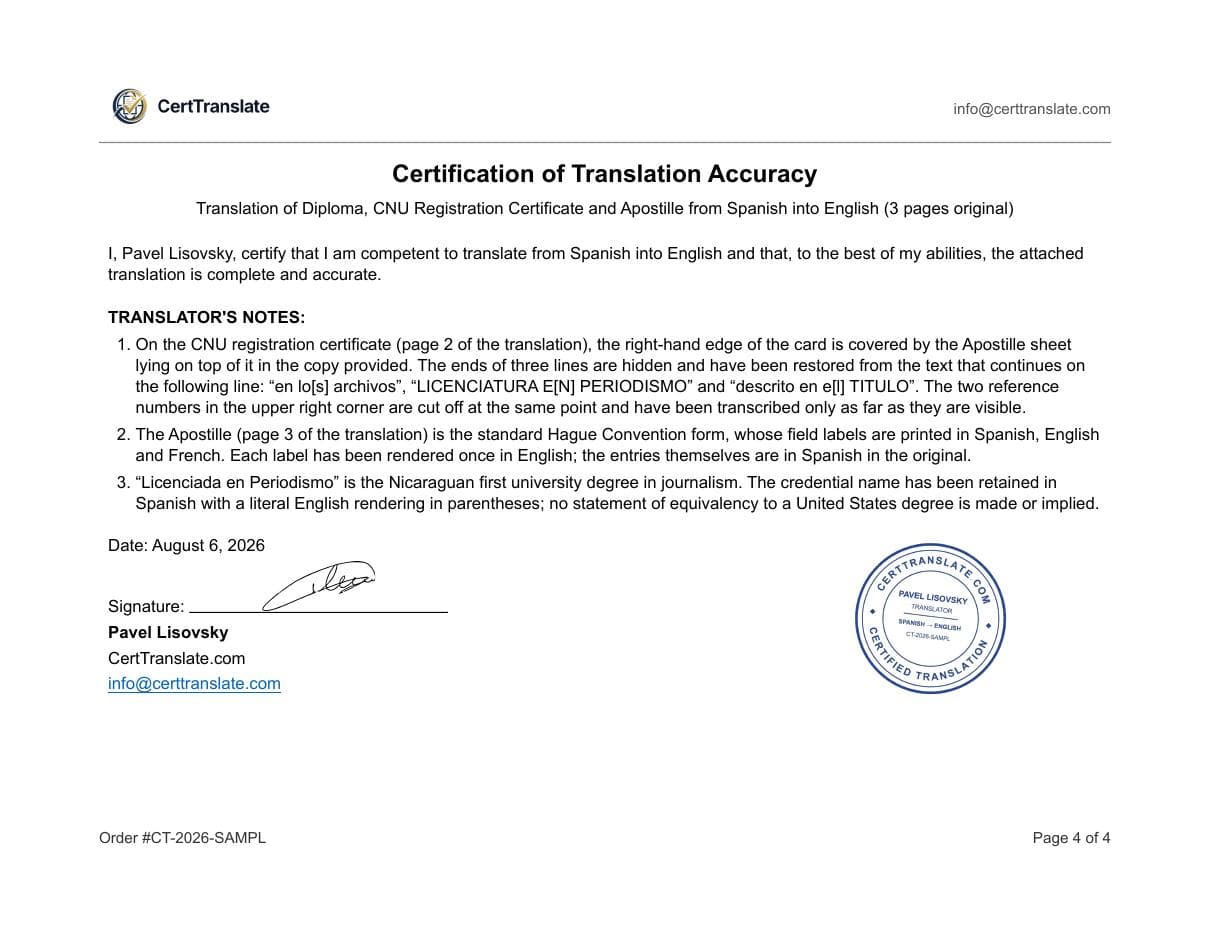
Signed and Stamped Certificate of Accuracy
Company letterhead · translator signature · company stamp

We check your files and confirm the total before you pay



What you receive
Your final package includes a copy of the source document, the complete English translation, and a signed and stamped Certificate of Translation Accuracy. The certificate states that the translation is complete and accurate and that the translator is qualified to translate it.
Files checked and total confirmed before payment
Before you order
Upload every academic page you have. We identify the Urkunde, the supplement, and system-specific records, then confirm the page count, price, and delivery time before you pay.
01 · Always start here
The degree certificate with the Hochschulgrad, the university seal, and the rector’s signature. Upload both sides.
02 · Commonly reviewed with it
The Supplement carries ECTS detail; the Zeugnis or Prüfungszeugnis lists examinations. Evaluators read them beside the Urkunde.
03 · Depends on your track
Law, medicine, and teaching qualify through the Staatsexamen — its certificates are part of the credential record.
Real German translation casework
Each case shows what was unusual, how we translated it, and what the evaluator or officer needed to see.
Austria · False friend
The Austrian municipal office was rendered as city administration, with the false friend documented in a note.
Read the case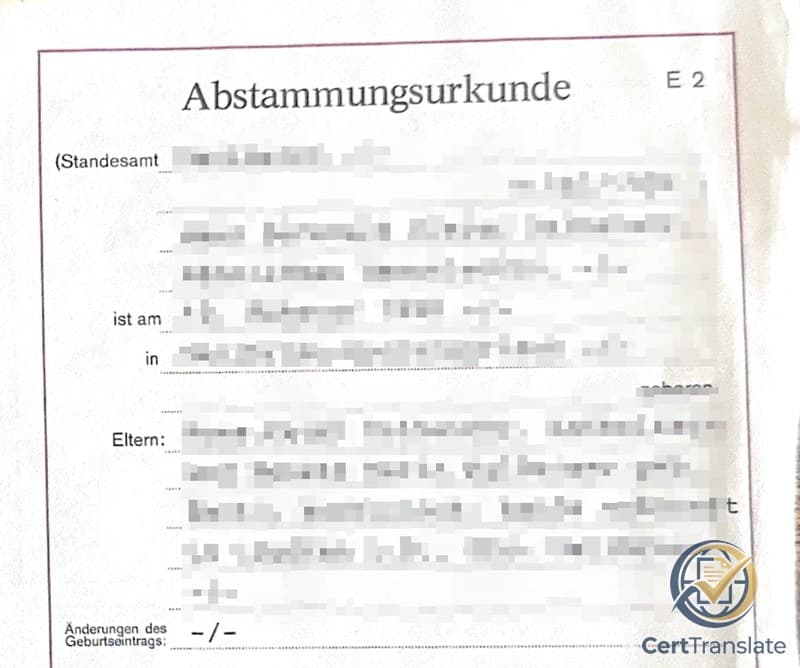
Germany · Historic record
The discontinued Abstammungsurkunde was named and explained so a U.S. reviewer knows what it certifies.
Read the case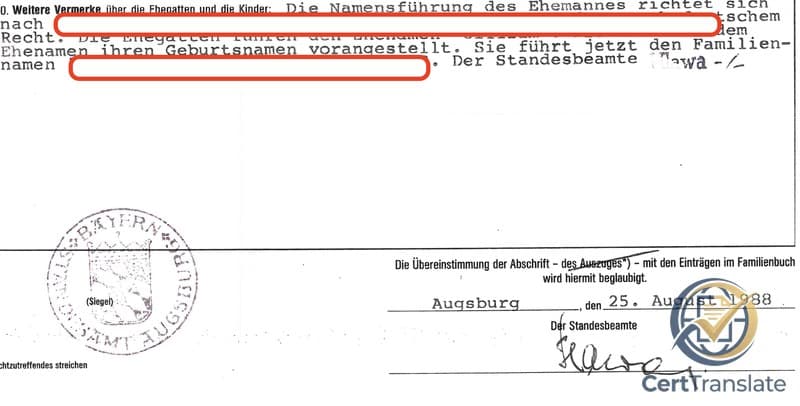
Germany · Name history
The BGB combined-surname entry was translated with its legal basis, keeping Geburtsname and Ehename distinct.
Read the caseHow it works
Upload your documents first. We confirm the pages, price, and delivery time before you pay. You can review the translation before we certify it.
Send a PDF, scan, or phone photo. Include the Urkunde, the Diploma Supplement or Zeugnis, and any Staatsexamen or apostille pages.
Degree title, FH or university status, ECTS references, umlauts against the passport spelling, and every seal are checked against the source.

Request free corrections before certification. After approval, you receive the complete English translation and a signed, stamped Certificate of Translation Accuracy.

One physical page is billed once.
We do not split a dense page into two or three billed pages.
Certified price
$24.95/ page
No payment until file review
Client reviews
Friedrich R.
Boston, MA
“My Diplom-Ingenieur degree and Diploma Supplement needed WES evaluation. The original title was preserved exactly, with the pre-Bologna context clear.”
Germany · Diplom-Ingenieur + Supplement
WES evaluated it cleanly
Monika L.
Philadelphia, PA
“I had an Austrian Magister degree with a German-only Diploma Supplement. They handled both documents and kept the university wording intact.”
Austria · Magister degree
Both documents handled
Jan S.
Seattle, WA
“My ETH Zürich diploma was bilingual German and French with ECTS grading. Everything was translated and the grading kept as displayed.”
Switzerland · Bilingual ETH diploma
ECTS grading preserved
Country-specific diploma review
A German Bologna degree, an Austrian Magister, and a Swiss bilingual award are structured differently. Choose the system where you studied to see what we check.
Urkunde · Diplom · Magister
Also issued with: Staatsexamen qualifies law, medicine, and teaching
German credentials span Bologna Bachelor and Master degrees, the pre-Bologna Diplom and Magister, and the Staatsexamen state qualification — each with its own weight for an evaluator.
We keep every title as issued, preserve the Fachhochschule or Universität status of the issuer, and translate the Diploma Supplement in full when it is included.
Magister · Diplomingenieur
Also issued with: Austrian titles differ from German conventions
Austrian universities kept the Magister and Diplomingenieur traditions alongside Bologna degrees, and the title on the Urkunde is part of the credential.
We translate the award exactly as conferred and keep Austrian institutional wording distinct from German conventions.
Diplom · Bachelor · Master
Also issued with: Records are often bilingual or trilingual
Swiss diplomas may run German beside French or Italian, with ECTS grading and both federal and cantonal issuers in one set.
We translate every language column once, by meaning, and keep the grading exactly as the institution displays it.
Studied in another German-speaking system? These are the systems we see most often, but we translate German-language diplomas from every issuing institution.
Translate another German diplomaCompare page-based pricing
A diploma may contain only a few words, but a transcript, registry page, or supplement can be dense. A provider with a 250-word cap may bill one physical page as two or three pages.
CertTranslate
$24.95 per physical page, regardless of word count
Typical capped provider
Re-counts the same document in 250-word billing units
Included here
Matched formatting, certification, and free corrections for objective errors
Your quote is based on physical pages. We confirm the page count and final total before payment.
Typical — a diploma, registry page, or short supplement
1 page × $24.95 — flat, no word cap
380 words ÷ 250 = 2 billed pages × $24.95
You keep $24.95 on this document.
Get your exact priceComparison estimate only, based on a 250-word page definition at a representative $24.95 per-page rate. Your final price depends on the actual document.
Frequent problems we correct
These four issues can make a diploma difficult to compare with the original. We check for each one before certification.
How we handle it: We keep the FH status visible — a university of applied sciences is a different issuer class, and evaluators weigh it.
How we handle it: The Diplom and Magister stay as issued with their long-cycle context — the evaluator decides what they map to.
How we handle it: We translate the Supplement in full — its ECTS and program detail is often exactly what the evaluator needs.
How we handle it: We reconcile ä, ö, ü, and ß renderings with the passport spelling, so the packet reads as one person’s record.
The standard behind these checks
AcceptReady™ is CertTranslate's published standard for certified translations: complete word-for-word translation, mirrored page layout, signed and stamped Certificate of Accuracy on letterhead, and matched to the receiver's published requirements.
How to check each one yourselfIf a field is unreadable, we do not guess. We ask for a clearer image or identify the limitation in a translator note.
Upload files for a free checkCertified diploma translation FAQ
Clear answers about WES, ECE, pre-Bologna degrees, the Supplement, price, delivery, notarization, and seals.
Certified German diploma translation starts at $24.95 per physical page. One physical page is billed once, even when it contains more than 250 words. We confirm the page count and total before payment.
Most 1–3 page orders are delivered within 24 hours, included in the standard price. Twelve-hour Rush and six-hour Super Rush are also available. If the documents are longer or difficult to read, we confirm the delivery time before work begins.
WES requires an exact, word-for-word English translation when a translation appears in your personal Required Documents list. We provide it with a signed and stamped Certificate of Translation Accuracy. WES makes the final decision. If it requests a translation-related correction, we revise it free; if the translation is still rejected for that reason, we refund the translation cost.
ECE uses different rules from WES. ECE offers a paid Translation Waiver and may accept a word-for-word translation prepared by the applicant when the waiver is not purchased. Check your ECE order before buying a separate translation.
Yes. Translating the Urkunde and the transcript or Supplement together keeps the student name, institution, degree title, and course terminology consistent. Whether you need both depends on the evaluator. Upload every academic document you have, and we will identify which pages need translation before you pay.
No. CertTranslate translates the academic documents into English. WES, ECE, or another evaluator decides the U.S. equivalency of the degree. We preserve the original credential wording and do not invent a U.S. degree or GPA conversion.
We keep the title exactly as issued and describe its long-cycle structure, without asserting a U.S. equivalency. Evaluators treat the Diplom and Magister case by case, and the faithful label is what they need.
A Fachhochschule is a university of applied sciences — a distinct issuer class from a Universität. We keep the FH status visible on the translation, and the evaluator decides how it maps.
Yes. Upload the front and back, including every seal, stamp, signature, registry entry, and attached apostille. We translate or describe every legible element that appears on the document.
A certified translation includes the translator’s signed statement that the translation is complete and accurate. Notarization only verifies the identity of the person signing that statement. Add notarization only when the organization receiving your diploma asks for it.
No. One physical page stays one billed page, even when the diploma, transcript, or supplement is unusually dense.
Evaluator reference
These descriptions show how each degree fits into its local education system. The evaluator—not the translator—decides its formal U.S. equivalency.
| Original degree | Place in local system | Typical duration | Translation note |
|---|---|---|---|
| Bachelor (B.A. / B.Sc. / B.Eng.) | Bologna first cycle | 3–4 years / 180–240 ECTS | Post-1999 first degree |
| Master (M.A. / M.Sc.) | Bologna second cycle | 1–2 years / 60–120 ECTS | University or FH master’s |
| Diplom / Magister | Pre-Bologna long degree | 4–6 years | Single long cycle — kept as issued, never converted |
| Staatsexamen | State examination | 5–6+ years | Law, medicine, teaching — a state qualification, not a standard degree |
| Doktor (Dr.) | Research doctorate | 3+ years | Highest academic award |
Document glossary
These terms explain why the certificate, supplement, and examination records may need to be translated as separate documents.
Common destinations
The documents you need depend on where you are submitting the translation. These examples show what each reviewer checks and what people commonly send with a diploma.
Evaluators compare the English diploma with the original and usually review the transcript in the same file.
Commonly sent
Urkunde + Diploma Supplement + transcript
Admissions teams use the translation to confirm your degree, field, institution, and graduation date.
Commonly sent
Diploma + transcript or academic supplement
Nursing, engineering, teaching, and other boards may need both the academic award and professional registration.
Commonly sent
Diploma + Staatsexamen certificates where relevant
An employer or immigration counsel may use the credential to document the degree claimed for the role or petition.
Commonly sent
Diploma + any evidence named in the request
Not sure which path applies to your diploma?
Upload your diploma and any related academic documents. We’ll confirm which pages need translation, the price, and the delivery time before you pay.
Reference library
Sources verified .
Ready when you are
Include the Diploma Supplement, the Zeugnis, and any Staatsexamen or apostille pages. We’ll confirm the pages, price, and delivery time before you pay.
No payment until file review
