Spanish marriage certificate translation
Acta de matrimonio specialists · Name-consistency review · USCIS-ready format
Certified English translation for USCIS, spouse petitions, courts, legal name changes, and consular use.
Ready within 24 hours
Complete translation
Word-for-word, same structure
Every field, stamp, seal, signature, and annotation
Certified package
Signed and Stamped Certificate of Accuracy
Company letterhead · translator signature · company stamp

We check your files and confirm the total before you pay


Your finished package
Your delivery includes the source-document scan, a complete English translation, and a signed and stamped Certificate of Translation Accuracy.
Files checked and total confirmed before payment
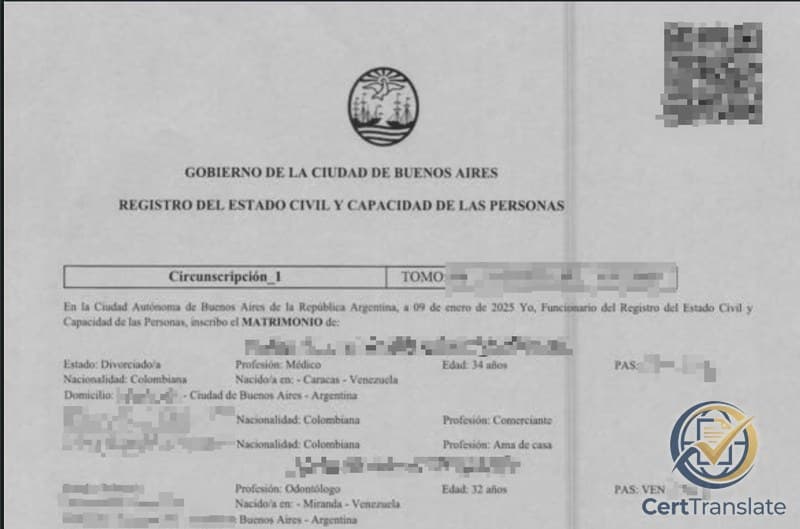
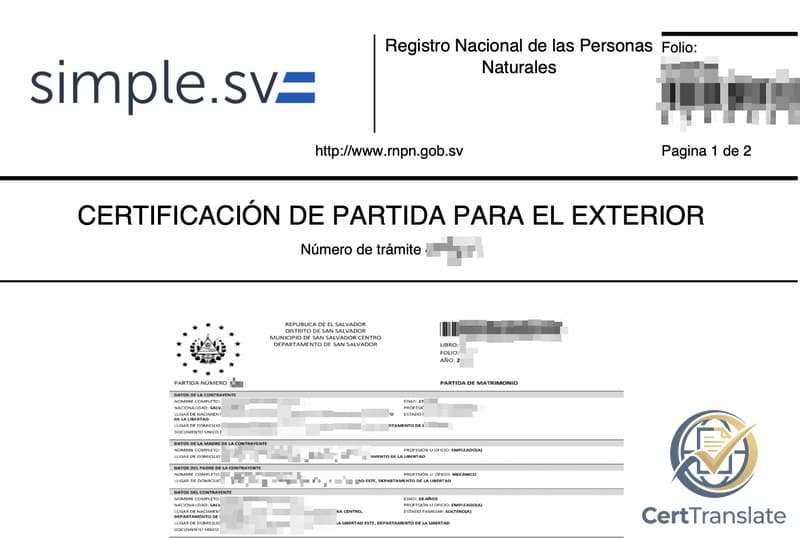
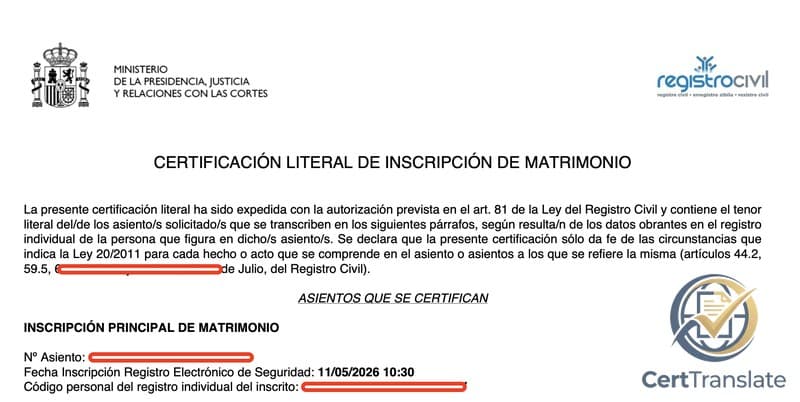
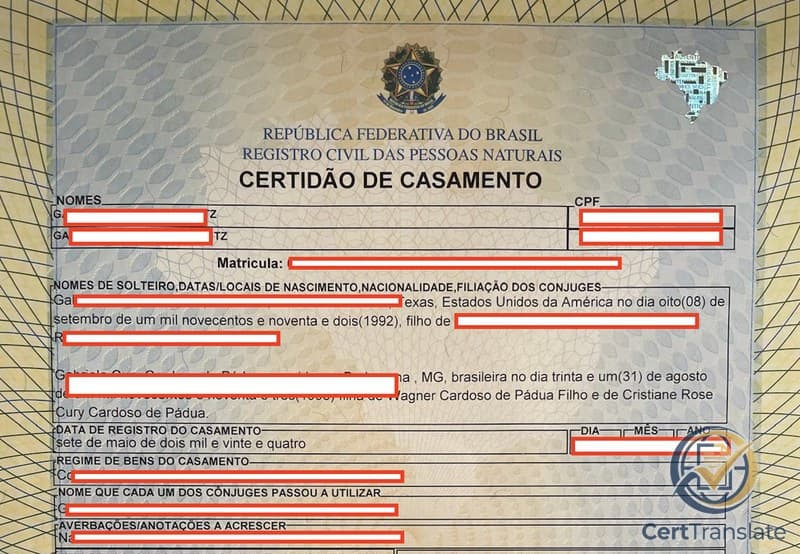
Each pair below is its own page, built around that country’s registry forms, booklet formats, and naming rules. Same $24.95 flat page rate on all of them.


Acta de matrimonio specialists · Name-consistency review · USCIS-ready format
Native French speakers · Acte de mariage expertise · Marginal-note handling


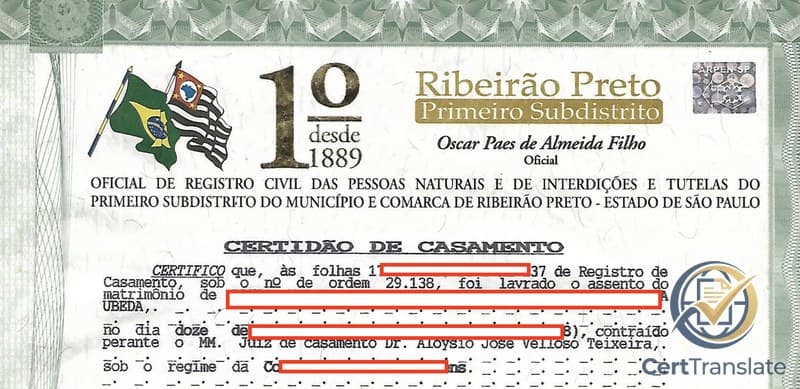
Native Portuguese speakers · Certidão de casamento expertise · Averbamento handling
Real marriage-record casework
These are anonymized orders. Each one shows a field that could be misread and the decision we made about it.

Field meaning
We translated it as the citizenship field the registry intended, so the packet did not contradict the birth certificate beside it.
Read the case
Electronic record
We described the electronic issuance and its verification code instead of noting a missing seal that was never meant to be there.
Read the case
Name rendering
We restored the Latin spelling from the passport and recorded the transliterated form, so both readings stayed traceable.
Read the caseHow it works
Upload once. We check the files and confirm the total before payment. Then our team translates, reviews, and certifies the complete package to the AcceptReady™ standard we publish.
Send every page, both sides, including booklet spreads and any margin note added after the wedding. A passport page helps us match the spelling of both names.
A translator renders every field and annotation. A second reviewer checks both spouses’ names, the date and place, and the registry entry against the source.


Corrections are free at this stage. Once approved, the certified set is delivered as a searchable PDF alongside the scan you uploaded.

One physical page means one billed page.
No 250-word cap and no dense-page rebilling.
Certified price
$24.95/ page
No payment until file review
Cost
A certified marriage certificate translation costs $24.95 per physical page. Most certificates are one or two pages, so the usual total is $24.95 to $49.90, confirmed before you pay.
Start my marriage certificate order| What you are sending | Certified total |
|---|---|
| Certificate, 1 page | $24.95a standard single-sheet record |
| Certificate, front and back | $49.90when annotations sit on the reverse |
| Booklet, 4 pages | $99.80family-book formats with several filled spreads |
| 5 or more pages | $24.95 per pagelong-form records with added annotations |
A note on “100% acceptance”
If a service promises “100% acceptance,” be careful — no one controls USCIS’s decision. What actually protects you is the written remedy: we revise free, or refund in full.
Client reviews
Rana T.
Chicago, IL
“Our marriage certificate was in Arabic and had two spellings of my last name in other documents. Their reviewer flagged this before filing and that helped us avoid delays.”
I-130 spouse petition · Two name spellings
Mismatch flagged before filing
Sofia G.
Phoenix, AZ
“I had a family booklet format from Mexico. They translated the relevant pages and included proper certification language.”
Legal name change · Family booklet
Right pages translated
Mark D.
Seattle, WA
“Very clear communication and no hidden fee changes. Court filing went through on first submission.”
Family court filing · Fixed quote
Accepted on first submission
Questions before ordering
If your document does not match one of these situations, send it anyway. Support replies in 15–30 minutes during support hours.
A certified marriage certificate translation costs $24.95 per physical page. A one-page certificate is $24.95 and a front-and-back record is $49.90. There is no word cap, and we confirm the page count and total before you pay.
Most certificates are delivered within 24 hours of a clear upload. Booklet records, older handwriting, and certificates carrying several annotations take longer, and we name the window before work begins.
USCIS accepts a certified translation that renders the whole document and carries the translator’s signed certification, and your delivery includes both. If a receiving authority rejects the translation for a translation-related reason, we revise it free. If it is still rejected, we refund the translation cost.
We translate each name exactly as the certificate prints it, including the surname the marriage created. We never quietly align it with a passport, because the difference between the two documents is usually the point a reviewer is checking.
We translate marriage certificates from 65+ languages into English. The pairs with a dedicated page are listed above. If yours is not there, upload the document anyway — the rate and the process are the same.
We translate every page that carries information, and skip blank spreads. Send the whole booklet so we can see which pages are filled — deciding that from a partial upload is how a page gets missed.
Often it matters more than the certificate body. Margin notes record later events such as a divorce, an annulment, or a name correction, so each one is translated in place beside the entry it changes.
For most USCIS submissions, certification is the requirement and notarization is not. Some courts, consulates, and foreign registrars ask for both, so we add notarization for $19.95 per order without changing the translated text.
No. A page is one physical page of the source document. Many services cap a page at 250 words and rebill a dense page as two or three; we bill the page you upload.
Yes. You can read the finished translation and request unlimited free corrections before we certify it. If an authority later asks for a translation-related change, we correct the certified file at no charge.
No. A clear scan or phone photo is enough — the receiving authority reviews the copy of the foreign-language document together with the certified translation. The original stays with you.
A USCIS filing does not need one. A foreign registry recording your marriage abroad usually does, and we add a physical apostille for $190 per order when the certificate was issued by a US state.
Four things, and you can check all four yourself. Compare any line of the original marriage certificate with the translation, including the text inside stamps. Put the two documents side by side — same page count, same order, tables and stamps in the same places. Read the Certificate of Accuracy for the complete-and-accurate statement, the competence statement, the signature, date, and company stamp. Then confirm the wording matches what your receiving office publishes. Those four checks are the AcceptReady™ standard, and CertTranslate publishes it in full. Read the AcceptReady™ standard.
Most frequent problems we correct
These four come up repeatedly in spousal packets, both in files we translate and in translations clients ask us to review.
Our check: We render each name as the certificate prints it, because the reviewer is comparing documents and an invisible correction removes the evidence they need.
Our check: We translate every annotation in place, since a later note is often what explains why this record differs from the rest of the packet.
Our check: We ask for the whole booklet before starting, because the filled spread carrying the registry entry is rarely the one on the cover.
Our check: We tell you when a certificate looks like an abbreviated extract, so you can request the fuller registry copy before the deadline rather than after it.
The standard behind these checks
AcceptReady™ is CertTranslate's published standard for certified translations: complete word-for-word translation, mirrored page layout, signed and stamped Certificate of Accuracy on letterhead, and matched to the receiver's published requirements.
How to check each one yourselfChecked before certification. If an authority later requests a translation-related correction, revisions remain free.
Start my translationCommon filing contexts
A marriage certificate proves a relationship exists and, just as often, explains why a name on one document differs from the name on another. Both readings matter to the office reviewing your file.
The key is consistency: both spouses’ names, the date, and the place should line up with the passports and the birth certificates filed alongside it.
The certificate is the primary evidence that the marriage the petition rests on actually exists.
Filed again years later alongside evidence that the marriage continued, so the translated names must match the original filing.
Naming history is traced across the marriage record and every document issued before and after it.
Passport offices, the Social Security Administration, and foreign registries all read the record to update a civil status.
Document glossary
The parts of a marriage record that decide how a certified translation is built, whatever language the original is in.
Mexican marriage records may be submitted as individual certificates or within libreta de familia booklets, depending on issuance period and state format.
If your file references prior divorce by annotation or timeline, USCIS may later request divorce decree translation too. We flag this risk early.
Registry office signatures, witness data, and marginal notes are translated in full because they can affect legal interpretation.
Mexico is a Hague Apostille Convention member, so apostille is usually used when non-U.S. authorities request legalization.
If your certificate references a prior marriage timeline, submitting the related divorce decree translation in the same packet can prevent later follow-up.
Chinese marriage certificates often rely on romanized names plus Chinese script, and spelling consistency is critical across immigration files.
Official chops and issuing office data are translated and labeled for clarity.
If both spouses have multiple transliterations in supporting records, we preserve source spelling and document discrepancies explicitly.
China is a Hague Apostille Convention member, so apostille is the standard route for legalization when required outside USCIS.
Certificate number formatting and issuing office fields should stay exactly as shown because these fields are used to verify civil record consistency.
When spouses use different passport transliteration systems, we keep source spelling and flag mismatch risk so legal counsel can add clarifying evidence.
Indian marriage documentation may combine civil and religious record formats. We translate the exact submitted document without assuming legal status.
If only a religious record is available, we note that legal recognition can differ by destination and filing context.
If the certificate references local-language registries, those references are translated exactly rather than generalized.
Where dates are shown in multiple calendar or regional formats, we preserve source notation and clarify format in translation.
India is a Hague Apostille Convention member, so apostille is typically used when legalization is requested beyond USCIS submission.
If civil and religious records are both available, translate the document type requested by the receiving authority and keep the second record as supporting context.
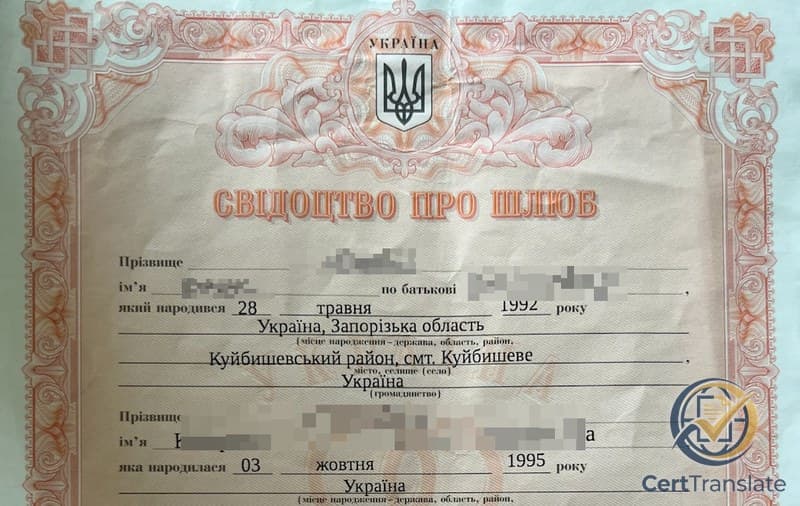
Ukrainian marriage records can include patronymics and inflected surnames that differ from passport style spelling.
We maintain source-accurate form and flag cross-document naming differences so users can prepare supporting explanation if needed.
Ukraine is a Hague Apostille Convention member, so apostille is generally the legalization method for non-U.S. destination filings.
Inflected surnames and patronymics are common, so source spelling is preserved and not normalized to informal English variants.
If the certificate references registry amendments, each amendment line is translated because it can affect legal marital status interpretation.
For court-bound packets, we also flag whether notarization is commonly requested by local clerk practice before final delivery.
Arabic-script marriage records require careful romanization alignment with passports and prior immigration records.
Notarial and registry seals are translated with precise source labels, which helps legal reviewers track issuing authority authenticity.
Egypt is not a Hague Apostille Convention member, so legalization usually goes through consular authentication rather than apostille.
Arabic-script entries are translated exactly and then aligned with passport spelling notes when mismatch risk is present.
Religious and civil registration references are translated in full so reviewers can understand legal issuance context, not just names and dates.
If the receiving authority asks for notarization, it is added after translation so the underlying certified content remains unchanged.
“When marriage documents and passports use different romanization styles, we do not normalize names. We translate exactly, then note the mismatch risk so clients can attach supporting evidence before submission.”

Reference library
Guidance and source links last rechecked .
Ready when you are
Upload every page, both sides, with any booklet spread and margin note. Page count, price, and delivery time are confirmed before payment.
No payment until file review