

If your records are in Korean and you are filing with USCIS, a U.S. court, or a university, you need Korean translation services that include every visible element from the source document.
Every Korean file is assigned to a native Korean speaker, and your certified Korean translation is handled by a specialist in civil records, legal documents, and academic credential workflows.
Korean to English translation requires more than fluency: name romanization must match passport spelling, academic scales must remain exact, and family relationship documents must be interpreted using current and legacy format context.
Most Common Korean Documents We Translate
Korean-language documents are most frequently submitted with Form I-485 (Adjustment of Status), Form I-130 (Petition for Alien Relative), Form N-400 (Application for Naturalization), and Form I-751 (Petition to Remove Conditions on Residence). These Korean translation services focus on records most often needed for USCIS translation requirements and green card application packets.
Birth certificate and family relationship records (출생 관련 서류 / 가족관계증명서)
Korean birth certificate translation and family relationship record translation are frequently required for USCIS petitions and identity verification workflows.
Modern Korean records may use family relationship certificate formats instead of older family registry structures, so translation must reflect current document context accurately.
For filing guidance, review our certified birth certificate translation page before submission.
Marriage certificate (혼인관계증명서)
Marriage records are commonly required for spouse petitions, legal name-history checks, and court workflows.
Korean forms may include relationship history details and field labels that must be translated completely, not summarized.
See our certified marriage certificate translation page for packet-level requirements.
Divorce records (이혼 판결문 / 이혼관계증명서)
Divorce files are often multi-page legal records with court findings, dates, and civil-status updates.
Terminology must reflect legal context and procedural structure so U.S. reviewers can interpret the record correctly.
Our certified divorce document translation page covers complete decree handling for submission.
Passport and identity records (여권 / 주민등록증)
Identity records anchor name spelling consistency and date verification across all translated documents.
Romanization consistency is critical because one mismatch across passport and civil records can trigger additional review.
Use our certified passport translation page for USCIS-ready formatting expectations.
Diploma and degree records (졸업증명서 / 학위증)
Korean diploma translation is often required for admissions, licensing, and employment verification.
Korean degree titles such as 학사, 석사, and 박사 must be translated precisely with context rather than flattened into generic wording.
WES, ECE, and other NACES evaluators expect exact degree-title wording and issuing-institution details, which we preserve in every certification-ready Korean translation.
Academic transcript (성적증명서)
Transcripts require line-level translation of courses, grades, scales, institutional headers, and signatures.
Korean academic records may use 4.5 or 4.3 scales that must be translated exactly, not converted to U.S. GPA by the translator, especially for WES and ECE review.
Visit our certified transcript translation page for course-by-course submission guidance.
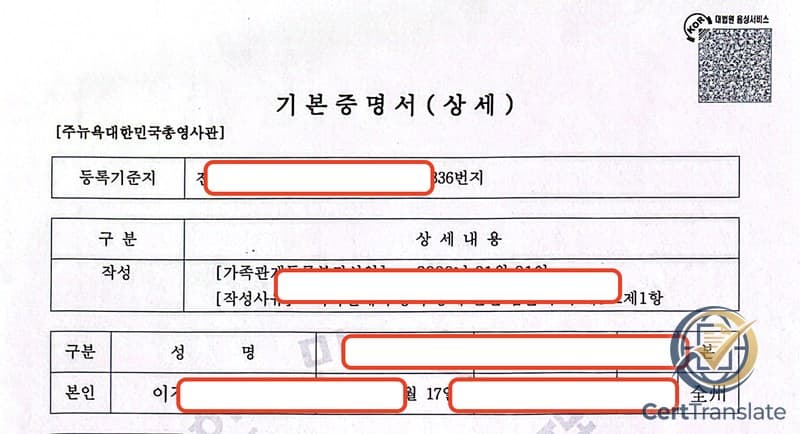
Basic certificate and family records (기본증명서 / 가족관계증명서)
These records often support immigration filings where family relationships and identity history must be documented precisely.
Modern certificates replaced older family registry formats, so translators must identify format era and preserve field meaning accurately.
Korean translation for USCIS family filings should keep every certificate aligned across record eras, so start with the free requirements checker before ordering.
What Makes Korean Translation Different
Korean translation quality for official use depends on precise romanization control, document-era awareness, and exact academic and legal terminology. These are the issues that most often affect acceptance.
Romanization must match passport spelling exactly
Korean names can be romanized in multiple valid ways, and the accepted spelling depends on passport evidence and prior official records.
A mismatch such as Kim versus Gim or Park versus Bak can create identity inconsistency across filing packets.
We anchor final spelling to passport evidence and run cross-document name QA before certification.
Revised Romanization and legacy spellings can conflict
Modern Korean passports generally follow Revised Romanization, but older records may reflect earlier conventions.
Unmanaged spelling differences can trigger additional reviewer questions even when source documents are valid.
We preserve source content and provide clear consistency handling across all translated files.
Academic grading scales must remain exact
Korean transcripts often use 4.5 or 4.3 grading systems, and translators should not convert values into U.S. GPA equivalents.
Unauthorized conversion can distort academic meaning and create evaluator confusion.
We translate grading terms and preserve source values exactly as printed.
Family register format changes require document-era awareness
Korean family documentation shifted from older family registry records to updated family relationship and basic certificates.
Treating all formats as identical can lead to field-label errors and incomplete relationship rendering.
We identify record type and era first, then translate fields using the appropriate administrative context.
Degree titles require precise academic terminology
Degree labels such as 학사, 석사, and 박사 carry specific academic meaning that should be translated consistently.
Over-simplified equivalents can lead to evaluator follow-up requests about credential level or field mapping.
We preserve source titles and add clear context where equivalence is not one-to-one.
Seals, annotations, and mixed-language elements must be fully rendered
Korean official documents often include seals, side notes, and occasional English segments within Korean layouts.
Partial translation can produce incomplete evidence and delay official review.
We translate all visible source-language content and describe official marks clearly in certified output.
How We Translate Your Korean Documents — Step by Step
Step 1 — Upload your document
Upload scans, photos, or PDFs of your Korean records. If pages are old, handwritten, or include seals and side notes, send every page so readability can be confirmed before translation starts.
Step 2 — Native-speaker assignment
Your file is assigned to a native Korean translator matched to document type and official-use context. We do not route high-stakes civil or legal records to general translators outside this language pair.
Step 3 — Translation and certification
We translate all visible content including text, seals, signatures, annotations, and structured fields. Names are checked against passport spelling, academic or legal terminology is rendered with precise context, and every delivered file includes a signed Certificate of Accuracy.
Step 4 — Two-person quality review
A second native Korean reviewer verifies names, dates, identifiers, grading terminology, and completeness. This review stage catches subtle issues that commonly trigger official follow-up requests.
Step 5 — Delivery
Certified PDF delivery is typically completed within 24 hours for standard files. Expedited turnaround and hard-copy mailing are available when your deadline is tight.
Secure Process
100% Confidentiality
Your files are transmitted over 256-bit SSL encryption. We never use Google Translate, DeepL, or any machine translation tool for official documents. Files are deleted within 30 days, or sooner on request.
Korean Translation by Country
South Korea
Most Korean requests involve civil, family relationship, identity, and academic records issued in South Korea for immigration and official U.S. use.
Document sets often combine modern certificates with older supporting records, so format-era awareness is essential for accurate translation.
South Korea is a Hague Apostille Convention member, so apostille is commonly used for international authentication while certified translation handles the language-conversion requirement.
For filing context, review our USCIS page and certified birth certificate translation guidance before submission.
South Korea (Legacy Registry Records)
Legacy family registry records can appear alongside newer family relationship certificates in one packet.
These mixed-format submissions require careful field mapping so relationship and identity data remain coherent across all translated pages.
Silent normalization between old and new forms can create inconsistencies in official review even when apostille and translation were otherwise prepared correctly.
Uploading all related pages together helps maintain one consistent naming and relationship framework.
South Korea (Consular Documents Issued Abroad)
Some applicants submit Korean-language records issued through consular channels outside Korea.
These documents can include bilingual elements and administrative references that still require complete Korean-to-English rendering.
Identity consistency across domestic and consular records should be reviewed before filing because apostille and certification do not fix inconsistent name rendering.
When in doubt, use the requirements checker first to confirm exactly which pages to translate.
How Much Does Korean Translation Cost?
Our Korean translation services use the same $24.95/page base rate as every other supported language. No language-based surcharges.
Optional add-ons
- Notarization (+$19.95)
- Expedited turnaround
- Hard-copy mailing
Exact price is confirmed after document review and before payment.
Many certified translation providers charge $30-$60 per page. Our Korean-certified workflow at $24.95 includes the Certificate of Accuracy, unlimited revisions, and USCIS acceptance guarantee.
Mistakes That Get Korean Translations Rejected
Using machine translation for official Korean records
Google Translate and DeepL often miss legal-register nuance, field structure, and annotation context in Korean documents.
A common error is flattening 가족관계증명서 into generic wording or producing inconsistent Kim/Gim and Park/Bak spellings across one packet.
These failures can trigger a USCIS RFE (Request for Evidence), so we use native human translators and second-pass native QA on every certified file.
Submitting translation without complete certification
USCIS expects complete translation plus a signed certification statement from a competent translator.
Text-only translation without compliant certification language can cause avoidable filing delays.
Every delivery includes a signed Certificate of Accuracy prepared for official submissions.
Inconsistent Korean name romanization across records
Differences such as Kim versus Gim or Lee versus Yi can trigger identity review issues if unmanaged.
These mismatches are common when older records and modern passports use different spelling conventions.
Our process anchors spelling to passport evidence and verifies consistency across the full packet.
Converting transcript scores instead of translating exactly
Korean transcript scales such as 4.5 and 4.3 should be translated as written, not converted by the translator into U.S. GPA.
Unauthorized conversion can distort record meaning and create evaluator follow-up requests.
We preserve source values exactly and translate grading terminology clearly.
Incomplete translation of seals, margins, and side notes
Rejections often happen when only main body text is translated and official marks are omitted.
Korean civil and legal records can place important metadata outside central text blocks.
We require full visible-content translation including stamp descriptions and annotation lines.
Mixing modern and legacy family record terminology incorrectly
Korean family documentation includes both modern certificate formats and legacy record structures in real filing packets.
Incorrect field mapping between these formats can create relationship inconsistencies.
We identify record type first and apply format-appropriate terminology with final cross-document QA.
Our Korean Translation Track Record
Korean is one of our highest-volume language pairs. Our workflow includes passport-aligned romanization checks, family-certificate format mapping, and two-person native-speaker QA before certification. We cover civil, legal, and academic records issued in South Korea, including legacy registry and modern certificate formats.
Our Korean translation services are processed with passport-aligned romanization checks, format-era awareness for family records, full-page completeness review, and two-person native QA before certification. This reduces avoidable USCIS and evaluator follow-up requests.
What Korean-Speaking Customers Say
“They translated my family relationship certificate and birth documents with perfect name consistency. USCIS accepted everything on first submission.”
Min J.
Los Angeles, CA • Family + Birth Records • USCIS family petition
January 2026 on Google
“My Korean transcript translation for WES was accurate and clear. They kept the 4.5 grading system exactly and the evaluator accepted it without revisions.”
Hae R.
Seattle, WA • Academic Transcript • Credential evaluation
December 2025 on Trustpilot
“Excellent quality on marriage and passport records. They flagged a romanization mismatch before delivery, which helped us avoid filing delays.”
Sun K.
Dallas, TX • Marriage + Passport • Green card application
November 2025 on Google
“Fast and complete translation of older Korean civil records with stamps and side notes. Our attorney approved the packet immediately.”
Ji W.
Atlanta, GA • Civil records bundle • Legal filing
October 2025 on BBB
Korean Document Translations
Dedicated pages for specific korean document types — pricing, requirements, and expert translators.
Korean Transcript Translation
Certified Korean transcript translation for WES and admissions. $24.95/page. Hangul romanization and 4.5-scale grading handled.
Korean Birth Certificate Translation
Certified Korean birth certificate translation for USCIS. $24.95/page. Family register, Hangul romanization, and 기본증명서 formatting handled.
Other Languages We Translate
Chinese
Common in East Asian packets where name order and romanization consistency must be managed across languages.
Japanese
Frequently appears with Korean academic and civil records in admissions and immigration workflows.
Vietnamese
Regional family packets can include Korean and Vietnamese records requiring multi-language consistency checks.
Tagalog
Mixed migration records can involve Korean and Philippine documents in one filing set.
Russian
Cross-border legal and academic cases sometimes combine Korean and Cyrillic document sets.
Same $24.95/page base rate for every language.
Frequently Asked Questions About Korean Translation
How much does certified Korean translation cost?
Korean translation services start at $24.95 per page for up to 250 words. That base rate includes certified Korean translation, a signed Certificate of Accuracy, and revision support if a receiving authority requests a translation-format adjustment. Final cost depends on page count, document complexity, and optional services such as notarization, expedited turnaround, or hard-copy mailing. To avoid cost surprises, upload all pages together, including reverse sides and attachments, so pricing can be confirmed before payment. This intake process helps prevent delays caused by missing pages discovered during production and supports better filing timeline planning. You can request a pre-payment page audit for budget clarity.
How long does Korean document translation take?
Most standard Korean documents are delivered within 24 hours, and many one-page records are completed sooner. Turnaround depends on page volume, scan quality, handwriting density, and whether files include multi-page legal wording, dense annotations, or mixed-era family records. If your deadline is strict, request expedited handling at upload so your file can be prioritized. To keep timing predictable, submit all related records in one batch and include passport spellings used in your forms. This helps resolve name and terminology consistency early, rather than during final review, and reduces the risk of avoidable filing delays for time-sensitive cases. Include your filing date in the order note for better scheduling.
Will my Korean translation be accepted by USCIS?
Korean translation for USCIS is generally accepted when filings include a complete English translation and a signed certification statement from a competent translator. Our Korean workflow is built around that requirement: native-speaker translation, full visible-content coverage, two-person quality review, and certification-ready output. USCIS makes final decisions, but if a translation-format issue is raised, we provide prompt corrective revisions under our guarantee. For best results, submit original-language copies and certified translations together, then verify names and dates against your USCIS forms before filing. A packet-level consistency review before submission is one of the best ways to reduce avoidable follow-up requests and timeline delays.
Are your Korean translators native speakers?
Our Korean translators are native speakers with formal experience in immigration, legal, and academic workflows. Native expertise matters because official records require precise handling of romanization, family-certificate field labels, and legal-administrative terminology. Translators must identify document format and issuing context first, then apply accurate English equivalents without flattening important distinctions. If your packet includes multiple record types, mention that during upload so terminology, names, and date fields can be aligned across the full file set. This improves first-pass acceptance reliability and reduces avoidable revisions caused by mixed-format inconsistencies in one filing packet. It also keeps names and dates stable across all translated pages.
Do I need my Korean documents notarized?
In many USCIS filings, notarization is not required when you already submit a proper certified translation with a signed Certificate of Accuracy. Some courts, schools, licensing agencies, and state offices may still request notarization as an additional procedural step. Requirements vary by destination, so confirm whether the receiving authority requires certification only or certification plus notarization. We can add notarization when needed without changing translation content. If the same packet will be used in multiple destinations, tell us at intake so delivery format can be prepared correctly in one cycle. Confirming this before payment usually prevents avoidable reprocessing and timeline delays.
Can I translate my own Korean documents for USCIS?
You can translate your own Korean documents for USCIS, but USCIS expects a certified third-party translation with a signed accuracy statement. Even fluent bilingual applicants often miss critical details such as seal text, side annotations, family-certificate field context, and romanization consistency across records. Korean official documents also require format-aware terminology choices that informal translation rarely handles consistently. Professional workflow adds independent QA and compliant certification language. If speed is your concern, upload clear scans and request standard 24-hour processing. That route is typically faster than correcting a rejected filing later because of preventable translation issues and extra review cycles. If you drafted your own version, share it only as reference material.
What if my Korean document is handwritten or hard to read?
Handwritten or low-contrast Korean records can still be translated, but accuracy depends on image quality and complete page coverage. We regularly handle older civil and legal extracts with handwritten notes, faded stamps, and compact administrative references. When a segment is unclear, we mark it transparently and verify context before certification instead of guessing. For best results, upload high-resolution scans, include both sides of each page, and avoid cropped margins where official marks often appear. If multiple versions exist, send all copies so reviewers can cross-reference difficult sections during QA. Intake screening can identify pages that should be rescanned before production begins.
Do I need an apostille for my Korean documents?
You need an apostille for Korean documents only when the receiving authority requires Hague Convention authentication. Apostille is different from certified translation of Korean documents: apostille verifies document origin, while translation converts the content into English for USCIS, courts, or universities. South Korea uses apostille workflows for many cross-border submissions, but apostille does not replace passport-matched romanization or complete certified translation. The safest next step is to confirm whether your destination requires translation only, translation plus apostille, or another legalization step before submission. If your packet is going to multiple authorities, list each one at intake so the workflow order is set correctly from the beginning.
Will WES accept your Korean transcript translation?
Credential evaluators such as WES generally review Korean transcript translations when they are complete, clearly formatted, and consistent with the source record. Our transcript workflow translates every visible field, preserves grading scales exactly as printed, and avoids unauthorized GPA conversion by the translator. We also keep course titles, credits, and institutional labels aligned for evaluator readability. Acceptance decisions always belong to the evaluator, but if a formatting clarification is requested, we provide revision support quickly. To reduce delays, upload all transcript pages and any related degree documents together so terminology stays consistent across the academic packet from the start. This helps avoid evaluator follow-up on formatting and scale interpretation.
How do you handle Korean name romanization differences?
We handle romanization by anchoring final spelling to passport evidence and then checking every translated document for exact consistency. Korean names may appear under different conventions, especially when older records and newer passports use different romanization practices. A mismatch such as Kim versus Gim or Park versus Bak can trigger identity review friction if it is not managed carefully. Our translators preserve source-language content, apply passport-consistent spelling in the certified output, and flag historical variants when needed for clarity. If you have prior USCIS filings, share those spellings so final output remains consistent with your full case history and supporting records.
Ready to Get Your Korean Documents Translated?
Your Korean documents are translated by native Korean speakers with passport-aligned romanization checks and full certification support.
We handle civil, legal, and academic records for USCIS, courts, and universities with fast turnaround and strong two-person QA.
Start your order now or call to confirm requirements before payment.

Hyun-jin Park
Native Korean speaker · Born in Busan, South Korea • Language pair: Korean <> English