
“They translated my mainland China notarial marriage certificate with all the red chops described clearly. USCIS approved my I-130 without any RFE on the translation.”
L
Li W.
Flushing, NY
结婚证公证书
Certified English translation for USCIS, spouse petitions, courts, legal name changes, and consular use.
Ready within 24 hours
Complete translation
Word-for-word, same structure
Every field, stamp, seal, signature, and annotation
Certified package
Signed and Stamped Certificate of Accuracy
Company letterhead · translator signature · company stamp

We check your files and confirm the total before you pay




Chinese marriage certificate translation produces a certified English version of notarial marriage certificates, marriage registration records, and civil-registry extracts from mainland China, Taiwan, and Hong Kong, formatted for USCIS spouse petitions, court filings, and name-change proceedings.
Most clients order this combination for Form I-130 spouse petitions, where the marriage certificate is the primary proof of marriage. It also appears in Form I-485 adjustment of status, K-1/K-3 visa support packets, court proceedings, and name-change filings where the receiving authority needs a complete English version of the Chinese marriage record.
The translated marriage certificate should stay consistent with the passport, birth certificate, and other records in the same filing. Name romanization, date formats, and institutional references all need to align across the translated packet rather than each document being handled in isolation.
For Chinese marriage certificate translation, we preserve every notarial seal, registration reference, and spouse-name field so the English version stays traceable to the original record and consistent with the rest of the USCIS packet.
PDF, photo, or scan — any format works. Takes about 30 seconds.

A native-speaking Chinese translator handles every word, stamp, and signature. Signed Certificate of Accuracy included — USCIS-ready format.
Review the completed translation before it is certified — unlimited free revisions until every detail is right. Final searchable PDF delivered typically within 24 hours.
4.9/5•From 2,400+ reviews
“They translated my mainland China notarial marriage certificate with all the red chops described clearly. USCIS approved my I-130 without any RFE on the translation.”
Li W.
Flushing, NY
“My Taiwanese marriage certificate had a different name romanization from my wife's passport. CertTranslate flagged the discrepancy and we fixed it before filing.”
David T.
San Jose, CA
“The Hong Kong marriage certificate was bilingual but the Chinese administrative lines needed proper translation. They handled both languages and the attorney was satisfied.”
Grace L.
Houston, TX
We don't have a published case on Chinese marriage certificate translation specifically — here are recent Chinese translation cases on related documents.
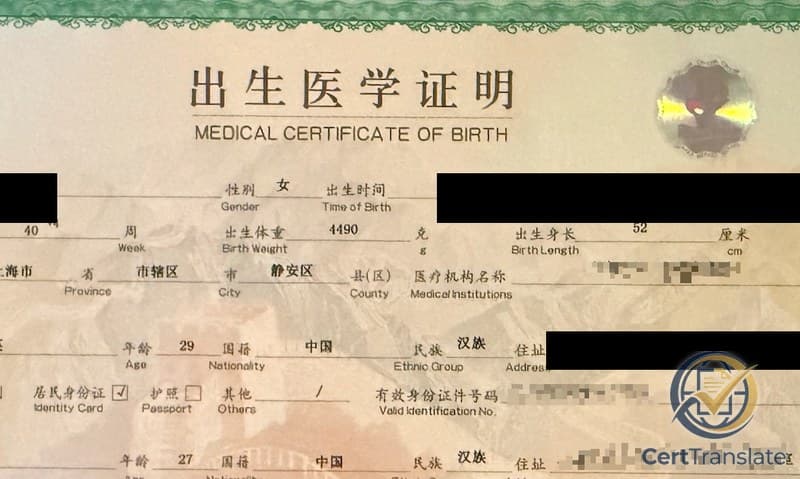
A Chinese Medical Certificate of Birth (出生医学证明) recorded the bearer's name only in Chinese characters, in surname-first order. The bearer's PRC passport spelled the same name in given-first Western order, not the default Hanyu Pinyin. We translated the document using the passport's exact spelling and added a Translator's Note documenting the choice. The certified translation was delivered for the client's USCIS filing.
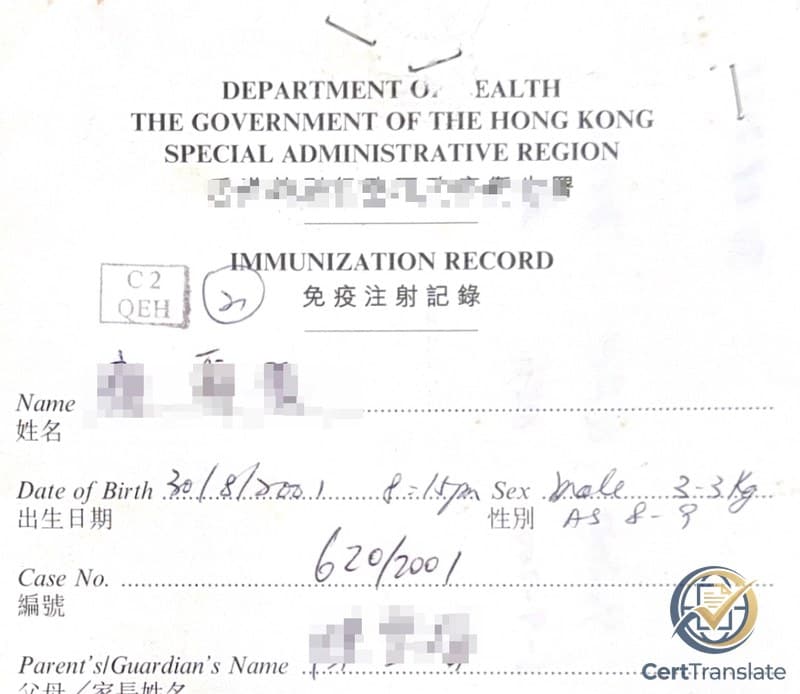
A client submitted a bilingual Hong Kong Department of Health immunization card for a US university medical clearance. The clinic name 柏立基母嬰健康院 is the Robert Black Maternal and Child Health Centre — named after Sir Robert Black, governor of Hong Kong 1958–1964. We used the official English form so the identity block matched the same centre's English mention on the card's reverse. The certified translation was delivered for the filing.
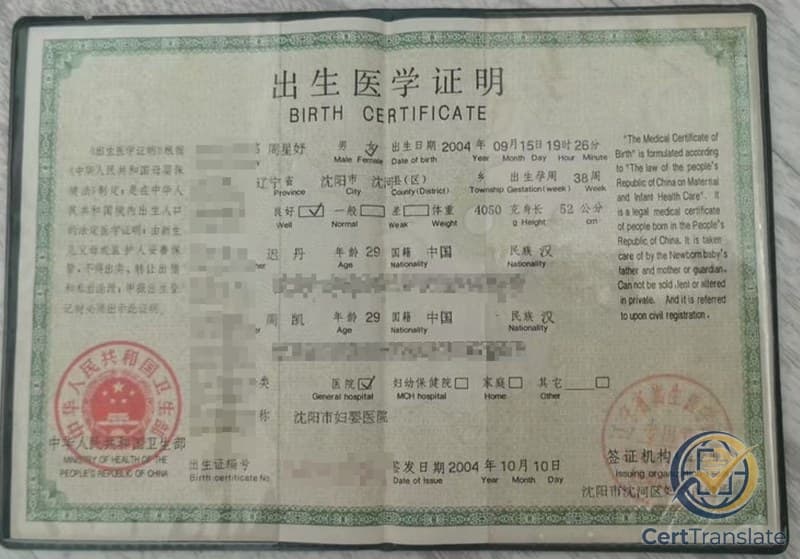
A Chinese Medical Certificate of Birth (出生医学证明) is a pre-printed bilingual form that labels two different fields 'Nationality.' One records citizenship — 国籍, e.g., China. The other records ethnicity — 民族, e.g., Han. We translated each label by its actual Chinese meaning, not by the form's printed English, and added a Translator's Note documenting the disambiguation. The certified translation was delivered for the client's USCIS I-130 packet.
Chinese marriage certificate translation requires handling notarial marriage formats with red chops, matching Pinyin romanization between the marriage record and the passport, preserving hukou family-registration cross-references, and distinguishing between mainland, Taiwanese, and Hong Kong marriage registration systems.
A mainland Chinese notarial marriage certificate issued through a local notarial office, a Taiwanese marriage registration extract, and a Hong Kong marriage certificate from the Marriage Registry prove the same legal fact but use different formats, seal conventions, and administrative language.
Your marriage certificate is assigned to a native Chinese specialist who handles civil records daily, so red chops, notarial office wording, Pinyin romanization, and dual-name fields are reviewed with the precision that USCIS and court reviewers expect.
If a receiving authority asks for a translation-only correction, we revise the file at no added cost so the final English version stays aligned with the original record and the rest of your filing packet.
In mainland China, the marriage record is often a notarial marriage certificate issued by a local notarial office rather than a simple municipal registration form. The notarial format includes formal issuing language, red chops, and notarial office references that have to be preserved in the English version.
Some applicants also have the original marriage registration booklet (结婚证). The translator has to identify which record is being submitted and translate its administrative language accurately so the receiving officer can trace the English output back to the original document.
Chinese marriage records carry red chops, notarial seals, and sometimes embossed marks from the issuing office. Those marks are part of the document and should not be ignored as decoration.
The English version has to identify each seal, label it accurately, and preserve its connection to the notarial office or civil-registry authority. That is especially important when USCIS needs to understand how the record was authenticated.
The marriage certificate usually shows both spouse names in Chinese characters, and sometimes in Pinyin or another romanization form. If the English translation uses a different spelling from the passport or birth certificate, the packet becomes internally inconsistent.
We review the likely romanization path against the passport or governing ID and flag any visible discrepancies. The goal is to keep the English record aligned with the identity document that controls the filing rather than introducing a new spelling.
Chinese marriage certificates often include both the marriage date and a registration date or number that proves when the marriage was officially recorded. Some records also carry references to the marriage registration office or district that are important for legal context.
The English translation should preserve the date format and any registration references as shown on the original record. Silently reformatting or omitting those details can create avoidable questions from the reviewing officer.
Mainland records use Simplified Chinese while Taiwanese and some Hong Kong records use Traditional Chinese. The differences go beyond script — the institutional naming, registration wording, and seal conventions also change.
The translator has to recognize which system issued the record and adapt the translation approach accordingly rather than treating all Chinese marriage records as interchangeable.
The marriage fact is the same, but the document format, issuing authority, and administrative language differ enough across mainland China, Taiwan, and Hong Kong that the translation approach has to change.
Mainland marriage records most commonly appear as notarial marriage certificates issued through local notarial offices. They carry formal Chinese issuing language, red chops, and notarial office identification. Some applicants also submit the original marriage registration booklet.
These records are commonly translated for Form I-130 spouse petitions and Form I-485 adjustment of status. The notarial format requires careful translation of the issuing authority language and preservation of all seals. We keep the English layout traceable to the original document structure.
Taiwanese marriage certificates are issued by the household registration office and use Traditional Chinese. The document format differs from mainland records and may include household-registration references or endorsements that tie the marriage record to the broader family registration system.
We preserve the Traditional Chinese administrative structure and match the spouse names to the romanization used on the passports. That is especially useful when one spouse has older records using Wade-Giles while newer documents use a different romanization system.
Hong Kong marriage certificates from the Marriage Registry are often bilingual in Chinese and English, but partial English text does not eliminate the need for a complete translation review. Chinese-only administrative lines, seal references, and ceremony-type designations still have to be translated when they carry material information.
We review the full record and preserve every line that matters to the marriage fact and registration context, including any bilingual sections that need cross-checking for consistency.
$24.95
per page · no word cap
Typical length
Most records are 1 to 2 pages
Typical total
$24.95
No hidden fees. Free Quote.
Our service starts at $24.95 per page. Most orders fall between $24.95 and $49.90 because the typical record is one or two pages. You receive the confirmed page count before payment, and there is no language surcharge for chinese.
Most marriage certificate orders are delivered within 24 hours once we receive clear scans. If the record includes extra notarial pages, multiple chops, or mixed-language sections, we confirm timing before production starts so the filing schedule is clear.
Yes. This service is designed for USCIS and other authorities that need a complete certified English translation of a Chinese marriage certificate, especially for spouse petitions and adjustment of status. Our package includes the full English translation plus a signed Certificate of Accuracy, which is the format most receiving authorities expect for foreign-language records.
Yes. We handle marriage certificates from mainland China, Taiwan, Hong Kong, and other Chinese-speaking issuing systems, with the translation adapted to the specific format and administrative conventions. If your record uses a rare regional format, upload every page so the translator can match the exact issuing-country structure before production starts.
We can usually work from scans that include red chops, embossing, and slightly faded print. If a seal or key line is too weak to certify safely, we ask for a better image before production begins. When a field is genuinely unreadable, we mark it transparently instead of guessing, which is safer than inventing a name, date, or registry number.
Yes — you receive the completed translation for review before we certify it, and we make unlimited free revisions until every name, date, and detail is right. If USCIS later requests a change, we correct the certified file at no charge.
No — we bill the physical page you upload, never a word count. Many services cap a "page" at 250 words and re-bill a dense marriage certificate as two or three pages; here one page of your document is one $24.95 page, however dense the text.
For most USCIS filings, the notarial marriage certificate is the standard submission format for mainland China records. If you have both the notarial certificate and the original registration booklet, upload both so the translator can see the full documentation. Some filing contexts may require one or the other specifically.
We translate the marriage certificate exactly as issued and compare the spouse-name romanization against the passports when provided. If we notice a visible discrepancy, we flag it so you can address the mismatch before filing rather than discovering it after USCIS returns the packet.
A Chinese marriage record is often a notarial certificate (公证书) wrapping the underlying registration, sealed with red chops and showing names in characters and Pinyin. We translate every element so the English version stays traceable to the original and consistent with the passport.
| Field | What it is | How we handle it |
|---|---|---|
| 结婚证 / 公证书 | Marriage registration booklet vs notarial certificate (the document type) | Identified and labeled so the officer can trace the English back to the source. |
| 公证处 / 婚姻登记处 + 编号 | Issuing notarial office or marriage-registration office and the certificate number | Authority and number preserved exactly as printed. |
| 夫妻双方 (characters + Pinyin) | Both spouses, in Chinese characters and often Pinyin | Names matched to the passport romanization, not given a new spelling. |
| 结婚登记日期 / 登记号 | Marriage-registration date and registration number | Date format and registration reference preserved, not silently reformatted. |
| 红章 / 钢印 | Red chops and embossed seals from the issuing office | Each seal identified and labeled in English, tied to its authority. |
| 简体/繁体 + 户口 cross-ref | Script system (Simplified/Traditional) and household-registration references | Issuing system recognized; hukou cross-references kept visible. |
Mainland records use Simplified Chinese and notarial offices; Taiwan and Hong Kong use Traditional Chinese and household/Marriage-Registry formats. Hong Kong certificates are often bilingual, but Chinese-only lines (seals, ceremony-type designations) still require translation.
Most translation-related RFEs trace back to a few issues. These are what we check on every Chinese-language marriage record.
01Pinyin spelling differs from the passport
We match each spouse’s romanization to the passport/governing ID and flag discrepancies rather than introducing a new spelling.
02Red chops and seals left unlabeled
We identify and label every red chop and embossed seal, tying it to the notarial office or registry authority.
03Notarial certificate and registration booklet not distinguished
We identify which record was submitted (公证书 vs 结婚证) and translate its administrative language accordingly.
04Registration date/number omitted or reformatted
We preserve the date format and registration reference exactly as shown, avoiding avoidable officer questions.
Patterns drawn from real Chinese-language marriage-record casework (mainland China, Taiwan, Hong Kong). Unreadable fields are marked transparently, never guessed.
Every order is checked against this list before certification — and covered by the revise-free-or-refund guarantee.
Start my translationCommon terms you will see on a Chinese-language marriage record, with what they mean on the certified English version.
Our guidance on Chinese marriage certificate translation reflects the published requirements of the authorities below.
Upload the full marriage certificate, including any notarial cover page, registration booklet pages, or certification pages. Chinese marriage records are clearer when the translator can see the complete document set.
If your filing packet also includes birth certificates, passports, or other Chinese civil records, order them together so names, dates, and identity details stay consistent across the translated set.