Spanish medical records translation
Cartillas de vacunación, historias clínicas, IMSS printouts, and lab reports from Mexico, Colombia, Venezuela, and Spain — dose dates, units, and stamps kept exactly.
Dose-by-dose certified English translation for USCIS medical files, schools, employers, and travel review.
Ready within 24 hours
Health record
Vaccines, doses and dates preserved
Product names · lot numbers · providers · stamps · signatures
Certified package
Signed and Stamped Certificate of Accuracy
Company letterhead · translator signature · company stamp

We check your files and confirm the total before you pay


Your finished package
Your delivery includes the source-document scan, a complete English translation, and a signed and stamped Certificate of Translation Accuracy.
Files checked and total confirmed before payment
Each pair below is its own page, covering that country’s card formats, clinic stamps, and digital reprints. Same $24.95 flat page rate on all of them.
Cartillas de vacunación, historias clínicas, IMSS printouts, and lab reports from Mexico, Colombia, Venezuela, and Spain — dose dates, units, and stamps kept exactly.

ptCaderneta de vacinação
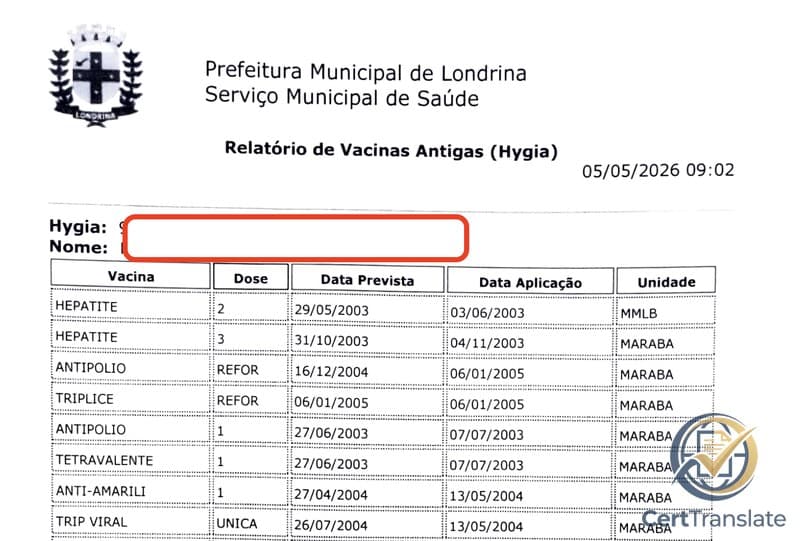
Cadernetas, e-SUS and Hygia printouts, SNS 24 eBoletim PDFs, and hospital records from Brazil and Portugal — every dose date, unit, and system code kept exactly.
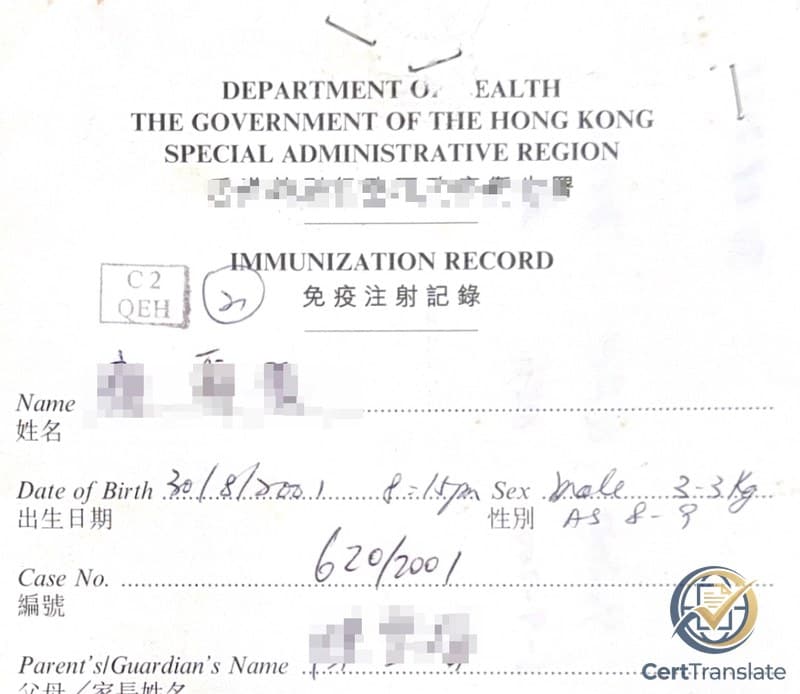
预防接种证 booklets, hospital 病历 forms, and bilingual Hong Kong cards — vaccine names, batch numbers, dates, and stamps kept exactly.
Real immunization casework
Three anonymized orders. Each one turns on something a card does that a reviewer has to be able to follow: no stamp, an issuer that reads like a person, and handwriting at its limit.

System printout
We rebuilt the dose table exactly as the system produced it and described the stampless format, so the doctor could credit each row instead of questioning the page.
Read the case
Issuer identity
We identified the issuer as an institution and rendered its name that way, keeping the immunization entries aligned with the card’s own bilingual layout.
Read the case
Illegible handling
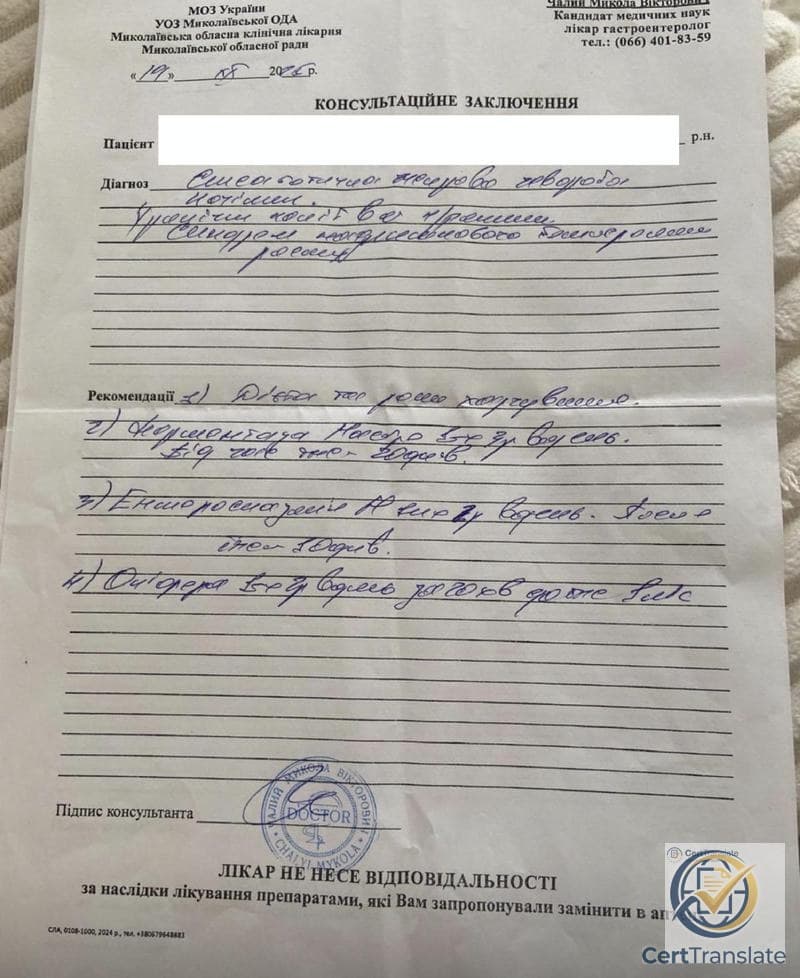
We translated every legible line and marked the rest as illegible rather than guessing, so the reviewer knew precisely what the source supports.
Read the caseHow it works
Upload once. We check the files and confirm the total before payment. Then our team translates, reviews, and certifies the complete package to the AcceptReady™ standard we publish.
Send every page carrying an entry, both sides of a card, each booklet spread, and any printout the clinic gave you. Blank pages cost nothing, and a missing spread is what usually delays an appointment.
A translator rebuilds the table row by row. A second reviewer checks each vaccine name against the schedule it belongs to, every date, and the patient name as spelled in your other documents.


Corrections are free at this stage. Once approved, the certified files arrive as a searchable PDF you can hand to the examining doctor, a school nurse, or a registrar.

One physical page means one billed page.
No 250-word cap and no dense-page rebilling.
Certified price
$24.95/ page
No payment until file review
Cost
A certified vaccination record translation costs $24.95 per physical page. A single card is $24.95, a card filled on both sides is $49.90, and a full childhood booklet usually lands between those and $74.85.
Start my order| What you are sending | Certified total |
|---|---|
| Card or printout, 1 page | $24.95one side, or a single system report |
| Card, front and back | $49.90when doses continue on the reverse |
| Booklet, 3 filled spreads | $74.85a childhood record with boosters over many years |
| 4 or more pages | $24.95 per pagelong booklets and multi-clinic histories |
A note on “100% acceptance”
If a service promises “100% acceptance,” be careful — no one controls USCIS’s decision. What actually protects you is the written remedy: we revise free, or refund in full.
Client reviews
Melissa G.
Austin, TX
“School registrar accepted our translated immunization booklet immediately. They translated every booster entry and date clearly.”
School enrollment · Booster history
Accepted at the desk
Youssef A.
Chicago, IL
“USCIS packet review went smoothly because vaccine names and dates were consistent with our other documents.”
Immigration filing · Name consistency
Packet review went smoothly
Carla N.
San Diego, CA
“They translated my WHO yellow card fully, including handwritten notes. The clinic accepted it without any corrections.”
Healthcare transfer · Yellow card
No corrections requested
Questions before ordering
If your record does not match one of these situations, send it anyway. Support replies in 15–30 minutes during support hours.
A certified vaccination record translation costs $24.95 per physical page. A single card is $24.95 and a two-sided card is $49.90. There is no word cap, and we confirm the page count and total before you pay.
A one- or two-page card is usually delivered within 24 hours of a clear upload. Booklets with many filled spreads or faded handwriting take longer, and we name the window before work begins.
Examining physicians, school nurses, and USCIS all expect a complete translation of the whole record with a signed certification, and that is what we deliver alongside the source scan. If a receiving authority rejects the translation for a translation-related reason, we revise it free. If it is still rejected, we refund the translation cost.
We translate vaccination records from 65+ languages into English. The pairs with a dedicated page are listed above. If yours is not there, upload the document anyway — the rate and the process are the same.
A dose counts only when the written record shows when it was given. Entries that never carried a full date can send you back for a repeat dose or a blood test, so we reproduce each date exactly and flag the incomplete ones instead of tidying them.
They work from different lists. A school checks the requirements its own state sets for enrollment, while the immigration medical exam follows the federal schedule. One translated record serves both, which is why we translate the whole card rather than selected rows.
That is normal, because manufacturers sell the same vaccine under different names by country. We give the recognized English name a reviewer can match to a schedule and keep the printed name beside it, so nothing is lost or invented.
Yes. Yellow cards, app exports, and clinic system printouts are all translated as issued. Where a record carries a verification code instead of a stamp, we preserve the code and describe the format in a translator’s note.
For medical exams and most school filings, certification is what is asked for and notarization is not. Some programs abroad want both, and we add notarization for $19.95 per order without changing the translated text.
No. A page is one physical page of the source document. Many services cap a page at 250 words and rebill a dense page as two or three; we bill the page you upload.
Yes. You can read the finished translation and request unlimited free corrections before we certify it. If an authority later asks for a translation-related change, we correct the certified file at no charge.
No. A clear scan or phone photo of each filled page is enough, and the original stays with you — you will need it again at the appointment. Photograph each spread flat, with all four corners visible.
Four things, and you can check all four yourself. Compare any line of the original vaccination record with the translation, including the text inside stamps. Put the two documents side by side — same page count, same order, tables and stamps in the same places. Read the Certificate of Accuracy for the complete-and-accurate statement, the competence statement, the signature, date, and company stamp. Then confirm the wording matches what your receiving office publishes. Those four checks are the AcceptReady™ standard, and CertTranslate publishes it in full. Read the AcceptReady™ standard.
Most frequent problems we correct
These four recur in exam and enrollment files, both in records we translate and in translations families ask us to review.
Our check: We reproduce what the record actually shows and mark an incomplete entry as incomplete, because a reviewer treats an invented date as a reason to repeat the dose.
Our check: We give the name a reviewer can match and keep the printed one beside it, so a local brand never turns into a vaccine that does not exist.
Our check: We ask for every filled spread and both sides of each card, since a booster recorded years later usually sits on a page nobody expected to need.
Our check: Before we certify, we cross-check the name on the record against the passport spelling used across your filing.
The standard behind these checks
AcceptReady™ is CertTranslate's published standard for certified translations: complete word-for-word translation, mirrored page layout, signed and stamped Certificate of Accuracy on letterhead, and matched to the receiver's published requirements.
How to check each one yourselfChecked before certification. If an authority later requests a translation-related correction, revisions remain free.
Start my translationCommon filing contexts
A vaccination record answers one narrow question — which doses, and when — but three different readers ask it: the physician completing the immigration medical exam, a school or university health office, and a new treating clinician.
The key is consistency: the name should match the passport used across your filing, and every page carrying an entry should be in the set you send.
The examining physician credits prior doses from written records, and bringing them in English is the applicant’s responsibility.
A district nurse checks the dose history line by line against the state’s own requirements before clearing a student.
Universities set their own pre-registration immunization requirements and ask for documentation in English.
A new physician or a program abroad reads the record to decide what is due and what is already covered.
Document glossary
The parts of an immunization record that decide how a certified translation is built, whatever language the original is in.
Mexico issues its vaccination booklet in five age-group versions, and the dose schedule inside is stamped by the clinic at each visit.
Since 2026 the booklet can also be reprinted digitally. Such a record arrives as a printout carrying a folio and verification data instead of a wet stamp.
Older childhood doses are usually handwritten across several visits, sometimes by different clinics with different hands.
We translate each row as recorded and describe the stamps, so a reviewing physician can credit the doses without holding the original.
Brazilian vaccine history splits by era: the paper card for older doses, the federal health app for recent ones, and municipal systems in between.
Clinics print legacy doses as system reports carrying no stamp and no signature. That is normal for the format, and worth explaining to a reviewer.
Local dose tables use national-programme shorthand, not the vaccine names a U.S. schedule lists. Each entry is carried over deliberately rather than transliterated.
A translator’s note describes the printout format, so a stampless record reads as a system export rather than an incomplete document.
Russia keeps vaccination history in two places: a personal certificate that travels with the patient, and a clinic card that stays filed at the polyclinic.
Both carry the same doses, so when the booklet stayed behind, a clinic-issued extract is what families abroad actually hold.
Dates are written day first, and the translation labels that order once so an early-month date is not read as a different month.
Soviet-era pages arrive handwritten and stamped, sometimes with several seals crowding a single row of the table.
China issues a vaccination booklet within a month of birth, and national law requires schools and kindergartens to check it at enrollment.
Every entry records the vaccine, the batch number, the date, and the unit that gave it. Those batch digits are data, not clutter.
Hong Kong records are printed bilingually, which tempts filers to submit them untranslated while the handwritten entries remain in Chinese.
We reproduce each identifier exactly, because a reviewer comparing a booklet against a clinic letter matches on those numbers.
The Ukrainian immunization card is kept by the clinic rather than the family, which separated many households from their records after 2022.
A family doctor can issue a vaccination statement generated from that card and the national eHealth system, often signed electronically instead of stamped.
We preserve the electronic signature block and describe it, so a reviewer can see how a digitally issued record authenticates.
Older pages often mix languages: printed headings in one, handwritten dose entries in another. Both layers are translated in one certified file.
The German vaccination booklet follows the WHO format, so its printed headings appear in three languages while the entries themselves stay handwritten German.
National infection-protection law puts the date, the vaccine, the batch number, the disease, and the vaccinator into every single entry.
Trade names common in German-speaking practice are carried over to the names a U.S. schedule recognizes. The printed name stays beside them.
Because the headings are already multilingual, families often assume the record needs no translation — the substantive entries still do.
Saudi official paperwork is dated by the Umm al-Qura Hijri calendar, so a dose may carry a Hijri date, a Gregorian one, or both.
Each date stays exactly as written and is labeled by calendar. A Gregorian equivalent goes into a note rather than replacing the original.
The health ministry issues child vaccination certificates through its national app, while doses from earlier years remain on paper cards.
Right-to-left tables are rebuilt so the reading order of each row survives, and clinic stamps are described rather than dropped.
Egyptian childhood records grow at the local health office, where newborn registration and the compulsory vaccination series share one administration.
The stamped vaccination certificate produced by that trail is the document U.S. schools and exam offices usually ask about.
National ID numbers on Egyptian paperwork encode birth data, so every digit is reproduced exactly rather than summarized.
Egypt is not a Hague Apostille Convention member, so authentication follows the consular legalization chain instead of an apostille.
“A dose that loses its date stops being evidence. We reproduce every row as the clinic wrote it. Where an entry was never completed, we say so rather than tidy it into something a reviewer would trust.”

Reference library
Guidance and source links last rechecked .
Ready when you are
Upload the card, both sides, and every filled booklet spread. We confirm the page count, price, and delivery time before you pay.
No payment until file review