
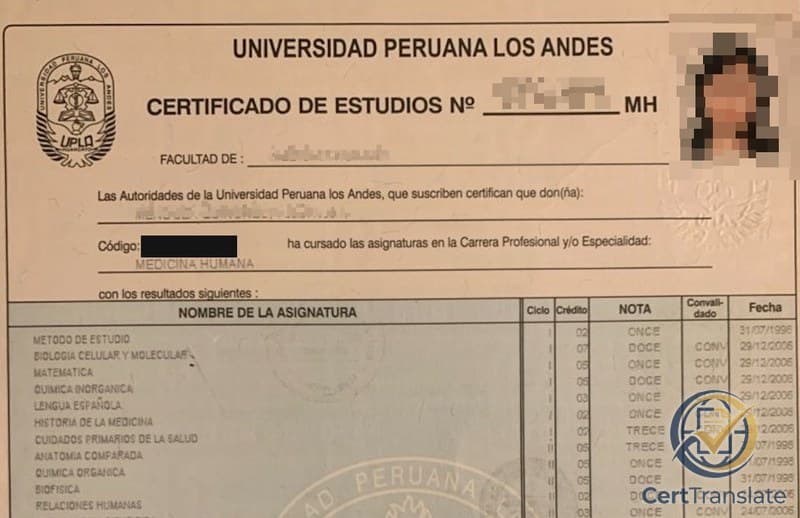
Peru · 0–20 grading scale
A Peruvian transcript listed grades as words, not numerals
We translated each written-out grade and added its numeral. We kept the 0–20 scale, passing grade, and both pages in the same order.
Read the caseKardexCertificado de notasCertificado analítico
Spanish transcript translations for WES and ECE preserve every course, crédito, carga horaria, grade scale, retake, legend, registrar note, and seal across Latin American and Spanish academic records.
Ready within 24 hours
Spanish academic records
Courses, grades and table structure preserved
Kardex/analítico · credits/hours · grade scales · retakes
Certified package
Signed and Stamped Certificate of Accuracy
Company letterhead · translator signature · company stamp

One physical page, billed once. Unlike services that split dense pages into 250-word billing blocks.
We check your files and confirm the total before you pay



What you get
You receive a complete English translation and a signed and stamped Certificate of Translation Accuracy. Send both with the source record; the English translation does not replace it.
Files reviewed before payment
Three steps
Upload your transcript, review the price, and approve the translation. We check the full file before we sign and stamp the certificate.
Send all pages, including backs with text or stamps. Add the grading legend and any instructions from the school or agency.
A Spanish specialist translates the courses, grades, credits, legends, registrar notes, seals, and certificates in the same order.

You review the translation before we certify it. We fix translation errors at no added cost, then send the final PDF with its signed and stamped certificate.
One physical page means one billed page
There is no word cap or Spanish-language surcharge. We confirm the delivery time for longer files before you pay.
$24.95/physical page
$24.95/ page
Instant total · no obligation
First-hand document experience
Transcripts are among the most demanding documents to translate well. Dense tables, repeated columns, grading legends, stamps, and continuation pages must stay easy to match with the source. A translator has to rebuild that structure, not just translate the words. These real cases show why.
Peru · 0–20 grading scale
We translated each written-out grade and added its numeral. We kept the 0–20 scale, passing grade, and both pages in the same order.
Read the case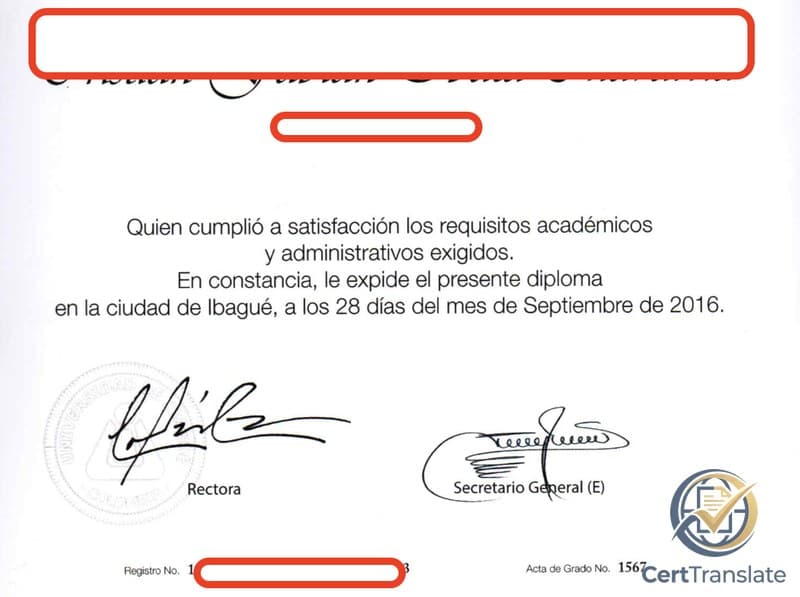
Colombia · Typo in the source
We translated the text as issued and kept the school identifier visible. A clear translator note explained the typo instead of silently correcting it.
Read the case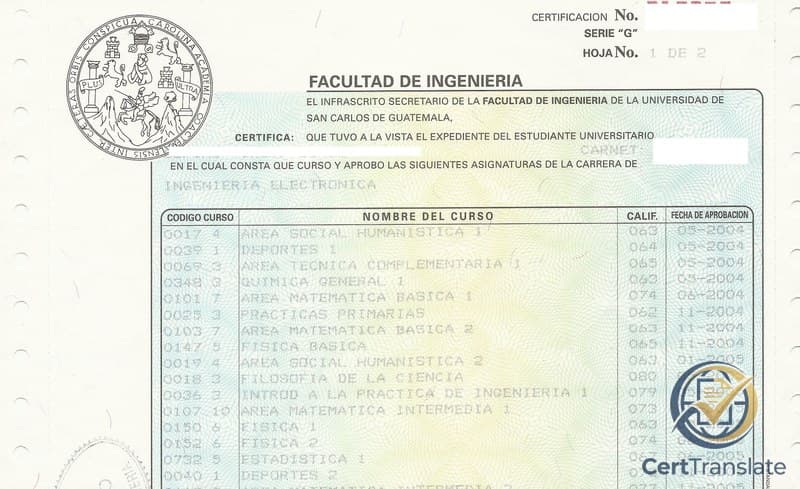
Guatemala · Overlapping seals
We translated the text that remained legible and marked the parts covered by seals. We did not guess the hidden name or date.
Read the caseRecent academic-record outcomes
Fernanda L.
Dallas, TX
“My Mexican kardex had a long course list and a separate grading legend. The English version was easy to compare with the original, and WES accepted it the first time.”
Mexico · Kardex
WES accepted the set
Andrés G.
Atlanta, GA
“They preserved the Colombian 0–5 scale instead of trying to turn it into a U.S. GPA. The evaluator could understand the legend without any extra explanation from me.”
Colombia · Certificado de notas
Scale stayed clear
Lucía B.
San Francisco, CA
“I ordered my analítico definitivo and diploma together. The faculty name and degree terminology were consistent across both files, which was exactly what admissions needed.”
Argentina · Analítico definitivo
Terminology matched the diploma
Translation and evaluation are different services
Choose certified translation when you need an accurate English version. Choose credential evaluation when a school or agency asks how your studies compare with a U.S. degree. Many people need both.
What CertTranslate provides
A certified translation is a complete English translation accompanied by the translator's signed statement that the translation is complete and accurate and that the translator is competent to translate.
We translate your record. We do not change the credential or calculate a new GPA.
What a credential evaluator provides
A credential evaluation shows how your studies compare with the U.S. system. WES, ECE, and similar agencies issue this report.
CertTranslate does not issue evaluation reports. Check the file list from the school or agency handling your case.
See what WES asks you to submitBefore you order
Upload every transcript page, including backs, continuation pages, and grading legends. This helps us quote the right price and produce a complete translation.
01 · Transcript
Include all semesters and continuation sheets. Add any back page with a stamp, note, or registrar statement.
02 · Grading details
A grading legend can explain the passing grade, credit unit, course status, and symbols used by your school.
03 · Related documents
Add your diploma if you need both files in English. Include any checklist from your school, evaluator, or licensing board.
Country-specific records
Spanish transcripts use different names, grading scales, and credit systems in each country. We follow the terms and scale printed on your record.
Certificado de Estudios
Also issued with: Also: kardex / historial académico
Mexican transcripts are often called kardex, historial académico, or certificado de estudios. We keep the source title, course order, créditos, grading legend, and SEP references.
Grades stay on the scale used by the school. A credential evaluator decides how they compare with U.S. grades.
Certificado de Notas
Also issued with: Also: historial académico
Colombian transcripts often use a 0–5 scale. They may also list program codes, accreditation details, and school-specific credit notes.
We keep decimal grades, SNIES references, legends, and registrar lines easy to compare with the Spanish record.
Certificado Analítico
Also issued with: Parcial (in progress) / definitivo (final)
An analítico parcial shows studies in progress. An analítico definitivo is the final school record, so the translation keeps this difference clear.
If you order the diploma too, we use the same university, faculty, student name, and degree terms in both translations.
Récord Académico
Also issued with: Also: certificado de estudios
Peruvian transcripts commonly use a 0–20 scale. We keep that scale and its grading legend exactly as the school issued them.
We also translate SUNEDU references, registrar statements, written-out grades, and entries on the back.
Certificación Académica Personal
Also issued with: Also: expediente / certificado académico
Transcripts from Spain may use aprobado, notable, sobresaliente, matrícula de honor, and ECTS credits.
We keep these grade names and the source credit system. We do not force the record into a Latin American format.
Issued somewhere else? Upload your transcript and we will identify the record type and grading system before you pay.
Check my transcriptThe real price of a dense page
A 250-word cap can turn one dense transcript page into two or three billed pages. CertTranslate charges for the physical pages you upload, not the number of words on them.
CertTranslate
One physical page, with no word cap
A provider with a 250-word cap
One billed page for every 250 words
Compare your document
Choose your page count and estimated words per page below
The calculator uses the same rate on both sides. The only difference is how each service counts a page.
Typical — a course-and-grade table
1 page × $24.95 — flat, no word cap
380 words ÷ 250 = 2 billed pages × $24.95
You keep $24.95 on this document.
Get your exact priceComparison estimate only, based on a 250-word page definition at a representative $24.95 per-page rate. Your final price depends on the actual document.
Before you submit
Questions often come up when the translation breaks the link between a course, its credits, and its grade — or when a page, legend, or seal is missed. We rebuild the layout and check these details before certification.
How we handle it: We review the full file first and flag any visible reference to a missing page or back side.
How we handle it: We keep the source scale and translate its legend. The evaluator handles equivalency and GPA conversion.
How we handle it: We check repeated faculty, program, and course names across every document in your order.
How we handle it: We include every legible seal, registrar statement, signature, issue detail, and SEP, SNIES, or SUNEDU reference.
The standard behind these checks
AcceptReady™ is CertTranslate's published standard for certified translations: complete word-for-word translation, mirrored page layout, signed and stamped Certificate of Accuracy on letterhead, and matched to the receiver's published requirements.
How to check each one yourselfStart with the full record: send all pages and the instructions from the school or agency. If a name, grade, or date is unreadable, we ask instead of guessing.
Check my transcript setCommon questions
These answers cover price, delivery, evaluation requirements, grading scales, and the files you should send.
Certified Spanish transcript translation starts at $24.95 per physical page. A page is one physical page of the source document. CertTranslate never re-counts a dense page as two.
Most 1–3 page orders are delivered within 24 hours — included in the price. We confirm the timing for longer or hard-to-read transcripts before you pay.
WES asks for translations when school records are not issued in an accepted language. Send the translation with the source record, and follow the WES file list for your country and credential.
Accepted — or your money back. If a school or agency rejects the translation for a translation-related reason, send us its notice and we will revise the file free. If it is still rejected for that reason, we refund the translation cost. The school or agency still decides whether your record meets its rules.
No. We keep every grade on the original scale and translate the grading legend. Your university or credential evaluator decides U.S. equivalency and any GPA calculation.
Yes. Upload all terms, continuation sheets, grading legends, signed pages, and back sides that contain text or stamps. We translate the full record you provide.
Yes. These are common names for Spanish school records, but they do not always mean the same thing. We keep the exact title and format used by the school.
Yes. You can review the translation before we sign and stamp the certificate. We fix translation errors at no added cost, both before and after delivery.
Notarization is separate from certified translation. It only checks the identity of the person signing, so add it only when your school or agency asks for it.
If the school or agency needs both, ordering them together keeps the student name, school, faculty, program, and degree terms consistent across both translations.
Upload the clearest scan you have. If we cannot read a detail safely, we ask for a better image or mark it as illegible. We do not guess.
Grading reference
We show grades exactly as they appear on the transcript. This table lists common scales, but the grading legend from your school is the final reference.
| Issuing system | Typical scale | Common pass mark | What stays visible |
|---|---|---|---|
| Mexico | 0–10 | 6 | Institution legend, créditos, SEP references |
| Colombia | 0.0–5.0 | 3.0 | Decimals, credits, SNIES/program identifiers |
| Argentina | 0–10 | Often 4; institution rules vary | Parcial/definitivo status and faculty terminology |
| Peru | 0–20 | 11 | Legend, grades written as words, SUNEDU references |
| Spain | 0–10 | 5 | Named grade categories and ECTS/pre-Bologna credits |
Spanish academic terms
The same school record can have a different name in each country. We choose the English term that fits and keep key differences clear.
Where your translation goes
Send the certified translation with the source transcript. Follow the current rules from your school, board, or agency.
Each evaluator sets file rules by country, school, and credential. Check your account before sending the file.
What to prepare
Original transcript + certified translation + required documents
A university may ask for the transcript, diploma, and records sent directly by your previous school.
What to prepare
Transcript + translation + diploma if requested
Nursing, teaching, engineering, and accounting boards set their own rules for school records and delivery.
What to prepare
Transcript + translation + board checklist + evaluation if requested
A transcript can prove your school history. USCIS or an employer may also ask for the diploma, an evaluation, or other proof.
What to prepare
Original transcript + certified translation + requested evidence
Follow the instructions for your exact application
Upload the checklist or email you received. We will check the translation against it before you pay. The school, board, or agency makes the final decision.
Sources and next steps
Check the current rules for your school or agency, country, and credential before you submit. .
Ready to order?
Upload every transcript page, grading legend, and instruction you received. We will confirm the exact price and delivery time before you pay.
Encrypted upload · no payment until file review