




How do you translate a dot-matrix printed transcript without losing the table structure?
TL;DRA 1998 Brazilian bachelor's transcript (Histórico Escolar Final) was printed on a dot-matrix printer with ASCII box-drawing table borders, handwritten diploma dates on an otherwise machine-printed form, and a mid-transcript program option change. We recreated the full four-page layout in a modern DOCX, marked all handwritten entries as [Handwritten: ...], and cross-verified all 27 courses against accumulated credit totals. The certified translation was delivered for credential evaluation.
Case Specifications
- Document
- Academic transcript (bachelor's degree)
- Foreign Name
- Histórico Escolar Final
- Country
- Brazil
- Languages
- Portuguese → English
- Submitted To
- Credential evaluation (WES)
What We Received
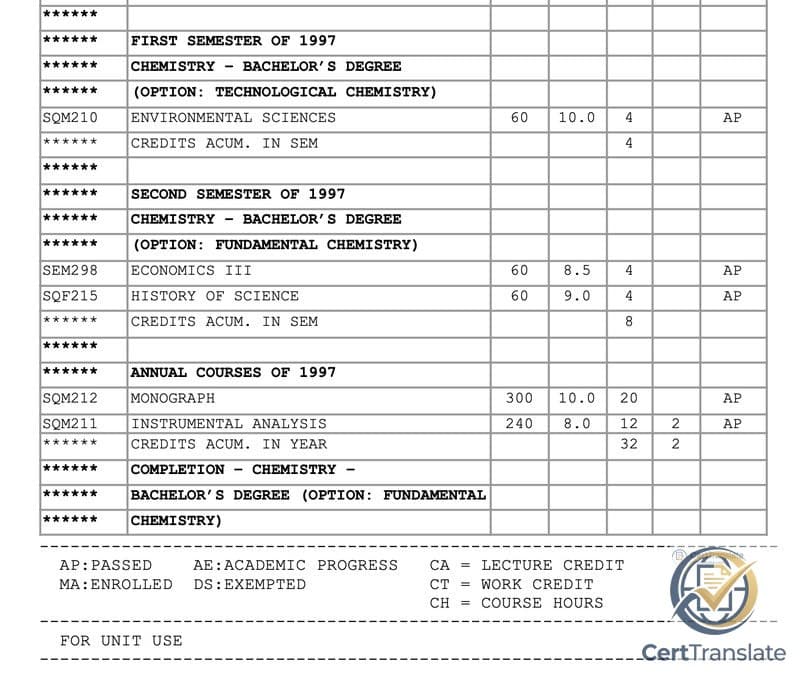
A client submitted a four-page academic transcript (Histórico Escolar Final) for a bachelor's degree in Chemistry, issued by a major Brazilian federal university. The document was printed in 1998 on a dot-matrix printer using pipes, dashes, and other ASCII characters to create borders and table structure.
Each page repeats a full header with the university name, page number, issuance date, and student information — followed by a course table with columns for course code, course name, credit hours, grade, accumulated credits, and result. Pages two through four include a legend footer with abbreviation definitions laid out in two columns.
The diploma information section on page one contains three dates — conferral date, completion date, and diploma issuance date — that are handwritten on an otherwise machine-printed form. The certified translation was needed for a credential evaluation through WES.
Why This Required Special Handling
A modern DOCX cannot replicate monospace ASCII art. The translator has to decide how to faithfully represent the table structure, repeating headers, and legend footers without oversimplifying — losing structural information — or overcomplicating the layout into a visual mess. The asterisk markers (******) in the course code column for non-course rows (semester headers, credit totals, notes) are part of the original's data structure and must be preserved.
The handwritten dates create a second problem. If you don't mark them as handwritten, a reviewer comparing the translation against the original sees typed dates where the original has handwriting. That discrepancy can raise questions about whether the translator accurately represented the source — exactly the kind of issue that delays a WES credential evaluation.
In the first semester of 1997, the student temporarily switched program options from "Fundamental Chemistry" (Química Fundamental) to "Technological Chemistry" (Química Tecnológica) for one course, then switched back. This appears as a small inline note between semester headers. A translator who misses it produces an inconsistent transcript — a specialized course appearing in the wrong program without explanation. A credential evaluator would notice.
How We Handled It
We reproduced the exact four-page structure in the DOCX. Each page has its own section with the full repeating header (university name, page number, issuance date, student information), the course table with all seven columns (Code, Course Name, Credit Hours, Grade, Accumulated Credits, Credit Type, Result), and the legend footer with the two-column abbreviation layout plus the "For Unit Use" box.
All asterisk markers (******) in the code column are preserved for non-course rows. Abbreviated labels like "Credits Accum. in Sem." and "Credits Accum. in Year" mirror the abbreviated Portuguese originals ("Créditos Acum. no Sem." / "Créditos Acum. no Ano").
"Translator's Note (excerpt): 1. This document is a computer-generated academic transcript printed circa 1998. Three dates in the Diploma Information section are handwritten and marked as [Handwritten: ...] in the translation. 2. Dates have been converted from DD/MM/YY format to Month DD, YYYY. 3. Decimal notation has been converted from Brazilian convention (comma) to US convention (period). 4. "Bacharel em Química" is the academic title conferred upon completion of a bachelor's-level program in Chemistry. 5. "Concurso Vestibular" refers to the standardized university entrance examination. 6. In the first semester of 1997, the student's program option changed from "Química Fundamental" to "Química Tecnológica" for one enrolled course, then reverted in the second semester."

The three handwritten diploma dates were marked as [Handwritten: February 13, 1998], [Handwritten: December 1997], and [Handwritten: February 13, 1998] in the translation body. A stamped "EM BRANCO" (Blank) observation was identified and documented as stamped text.
The program option change was reflected exactly as printed — the option name appears as a note row within the course table for both affected semesters, matching the original's inline structure.
We cross-verified every grade and credit value against accumulated totals per semester, per year, and the grand total (Credit Hours: 4,440 / Accumulated Credits: 220 / Credit Types: 38). This caught potential ambiguities in reading dot-matrix printed numbers — for example, confirming a Physics course's credit values by working backwards from the 1994 annual total when other course values were summed. The transcript translation included 14 Translator's Notes covering date conversions, abbreviation definitions, Brazilian academic terminology, signatory identification, and a non-standard course name ("Cromatologia" rendered as "Chromatography" with an explanatory note).
The Outcome
The certified translation was delivered to the client for submission to WES. The four-page layout, handwritten date annotations, and 14 Translator's Notes provide full transparency about every structural and formatting decision.
This is the first case where we handled a Brazilian dot-matrix transcript with ASCII table structure. The approach to repeating page headers, abbreviated credit labels, and program option changes applies to any Brazilian "Histórico Escolar" document from this era.
What This Means for You
A dot-matrix printed transcript requires more than text translation — the table structure, repeating headers, and legend footers carry information that a credential evaluator needs to see. Handwritten entries on machine-printed forms must be marked as such to avoid discrepancies between the original and the translation. If your Brazilian transcript was printed in the 1990s or earlier, expect the translator to spend time on layout reconstruction — and verify that every course, grade, and credit total is cross-checked against the document's own running totals.
Have a similar situation?
We handle older-format Brazilian academic documents and dot-matrix printouts regularly.
Related Cases & Resources
Sources & References
- WES Required Documents — Brazil·WES·Verified 2026-05-21
Explore the Hub
All identifying information has been removed from document images. Case details are shared with client permission. No personal data is stored or displayed on this page.