
65+ languages → English
Certified Driver's License Translation
Certified translation of front and back license data for DMV and USCIS, insurers, courts, and other official use.
Ready within 24 hours
License data
Classes and restrictions preserved
Front and back · license number · endorsements · validity dates
Certified package
Signed and Stamped Certificate of Accuracy
Company letterhead · translator signature · company stamp

Calculate your license price
We check your files and confirm the total before you pay




What you get with every certified driver's license package
License translation is detail-sensitive. Back-side codes, restrictions, and endorsements are often decisive in DMV or legal review. We translate all submitted fields exactly and keep structure clear so reviewers can map translated values to source content quickly. Our driver's license translation services include front/back scope checks, endorsement-code mapping, and restriction legend verification.
Everything you need for your driver's license translation.
Nothing sold separately.
- Word-for-word translation of front and back license content in submission scope
- Signed Certificate of Accuracy on company letterhead
- Translator name, credentials, and contact details
- Separate translation of endorsements and restrictions when present
- License class, category, and validity fields translated exactly
- PDF delivery ready for DMV, USCIS, or legal submission
- Optional notarization and hard-copy mailing
- Unlimited revisions until accepted
How to get your driver's license translated, step by step
- Step 1 of 3
Step 1: Upload Your Driver's License
PDF, photo, or scan — any format works. Takes about 30 seconds.
- Step 2 of 3

Step 2: We Translate & Certify
A native-speaking translator handles every word, stamp, and signature. Signed Certificate of Accuracy included — USCIS-ready format.
- Step 3 of 3
Step 3: Receive & Submit
Delivered as a searchable PDF, typically within 24 hours. Free revisions if any institution requests adjustments.
Your license files are transmitted over 256-bit SSL and stored on secure infrastructure. Uploaded files are deleted within 30 days of delivery or sooner on request.
Who needs a driver's license translation?
DMV conversion and state licensing workflows
State DMVs can require certified translation of foreign licenses during conversion, testing, or eligibility review.
Requirements differ by state. Some accept certified translation directly, while others also require additional supporting identity records.
Submitting incomplete translation of class, endorsement, or restriction lines often triggers extra review and delays.
USCIS and identity-support filings
In some immigration scenarios, translated license pages are used as supporting identity or residence evidence.
When submitted, non-English content should be translated fully with signed certification language.
Consistency between license name fields and other documents in your packet is critical to reduce mismatch risk.
Court, insurance, and legal proceedings
Courts and insurers may request translated license records when driving status or endorsements are part of the case.
In legal contexts, back-side restrictions and code legends can matter as much as front-side identity fields.
Certified translation is commonly required so the translated record is traceable and formally accountable.
Short-term driving and car-rental confusion cases
Certified translation for DMV or legal use is not the same as an IDP used for temporary driving in some countries.
If your goal is short-term international driving, IDP rules may apply separately from certified translation requirements.
Clarifying destination purpose first avoids paying for the wrong service and losing time near travel deadlines.
What customers say about our translated driver licenses
“They explained that my DMV case needed certified translation, not IDP. The translated license was accepted and I avoided another trip to the office.”
Karina P.
Sacramento, CA
Verified on Google
“Fast delivery and complete translation of both sides, including restriction codes. Court accepted it without corrections.”
Mikhail V.
Brooklyn, NY
Verified on Trustpilot
“They caught that my commercial endorsement was on the back and translated it separately. That detail was exactly what my agency needed.”
Diego R.
Houston, TX
Verified on Google
“Clear formatting, quick turnaround, and no hidden fees. My translated foreign license was accepted on first review.”
Layla A.
Phoenix, AZ
Verified on Google
Real driver's license translation cases we've handled
Anonymized driver's license translations we've delivered. Each case shows the specific issue in the original and how the certified translation addressed it.
 RecentAug 2026embedded-non-textFrance
When a Driving License Is Mostly Icons, Stamps, and Codes
A French driving license (permis de conduire) carried most of its content as non-text elements — vehicle-category icons, a photo, security stamps, and a machine-readable zone. A plain word-for-word translation would have dropped that meaning. We described each non-text element in brackets, translated the text inside the stamps, and reproduced the machine-readable zone exactly. The certified translation was delivered for the client's USCIS filing.
Handled by Sarah Jenkins, Certified French & Official Documents TranslatorUSCISRead case →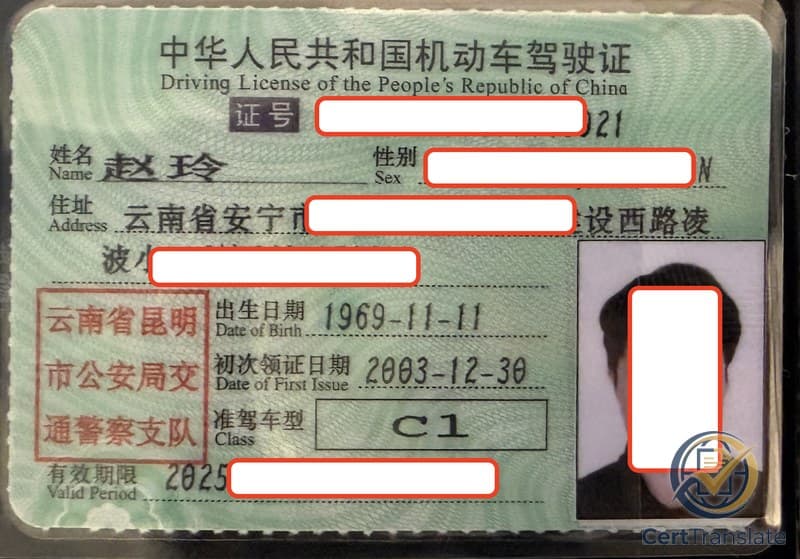 Jun 2026Multi-Part Document & Conditional ValidityPeople's Republic of China
When 'Long-term' on a Chinese License Still Has a Back-Page Clock
A PRC driver's license listed its Valid Period as '至 长期' ('until Long-term') on the main page, while the supplementary page (副页) carried a clause requiring an annual medical certificate within 30 days of December 30 every year after 2039 — the PRC's standard ≥70-year-old rule. We translated both pages as one certified file, rendered '长期' as 'Long-term' rather than 'never expires', and reproduced the supplementary clause literally with a Translator's Note pointing the reader to it.
Handled by Michael Chen, Lead Immigration Document TranslatorU.S. state DMV / USCIS supporting IDRead case →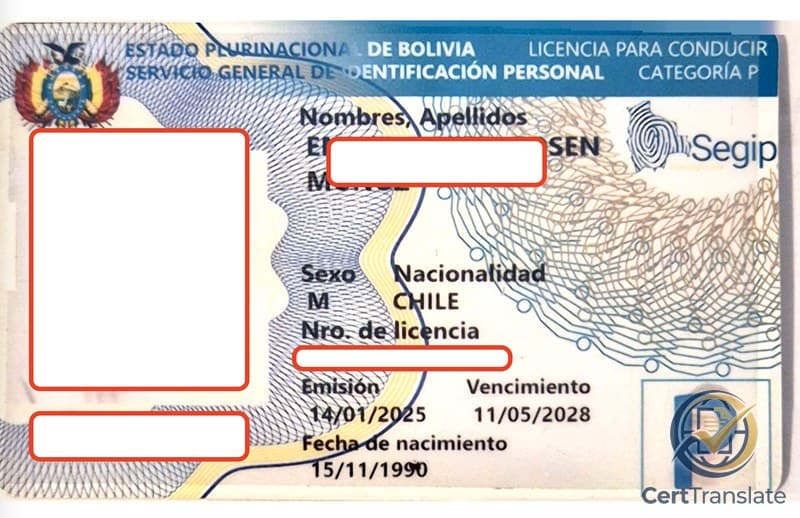 Jun 2026Date Format & Numeric ConventionPlurinational State of Bolivia
When 11/05/2028 on a Bolivian License Meant Two Different Months
A Bolivian driver's license listed dates in the country's DD/MM/YYYY convention, and the expiration value '11/05/2028' could be misread as November 5, 2028 by a U.S. reader who assumed MM/DD/YYYY. We rendered every date in unambiguous English long-form (May 11, 2028; January 14, 2025; November 15, 1990) and documented the conversion in a Translator's Note that preserved the original numerals. The certified translation was delivered with no field a DMV or USCIS adjudicator could read two different ways.
Handled by Mateo García, Senior Immigration Translation SpecialistU.S. state DMV / USCIS supporting IDRead case →
Our track record with translated driver licenses
Identity and licensing records translated since 2014
Service history
DMV workflows, USCIS support files, court and insurance documentation
Common destinations
90+ languages
Language coverage for licensing records
Driver license records are one of our highest-volume identity workflows and account for roughly one in five ID-document translation orders. Our QA checklist includes front/back scope validation, endorsement and restriction coverage checks, and class-code consistency review before release. We run this workflow across 90+ language pairs from 100+ countries.
Driver's licenses by country of origin
🇲🇽MexicoMXMexican licenses often contain class and restriction fields that must be translated exactly for DMV and legal review.
Mexican licenses often contain class and restriction fields that must be translated exactly for DMV and legal review.
Front and back data should be translated together because code legends and limitations can appear on either side.
Name and date fields are checked against supporting identity records to reduce mismatch risk.
When endorsements are present, each endorsement is translated separately so receiving offices can evaluate privileges correctly.
Mexico is a Hague Apostille Convention member, so apostille is generally used when non-U.S. authorities request legalization after translation.
This is a frequent workflow, and our QA checklist includes class-code and restriction validation before delivery.
🇨🇳ChinaCNChinese licenses may use field structures and category labels that require precise mapping into English without reinterpretation.
Chinese licenses may use field structures and category labels that require precise mapping into English without reinterpretation.
We translate all category and validity fields exactly and preserve source numbering formats.
Back-side notes and issuing authority details are translated when included in submission scope.
If name transliteration differs from passport spelling, we preserve source text and flag consistency risks before final release.
China is a Hague Apostille Convention member, so apostille is typically the legalization path when required for non-U.S. destinations.
When multiple licenses or renewals are submitted, each record is labeled separately to preserve chronology.
🇸🇦Saudi ArabiaSAArabic-script license records require careful transliteration handling so identity fields remain consistent across supporting documents.
Arabic-script license records require careful transliteration handling so identity fields remain consistent across supporting documents.
We translate front and back fields in structured format with clear label-to-value mapping.
Category permissions and restrictions are translated in full because they can affect DMV interpretation.
If the license includes handwritten or stamped updates, those elements are translated where legible and marked transparently where unreadable.
Saudi Arabia is a Hague Apostille Convention member, so apostille is commonly used when foreign authorities request document legalization.
Our QA pass checks name order and date-field consistency across all submitted pages.
🇧🇷BrazilBRBrazilian licenses frequently include category and limitation fields that must be translated without summarizing code meaning.
Brazilian licenses frequently include category and limitation fields that must be translated without summarizing code meaning.
We preserve source terminology for restrictions and provide clear structured translation for DMV readability.
Issuing authority, document number, and validity windows are translated exactly as shown.
If endorsements are listed with local abbreviations, each abbreviation is translated and kept traceable to source context.
Brazil is a Hague Apostille Convention member, so apostille is the standard legalization route for many non-U.S. filing destinations.
This workflow is common in cross-border residency and licensing cases, so document-scope review is done before production.
🇷🇺RussiaRURussian licenses can include transliteration-sensitive identity fields and class markers that require precise rendering.
Russian licenses can include transliteration-sensitive identity fields and class markers that require precise rendering.
We preserve source spelling and do not silently normalize names to alternate variants.
License classes, restrictions, and coded notes are translated line by line where they appear.
Back-side legend details are included when submitted because they can influence receiving authority decisions.
Russia is a Hague Apostille Convention member, so apostille is generally used when legalization is requested outside DMV-only workflows.
Final QA verifies numbering, validity dates, and endorsement coverage before certification.
“IDP is a travel document, not a certified translation for DMV conversion files. We confirm your destination purpose first so the translated scope matches the real requirement.”

Driver's license translation cost
$24.95
per page · no word cap
Typical length
Most driver license orders are 1-2 pages
Typical cost
Typical total is $24.95-$49.90
Cost Estimation
Always Included
No hidden fees. Pay upon review.
How we count pages
A one-sided submission is usually one page, but many official requests require both front and back.
Back-side restrictions, class legends, and endorsement codes count when translated.
Exact total is confirmed before payment.
Common mistakes that get translated licenses rejected
1Confusing certified translation with IDP
Risk
Ordering the wrong document type can leave you without the format your destination actually requires.
Our Solution
We confirm destination purpose first and clarify whether certified translation or IDP pathway applies.
2Submitting front side only when back-side data is required
Risk
Missing restrictions, code legends, or endorsements can make the submission incomplete and may trigger a USCIS RFE when licensing evidence is submitted in immigration support files.
Our Solution
We request and translate both sides whenever official scope includes back-side data.
3Omitting endorsements and restrictions
Risk
Receiving offices may reject translation that does not include class privileges or limitations.
Our Solution
Each endorsement and restriction line is translated and labeled separately.
4Using rental-driving assumptions for DMV conversion cases
Risk
Short-term travel rules differ from DMV conversion rules, leading to preventable rejection.
Our Solution
We separate use cases and match translation scope to DMV or legal requirements.
5Submitting without signed Certificate of Accuracy
Risk
Authorities may treat translation as non-compliant even when language appears accurate.
Our Solution
Every package includes signed certification and translator identity details.
Often submitted together with a driver's license
Passport Translation
Supports identity matching when DMV or legal workflows compare document sets.
Birth Certificate Translation
Often used to verify identity and legal name history in state and immigration contexts.
Marriage Certificate Translation
Common when name change history affects licensing or identity verification.
Submitting multiple identity records? Upload all documents in one order for one coordinated delivery package at the same $24.95/page rate.
Where This Document Is Used
Immigration & Filing
Accepted By
Frequently asked questions
Everything you need to know about getting your document translated appropriately.
How much does a certified driver's license translation cost?
How long does driver's license translation take?
Will my translated driver's license be accepted by DMV or USCIS?
Do I need my driver's license translation notarized?
Do I need an apostille for my driver's license translation?
What is the difference between certified translation and IDP?
Can I translate my own driver's license for DMV or USCIS use?
Do you translate endorsements and restriction codes?
Do I need to translate both front and back of the license?
What if my license is expired or damaged?
What can I check on my driver's license translation before I send it?
Ready to get your driver's license translated?
Upload both sides of your license and receive a certified, submission-ready package, usually within 24 hours.