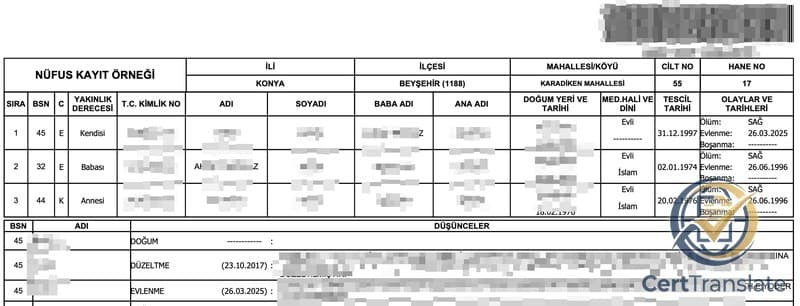
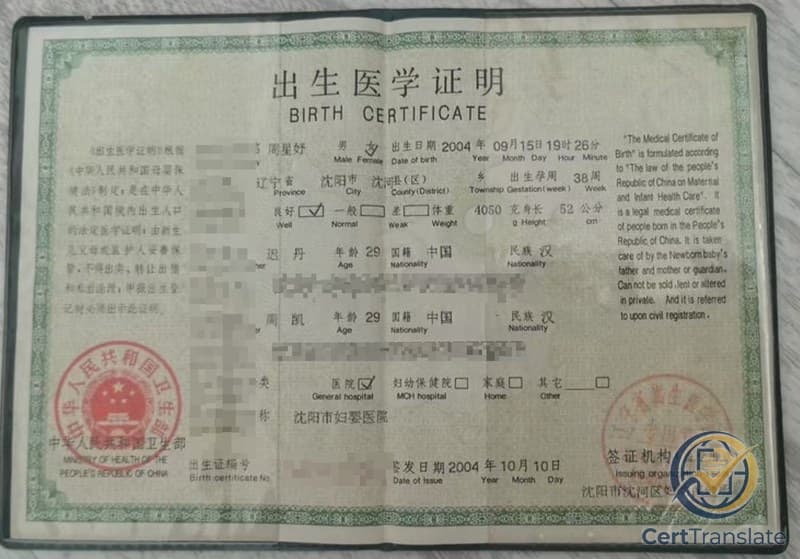
What Is a Certified Translation of a Birth Certificate?
In the United States, a certified translation of a birth certificate is a formal package consisting of the translated document and a signed Certificate of Accuracy. It is not sufficient to simply type up an English version of your birth record.
The certification must state that the translator is competent to translate from the source language into English, and that the translation is complete and accurate. This declaration makes the translation legally acceptable for USCIS, federal agencies, and state courts.
Unlike in some European or Latin American countries where translators are sworn by a court (Sworn Translators), the U.S. relies on this signed certification model. We provide this exact certification format on company letterhead with every order, ensuring full compliance with U.S. immigration and legal standards.
Certified vs. Notarized Translation
USCIS requires a certified translation, not a notarized one. However, some state courts, DMVs, and universities do request notarization. If you need it, a Notary Public will authenticate the signature on our Certificate of Accuracy. You can add notarization at checkout.
Start your translation orderCritical Birth Certificate Fields We Verify
A single mistranslated field can cause your application to be rejected by USCIS or requesting agencies. Our translators and QA reviewers carefully extract and format every identifying data point.
Why Birth Certificates Are High-Risk Documents
Discrepancies in Name spellings
If the name on your birth certificate differs from your passport due to varying transliteration rules or cultural naming conventions, USCIS will immediately flag it. We handle these discrepancies with careful translator notes.
Stamps, Seals, and Marginal Notes
Many civil registries add late-registration notes, legitimations, or name-change amendments in the margins of the certificate. Skipping these annotations renders the translation legally incomplete.
Dialects and Archaic Legal Terminology
Older birth records often use antiquated civil registry terms or regional dialects that automated translation tools fundamentally misunderstand. Human contextual review is strictly required.
Formatting and Layout Matching
A translation must be easily cross-referenced by a reviewing officer. We mirror the layout of your original certificate, ensuring that tables, signature blocks, and stamps appear exactly where expected.
Who needs a certified birth certificate translation?
USCIS and immigration filings
If you are filing Form I-485 (Adjustment of Status), Form I-130 (Petition for Alien Relative), Form N-400 (Naturalization), or Form I-751 (Remove Conditions), USCIS requires birth certificate translation.
In most cases, you submit the foreign-language document copy and the full English certified translation together. USCIS officers expect complete field-by-field rendering, including margins, stamps, and handwritten notes.
If your birth certificate name differs from your passport because of marriage or legal change, the discrepancy must be translated exactly and explained in context instead of silently corrected.
University admissions and credential evaluation
Some schools and evaluators, including WES and ECE workflows, ask for translated birth certificates when identity details do not match transcripts or diplomas.
Unlike USCIS packets, universities may request a cleaner formatting style, but they still require complete translation with translator identity and signed certification.
Court and civil record updates
State courts and local agencies may request certified translation for parentage matters, delayed registration, inheritance, and legal name corrections.
Some jurisdictions request notarization in addition to certification. When that applies, notarization can be added after translation so the translated content remains unchanged.
Passport, benefits, and family verification workflows
A translated birth certificate is often needed before passport updates, dependent benefits enrollment, and other identity-verification processes.
If you are unsure which authority will review your file, use the requirements checker first so you avoid rework.
What you get with every certified birth certificate package
Delivery Promise
Word-for-word does not mean robotic wording. It means we preserve every data element exactly while writing clear English that mirrors the source structure. On birth certificates this prevents hidden mismatches in names, diacritics, registration codes, and civil-status annotations that cause avoidable delays. Our birth certificate translation services include CURP validation, name-history checks, and full annotation coverage before delivery.
Birth certificates by country of origin
Mexico
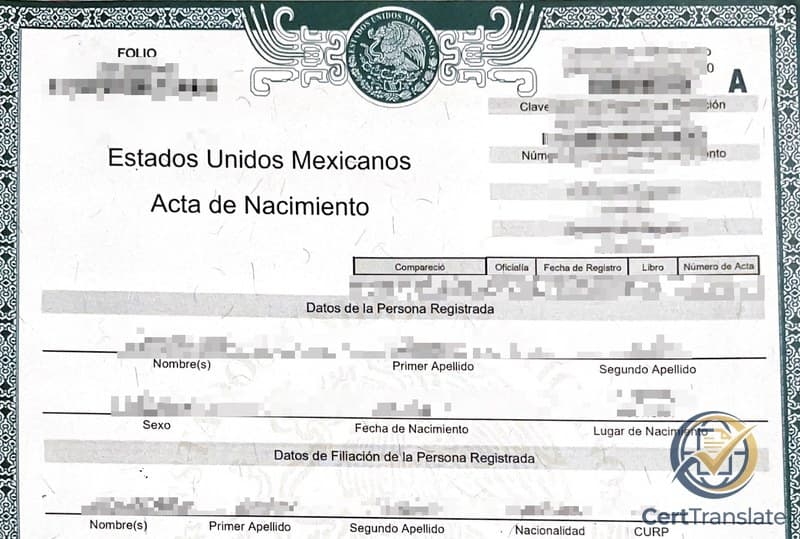
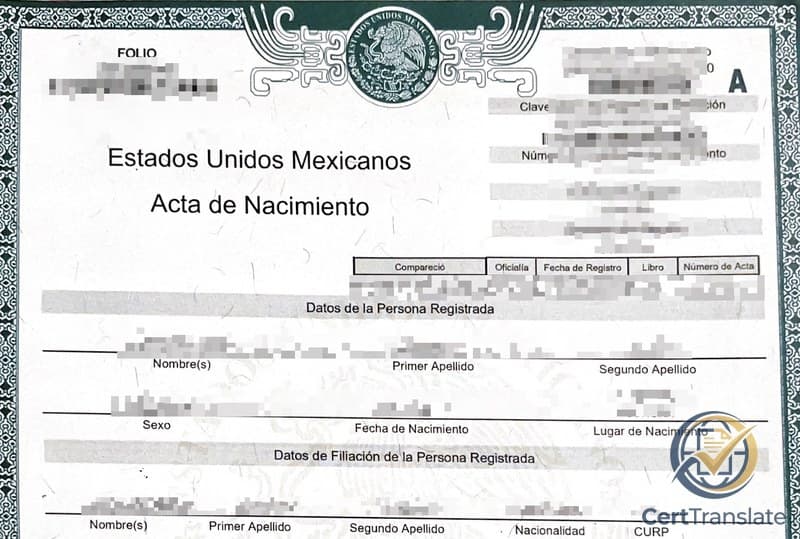
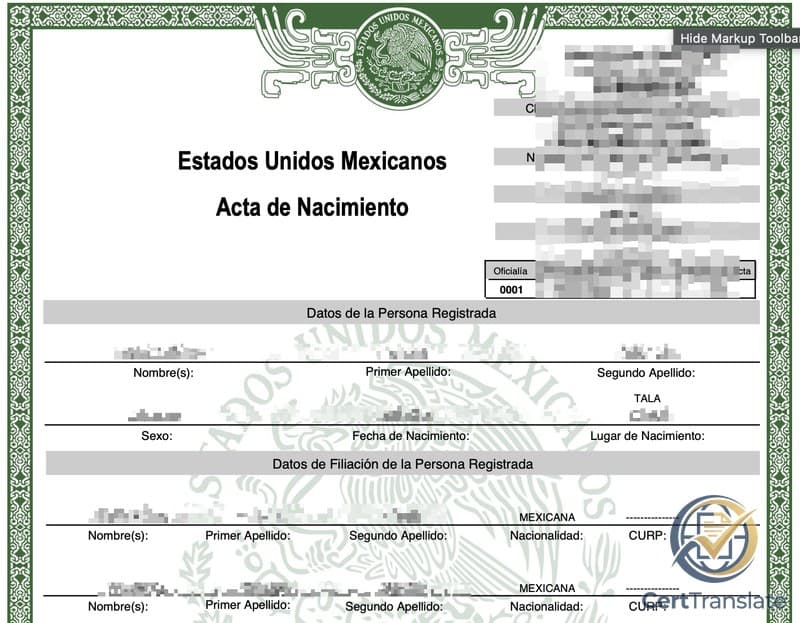
Mexican birth certificates usually contain a CURP number and civil registry identifiers that must be reproduced exactly in the translation.
We frequently see multi-format records: modern digital actas and older scanned copies with handwritten margins. Both require complete translation of stamps, side notes, and registrar fields.
If the document includes annotations for legitimation, acknowledgment, or correction, we translate each annotation in place so USCIS can follow the document history.
Apostille may be requested for non-USCIS destinations, but USCIS generally focuses on full certified translation rather than apostille for identity evidence.
Mexico is a Hague Apostille Convention member, so apostille is usually the legalization route when a non-U.S. authority asks for authentication.
This is one of our highest monthly-volume civil record workflows, and our QA checklist includes a dedicated CURP and registry-number validation step.
China
Chinese birth records are often issued as notarized certificates rather than simple civil forms, and names may appear in Hanzi plus Pinyin.
Romanization must match the passport used in the immigration case. We flag mismatches before final delivery so clients can submit supporting evidence proactively.
Official red chops, notarial stamps, and issuing authority lines are translated and labeled, not ignored as decorative elements.
Mainland notarial records may also cross-reference household registration or other source evidence, and those references must remain visible in English.
When both Chinese and partial English text appear, we still provide a complete certified package to avoid missing-field confusion.
China is a Hague Apostille Convention member, so apostille is generally used for non-U.S. legalization when requested by destination authorities.
For a detailed guide covering mainland China, Taiwan, and Hong Kong birth-record formats, see our dedicated Chinese birth certificate translation page.
India
Indian birth certificates vary by state and issuing authority, and bilingual records are common. Every visible field must still be rendered consistently in English.
Older records may include handwritten parent names or correction stamps. We preserve those exactly and mark unclear portions as [illegible] with translator notes.
If the certificate is accompanied by a late-registration affidavit, we recommend translating both documents together to reduce follow-up requests.
India is a Hague Apostille Convention member, so apostille is usually used when authentication is requested outside USCIS filing.
Philippines
Philippine civil records are commonly submitted as PSA copies and may include multiple sections, reference codes, and registrar remarks.
Some clients upload booklet-style or multi-page records. All pages that contain identifying data must be translated, even if one page appears repetitive.
Church-issued birth records are still used in some provinces, and they can be translated and certified for USCIS when they are the official available record.
The Philippines is a Hague Apostille Convention member, so apostille is the standard legalization method for destinations that require it.
Our team keeps section labels aligned with the source layout so reviewers can cross-reference quickly.
If your record includes a reference to delayed registration or correction, include that page in the upload so the translated packet stays complete.
Dominican Republic
Dominican birth certificates can include long-form civil history notes and handwritten registrar additions.
Name particles and accent marks are common sources of mismatch. We preserve original spelling and include consistency checks against provided passport data.
If the record has marginal notes about acknowledgment or amendments, we translate each note in full because those notes can affect legal identity interpretation.
The Dominican Republic is a Hague Apostille Convention member, so apostille is commonly used for non-U.S. legalization requests.
When civil offices issue duplicate extracts and long-form records together, translate the version you will submit and keep naming consistent across both files.
Egypt
Egyptian birth records often use compact civil-register labels, dense name fields, and seal-heavy layouts that require careful line-by-line rendering in English.
The document may look straightforward until a USCIS officer needs to trace a date, parent name, or issuance note back to the original Arabic field structure.
Right-to-left layout, patronymic name chains, and Hijri-versus-Gregorian date presentation are common review points on these records.
Egypt is not in the Hague Apostille Convention, so applicants using the certificate outside a USCIS filing should confirm legalization requirements separately from the translation order.
For a detailed guide to Arabic-language birth records from Egypt, Iraq, Syria, Saudi Arabia, Jordan, and Yemen, see our dedicated Arabic birth certificate translation page.
“The most expensive birth-certificate error is not a grammar issue. It is an identity mismatch between source data and translated fields. We check names, dates, registry codes, and document numbers before delivery.”

How to get your birth certificate translated, step by step
Step 1: Upload clear images of every relevant page
PDF is preferred, but high-resolution phone photos are accepted.
If your document is folded, faded, or partially handwritten, upload the best image you have. We review legibility before billing.
If your country issues booklet-style records, upload all pages, not only the cover.
Step 2: We perform a pre-translation compliance review
We confirm completeness, page count, and final price before production starts.
If we detect missing pages or unclear identity fields, we contact you immediately so your order does not stall later.
Step 3: A native-speaking professional translates and certifies
The translator reproduces all content, including stamps and handwritten notes.
Certificate of Accuracy is signed and dated with translator credentials.
Step 4: QA review, delivery, and support
You receive the completed PDF package, usually within 24 hours.
If any institution requests a formatting adjustment, we revise without extra fees.
Hard-copy mailing and notarization are available as add-ons.
Files are transmitted over 256-bit SSL and stored on secure infrastructure. We delete uploaded files within 30 days of delivery, or sooner upon request.
Birth certificate translation cost
$24.95
per page (up to 250 words)
Typical length
Most birth certificates are 1-2 pages
Typical cost
Typical total is $24.95-$49.90
Cost Estimation
Always Included
No hidden fees. Pay upon review.
How we count pages
A standard one-page certificate is billed as one page.
If your file includes an additional annotation or registry page, that page is billed separately.
You receive confirmed page count and total before payment.
Common mistakes that get translated birth certificates rejected
1Using a friend, relative, or machine output as final submission copy
Risk
USCIS often rejects informal translations because they lack formal certification language and translator credentials.
Our Solution
We provide a complete certified package with signed Certificate of Accuracy and translator identity information.
2Submitting translation without a Certificate of Accuracy
Risk
Without certification language, the receiving authority cannot verify translator competency and accountability.
Our Solution
Every order includes signed certification on company letterhead and is formatted for immigration and legal review.
3Ignoring CURP, registry number, or annotation mismatches
Risk
Identity-data mismatches are a frequent trigger for RFEs because officers cannot reconcile records across supporting documents.
Our Solution
Our QA process includes field-level checks for names, dates, registry IDs, and known country-specific identifiers.
4Translating only the first page of a multi-page booklet
Risk
Omitted pages can hide amendments or legal notes, making the packet incomplete.
Our Solution
We require upload of every page and translate all content that affects identity, civil status, or registry history.
5Silently correcting name differences instead of translating exactly
Risk
Unexplained normalization creates contradictions against passport and visa records.
Our Solution
We translate exact source spelling and provide clear notation when discrepancy context matters.
Our track record for translated birth certificates
240,000+
Site-wide documents translated since 2014
USCIS and family-based immigration filings
Primary use case
90+
Languages covered for civil records
This document type is one of our highest-volume workflows and accounts for roughly one in five civil-record orders. Our QA checklist includes CURP, registry-number, and name-history consistency checks before release. We run this workflow across 90+ language pairs from 100+ countries.
What customers say about our translated birth certificates
“My Mexican birth certificate had handwritten notes and a CURP line. The translation came back same day and USCIS accepted it with no follow-up.”
Elena R.
Houston, TX
Verified on Google
“They caught that one page in my Dominican record had a margin annotation I almost skipped. That page mattered and saved me from re-submitting.”
Carlos M.
Miami, FL
Verified on Google
“Fast, clear, and exactly formatted. My attorney said it was one of the cleanest certified translations she had seen.”
Priya S.
Jersey City, NJ
Verified on Trustpilot
“I had an old damaged certificate and thought I would need a new one first. They translated what was legible and flagged one unclear section properly.”
Minh L.
San Jose, CA
Verified on Google
Often submitted together with a birth certificate
Marriage Certificate Translation
Needed for spouse-based petitions and name-history consistency.
Passport Translation
Supports identity matching across immigration records.
Divorce Document Translation
Frequently requested when prior marital history affects petition review.
Submitting multiple documents? Upload them in one order. The same $24.95/page rate applies with one combined delivery package.
Where This Document Is Used
Immigration & Filing
Frequently asked questions
Everything you need to know about getting your document translated appropriately.
How much does a certified birth certificate translation cost?
Certified birth certificate translation starts at $24.95 per page for up to 250 words, and most clients pay $24.95 to $49.90 because many records are one or two pages. Price changes mainly when your file includes extra annotation pages, federal cover sheets, or registrar notes that must be translated to keep the packet complete. Before billing, we confirm page count and total so you see the exact amount in advance. Optional services such as notarization, rush turnaround, and hard-copy mailing are listed separately. The best next step is to upload every page you plan to submit so the quote reflects the real filing package.
How long does birth certificate translation take?
Most certified birth certificate orders are delivered within 24 hours after the file passes legibility review. Timing extends to 24 to 48 hours when the record includes heavy handwriting, low-quality scans, or multiple booklet pages that contain legal annotations. We do a pre-production check first, so you know timeline and final scope before work starts. If your filing deadline is close, include the exact submission date in your order notes and request rush processing at checkout. Uploading clear scans of seals, margins, and handwritten sections is the fastest way to avoid preventable delays. If a section is blurry, send one close-up image and one full-page image so QA can validate both context and detail.
Will my translated birth certificate be accepted by USCIS?
USCIS accepts birth certificate translations when they are complete, accurate, and accompanied by a signed certification statement from the translator or agency. Our package is built around that standard: full translation of all visible content, Certificate of Accuracy, translator identity details, and formatting that mirrors the source document. Acceptance issues usually come from omitted annotations, identity mismatches, or missing certification language rather than grammar mistakes. Before submission, compare names and dates across your passport, birth certificate, and immigration forms to catch discrepancies early. If your record includes unusual civil notes, attach all pages so reviewers see full context. This simple pre-submit check prevents many avoidable RFEs tied to document inconsistency.
Do I need my birth certificate translation notarized?
For most USCIS filings, notarization is usually not required, while certified translation is the core requirement. Notarization may still be requested by courts, state agencies, or foreign authorities that apply their own document rules. Certified translation confirms the translation is accurate; notarization confirms the identity of the person signing that certification statement. They are different requirements and are not automatically interchangeable. The practical approach is to confirm destination instructions first, then add notarization only when that authority asks for it. If you are submitting to multiple institutions, tell us each destination so we can recommend the safest format before delivery.
What if my birth certificate is damaged, faded, or handwritten?
A damaged or handwritten birth certificate can still be translated if critical identity fields are readable. We translate all legible text and mark unclear parts as [illegible] when a section cannot be reconstructed with confidence, which is the accepted professional method for uncertain source text. Before production, we review scan quality and tell you if we need a clearer image to protect accuracy. You can speed this up by sending close-up photos of hard-to-read margins, seals, and handwritten notes in addition to the full page image. If your country issued a cleaner duplicate copy, upload both versions so we can verify fields safely.
Can I translate my own birth certificate for USCIS?
Self-translation is a high-risk option for USCIS because the agency expects a third-party certified translation package with clear translator accountability. Even fluent applicants are often asked to replace self-prepared text when certification format or identity details are incomplete. A professional translator also catches problems that applicants miss, such as number mismatches, omitted annotations, and inconsistent spelling across documents. If your case timeline is tight, submitting a compliant certified package first is usually faster than responding to an avoidable request for evidence. The practical step is to use a provider that includes signed certification, translator contact details, and revision support if format feedback appears.
What is the difference between certified and notarized translation?
Certified translation is the full translated document plus a signed Certificate of Accuracy stating the translation is complete and accurate. Notarized translation adds a notary step that verifies the identity of the person who signs the certificate, but it does not replace the translation itself. USCIS generally focuses on certified translation requirements, while some courts and agencies request notarization in addition to certification. The two terms are often confused, so checking destination instructions before ordering prevents unnecessary cost or rework. If you are uncertain, start with certified translation and add notarization only when the receiving office explicitly requires it in writing.
Do I need an apostille for my birth certificate translation?
Birth certificate translation for USCIS does not require an apostille in most cases. USCIS requires complete certified translation, while apostille is a separate legalization step used mainly for non-U.S. authorities. If another institution asks for apostille, that request usually depends on Hague Convention rules between the issuing country and destination country. For example, apostille is common for civil-record use outside USCIS, but it does not replace the Certificate of Accuracy in your translated package. The safe process is to confirm destination requirements in writing before submission. If you are filing both U.S. and non-U.S. packets, we can structure the order so certification and apostille workflows do not conflict.
My birth certificate name does not exactly match my passport. Can you still translate it?
Yes, we can translate it, and the correct method is to translate the birth certificate exactly as issued without silently changing names to match the passport. Silent edits create a new inconsistency risk because reviewers compare source and translation line by line. When we see mismatch patterns, we flag them so you or your attorney can provide supporting evidence such as marriage certificates, court orders, or prior identity documents. This is especially important for diacritics, patronymics, and regional spelling variations. Before submission, verify that all supporting documents in your packet use a consistent identity history and include explanation where differences are expected.
Ready to get your birth certificate translated?
Upload your document now and get a certified, USCIS-ready translation package, usually within 24 hours.