
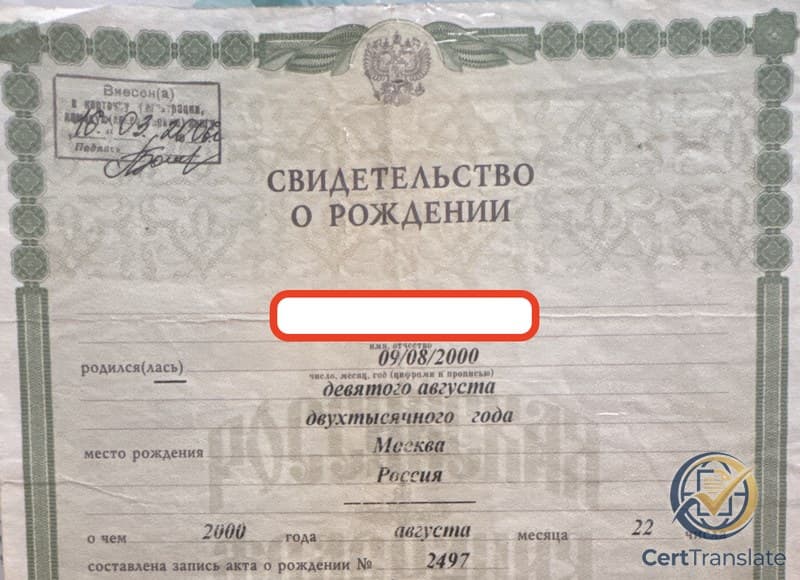
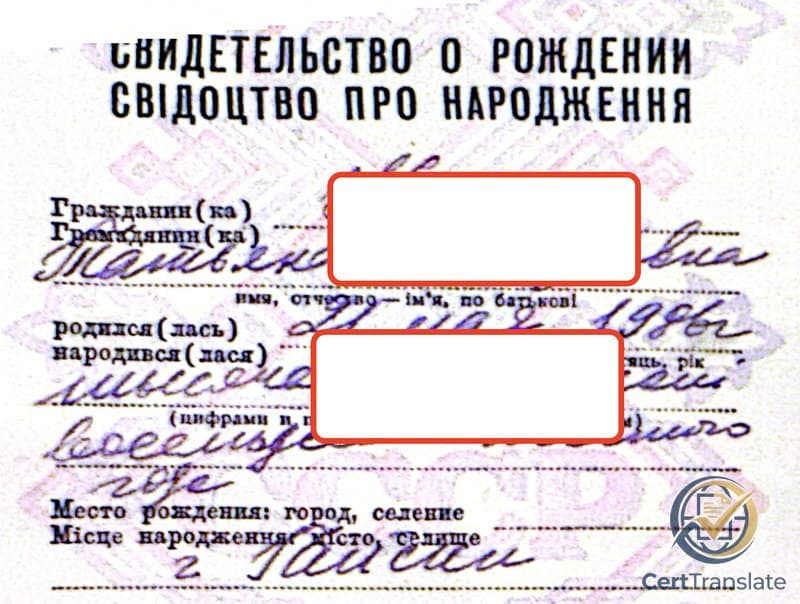
Birth certificate
ruсвидетельство о рождении
Russian birth certificate translation is frequently required for USCIS petitions and identity verification workflows.
Signed & stamped Certificate of Accuracy
Word-for-word · exact structure preserved
Russian → English
Certified Russian-to-English translations for USCIS, WES, courts, universities, and other official uses.
Ready within 24 hours
Russian expertise
Word-for-word, same structure
Cyrillic · patronymics · passport spelling · Soviet-era records
Certified package
Signed and Stamped Certificate of Accuracy
Letterhead · translator signature · company stamp

We check your files and confirm the total before you pay




If your records are in Russian and you are filing with USCIS, a U.S. court, or a university, you need Russian translation services that include every visible element from the source document.
Every Russian file is assigned to a native Russian speaker, and your certified Russian translation is handled by a specialist in civil records, legal documents, and academic credential workflows.
Russian to English translation requires more than fluency: patronymics must stay intact, Cyrillic romanization must match passport spelling, and Soviet-era or republic-specific terminology must be interpreted in historical context.
Matched to your language pair and document type.
On company letterhead with translator credentials.
Complete translation of everything visible in the source.
Objective translation errors are corrected at no cost.
Included for most 1–3 page orders.
Translation-related rejection: free revision, then refund.
Searchable, email-ready, and print-ready.
Russian-language documents are most frequently submitted with Form I-485 (Adjustment of Status), Form I-130 (Petition for Alien Relative), Form N-400 (Application for Naturalization), and Form I-751 (Petition to Remove Conditions on Residence).
ruсвидетельство о рождении
Russian birth certificate translation is frequently required for USCIS petitions and identity verification workflows.
Signed & stamped Certificate of Accuracy
Word-for-word · exact structure preserved
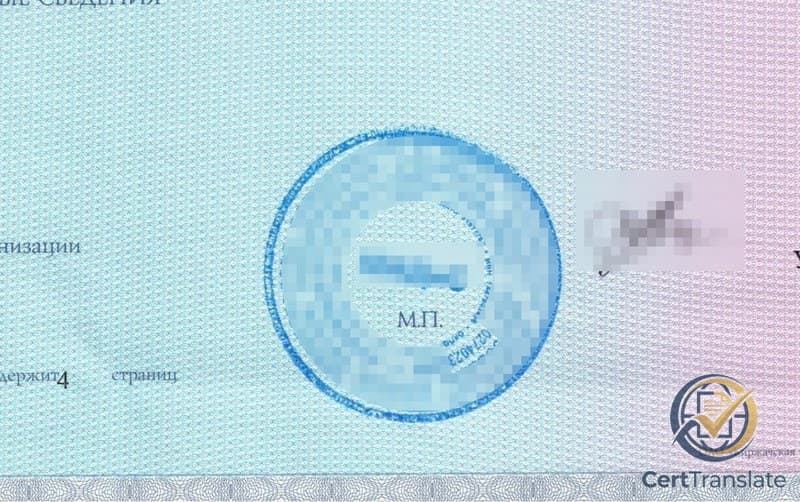
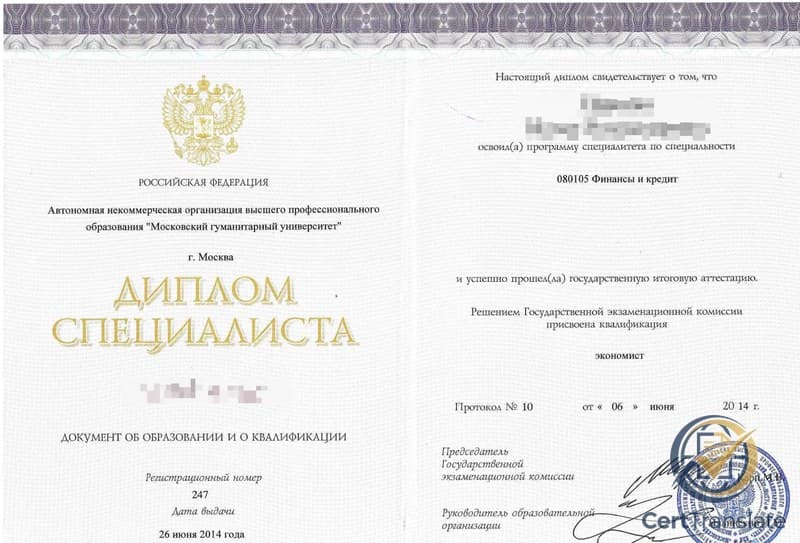
ruдиплом · приложение к диплому
Russian diploma translation is often required for admissions, licensing, and employment verification.
Signed & stamped Certificate of Accuracy
Word-for-word · exact structure preserved
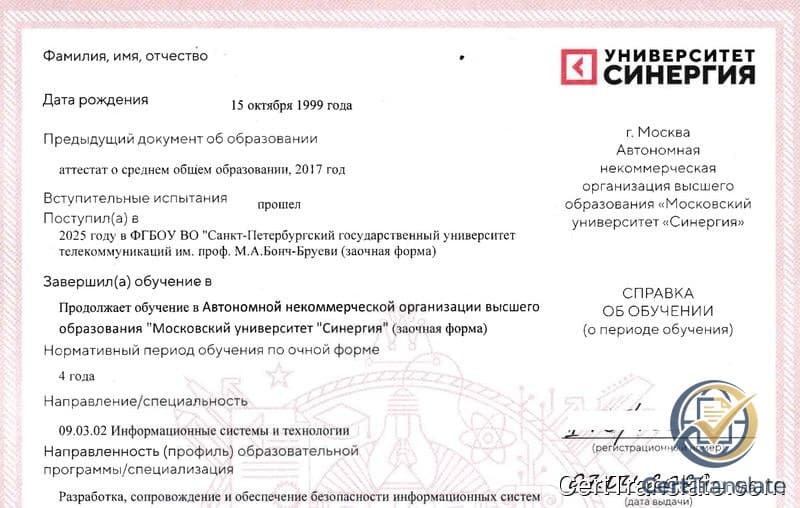
ruакадемическая справка · приложение
Academic supporting records require line-level translation of courses, grades, scales, and institutional headers.
Signed & stamped Certificate of Accuracy
Word-for-word · exact structure preserved
свидетельство о браке
свидетельство о расторжении брака · решение суда
свидетельство о смерти
паспорт
медицинские справки · судебные документы

Russian records reviewed by Elena Sokolova — ATA-certified Russian↔English translator · Senior Slavic languages reviewer
Russian translation quality for official use depends on precise transliteration control, patronymic preservation, and accurate handling of Soviet-era and republic-specific context. These are the issues that most often affect acceptance.
Russian names can appear under different transliteration systems depending on passport era and issuing standard.
A mismatch such as Iurii versus Yuri or Sokolov versus Sokoloff can create cross-document identity friction in filings.
We anchor final spelling to passport evidence and verify consistency across every translated page.
Russian patronymics are part of the legal full name and should not be omitted or treated as optional filler.
Dropping an отчество can make two valid records look inconsistent to USCIS or court reviewers.
We preserve full-name structure exactly and run final QA on every identity field in the packet.
Pre-1991 documents may reference institutions, republic names, and place names that have changed since issuance.
Silently updating those names can distort the legal meaning of the original record and confuse timeline review.
We translate as written and add concise neutral context when older institutional references need clarification.
Russian-language documents are often issued outside the modern Russian Federation, including Kazakhstan, Belarus, or Uzbekistan.
Treating all Russian-language records as Russia-issued can produce authority-label and jurisdiction errors in English.
We identify the issuing country first, then translate institutional language according to that legal context.
Russian diplomas often come with a separate supplement containing the full course and grade record.
If only the diploma cover page is translated, evaluators may still request the supplement before accepting the credential file.
We flag supplement requirements early and translate both documents together when needed.
Russian records frequently use compact abbreviations that are obvious locally but unclear in U.S. review context.
Literal abbreviation copying into English can create ambiguity around diagnoses, institutions, or legal status fields.
We expand abbreviations carefully in context while preserving the original meaning and document structure.
Upload scans, photos, or PDFs of your Russian records. If pages are old, handwritten, or include seals and side notes, send every page so readability can be confirmed before translation starts.
Your file is assigned to a native Russian translator matched to document type and official-use context. We do not route high-stakes civil or legal records to general translators outside this language pair.
We translate all visible content including text, seals, signatures, annotations, and structured fields. Names are checked against passport spelling, patronymics are preserved, and historical or republic-specific terminology is rendered with precise context. You receive a signed Certificate of Accuracy with your final translation.
A second native Russian reviewer verifies names, dates, patronymics, transliteration, institutional terminology, and completeness. This review stage catches subtle issues that commonly trigger official follow-up requests.
Certified PDF delivery is typically completed within 24 hours for standard files. Expedited turnaround and hard-copy mailing are available when your deadline is tight.
Secure Process
100% Confidentiality
Your files are transmitted over 256-bit SSL encryption. We never use Google Translate, DeepL, or any machine translation tool for official documents. Files are deleted within 30 days, or sooner on request.
“They translated my Russian birth and marriage certificates with perfect patronymic consistency. USCIS accepted everything on first submission.”
Irina V.
Brooklyn, NY • Birth + Marriage Records • USCIS family petition
January 2026 on Google
“My Soviet-era diploma and supplement translation for credential evaluation was excellent. They handled old institutional names correctly and the evaluator accepted it without revisions.”
Maksim D.
Chicago, IL • Diploma + Supplement • Credential evaluation
December 2025 on Trustpilot
“Excellent work on passport and civil records. They caught a transliteration mismatch before delivery, which saved us a filing delay.”
Svetlana K.
Miami, FL • Passport + Civil Records • Green card application
November 2025 on Google
“Fast and complete translation of older Russian legal documents with stamps and abbreviations. Our attorney approved the packet immediately.”
Anton P.
San Francisco, CA • Legal Records • Court filing
October 2025 on BBB
Anonymized Russian-to-English orders. Each case shows the exact translation problem and how we solved it for the receiving authority.
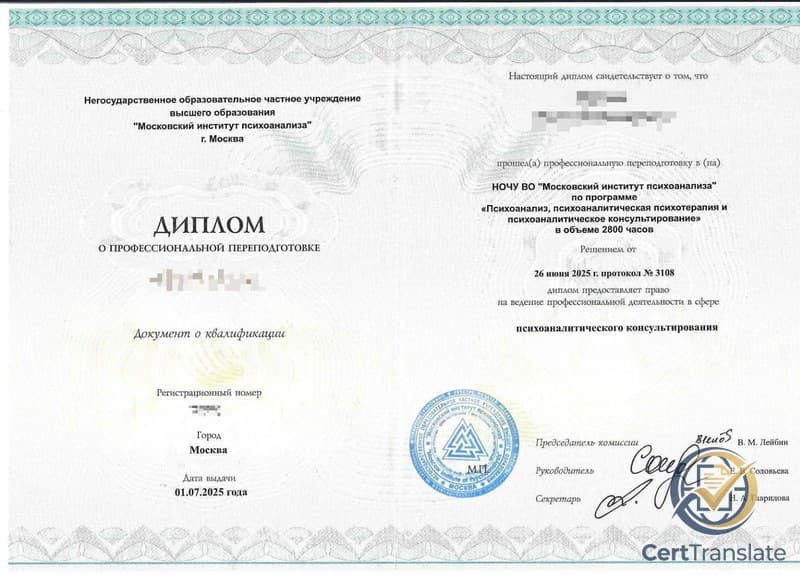
A client submitted two Russian credentials from the Moscow Institute of Psychoanalysis: a 2025 Diploma of Professional Retraining (2,800 hours, psychoanalytic counseling) and a 2022 Certificate of Advanced Training (48 hours). Both fall under Russian supplementary professional education — not academic degrees. We labeled each document type precisely, preserved the legal grant phrase, and kept the hour counts intact. The packet was delivered for Academic Evaluation Services (AES) filing.
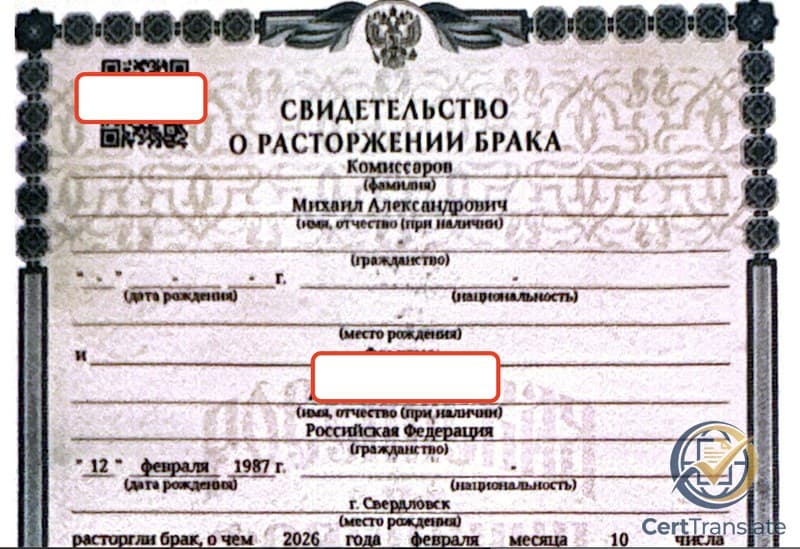
A Russian divorce certificate (свидетельство о расторжении брака) issued by Pervouralsk ZAGS carried full personal data only for the wife — the bearer of this copy — while the husband's date-of-birth, citizenship, nationality, and place-of-birth fields were blank. We rendered every empty field as '[Blank in original]' and added a Translator's Note explaining that post-2018 FGIS ЕГР ЗАГС practice issues each ex-spouse a copy with full data for the bearer only. The translation was delivered for a USCIS family-based filing.
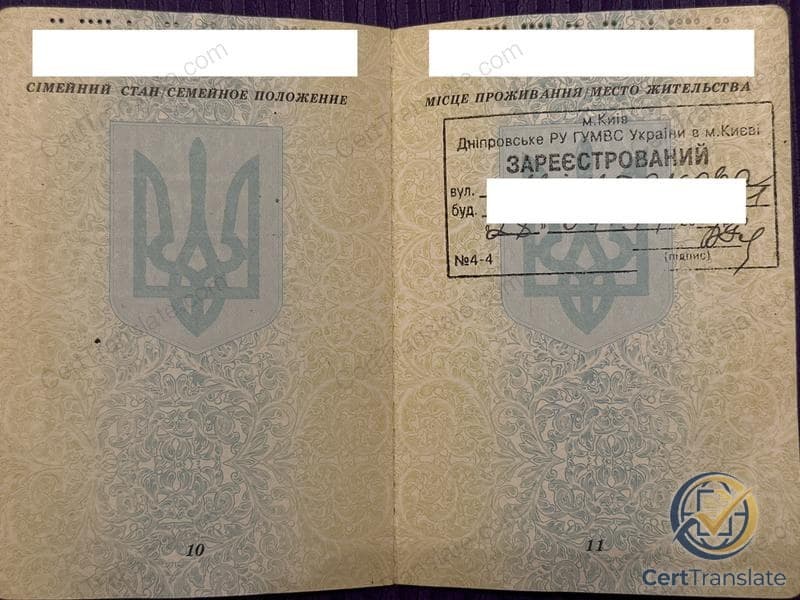
A Ukrainian internal passport (паспорт громадянина України) contained a dot-matrix perforated serial number and a 1991 handwritten residence registration stamp with a partially legible street name in Cyrillic cursive. We transcribed the perforated serial by examining each dot cluster under magnification, translated the bilingual Ukrainian/Russian headings once into English, and flagged the partially legible handwritten entries in the Translator's Notes. The certified translation was delivered for the client's USCIS immigration filing.
Russian is one of our highest-volume Slavic language pairs. Our workflow includes passport-aligned Cyrillic romanization checks and patronymic consistency QA before certification. We cover civil, legal, and academic records from Russia, Ukraine, Kazakhstan, Belarus, and Uzbekistan, including Soviet-era and modern formats.
Our Russian translation services are processed with passport-aligned transliteration checks, patronymic preservation, full-page completeness review, and two-person native QA before certification. This reduces avoidable USCIS and evaluator follow-up requests.
Most Russian requests involve civil, identity, legal, and academic records issued in Russia for immigration and official U.S. use, and Russian birth certificate translation is one of the most common packet types.
Russia is a Hague Apostille Convention member, so many modern records use apostille rather than embassy legalization when a receiving authority asks for authentication.
For documents issued before Russia's apostille system took effect on May 31, 1992, receiving authorities may instead require consular or embassy legalization, especially for older Soviet-era records.
USCIS still requires a complete certified English translation separately, so confirm both authentication and translation requirements before filing.
Many applicants submit Russian-language civil, court, and academic records issued in Ukraine, especially older Soviet-era and bilingual packets.
Ukraine is a Hague Apostille Convention member, so apostille is commonly used instead of embassy legalization when the destination authority asks for authentication.
The language may be Russian, but the issuing-country context must stay Ukrainian in seals, ministry names, and registry labels.
USCIS still expects a complete certified English translation, so upload related Russian-language and Ukrainian-language pages together for one consistent packet.
Many applicants submit Russian-language records issued in Kazakhstan, especially civil certificates, passports, and academic records from the post-Soviet period.
Kazakhstan is a Hague Apostille Convention member, so apostille is commonly used for cross-border education, court, and civil submissions instead of embassy legalization.
The language may be Russian, but issuing-country context must still be preserved in authority labels, ministry references, and seal descriptions.
For USCIS and university filings, upload all related pages together so one jurisdiction framework is maintained across the packet.
Belarusian records often appear in Russian and include birth, marriage, court, and educational documents for immigration and credential workflows.
Belarus is a Hague Apostille Convention member, so apostille is typically used when a foreign authority requires document authentication instead of embassy legalization.
Country-specific institutional naming should be translated as issued rather than normalized to Russian Federation usage, even when the source text is entirely in Russian.
USCIS still focuses on complete English translation and certification, so send the whole record and we confirm which pages should be translated together.
Russian-language documents from Uzbekistan often appear in mixed packets with Uzbek-language civil, court, or school records.
Uzbekistan is a Hague Apostille Convention member, so apostille is commonly used for cross-border submissions instead of embassy legalization when the destination authority requires authentication.
A translator must preserve issuing-country context and document-era meaning across all files, not only the language of the text, especially for registry extracts and older academic records.
USCIS still requires a full certified English translation, and mixed-language packets should be reviewed together before production starts.
Our Russian translation services use the same $24.95/page base rate as every other supported language. No language-based surcharges.
Optional add-ons
Exact price is confirmed after document review and before payment.
Many certified translation providers charge $30-$60 per page. Our Russian-certified workflow at $24.95 includes the Certificate of Accuracy, unlimited revisions, and USCIS acceptance guarantee.
Google Translate and DeepL often miss patronymic structure, ministry terminology, and historical institution names in Russian official documents.
A common failure is flattening свидетельство о рождении into inconsistent wording or generating Yuri/Iurii spelling shifts across the same packet.
These errors can trigger a USCIS RFE (Request for Evidence), so we use native human translators and second-pass native QA on every certified file.
A bilingual friend or family member may understand the document, but that does not create the independent certified translation USCIS and many institutions expect.
Informal translation usually omits a compliant Certificate of Accuracy and misses packet-level consistency checks for names, patronymics, and dates.
Every delivery includes a signed Certificate of Accuracy prepared for official submissions and reviewed for record-to-record consistency.
Russian patronymics are legal name elements and should not be removed to make names look more familiar in English.
Silent normalization can make valid records appear inconsistent to reviewers.
We preserve full-name structure and align transliteration with passport evidence across the packet.
Older records may reference institutions or places under historical names such as Leningrad.
Replacing those names with modern versions without explanation can distort the original document record.
We translate as written and add concise neutral context where needed for reviewer clarity.
Translating only the diploma face page often leaves evaluators without the detail they need to assess the credential, especially in Russian diploma translation for WES or ECE review.
This can trigger re-requests for the supplement or transcript after submission.
We flag supplement requirements early and translate the full academic packet when needed.
Rejections often happen when only main body text is translated and official marks or abbreviations are omitted.
Russian civil, legal, and medical records can place essential context in compact notes or stamp areas.
We require full visible-content translation including seal descriptions, abbreviation expansion, and annotation lines.
Submitting your Russian documents to a specific country? Check translation requirements by country
Your Russian documents are translated by native Russian speakers with passport-aligned transliteration checks, patronymic preservation, and full certification support.
We handle civil, legal, and academic records for USCIS, courts, and universities with fast turnaround and strong two-person QA.
Start your order now or call to confirm requirements before payment.
Elena Sokolova
Native Russian speaker · Senior team translator • Language pair: Russian <> English