Russia · Degree vs program
The Russian “diploma” was not an academic degree
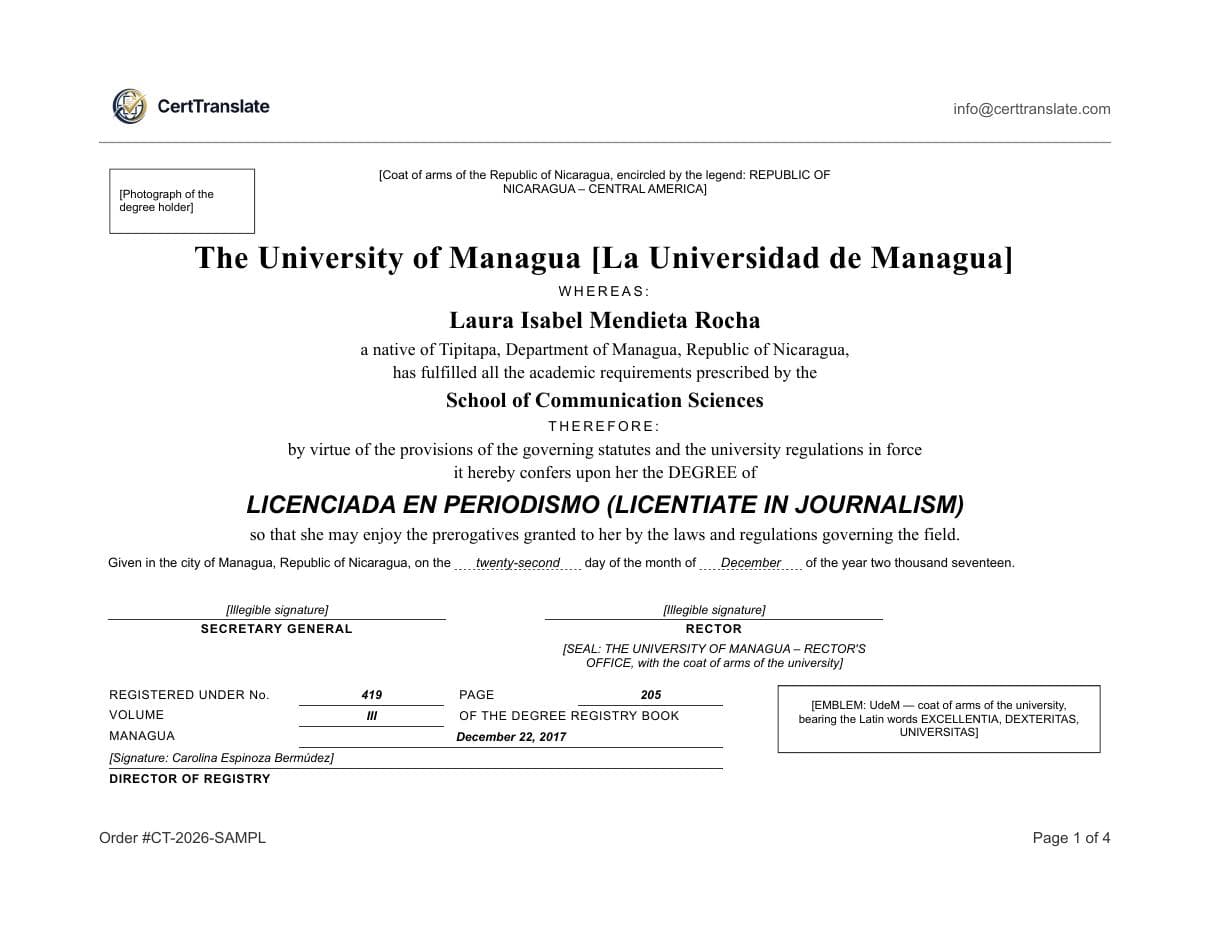
A Diploma of Professional Retraining was labeled precisely as supplementary education, so the evaluator saw its real level.
Read the caseДипломПриложение к дипломуДиплом специалиста
Russian and Soviet-era diploma translations for WES and ECE preserve the exact credential level—specialist, bachelor, master, or postgraduate—together with the diploma supplement, honors, institution history, seals, and registry numbers.
Ready within 24 hours
Russian academic records
Degree title and document structure preserved
Specialist degrees · diploma supplements · honors · seals
Certified package
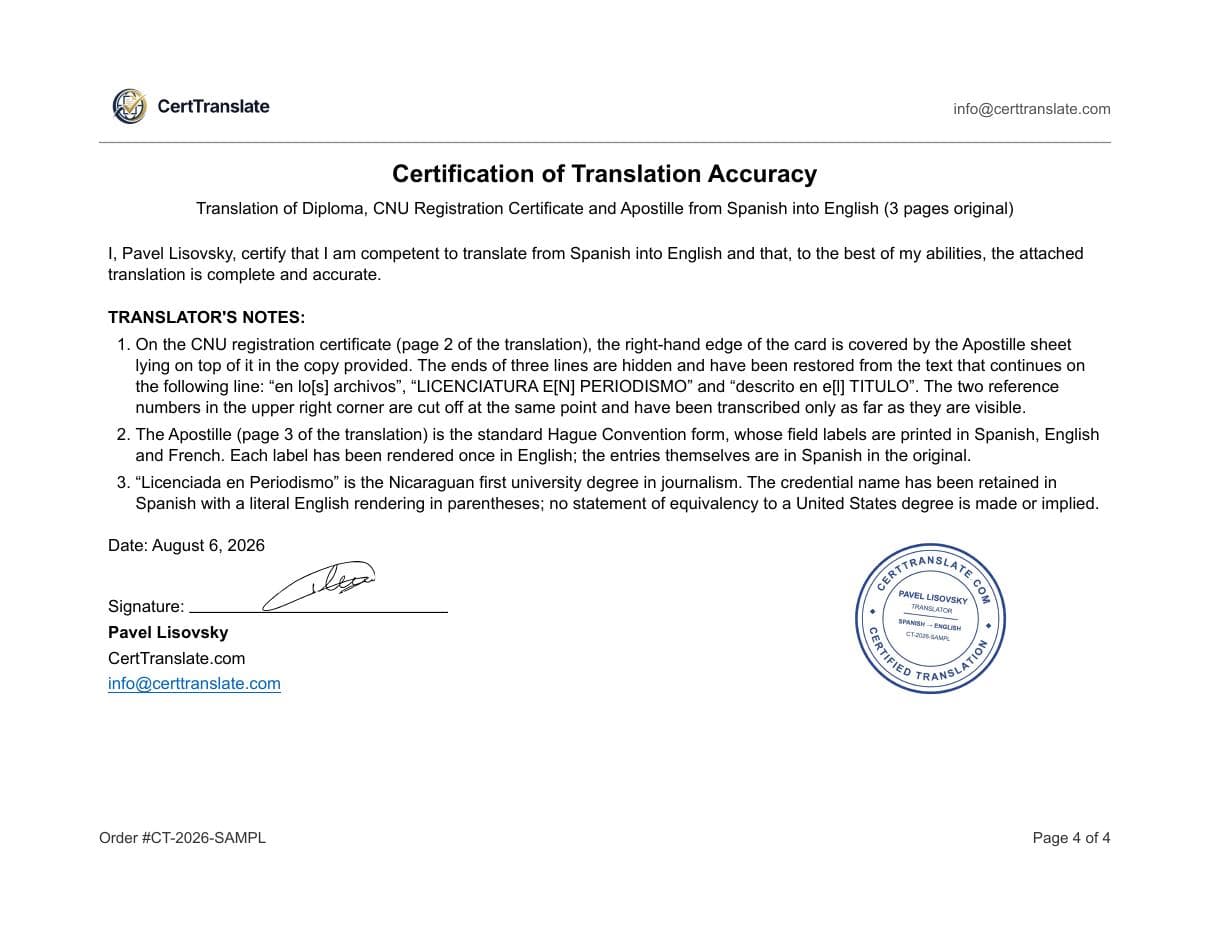
Signed and Stamped Certificate of Accuracy
Company letterhead · translator signature · company stamp

We check your files and confirm the total before you pay




What you receive
Your final package includes a copy of the source document, the complete English translation, and a signed and stamped Certificate of Translation Accuracy. The certificate states that the translation is complete and accurate and that the translator is qualified to translate it.
Files checked and total confirmed before payment
Before you order
Upload every academic page you have. We identify the diploma, supplement, and era-specific records, then confirm the page count, price, and delivery time before you pay.
01 · Always start here
Upload the front and back, including the degree title, institution wording, every seal, signature, and handwritten note.
02 · Commonly reviewed with it
The course-by-course insert with grades and hours. Evaluators usually review the diploma and supplement as one set.
03 · Depends on the era and country
Soviet-era records and Russian-language credentials from Kazakhstan, Uzbekistan, or Belarus may add pages the evaluator wants together.
Real Russian diploma translations
Each case shows what was unusual, how we translated it, and what the evaluator or licensing board needed to see.
Russia · Degree vs program
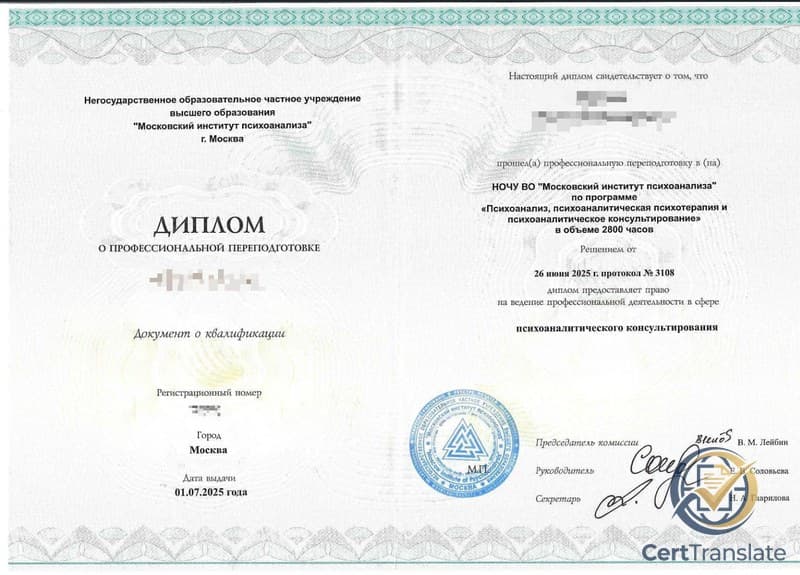
A Diploma of Professional Retraining was labeled precisely as supplementary education, so the evaluator saw its real level.
Read the case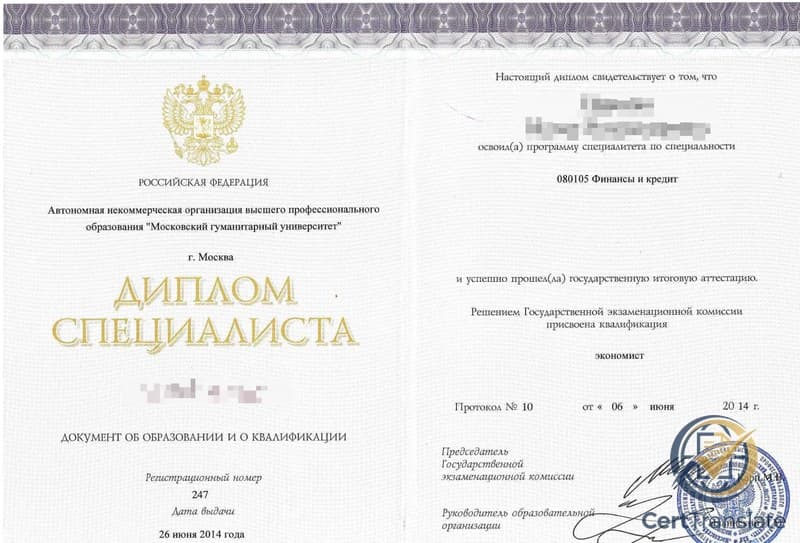
Russia · Renamed institution
The supplement’s renaming disclosure was preserved and translated, so the institution chain stayed verifiable.
Read the case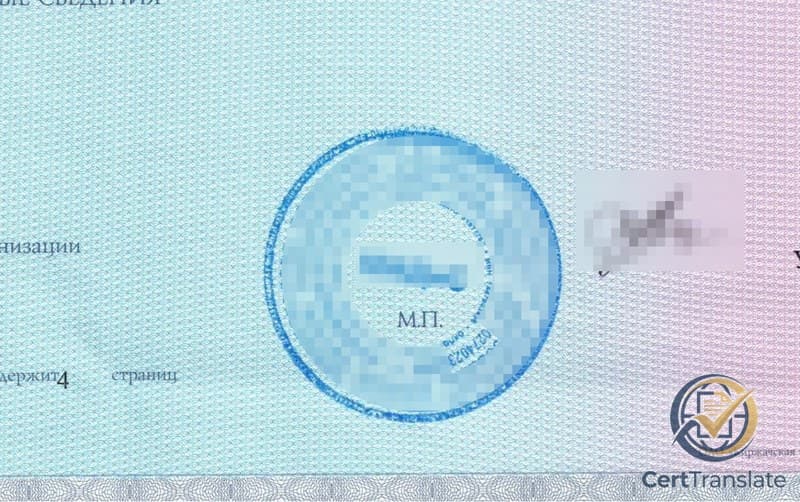
Russia · Seal number
The fine curved registry digits blurred on the scan — a check digit settled the reading before certification.
Read the caseHow it works
Upload your documents first. We confirm the pages, price, and delivery time before you pay. You can review the translation before we certify it.
Send a PDF, scan, or phone photo. Include the diploma, the supplement, both sides, and any apostille or earlier-degree pages.
Degree title, institution history, romanization, dates, seals, and the supplement are checked against the source and your passport spelling.

Request free corrections before certification. After approval, you receive the complete English translation and a signed, stamped Certificate of Translation Accuracy.

One physical page is billed once.
We do not split a dense page into two or three billed pages.
Certified price
$24.95/ page
No payment until file review
Client reviews
Natalia K.
Brooklyn, NY
“They translated my Soviet-era diploma and supplement without rewriting the school name into something modern. WES accepted the set.”
Soviet era · Diploma + supplement
WES accepted the set
Sergey P.
San Diego, CA
“My Russian degree title and passport spelling did not match older translations. The romanization was corrected and the evaluator had no issue.”
Russia · Degree title + romanization
Evaluator had no issue
Irina B.
Philadelphia, PA
“The supplement mattered for my licensing packet and they kept the entire diploma set consistent across all pages.”
Licensing · Full diploma set
Packet stayed consistent
System-specific diploma review
A modern Russian diploma, a Soviet-era award, and a Russian-language credential from an ex-USSR state follow different rules. Choose the system where you studied to see what we check.
Диплом · Приложение к диплому
Also issued with: The supplement usually travels with the diploma
Modern Russian diplomas pair the main award with a supplement that lists the program and grades. Post-2003 records use бакалавр and магистр wording, while older files may still follow the specialist structure.
We preserve the structure of both records and keep the official degree wording and the romanized name consistent with your passport.
Диплом специалиста
Also issued with: Кандидат наук and доктор наук research degrees
Soviet diplomas carry institution names, ministry seals, republic references, and degree language that no longer appear on modern records. Pretending the system is modern creates confusion, not clarity.
We preserve the legacy institution wording and the document structure. When a note helps, it explains the institutional history without replacing the source terminology.
Диплом (bilingual sets)
Also issued with: Kazakhstan, Uzbekistan, and Belarus most often
Diplomas from Kazakhstan, Uzbekistan, and Belarus may pair Russian with the national language, reflect transition-era wording, or come from institutions whose status changed after independence.
We keep the institution title, award wording, and romanization aligned across the whole academic set, and use translator notes only where an institution-history note genuinely helps.
Hold a Russian-language diploma from another country? These are the three systems we see most often, but we translate Russian-language credentials from any issuing system.
Translate another Russian diplomaCompare page-based pricing
A diploma may contain only a few words, but a transcript, registry page, or supplement can be dense. A provider with a 250-word cap may bill one physical page as two or three pages.
CertTranslate
$24.95 per physical page, regardless of word count
Typical capped provider
Re-counts the same document in 250-word billing units
Included here
Matched formatting, certification, and free corrections for objective errors
Your quote is based on physical pages. We confirm the page count and final total before payment.
Typical — a diploma, registry page, or short supplement
1 page × $24.95 — flat, no word cap
380 words ÷ 250 = 2 billed pages × $24.95
You keep $24.95 on this document.
Get your exact priceComparison estimate only, based on a 250-word page definition at a representative $24.95 per-page rate. Your final price depends on the actual document.
Frequent problems we correct
These four issues can make a diploma difficult to compare with the original. We check for each one before certification.
How we handle it: We keep диплом специалиста as “Specialist” and never relabel it “Master’s” — substituting degree systems misrepresents the credential.
How we handle it: We reconcile GOST-style older spellings with the ICAO passport spelling, so the diploma is not read as belonging to a different person.
How we handle it: We keep the original institution wording and add a context note rather than swapping in a current name.
How we handle it: We flag a missing supplement, since evaluators often need both the diploma and the приложение к диплому.
The standard behind these checks
AcceptReady™ is CertTranslate's published standard for certified translations: complete word-for-word translation, mirrored page layout, signed and stamped Certificate of Accuracy on letterhead, and matched to the receiver's published requirements.
How to check each one yourselfIf a field is unreadable, we do not guess. We ask for a clearer image or identify the limitation in a translator note.
Upload files for a free checkCertified diploma translation FAQ
Clear answers about WES, ECE, the supplement, Soviet-era degrees, price, delivery, notarization, and seals.
Certified Russian diploma translation starts at $24.95 per physical page. One physical page is billed once, even when it contains more than 250 words. We confirm the page count and total before payment.
Most 1–3 page orders are delivered within 24 hours, included in the standard price. Twelve-hour Rush and six-hour Super Rush are also available. If the documents are longer or difficult to read, we confirm the delivery time before work begins.
WES requires an exact, word-for-word English translation when a translation appears in your personal Required Documents list. We provide it with a signed and stamped Certificate of Translation Accuracy. WES makes the final decision. If it requests a translation-related correction, we revise it free; if the translation is still rejected for that reason, we refund the translation cost.
ECE uses different rules from WES. ECE offers a paid Translation Waiver and may accept a word-for-word translation prepared by the applicant when the waiver is not purchased. Check your ECE order before buying a separate translation.
Yes. Translating the diploma and приложение together keeps the student name, institution, degree title, and course terminology consistent. Whether you need both depends on the evaluator. Upload every academic document you have, and we will identify which pages need translation before you pay.
No. CertTranslate translates the academic documents into English. WES, ECE, or another evaluator decides the U.S. equivalency of the degree. We preserve the original credential wording and do not invent a U.S. degree or GPA conversion.
Usually yes. The приложение carries the course-by-course record that explains the diploma, and evaluators often review both documents as one set. Ordering them together keeps romanization and terminology consistent.
We translate the credential label as issued — диплом специалиста stays “Specialist” and кандидат наук stays “Candidate of Sciences” — with a neutral note only for clarity. The evaluator decides how the credential compares to U.S. terms.
Yes. Upload the front and back, including every seal, stamp, signature, registry entry, and attached apostille. We translate or describe every legible element that appears on the document.
A certified translation includes the translator’s signed statement that the translation is complete and accurate. Notarization only verifies the identity of the person signing that statement. Add notarization only when the organization receiving your diploma asks for it.
No. One physical page stays one billed page, even when the diploma, transcript, or supplement is unusually dense.
Evaluator reference
These descriptions show how each credential fits into its local education system. The evaluator—not the translator—decides its formal U.S. equivalency.
| Original degree | Place in local system | Typical duration | Translation note |
|---|---|---|---|
| Бакалавр (bakalavr) | First university degree | 4 years | Bologna first degree, used since 2003 |
| Магистр (magistr) | Postgraduate degree | 2 years | Bologna second degree |
| Диплом специалиста | Long-cycle first degree | 5 years | Soviet-era “Specialist” — kept as issued, never relabeled |
| Кандидат наук | Research degree | 3+ years | Candidate of Sciences — the evaluator maps its level |
| Доктор наук | Higher doctorate | — | Doctor of Sciences — above Candidate, no direct U.S. match |
Document glossary
These terms explain why the diploma, supplement, and research degrees may need to be translated as separate documents.
Common destinations
The documents you need depend on where you are submitting the translation. These examples show what each reviewer checks and what people commonly send with a diploma.
Evaluators compare the English diploma with the original and usually review the transcript in the same file.
Commonly sent
Diploma + supplement + transcript set
Admissions teams use the translation to confirm your degree, field, institution, and graduation date.
Commonly sent
Diploma + transcript or academic supplement
Nursing, engineering, teaching, and other boards may need both the academic award and professional registration.
Commonly sent
Diploma + supplement + license or registration evidence
An employer or immigration counsel may use the credential to document the degree claimed for the role or petition.
Commonly sent
Diploma + any evidence named in the request
Not sure which path applies to your diploma?
Upload your diploma and any related academic documents. We’ll confirm which pages need translation, the price, and the delivery time before you pay.
Reference library
Sources verified .
Ready when you are
Include the supplement, the back of the diploma, and any transcript or apostille pages. We’ll confirm the pages, price, and delivery time before you pay.
No payment until file review