
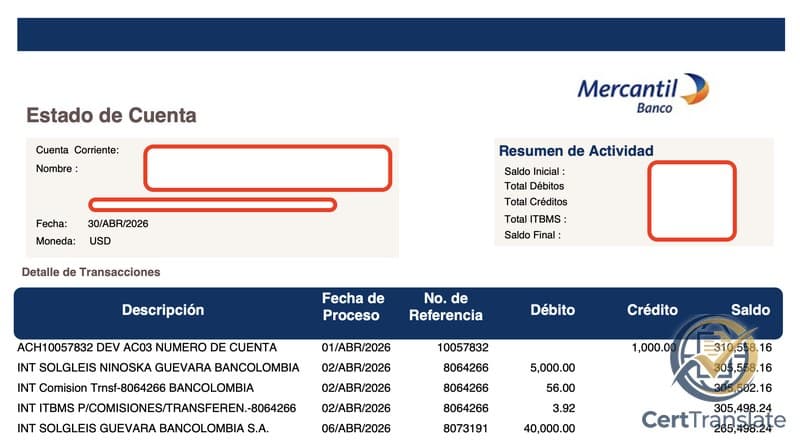
Proof of funds
A label the translator read as redundant
We restored the account type on the certified page, because the reviewing university counts a balance only when the statement says which kind of account holds it.
Read the caseComplete certified English translation of every statement page for visa, USCIS, and university proof of funds — amounts and currency exactly as your bank issued them.
Ready within 24 hours
Financial record
Balances and transactions stay aligned
Account fields · dates · transaction text · currency · bank details
Certified package
Signed and Stamped Certificate of Accuracy
Company letterhead · translator signature · company stamp

We check your files and confirm the total before you pay




Your finished package
Your delivery includes the source-document scan, a complete English translation, and a signed and stamped Certificate of Translation Accuracy.
Files checked and total confirmed before payment
A statement’s layout follows its bank, not its language. Tax lines, branch codes, and number formats change from one country to the next, and each note below says what we look for. Same $24.95 flat page rate on all of them.
A Mexican statement header carries two identifiers that are not account numbers: the 18-digit CLABE used for interbank transfers, and the account holder’s RFC tax number. Both are transcribed digit for digit and labeled, never merged into one "account" line.
Value-added tax on bank fees prints as its own debit row rather than being folded into the fee. We translate the row and leave the tax acronym as the bank writes it, with the English expansion on first appearance.
Amounts stay in pesos. Where a statement shows both MXN and USD columns, each keeps its own currency label so a reviewer can tell which figure is which.
Mexico is a party to the Hague Apostille Convention, which matters when a non-U.S. authority asks for legalization after the translation is done.
Colombian statements carry a small recurring debit for the financial-transactions tax, charged at four pesos per thousand moved. It looks like a rounding artifact next to the transfer it follows, and it is a real charge that stays in the translation.
Account numbers appear beside a separate product or office code, and the two are not interchangeable. We keep them on separate labeled lines so the receiving office reads the account it was given.
Statements downloaded from a bank portal often arrive without any stamp or signature. That is normal for an electronic statement, and we describe the format in a translator’s note rather than leaving a reviewer to guess.
Balances stay in Colombian pesos, where the large digit groups make the thousands separator worth checking twice — we transcribe the number as printed.
Panamanian transaction lines are mostly bank-internal shorthand, and much of it is not in any dictionary. On a statement we delivered in May 2026, almost every description line was an abbreviation: the movable-goods-and-services tax, a channel code the legend never explained, and a two-letter code for a returned transfer.
We expand each code into English, keep the original beside it, and add a translator’s note for anything the bank uses privately. Guessing a code changes what the row says happened.
Accounts are held in U.S. dollars, so figures need no conversion — but Spanish month abbreviations in the date column do need care. We spell the month out in English so a date cannot be read two ways.
A holder living abroad may have a foreign address printed on a Panamanian statement. It is kept exactly as issued, because the mismatch is information a reviewer is entitled to see.
A Brazilian statement identifies the account by a branch number and account number together, and identifies the holder by their CPF taxpayer registration. Dropping either one leaves a receiving office unable to verify the record.
Instant-transfer rows carry the counterparty name and a transaction key rather than a description. We translate the labels, keep the key untouched, and preserve the order the entries were posted in.
Amounts stay in reais, written with a decimal comma and a thousands point. Reformatting them into U.S. punctuation would change the number a reviewer reconciles against the original.
Brazil is a party to the Hague Apostille Convention, so an apostille is the usual legalization route when a non-U.S. authority asks for one.
Chinese banks issue a transaction statement printed at the branch and closed with a red institutional seal. The seal is part of the document, so it is described and translated rather than passed over as decoration.
Transaction descriptions use short settlement and channel categories that repeat down the page. Each is rendered the same way every time, because inconsistent wording across months is what makes a reviewer re-read.
Names are romanized to match the spelling on the passport in the same packet, not re-romanized independently. A statement that spells the holder differently from the filing is the mismatch that gets questioned.
Figures stay in renminbi with the currency named. We do not restate a balance in another currency, because the converted figure is not one the bank certified.
Indian statements identify the branch by an 11-character IFSC code, and the transaction narration usually names the rail that moved the money — NEFT, RTGS, IMPS, or UPI. We keep the codes verbatim and translate the words around them.
Large amounts are grouped in the Indian numbering system, so a balance can read 12,34,567.89 rather than 1,234,567.89. It is transcribed exactly as printed; regrouping the digits would change how the figure scans.
Many Indian statements are issued in English already, sometimes with only a header or a stamp in another language. Send the file and we will tell you whether it needs a full translation or none at all.
Where entries do appear in a regional language, the same term is used across every month so a multi-month packet reads as one record.
Ukrainian statements often arrive as a PDF exported from a banking app, with no stamp and no signature anywhere on the page. That is the normal form of the document, and a translator’s note saying so is more useful than a missing-seal marker.
Transaction rows name the counterparty and the payment purpose in full sentences rather than codes, which makes completeness the thing to watch — every row is translated, including small recurring fees.
Balances stay in hryvnia. Where a statement runs several currencies in parallel columns, each column keeps its own label so no figure is read against the wrong currency.
Ukraine is a party to the Hague Apostille Convention, which is the route to follow if a non-U.S. authority asks for legalization.
Most Philippine bank statements are issued in English already, which often means no translation is needed at all. Upload the file before ordering and we will say so plainly rather than bill you for a page that does not need us.
Where a statement does carry local-language entries, they usually sit in the branch name, a stamp, or a footer note rather than the transaction table.
Amounts stay in pesos with the currency named, so a reviewer converting for their own purposes starts from the figure the bank issued.
The Philippines joined the Hague Apostille Convention in 2019, so an apostille replaced consular legalization for documents going to other member countries.
“A bank statement is read as arithmetic, not prose. Every figure has to reconcile against the page it came from, so we translate the words around the numbers and leave the numbers alone.”

Real financial-record casework
Three anonymized orders. Each one turned on a detail a reviewer checks, and shows the decision we made.
Proof of funds
We restored the account type on the certified page, because the reviewing university counts a balance only when the statement says which kind of account holds it.
Read the case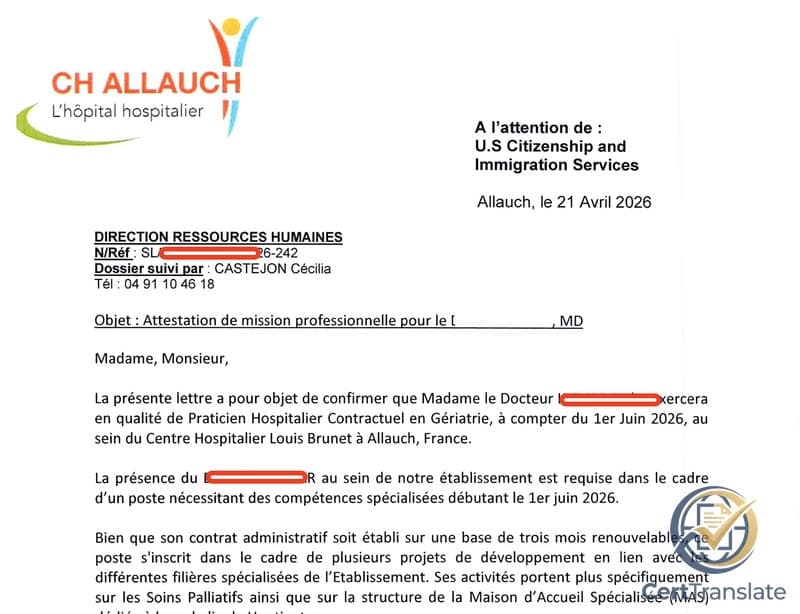
Support evidence
We translated all five lines inside the stamp rather than copying them across, so the office, the title, and the phone number reached the reviewer in English.
Read the case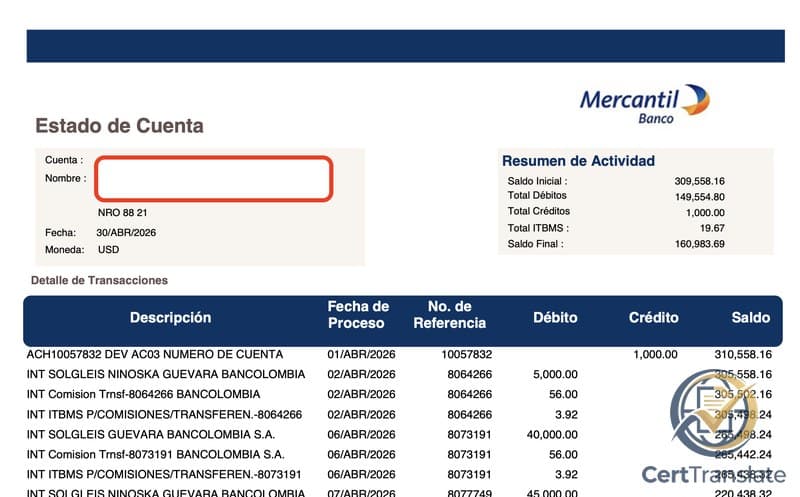
Bank shorthand
We expanded each code into English and kept the original beside it, adding a translator’s note for the tax acronym the bank prints on its own lines.
Read the caseHow it works
Upload once. We check the files and confirm the total before payment. Then our team translates, reviews, and certifies the complete package to the AcceptReady™ standard we publish.
Send every page of every month the office asked for, summary page and continuation sheets included. A PDF downloaded from your bank portal reads far better than a photo of a screen.
A translator renders every row, header, and stamp. A second reviewer checks the account holder’s name against the rest of your packet, then every date, code, and figure against the source page.

Corrections are free at this stage. Once approved, the certified files arrive as a searchable PDF ready for the consulate, the admissions office, or your attorney.

One physical page means one billed page.
No 250-word cap and no dense-page rebilling.
Certified price
$24.95/ page
No payment until file review
Cost
A certified bank statement translation costs $24.95 per physical page. One monthly statement is often one or two pages, and the three-month set most offices ask for lands between $74.85 and $149.70.
Start my order| What you are sending | Certified total |
|---|---|
| One month, 1 page | $24.95a short statement with few transactions |
| One month, 2 pages | $49.90the usual length once a transaction table runs over |
| Three months, 6 pages | $149.70the period most consulates and schools name |
| 7 or more pages | $24.95 per pagesix-month runs and multiple accounts — count confirmed first |
A note on “100% acceptance”
If a service promises “100% acceptance,” be careful — no one controls USCIS’s decision. What actually protects you is the written remedy: we revise free, or refund in full.
A single statement page can carry forty transaction rows and several hundred words. Count the pages you are sending below, and the total is that count times $24.95 — however many rows sit on each one.
Typical — a full month of transaction rows
A capped provider counts a “page” as 250 words or less, so one dense physical page is billed as two. We bill the page you actually send.
1 page × $24.95 — flat, no word cap
380 words ÷ 250 = 2 billed pages × $24.95
You keep $24.95 on this document.
Get your exact priceComparison estimate only, based on a 250-word page definition at a representative $24.95 per-page rate. Your final price depends on the actual document.
This is an estimate. Upload your document to confirm the exact page count and total before you pay — no card required.
Client reviews
Carlos M.
Houston, TX
“Consulate asked for six months of statements and they translated every page clearly. My visa file was accepted without extra questions.”
Visa interview · Six months of statements
Accepted without questions
Fernanda L.
Miami, FL
“Fast turnaround and accurate formatting. Admissions office accepted the translated statements on first review.”
Proof of funds · Admissions review
Accepted on first review
Rahul P.
Edison, NJ
“Our attorney appreciated that branch details and statement notes were fully translated. No resubmission was needed.”
Legal packet · Branch details intact
No resubmission needed
Questions before ordering
If your statement does not match one of these situations, send it anyway. Support replies in 15–30 minutes during support hours.
A certified bank statement translation costs $24.95 per physical page. Most visa and admissions packets run three to six pages. There is no word cap, and we confirm the page count and total before you pay.
A three- to six-page set is usually delivered within 24 hours of a clear upload. Six-month runs, multiple accounts, and faint scans take longer, and we name the window before work begins.
USCIS accepts a certified translation that renders the whole document and carries the translator’s signed certification, and your delivery includes both. If a receiving authority rejects the translation for a translation-related reason, we revise it free. If it is still rejected, we refund the translation cost.
We translate bank statements from 65+ languages into English, whichever bank issued them. Send the file even if your statement mixes scripts or prints its transaction lines in local shorthand — the rate and the timeline do not change.
Translate the exact period the receiving office named, most often the last three or six months. Send every page of each month, summary pages included, so the run has no gap for a reviewer to ask about.
No — amounts stay in the currency your bank issued, and every figure is transcribed digit for digit. A converted number is one the bank never printed, so a reviewer cannot reconcile it against the original. If you need a conversion for planning, we can supply it as a labeled note outside the certified translation.
Yes, and it is the best source you can send. A PDF exported from your bank portal keeps every row sharp and nothing cropped. Screenshots of a phone screen usually cut off the header, the balance column, or the closing total.
Usually yes. Many banks print English column headers above transaction lines that stay in the local language, and a reviewer reads every line. Upload the file and we will tell you what is actually left to translate.
For most USCIS submissions, certification is the requirement and notarization is not. Some consulates and courts do ask for it, and we add notarization for $19.95 per order without changing the translated text.
No. A page is one physical page of the source document. Many services cap a page at 250 words and rebill a dense page as two or three; we bill the page you upload.
Yes. You can read the finished translation and request unlimited free corrections before we certify it. If an authority later asks for a translation-related change, we correct the certified file at no charge.
Yes. Statements move over encrypted connections, only the team assigned to your order can open them, and we delete source files 30 days after delivery or sooner on request. We sign NDAs when you need one.
Four things, and you can check all four yourself. Compare any line of the original bank statement with the translation, including the text inside stamps. Put the two documents side by side — same page count, same order, course tables, grades, and totals where the reviewer expects them. Read the Certificate of Accuracy for the complete-and-accurate statement, the competence statement, the signature, date, and company stamp. Then confirm the wording matches what your receiving office publishes. Those four checks are the AcceptReady™ standard, and CertTranslate publishes it in full. Read the AcceptReady™ standard.
What we check before certification
These four come up across visa, sponsorship, and admissions files, both in statements we translate and in translations we are asked to repair.
Our check: We keep the issued currency and transcribe every figure as printed. A converted amount is a number the bank never wrote, and it cannot be reconciled against the statement.
Our check: Each bank abbreviation is expanded into full English with the source code kept beside it, so a reviewer can trace every line back to its original row.
Our check: We compare the uploaded pages against the period you name, then flag a missing month or an out-of-order page before translation starts.
Our check: Every submitted row is translated in source order, fees and repeated entries included. A balance without its transactions reads as a partial record.
The standard behind these checks
AcceptReady™ is CertTranslate's published standard for certified translations: complete word-for-word translation, mirrored page layout, signed and stamped Certificate of Accuracy on letterhead, and matched to the receiver's published requirements.
How to check each one yourselfChecked before certification. If an authority later requests a translation-related correction, revisions remain free.
Start my translationCommon filing contexts
Financial evidence is read by someone doing arithmetic. A consular officer looks at whether the balance holds up across months; an admissions reviewer checks it against a published cost figure. Both are reading numbers, not prose.
Consistency decides the rest: the name on the statement should match the passport spelling used across the filing, and every account you rely on should be in the packet.
Consulates commonly ask for three to six months of statements, so an officer can see account history rather than one balance.
A sponsor filing foreign-language financial evidence submits a certified English translation alongside the original pages.
Schools measure the balance against a published cost of attendance, and the account type decides whether it counts.
Attorneys and auditors read transaction lines as evidence, so one omitted row changes what the record shows.
Document glossary
The parts of a statement that decide how the translation is built — the same parts in every language.
Reference library
Guidance and source links last rechecked .
Ready when you are
Upload every page of every month the office asked for, summary pages included. We confirm the page count, price, and delivery time before you pay.
No payment until file review
