Who needs a certified medical records translation?
USCIS and humanitarian immigration filings
If you are filing Form I-485 (Adjustment of Status) and your packet references Form I-693 (Report of Immigration Medical Examination and Vaccination Record), USCIS medical records translation may be required for supporting non-English evidence.
Submitting partial translation is risky because USCIS officers often review diagnosis notes, treatment timelines, and physician remarks together with the source record.
A complete certified package with all relevant pages translated reduces avoidable document follow-up.
Insurance, disability, and legal claims
Courts, insurers, and disability reviewers may require translated records to evaluate treatment chronology, procedures, and provider findings.
In these cases, dosage details, lab values, and physician comments must remain exact because reviewers use them as evidence, not summary context.
Certified translation is commonly required to establish that the record is professionally translated and traceable.
Specialist referrals and continuity of care
When changing providers across countries, translated records help specialists understand prior diagnoses, medication history, and test results.
Accurate terminology and preserved units are essential so receiving clinicians can interpret findings safely.
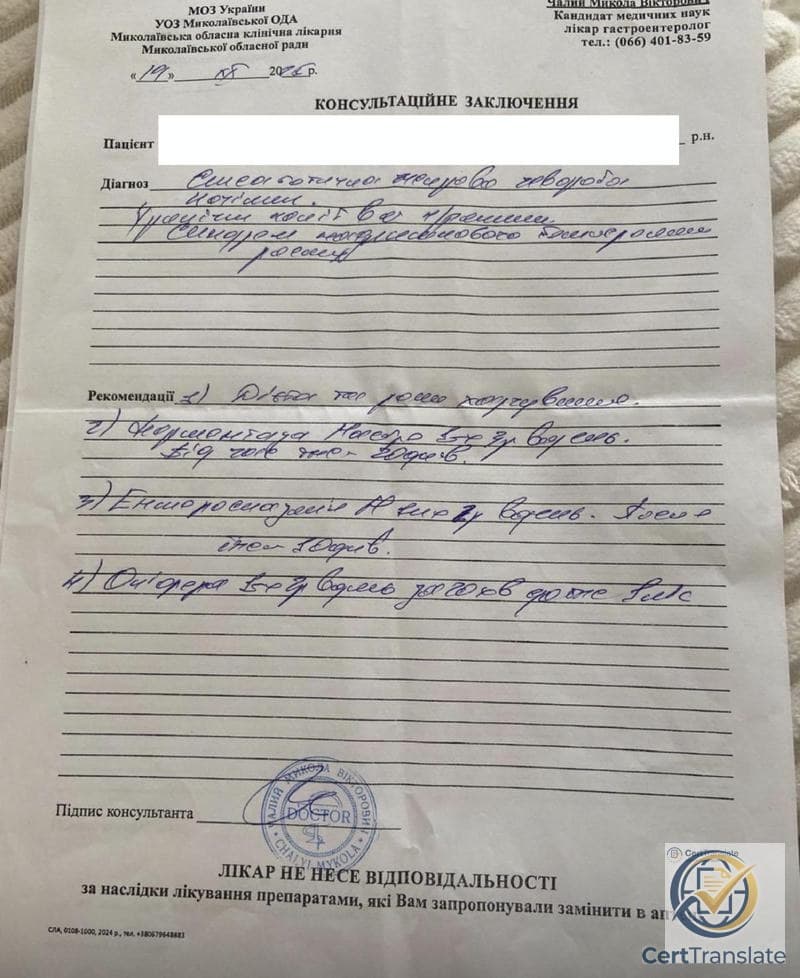
If records include handwritten notes, they should still be translated or marked [illegible] where unreadable rather than omitted.
Academic, licensing, and occupational medical clearance
Some schools, employers, and licensing boards request translated medical documents for health clearance or compliance review.
Requirements vary by institution, and notarization may or may not be required depending on destination policy.
Using the requirements checker first helps you choose the right scope and avoid repeating work under deadline pressure.
What you get with every certified medical records package
Delivery Promise
In medical translation, precision is non-negotiable. We do not summarize clinical language, reinterpret provider intent, or convert units in the translated record. Instead, we preserve the source faithfully and format sections clearly so legal, immigration, and clinical reviewers can verify details line by line. Each certified medical records translation is handled by terminology-focused linguists, and our medical records translation services include dosage-line checks, lab-unit integrity review, and abbreviation expansion controls.
Medical records translation by country of origin
Mexico
Mexican medical records often mix structured report fields with handwritten physician annotations that still require full translation.
Medication lines are translated exactly, including dosage and frequency, with no normalization of clinical instructions.
Lab result tables are preserved with original units so receiving reviewers can interpret values in source context.
Hospital discharge summaries and specialist notes are translated together when submitted as one evidentiary set.
Mexico is a Hague Apostille Convention member, so apostille is the standard legalization route when a non-U.S. authority requests authenticated medical records after translation.
We process Spanish medical records regularly and run dedicated checks for abbreviations, units, and physician credential lines before release.
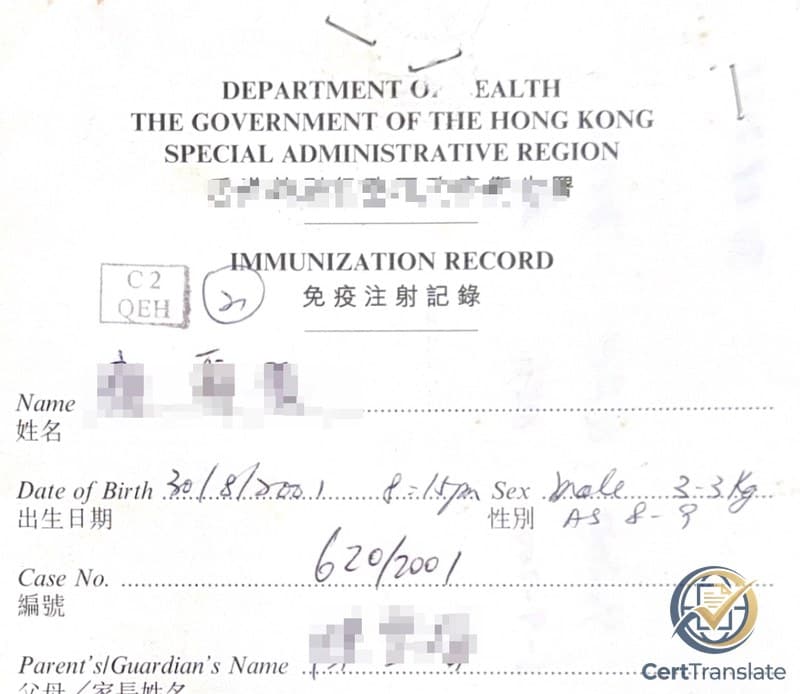
China
Chinese medical records can include abbreviated terminology, mixed table formats, and institutional stamps across multiple pages.
Abbreviations are expanded in English while preserving source abbreviation in brackets so reviewers can trace terms back to the original.
Lab and imaging sections are translated with full value lines and unchanged units to avoid interpretation risk.
When both Chinese and partial English appear, we still produce a complete certified package for consistency.
China is a Hague Apostille Convention member, so apostille is now the standard legalization route when destination authorities request authentication beyond certified translation.
India
Indian medical documents may combine printed hospital templates with handwritten notes and bilingual entries in one file.
Treatment chronology, diagnosis terms, and dosage lines are translated exactly and kept in sequence for evidence review.
Lab reference ranges and measurement units remain unchanged to preserve clinical meaning.
Discharge summaries, prescriptions, and diagnostic reports are often submitted together, and each document should be translated fully.
India is a Hague Apostille Convention member, so apostille is typically used for non-U.S. legalization requests after translation is complete.
Our review process checks patient identifiers across records so translated sets remain internally consistent.
Philippines
Philippine records frequently include English primary text plus local annotations that still need structured handling in certified packets.
We translate all submitted non-English entries and preserve chart labels, result values, and provider notes as written.
When records include immunization, inpatient, and outpatient sections together, each section is translated with clear headings.
Handwritten notes are translated where legible and marked [illegible] only when source cannot be read confidently.
The Philippines is a Hague Apostille Convention member, so apostille is commonly used when foreign authorities ask for authenticated medical documentation.
This workflow is common in immigration and school-related documentation, so scope review is done before production starts.
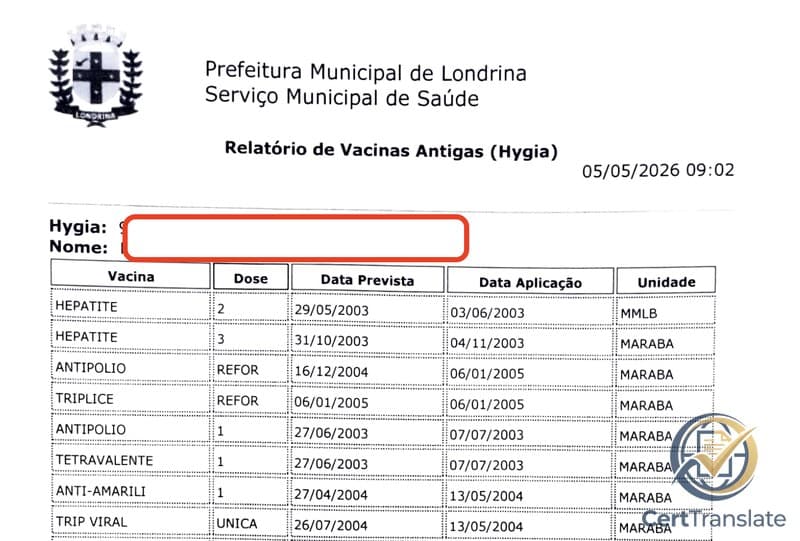
Brazil
Brazilian medical records often include detailed narrative notes and shorthand abbreviations that require domain-aware translation.
We expand abbreviations in English with source abbreviations retained in brackets for traceability.
Clinical values and medication dosage lines are translated exactly with original units preserved.
Provider signatures, stamp lines, and institutional identifiers are included when present because they can matter in legal and immigration review.
Brazil is a Hague Apostille Convention member, so apostille is the standard path when additional authentication is requested by destination authorities.
Translation and apostille are treated as separate compliance steps so certification requirements stay clear.
“The most dangerous medical translation error is silent data change. We preserve dosage, units, and abbreviations exactly so decision-makers see the same evidence the source record contains.”

How to get your medical records translated, step by step
Step 1: Upload complete medical record pages
Send PDF when possible, or clear photos of every page containing diagnoses, treatment notes, lab values, prescriptions, and signatures.
If records come from multiple providers, upload each set with clear file names so chronology stays organized.
Include legend or key pages when abbreviations are explained by the provider.
Step 2: Scope and legibility review before billing
We confirm page count, readability, and document completeness before production starts.
If pages are missing or critical lines are unreadable, we notify you first to prevent rework.
Exact cost and timeline are confirmed before payment.
Step 3: Translation and certification
A qualified translator renders all medical content exactly, including abbreviations, dosage lines, and lab units.
No unit conversion and no dosage rounding are performed in certified translation output.
Certificate of Accuracy is signed with translator credentials and date.
Step 4: QA, delivery, and revision support
You receive a certified PDF package, usually within 24 hours for standard files.
If receiving authority requests translation-related adjustments, revisions are included.
Notarization and hard-copy mailing are available when destination requires them.
Your medical files are transmitted over 256-bit SSL, stored on secure systems, and deleted within 30 days of delivery or immediately upon request. For HIPAA-covered workflows, we follow strict access and handling controls.
Medical records translation cost
$24.95
per page (up to 250 words)
Typical length
Most medical record orders are 3-10 pages
Typical cost
Typical total is $74.85-$249.50
Cost Estimation
Always Included
No hidden fees. Pay upon review.
How we count pages
Each page with translatable clinical content counts toward total page count.
Lab tables, discharge pages, and physician notes are counted when submitted in scope.
Exact cost is confirmed after review and before payment.
Common mistakes that get medical records translations rejected
1Using a general translator without medical context
Risk
Clinical terminology can be mistranslated, leading to evidence ambiguity, reviewer doubts, and potential USCIS RFE risk.
Our Solution
Medical records are translated with strict terminology controls and section-level QA before certification.
2Submitting translation without Certificate of Accuracy
Risk
Authorities may consider the package non-compliant even if language quality appears adequate.
Our Solution
Every order includes signed certification with translator identity details.
3Converting lab units or rewriting result formats
Risk
Unit conversion inside translation can alter clinical meaning and trigger rejection or clarification requests.
Our Solution
We keep original units and translate labels exactly as issued by the source provider.
4Rounding or interpreting medication dosage
Risk
Any dosage change, even small, can create compliance and safety concerns in legal or care contexts.
Our Solution
Dosage and frequency lines are translated exactly with no rounding or approximation.
5Omitting handwritten notes or stamp annotations
Risk
Missing provider notes can remove medically relevant context and delay review decisions.
Our Solution
All readable handwritten and stamp content is translated; unreadable sections are marked transparently.
Our track record with translated medical records
Medical records translated since 2014
Service history
USCIS, legal claims, specialist referrals, insurance reviews
Common destinations
90+ languages
Language coverage for medical records
Medical records are one of our highest-volume sensitive-document workflows and account for roughly one in six healthcare-document orders. Our QA checklist includes abbreviation expansion control, lab-unit integrity checks, dosage-line fidelity review, and patient-identifier consistency validation before release. We run this workflow across 90+ language pairs from 100+ countries.
What customers say about our medical records translations
“My USCIS packet included hospital records with lots of abbreviations. They translated everything clearly and kept dosage details exactly as written.”
Marina D.
Miami, FL
Verified on Google
“The team kept lab units unchanged and translated all physician notes, including handwritten parts. Our attorney submitted the file without revisions.”
Ravi P.
Dallas, TX
Verified on Trustpilot
“Fast delivery and very professional formatting. My new specialist could review my prior treatment records right away.”
Luz G.
Los Angeles, CA
Verified on Google
“They flagged a missing discharge page before translation, which saved us from filing incomplete records later.”
Omar S.
New York, NY
Verified on Google
Often submitted together with medical records
Vaccination Record Translation
Frequently required with medical history for school, immigration, and care intake workflows.
Passport Translation
Supports identity matching when medical records are reviewed in legal or immigration cases.
Death Certificate Translation
Often paired in estate, insurance, and court documentation involving medical evidence.
Submitting multiple health-related documents? Upload everything in one order for one coordinated delivery package at the same $24.95/page rate.
Where This Document Is Used
Immigration & Filing
Accepted By
Frequently asked questions
Everything you need to know about getting your document translated appropriately.
How much does a certified medical records translation cost?
Service starts at $24.95 per page for up to 250 words. Because medical files are often multi-page, common totals range from $74.85 to $249.50 depending on page count and record scope. Cost increases when additional report sets, discharge summaries, or lab sections are included. We confirm exact page count and final total before billing so you know pricing in advance. Optional add-ons like notarization, rush turnaround, and hard-copy mailing are listed separately. Uploading all pages you intend to submit is the best way to receive an accurate quote and avoid scope changes during production. Full-page upload at the start keeps pricing and timeline stable.
How long does medical records translation take?
Most medical record translations are delivered within 24 to 48 hours, depending on page count and document complexity. Smaller files may be completed in about 24 hours, while dense records with heavy tables, abbreviations, and handwriting can require additional QA. We confirm expected timing before production starts, so you can plan around filing or treatment deadlines. If your timeline is urgent, include the exact due date and request rush handling at the start. Uploading clear full-page scans plus close-ups of difficult sections is the fastest way to reduce delays caused by rework and missing details discovered during review. Complete source files usually produce the fastest release.
Will my translated medical records be accepted by USCIS?
USCIS generally accepts medical record translations when all submitted non-English content is translated completely and accompanied by a signed certification statement. Our package includes line-by-line translation, Certificate of Accuracy, and translator identity details to meet common compliance expectations. Rejections or follow-up requests usually happen when pages are missing, sections are summarized, or certification language is incomplete. Before filing, confirm that diagnosis notes, treatment timelines, and lab sections in your translation align with the source packet. If records come from multiple providers, submit all relevant sets together so the translated evidence remains consistent and easier for officers to review. Complete submission scope significantly lowers avoidable follow-up risk.
Do I need my translated medical records notarized?
For many USCIS and clinical documentation workflows, notarization is usually not required and certified translation is sufficient. Some courts, insurers, and foreign authorities may still request notarization as an additional legal step. Certified translation confirms content accuracy, while notarization confirms signer identity on the certification statement. These are separate requirements and should be selected based on destination instructions. If your records are being sent to multiple institutions, list every destination before ordering so you do not miss a requirement for one reviewer. Written requirement guidance is the safest basis for choosing the correct service combination and avoiding extra cost. Always request requirement wording before finalizing service scope.
What if my records are handwritten, faded, or partially unreadable?
Handwritten or faded medical records can still be translated when key clinical fields are legible. We translate all readable content and mark unclear portions as [illegible] when text cannot be recovered with confidence. This protects evidence integrity and avoids unsafe guessing in clinical language. Before production, we review quality and notify you if better images are needed for critical lines such as dosage, diagnosis, or provider notes. You can speed the process by sending one full-page image plus close-up photos of unclear segments. If multiple scans exist for the same page, include all versions to improve readability and reduce revision risk.
Can I translate my own medical records for USCIS?
Self-translation is usually risky for USCIS and other official workflows because reviewers expect independent third-party certification with clear accountability. Even fluent applicants can miss clinical abbreviations, dosage nuances, and formatting requirements that matter in legal review. If self-prepared translation is challenged, you may need to reorder and resubmit under deadline pressure. Professional certified translation reduces that risk by including signed certification, translator identity details, and QA focused on terminology and data fidelity. This is especially important for medical records where dosage lines, lab values, and provider notes can affect how evidence is interpreted across the rest of your case packet.
What is the difference between certified and notarized medical translation?
Certified medical translation includes the translated content plus a signed statement that translation is complete and accurate. Notarization is a separate legal process that verifies the identity of the person signing that certification statement. Notarization does not replace translation quality controls and does not make an incomplete translation compliant. Many destinations request certified translation only, while some request both certified and notarized versions. The practical approach is to confirm destination rules first and order only what is required. If notarization is requested later, it can usually be added without redoing the medical translation content from the beginning. This sequencing prevents unnecessary cost and delays.
Do I need an apostille for my medical records translation?
For USCIS filings, apostille is usually not required for translated medical records. Apostille is a separate legalization process used when non-U.S. authorities request authenticated foreign documents under Hague Convention procedures. Certified translation and apostille are different requirements: certification addresses translation accuracy, while apostille authenticates document origin for cross-border legal use. If both are requested, complete certified translation first, then follow destination legalization instructions. For non-Hague destinations, consular legalization may apply instead of apostille. The safest approach is to follow written instructions from the receiving authority before ordering extra legalization services. This avoids unnecessary cost and last-minute rework.
Do you convert lab units or dosage values during translation?
No, lab units and dosage values are not converted or rounded in certified medical translation output. We preserve source values exactly as issued because conversion can alter clinical and legal meaning. Labels, units, and numeric values are translated with fidelity so reviewers can evaluate evidence in original context. When abbreviations appear, we expand the term in English and retain the source abbreviation in brackets for traceability. If a receiving institution needs interpretation or conversion, that should be done by the qualified reviewer after translation, not inside the certified translation itself. This approach protects accuracy and reduces disputes about altered medical data.
Do you use specialized medical translators for medical records?
Medical record workflows are handled with terminology-sensitive translation and QA controls designed for clinical content. The process focuses on preserving diagnosis terms, treatment notes, abbreviations, dosage lines, and lab values exactly as issued. This is different from generic document translation because even small wording errors can change meaning in legal or care contexts. Every certified package includes signed accuracy certification and translator identity details so the record remains accountable. If your records are especially technical, include all related pages and context notes during upload so section-level consistency checks can be applied before release. That preparation improves first-pass acceptance reliability and reduces reviewer clarification requests.
Ready to get your medical records translated?
Upload your records now and receive a certified, compliance-ready translation package with terminology fidelity and secure handling.