CertTranslateCertTranslate
Live Support Specialists Available

Certified Divorce Document Translation

For USCIS, courts, and remarriage filings. Delivered in 24 hours.

Avoid Rejections
USCIS Guaranteed
24-Hour Turnaround
Reviewed by Amelia Rivera, Senior Certified Translation Reviewer

Reviewed by Amelia Rivera, Senior Certified Translation Reviewer

11 years handling legal and immigration records. ATA member since 2017.

The biggest divorce-file error is translating only the certificate when the authority asked for the decree. We verify document type first, then translate every operative legal section.

Who needs a divorce document translation?

USCIS and immigration filings

If you are filing Form I-130 (Petition for Alien Relative), Form I-485 (Adjustment of Status), or Form N-400 (Naturalization) and need to document prior marital history, USCIS divorce document translation may be required.

You usually submit the source document copy plus full certified English translation together in the same packet.

When prior marriages are relevant, translating only one page can be insufficient if the file also references decree terms, dates, or court outcomes.

02

Remarriage and state civil filings

State agencies may request translated divorce records before issuing a new marriage license or processing status updates.

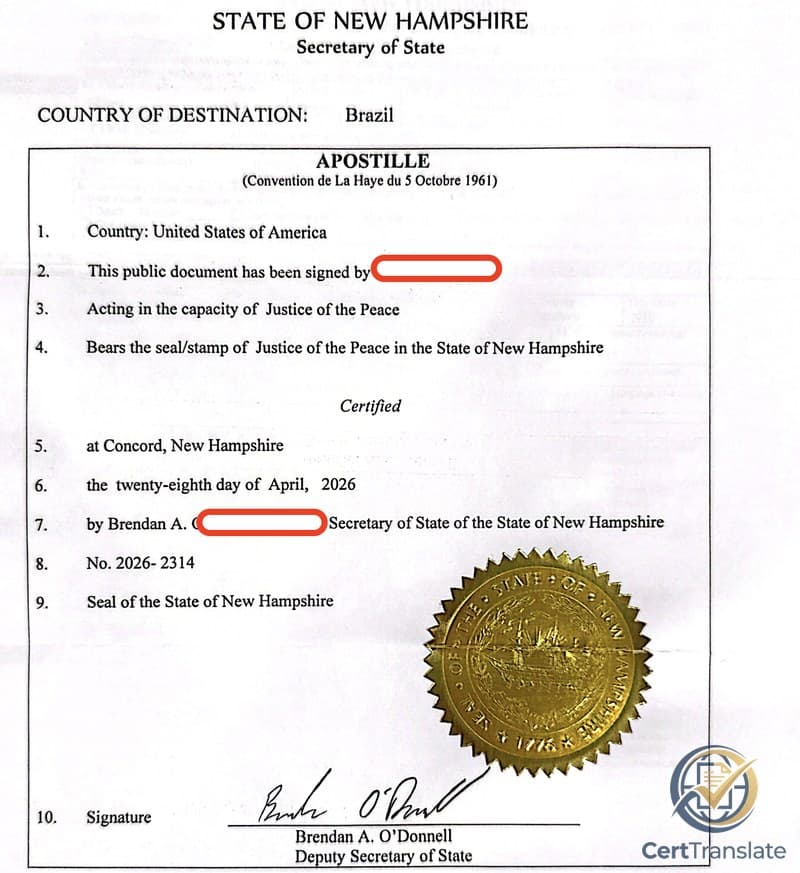
In some states, a foreign divorce decree may also need apostille in addition to certified translation for acceptance.

Confirming destination requirements early helps avoid last-minute rejection when ceremony or filing dates are close.

03

Court and legal proceedings

Courts may require translated divorce documents for custody, support, property, and related legal actions.

If a decree includes operative legal terms, those clauses must be translated in full; summary-only translation is not acceptable.

Notarization may be requested by specific jurisdictions, but requirements vary by court and should be confirmed in writing.

04

Administrative and background verification workflows

Employers, licensing boards, and foreign authorities sometimes request translated divorce evidence for identity and legal status verification.

Document naming differs by country, so translating the exact required record type is critical.

Using the requirements checker first helps you map your destination to the correct document scope.

What you get with every certified divorce translation package

Word-for-word translation of decree or certificate text, including court stamps and marginal notes
Signed Certificate of Accuracy on company letterhead
Translator name, credentials, and contact details
Exact translation of custody, support, and property clauses when present
Clear labeling of decree versus certificate document type
PDF delivery ready for filing
Optional notarization and hard-copy mailing
Unlimited revisions until accepted

Delivery Promise

Divorce translation is not just identity text. Many files contain legally operative clauses that determine how authorities interpret marital status and prior obligations. For certified divorce translation, we translate complete legal content as issued, including annexes and referenced pages in scope. Our divorce document translation services include decree-versus-certificate scope checks, clause completeness checks, and legal-term consistency review so reviewers see the same legal meaning as the source document.

Country-Specific Guidance

Divorce records by country of origin

Mexico

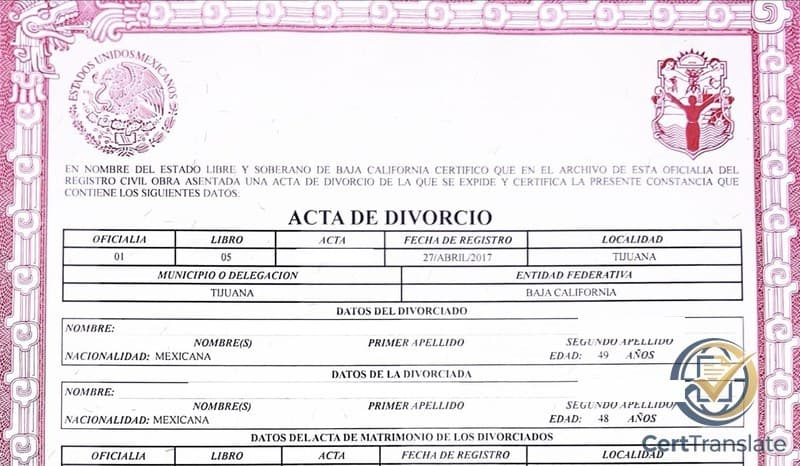
Mexican divorce files may include both court judgment records and civil registry entries, and both can be relevant depending on destination rules.

We identify whether your filing requires decree text, certificate record, or both before translation starts.

If the decree includes property or custody terms, those sections are translated fully and never summarized.

Registrar annotations and court stamps are included because they can affect legal validity interpretation.

Mexico is a Hague Apostille Convention member, so apostille is the standard legalization route when non-U.S. authorities request authentication after translation.

This is a frequent workflow for remarriage and immigration packets, so we run a checklist for document-type matching before release.

India

Indian divorce documentation may include court order pages, settlement references, and additional annex sections in one case file.

We translate all submitted operative pages and preserve legal section numbering for traceability.

If the file references maintenance, custody, or property clauses, those clauses are translated in full.

Document naming can vary by jurisdiction, so we verify whether your destination expects decree-level detail or civil-status extract.

India is a Hague Apostille Convention member, so apostille is typically used when foreign authorities request legalization beyond certified translation.

Where apostille is required for remarriage or foreign authority filings, it is handled as a separate post-translation compliance step.

Philippines

Philippine marital-status records can involve court and civil registry documentation that must be matched correctly to destination requirements.

When multiple pages define legal outcome, each page is translated and labeled in sequence so reviewers can follow chronology.

Handwritten registrar notes and stamped updates are translated when legible, with [illegible] used only where source cannot be read confidently.

If records are submitted for remarriage, destination authorities may request both status extract and core judicial text.

The Philippines is a Hague Apostille Convention member, so apostille is generally used when legalization is required outside USCIS workflows.

Scope validation before production helps avoid rework from incomplete submission sets.

Russia

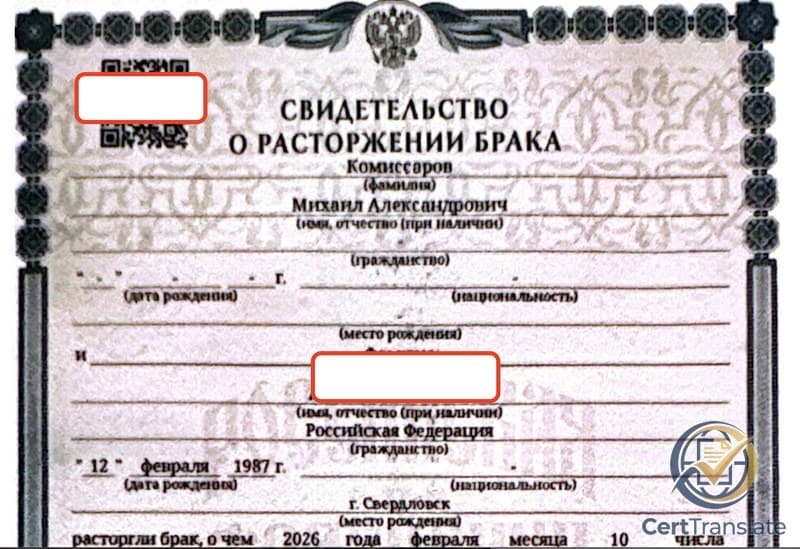
Russian divorce files can include separate court decision text and registry updates that serve different legal functions.

We preserve legal terminology and section references exactly so obligations and status outcomes remain clear.

Patronymic and surname forms are translated with source fidelity and not silently normalized to alternate spellings.

If decree pages reference child custody or asset allocation, those clauses are translated line by line without summary compression.

Russia is a Hague Apostille Convention member, so apostille is generally used when non-U.S. authorities require legalization.

Court stamps, signatures, and issuance markers are fully represented in certified output for evidentiary use.

Dominican Republic

Dominican divorce records may include multiple registry and court pages, and destination authorities often require complete set translation.

We verify which document version is being submitted and preserve all identifying numbers and annotations.

If remarriage is the use case, we flag when apostille may be requested by receiving authority in addition to translation.

Legal clauses covering custody, support, or property are translated fully because partial summaries are usually not accepted.

The Dominican Republic is a Hague Apostille Convention member, so apostille is commonly used when legalization is requested by non-U.S. destinations.

This workflow appears frequently in cross-border family filings, so we apply a full legal-content completeness check.

A divorce certificate confirms status, but a decree can contain operative legal terms. If the receiving authority needs decree content, summary translation will not pass review.
Expert
Amelia Rivera - Senior Certified Translation ReviewerTranslation Expert

How to get your divorce documents translated, step by step

Step 1: Upload all divorce-related pages in your filing scope

Upload decree pages, certificate pages, annexes, and any court attachments you plan to submit.

If you are unsure whether decree or certificate is required, upload both so we can confirm scope.

For scanned originals, include full pages plus close-ups of unclear stamp areas.

Step 2: Document-type and completeness review

We verify if your destination expects decree text, certificate status proof, or both.

We confirm page count, legibility, and final pricing before production begins.

If a required section is missing, we notify you immediately to prevent delay.

Step 3: Translation and certification

A professional translator renders all submitted legal text, including custody and property clauses when present.

Stamps, signatures, and notes are translated as visible elements, not omitted.

Certificate of Accuracy is signed with translator credentials and date.

Step 4: Delivery and revision support

You receive a certified PDF package, usually within 24 hours for standard files.

If receiving authority requests format adjustments, revisions are included.

Notarization and hard-copy mailing are available when destination requires them.

Your legal documents are transmitted over 256-bit SSL and stored on secure systems. Files are deleted within 30 days of delivery or sooner on request.

Transparent Pricing

Divorce document translation cost

$29.95

per page (up to 250 words)

Typical length

Most divorce document orders are 2-5 pages

Typical cost

Typical total is $49.90-$124.75

Cost Estimation

1 page (up to 250 words)
$24.95
2 pages
$49.90
3 pages
$74.85
4+ pages
Exact quote after review

Always Included

Notarization +$19.95
Rush turnaround
Hard-copy mailing
Notarization available ($19.95)
USCIS 100% Acceptance Guarantee
Lifetime Digital Delivery
Start Certified Translation

No hidden fees. Pay upon review.

How we count pages

Each translated legal page counts, including decree sections, annexes, and court attachments in scope.

Certificate-only files can be shorter, but decree files with legal clauses often include multiple pages.

Exact page count and cost are confirmed before payment.

Avoid These Errors

Common mistakes that get divorce document translations rejected

01

1Submitting the divorce certificate when the authority required the decree

Risk

Certificate-only submission may be rejected if legal findings or operative clauses are required, and USCIS may issue an RFE when required evidence is incomplete.

Our Solution

We confirm required document type before translation and flag when decree-level text is needed.

02

2Submitting translation without Certificate of Accuracy

Risk

Authorities may reject the package as non-compliant even when language appears correct.

Our Solution

Every order includes signed certification with translator identity details.

03

3Summarizing custody or property clauses

Risk

Summary output can omit operative legal obligations and trigger rejection or court objections.

Our Solution

We translate custody, support, and property sections fully and preserve legal structure.

04

4Ignoring multi-document divorce packet requirements

Risk

Some countries issue multiple related pages and missing one can make filing incomplete.

Our Solution

Scope review checks all related records before production starts.

05

5Skipping apostille check for remarriage filings

Risk

Some states or foreign authorities require apostille in addition to translation for acceptance.

Our Solution

We flag apostille-risk destinations and separate translation from legalization steps.

Our track record with translated divorce documents

Legal status documents translated since 2014

Service history

USCIS, state remarriage filings, courts, foreign civil registries

Common destinations

90+ languages

Language coverage for legal records

Divorce records are one of our highest-volume legal-status workflows and account for roughly one in seven family-status translation orders. Our QA checklist includes decree-versus-certificate scope validation, custody/property clause completeness checks, and cross-page legal reference verification before release. We run this workflow across 90+ language pairs from 100+ countries.

Excellent

What customers say about our divorce document translations

They explained the difference between my divorce certificate and decree before starting. We translated the right document and USCIS accepted the file.

P

Paola M.

Houston, TX

USCIS family filing

Verified on Google

My decree had custody and property sections, and they translated all of it exactly. Court accepted it on first submission.

I

Ivan R.

Boston, MA

State court filing

Verified on Trustpilot

Fast delivery, clear formatting, and no missing clauses. My attorney said the translated decree was filing-ready.

N

Nadia S.

Chicago, IL

Remarriage document packet

Verified on Google

They caught that my country issued two related divorce pages and translated both. That saved me from a rejection and refile.

L

Luis G.

Miami, FL

Civil status update

Verified on Google

Frequently asked questions

Everything you need to know about getting your document translated appropriately.

How much does divorce document translation cost?

Service starts at $24.95 per page for up to 250 words. Most files range from two to five pages, so common totals are about $49.90 to $124.75 depending on document scope. Certificate-only records are usually shorter, while decree packages with legal clauses and annexes are often longer. We confirm exact page count and final total before billing so you know the full price in advance. Optional add-ons such as notarization, rush turnaround, and hard-copy mailing are listed separately. Uploading all pages you plan to submit is the most reliable way to get an accurate quote and avoid scope changes during production.

How long does divorce document translation take?

Most divorce document translations are delivered within 24 hours after scope and legibility review. Complex decree files with multiple legal sections, annexes, or difficult scans can require 24 to 48 hours for accurate translation and QA. We confirm expected timeline before production starts so you can plan filing deadlines clearly. If your case has a court date, USCIS response deadline, or marriage license timeline, include that date in your order notes and request rush handling early. Submitting complete document sets at the start is the fastest way to avoid delays caused by missing pages discovered after translation has begun. Early scope confirmation keeps deadline planning realistic.

Will my translated divorce documents be accepted by USCIS?

USCIS generally accepts divorce document translations when all submitted non-English content is translated completely and accompanied by a signed certification statement. Our package includes line-by-line translation, Certificate of Accuracy, and translator identity details to align with common compliance expectations. Follow-up requests usually happen when applicants submit the wrong document type, omit decree sections, or provide incomplete certification language. USCIS divorce document translation is most likely to face scrutiny when prior marriage history is material to eligibility, so scope accuracy matters. Before filing, verify whether your case requires a decree, a certificate, or both. If your marital history affects eligibility, translating all relevant records together is the best way to reduce inconsistency and avoid avoidable delay in review.

Do I need my divorce documents notarized?

For many USCIS workflows, notarization is usually not required and certified translation is often sufficient. Some courts, state agencies, and foreign authorities may still request notarization as an additional legal formality. Certified translation confirms the translation is complete and accurate, while notarization confirms the signer identity on the certification statement. These are separate requirements and should be selected based on destination instructions, not assumptions. If your packet is going to more than one authority, list every destination before ordering. Using written destination requirements is the safest way to avoid paying for unnecessary services or missing a required notarization step. Written rules prevent costly filing mistakes.

What if my decree includes handwriting, stamp notes, or marginal annotations?

Handwritten notes and stamp annotations should be translated when legible because they can carry legal meaning in divorce records. We translate all readable notes and mark unreadable portions as [illegible] only when text cannot be confirmed safely. This approach preserves transparency and avoids inaccurate reconstruction. Before production, we review scan quality and request better images for critical legal sections if needed. You can speed this process by uploading full-page scans and close-up images of unclear stamp or note areas. Including all versions of the same page helps cross-check difficult sections and reduces the risk of revision requests after filing. This is especially important for court-stamped amendments.

Can I translate my own divorce documents for USCIS?

Self-translation is usually risky for USCIS and legal workflows because authorities expect independent third-party certified translation with clear accountability. Even fluent applicants can miss legal section references, formal certification elements, or clause details that matter in review. If self-prepared translation is challenged, you may need to reorder and resubmit under time pressure. Professional certified translation reduces that risk by including signed certification, translator identity details, and legal-structure QA checks. This is especially important for divorce records, where decree language may affect marital status interpretation and eligibility outcomes across your full filing packet. Independent certification is the safer submission path for time-sensitive cases.

What is the difference between certified and notarized divorce translation?

Certified divorce translation includes the translated document and a signed statement confirming the translation is complete and accurate. Notarized translation adds a separate legal step that verifies the identity of the signer on that certification statement. Notarization does not replace translation quality and does not make an incomplete translation compliant. Many destinations request certified translation only, while some request both certified and notarized versions. The practical sequence is to confirm destination rules first, then order only what is required. If notarization is requested later, it can usually be added without redoing the translated legal content from the beginning. This keeps cost and scope under control.

Do I need an apostille for my divorce document translation?

For USCIS filings, apostille is usually not required for translated divorce records. Apostille is a separate legalization process used when non-U.S. authorities request authenticated foreign civil records under Hague Convention procedures. Certified translation and apostille are different requirements: certification addresses translation accuracy, while apostille authenticates document origin for international legal use. If both are requested, complete certified translation first and then follow destination legalization instructions. For non-Hague destinations, consular legalization may apply instead of apostille. Written instructions from the receiving authority should always determine whether apostille is needed in your case. Confirm requirements early to avoid last-minute legalization delays.

What is the difference between a divorce decree and a divorce certificate?

A divorce decree is usually the court order that contains legal findings and operative terms, while a divorce certificate is often a status record confirming that the divorce was registered or finalized. They are not interchangeable in many workflows. Some authorities need the decree because they must review custody, support, or property language, while others may accept a certificate for status-only verification. Before ordering translation, confirm which document type your destination explicitly requests. If instructions are unclear, upload both records and request a scope review so the translated packet matches the legal requirement on the first submission. Choosing the wrong type often causes preventable delay.

Do I need to translate property and custody sections of the decree?

Yes, if property, custody, or support sections are part of the decree you are submitting, those sections should be translated fully. Summary-only translation is usually not acceptable when authorities need to evaluate legal obligations or case outcomes. Omitting operative sections can make the packet incomplete and trigger rejection or follow-up requests. We translate legal clauses line by line and preserve section numbering so reviewers can map the translated content to the source order. If your decree references annexes or attachments, include those pages too. Complete legal coverage is the safest approach for court, immigration, and remarriage-related filings. Full clause coverage protects filing integrity.

Ready to get your divorce documents translated?

Upload your decree, certificate, or full divorce packet and receive a certified, filing-ready translation package, usually within 24 hours.

No hidden feesUnlimited revisionsMoney-back guaranteeUSCIS accepted format