
Asylum Translation Requirements and Document Checklist
Form I-589 · Identity, Medical, and Country-Conditions Records Translated in 24 Hours

Reviewed by Reviewed by Natalia Vega, Senior USCIS Translation Reviewer
11 years in certified translation · ATA member since 2017 · High-volume reviewer of sensitive civil, medical, and evidentiary records
“The common asylum translation problem is not just language. It is packet completeness. A missing attachment, seal, or handwritten note can matter as much as the main page itself.”
Your instant price
Asylum ApplicationReview before payment · acceptance guarantee




What Documents Need Translation for Asylum?
The asylum process often starts with Form I-589, Application for Asylum and for Withholding of Removal, and may later involve an interview, credible fear review, reasonable fear review, or other follow-up steps depending on the case path. For asylum translation to stay complete, every non-English support document should be reviewed before filing rather than added one by one later.
As of February 28, 2026, USCIS describes asylum through the Form I-589 process and maintains separate guidance for affirmative asylum, credible fear screenings, and reasonable fear screenings. Translation for asylum application usually extends beyond one civil record and often includes personal, medical, and country-conditions evidence submitted together.
The checklist below covers the records most often translated for asylum support. If any of these documents are not in English, translation for asylum application should be completed before filing or before the interview stage so the packet stays organized and usable.
Birth certificate or other civil identity record
I-589 support, family derivative records
Civil identity records often help explain identity history, family relationships, and country-of-origin details in the packet.
Passport, national ID, or travel document
I-589 support, interview, status history
Passport and travel-document translation helps keep names, birth dates, and travel history consistent across the record.
Marriage certificate or dependent family records
I-589 derivative support
Family records may need translation when a spouse or child is included in the application or when the packet must explain family relationships.
Police reports, court records, or detention documents
I-589 support, interview support
Police, court, detention, or arrest records may need full translation when they support the applicant’s account of harm, detention, or official action.
Medical records documenting harm or treatment
I-589 support
Medical records may support the timeline of harm, injury, treatment, or follow-up care when the documents are in another language.
Affidavits, witness statements, or declarations
I-589 support
Translation for asylum application often includes witness statements and declarations when other people provide written support in a language other than English.
Country conditions evidence
I-589 support, interview support
News articles, NGO reports, government notices, and other country-conditions exhibits may need English translation when the applicant relies on them as support evidence.
Political, religious, or social-group membership records
I-589 support
Membership records, cards, certificates, or church and community documents may need translation when they support identity or background evidence.
Medical record translation for asylum is one of the most sensitive categories because the documents may include handwritten notes, treatment summaries, and dates spread across multiple visits. Translating the full record, including stamps and attachments, usually makes the packet easier to review later.
I-589 supporting evidence translation also reaches beyond civil records. Police reports, detention papers, affidavits, witness declarations, and country-conditions exhibits may all need English translation if they are submitted as supporting documents. In practice, translation for asylum application often expands as those additional exhibits are gathered.
Applicants often search for asylum document translation confidential handling because the source records can be intensely personal. That concern is valid. Sensitive files should be translated by a human team with controlled access and a clear confidentiality workflow rather than passed through generic tools.
Check What Documents You Need Translated — Free, 2 Minutes →
Common Languages for Asylum Document Translation
Spanish, Arabic, and Russian are common source languages in asylum translation because humanitarian cases often involve identity records, medical records, police documents, and country-conditions exhibits from a wide range of countries and agencies.
If your documents are in Spanish or Arabic, our certified Spanish translation services and certified Arabic translation services regularly support civil records, witness materials, and evidentiary documents used in USCIS-bound packets.
Russian-language files are also common in humanitarian work, especially when the packet combines official records with articles, declarations, and other background exhibits. In mixed-language packets, the main priority is preserving names, dates, and supporting detail consistently across the full file.
How to Get Your Asylum Documents Translated — Step by Step
Identify the full I-589 support packet first
Start with the checklist above and gather every non-English identity record, medical file, police or detention paper, witness statement, membership record, and country-conditions exhibit you may submit.
When translation for asylum application is still evolving, it is usually better to translate one extra support document than to discover later that the interview or screening stage still needs it.
Upload scans, photos, or PDFs in any format
Clear scans and phone photos are acceptable as long as the full page is visible, including reverse sides, seals, handwritten notes, exhibit labels, and attachments.
If the packet includes a main record plus annexes or attachments, upload the full set together so the translated evidence stays complete.
We assign native speakers with sensitive-record experience
Your files go to translators who regularly handle humanitarian evidence, civil records, and mixed-document packets where names, dates, and annotations must stay exact.
That matters because asylum translation often involves difficult handwriting, damaged pages, and emotionally sensitive records that still need complete English rendering.
Translation and certification are prepared together
Every visible source-language element is translated, including stamps, seals, structured fields, and handwritten notes wherever legible.
The final packet includes the English translation and the signed Certificate of Accuracy expected with non-English supporting records.
Review and delivery with confidentiality controls
Before delivery, we review names, dates, exhibit completeness, certification language, and visible-page coverage across the packet.
Most short documents are delivered within 24 hours as PDF files, and confidentiality procedures apply throughout handling because asylum support files often contain highly sensitive personal information.
Asylum cases often move in stages, and support evidence may be collected over time. Starting translation earlier usually prevents rush pressure around medical records, police files, witness statements, and country-conditions exhibits that still need full review. Translation for asylum application is easier to manage when the packet is built gradually instead of at the last minute.
Files are handled through encrypted upload channels, access is limited to production staff, and deletion policies are available for sensitive humanitarian records.
Translation Cost for Asylum
Flat per-page rate — no surprises, no hidden fees.
Certified Translation
Starting Rate
Standard Turnaround
1-2 Days
(Typically 24h)
Pay only after you review the quote
Cost by Document
Always Included — No Extra Cost
Asylum translation is priced by page, not by filing category. Our $24.95 base rate includes human translation, the signed certification statement, and revision support if USCIS raises a translation-format issue. Translation for asylum application usually costs more only when medical files or multi-exhibit country-conditions packets add pages. In other words, translation for asylum application becomes more expensive because the packet is larger, not because the certification format changes. Exact pricing is confirmed after document review and before payment, and our full translation pricing is available on the pricing page.
View full pricing detailsMistakes That Delay Asylum Applications
1Submitting an incomplete evidence packet
Consequence
Applicants sometimes translate the main identity record but leave out attachments, witness declarations, or supporting exhibits. That can make the record harder to use later because the context is split across untranslated pages.
Our Solution
Translate the full evidence set together so identity records, medical files, witness statements, and exhibits can be reviewed as one packet.
2Using machine translation or self-translation
Consequence
Machine output and self-prepared translations often fail on certification language, sensitive narrative detail, or the treatment of stamps, annotations, and handwritten notes.
Our Solution
Use a third-party translator who provides the full English translation and a signed Certificate of Accuracy for official review.
3Leaving out the certification statement
Consequence
A translated page without certification is incomplete because the reviewing authority still needs the translator to attest that the English version is complete and accurate.
Our Solution
Confirm that every delivered translation includes the signed certification statement and company identification.
4Ignoring handwritten notes, seals, or attachments
Consequence
Humanitarian records are often messy. If a handwritten notation, stamp, or attached page is skipped, the translation may miss details that matter to the record.
Our Solution
Upload every page and make sure the full document set, including attachments and reverse sides, is translated together.
5Waiting too long to translate sensitive evidence
Consequence
Asylum support files often contain medical records, declarations, and country-conditions exhibits collected over time. Leaving translation until the last minute turns the packet into a rush job at the exact point when careful review matters most.
Our Solution
Start the translation work early so sensitive evidence can be checked calmly, confidentially, and as a complete file.
Our Asylum Translation Track Record
Asylum support packets are a recurring part of our USCIS translation workload, especially identity records, medical files, witness statements, and country-conditions exhibits prepared for sensitive humanitarian cases.
Experience
Every asylum translation order is reviewed for names, dates, exhibit completeness, certification completeness, and visible-page coverage before delivery.
Quality Assurance
We support mixed-language humanitarian packets across 100+ source languages, from one-page civil records to multi-exhibit files that combine medical records, declarations, official documents, and country-conditions evidence.
Coverage
The strongest asylum translation work is not just literal sentence conversion. It is confidentiality-aware, exhibit-aware, and checked so sensitive records stay complete and usable from the first filing stage to later review. People sometimes search for refugee translation when they are comparing humanitarian document needs, but the packet still has to be translated for the exact process and authority handling the case.
Real translation cases for Asylum Application filings
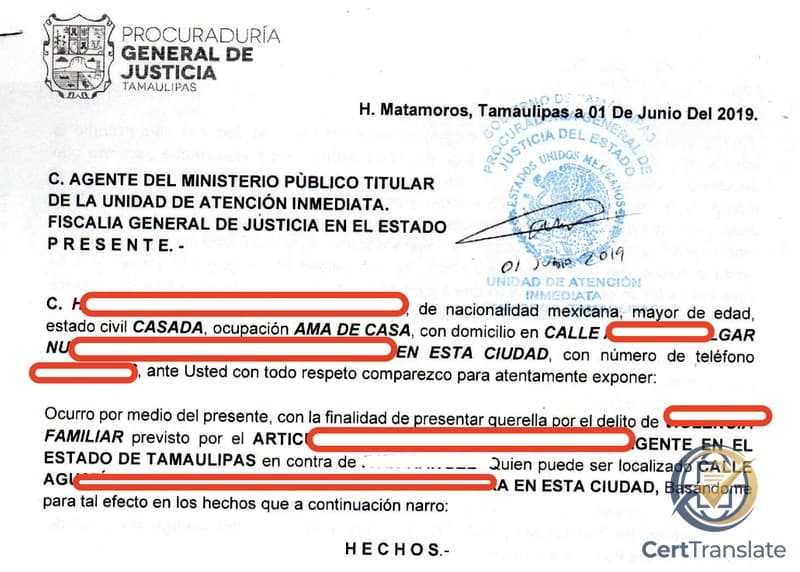
Anonymized translations we've delivered for Asylum Application packages. Each case names the source-document quirk and the translation decision that kept the packet clean.
Other Immigration Translation Guides
USCIS translation guide
Use the broader USCIS guide if you want the general certified-translation rules first before focusing on I-589 support evidence.
Court proceedings translation
Some humanitarian cases later depend on court-stage records and legally formatted evidence packets, even when the first translation work started with USCIS-bound support documents.
Green card translation
Some applicants later reuse translated civil records, identity documents, and family records in later permanent-residence filings.
Need documents for multiple filings? Upload everything in one order at the same $24.95/page rate so names, dates, and supporting evidence can be checked together.
Frequently Asked Questions About Asylum Translation
How much does translation cost for asylum?
Asylum translation starts at $24.95 per page. Many I-589 support packets fall between $74.85 and $324.35 depending on how many identity records, medical files, witness statements, and country-conditions exhibits need certified translation.
What documents need translation for asylum?
Any non-English document submitted with the case should be translated in full. Common examples are identity records, passports, family records, police or detention papers, medical records, witness statements, affidavits, and country-conditions exhibits.
How long does translation take for asylum filings?
Most short asylum documents are delivered within 24 hours. Larger medical files, multi-exhibit country-conditions packets, or combined witness-document sets may take longer, but timing is confirmed before payment.
Will my translations be accepted by USCIS?
Official reviewers generally accept complete certified translations that include the English rendering and a signed certification statement from a competent translator. Our asylum translation workflow is built around that standard, but USCIS or another reviewing authority always makes the final decision.
Can I translate my own documents for asylum?
Self-translation is a common risk in asylum cases. Official review expects foreign-language evidence to come with complete English translation and third-party certification, and self-prepared versions often create questions about completeness, neutrality, or omitted page elements.
What is the difference between certified and notarized translation for asylum?
Certified translation and notarized translation are different services. USCIS usually focuses on the certification statement, while notarization is only added if another receiving authority or legal representative specifically asks for it.
Do I need an apostille for asylum?
Usually no. Asylum packets generally focus on complete English translation and certification rather than apostille, although another authority outside the asylum process may separately ask for apostille on the same original record.
Do witness statements and country conditions evidence need translation?
Often yes. I-589 supporting evidence translation may include witness statements, affidavits, news articles, NGO reports, and other country-conditions exhibits when those records are submitted in another language.
Is asylum translation the same as refugee translation?
Not exactly. Asylum translation and refugee translation can involve similar civil, medical, and background records, but the legal process and reviewing authority are not always the same. The translation itself still needs to be complete, accurate, and certified for the authority receiving it.
Ready to Get Your Asylum Documents Translated?
Most short asylum support documents are translated and certified within 24 hours, and every order includes the Certificate of Accuracy expected for foreign-language evidence.
Use the checklist above if you already know the records in your I-589 packet, or start with the requirements checker if you want to confirm the full set before ordering.
Senior Certified Translation Reviewer
CertTranslate provides certified translation services only. We do not provide legal advice, immigration consulting, or representation. For questions about your immigration case, consult a licensed immigration attorney.