
Spanish diploma translation
Título universitario specialists · Cédula profesional handling · WES-ready layout
$24.95· 1-2 pagesWES-ready
Translate my Spanish diplomaSpanish diploma translation — formats, prices, samples →Exact, word-for-word English translation for WES and ECE, universities, licensing boards, and employers.
Ready within 24 hours
Academic document
Degree title and layout preserved
Honors · seals · signatures · institution details
Certified package
Signed and Stamped Certificate of Accuracy
Company letterhead · translator signature · company stamp

We check your files and confirm the total before you pay




Your finished package
Your delivery includes the source-document scan, a complete English translation, and a signed and stamped Certificate of Translation Accuracy.
Files checked and total confirmed before payment
Each pair below is its own page, built around that country’s award titles, honors, and registration marks. Same $24.95 flat page rate on all of them.
Título universitario specialists · Cédula profesional handling · WES-ready layout
Licence · Master · Doctorat accuracy · ECTS preserved · WES-ready layout
Native Portuguese speakers · Brazil & Portugal degree systems · Bacharelado, licenciatura & Bologna formats
Real diploma casework
These are anonymized orders. Each case shows what the diploma held and the translation decision we made.
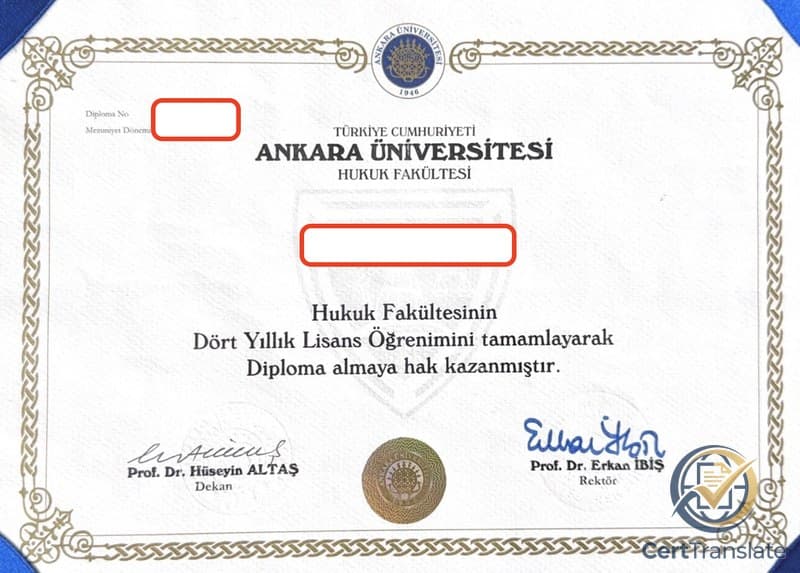
Degree title
We translated the award exactly as printed and left the US comparison to the evaluator, whose decision that is.
Read the case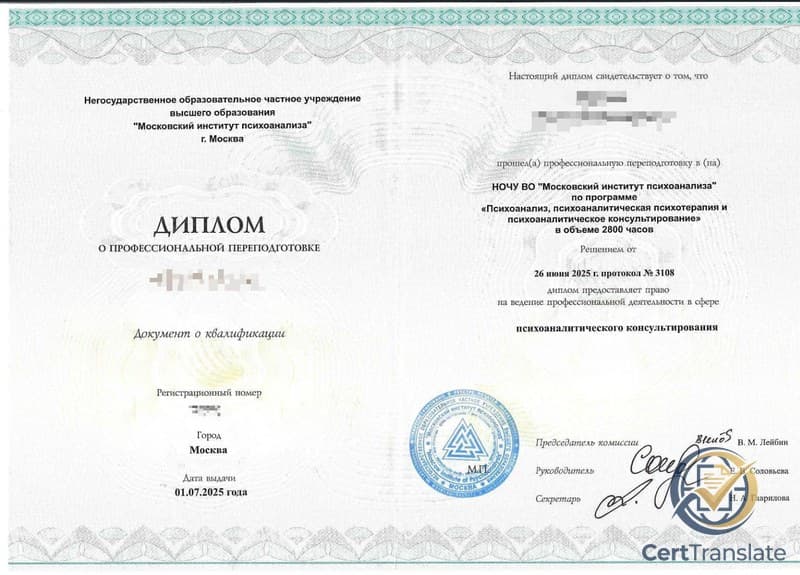
Document type
We rendered it as the retraining certificate it is, hour count included, so no reviewer would read it as a degree.
Read the case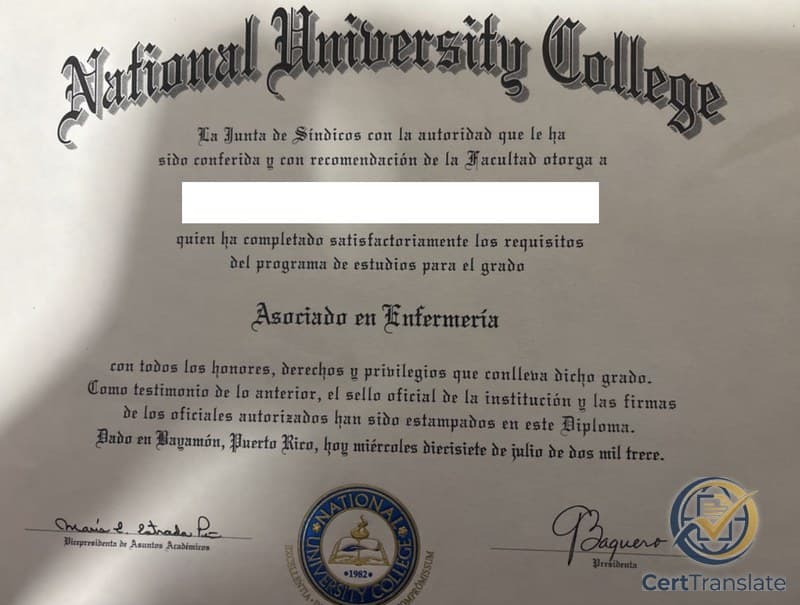
Licensing board
The ceremonial text was translated in full so a mainland licensing board could read the award and the institution.
Read the caseHow it works
Upload once. We check the files and confirm the total before payment. Then our team translates, reviews, and certifies the complete package to the AcceptReady™ standard we publish.
Send a PDF, scan, or phone photo. Include both sides of the diploma, any diploma supplement, and the transcript when you are filing them together.
An academic translator renders the award, field of study, honors, and institution. A second reviewer checks names, dates, and registration numbers against the source.

Corrections are free at this stage. Once you approve, the certified set arrives as a searchable PDF built to sit beside the original page for page.

One physical page means one billed page.
No 250-word cap and no dense-page rebilling.
Certified price
$24.95/ page
No payment until file review
Cost
A certified diploma translation costs $24.95 per physical page. Most diplomas are a single page, so the usual total is $24.95, confirmed before you pay.
Start my diploma order| What you are sending | Certified total |
|---|---|
| Diploma only, 1 page | $24.95the most common academic order |
| Diploma, front and back | $49.90when the registration entry sits on the reverse |
| Diploma plus a supplement page | $74.85diploma supplements and annexes count as pages |
| Diploma plus transcript | $24.95 per pageusually filed together; exact total confirmed after review |
A note on “100% acceptance”
If a service promises “100% acceptance,” be careful — no one controls USCIS’s decision. What actually protects you is the written remedy: we revise free, or refund in full.
A diploma itself is usually short, so a flat per-page rate and a capped provider often cost about the same. But the transcripts you submit alongside it are word-dense — and that is where a 250-word page cap quietly adds pages. Move the sliders to see how density changes your total at our flat $24.95/page rate (no word cap).
Typical — most birth, marriage and death certificates
A capped provider counts a “page” as 250 words or less, so one dense physical page is billed as two. We bill the page you actually send.
1 page × $24.95 — flat, no word cap
380 words ÷ 250 = 2 billed pages × $24.95
You keep $24.95 on this document.
Get your exact priceComparison estimate only, based on a 250-word page definition at a representative $24.95 per-page rate. Your final price depends on the actual document.
This is an estimate. Upload your document to confirm the exact page count and total before you pay — no card required.
Client reviews
Anna K.
Boston, MA
“My Russian diploma was old and had unusual stamps. Translation was clear and accepted by my evaluator with no revision request.”
WES evaluation · Older diploma
Accepted without revisions
Olena H.
Sacramento, CA
“Fast turnaround and great communication. The translator note about institution rename was very helpful.”
Licensing file · Institution renamed
Rename explained in a note
Joon P.
Austin, TX
“They preserved formatting exactly and translated back-page remarks too. University admissions accepted everything first try.”
Graduate admission · Back-page remarks
Accepted first try
Questions before ordering
If your document does not match one of these situations, send it anyway. Support replies in 15–30 minutes during support hours.
A certified diploma translation costs $24.95 per physical page. A single-page diploma is $24.95, and a front-and-back diploma is $49.90. There is no word cap, and we confirm the page count and total before you pay.
A one- or two-page diploma is usually delivered within 24 hours of a clear upload. Diploma supplements, older calligraphic awards, and files sent together with a transcript can take longer, and we name the window before work begins.
Credential evaluators ask for a complete, word-for-word English translation of the whole document, and that is what we deliver alongside the source scan and a signed Certificate of Translation Accuracy. If a receiving authority rejects the translation for a translation-related reason, we revise it free. If it is still rejected, we refund the translation cost.
No, and no translator should. Stating that a foreign award equals a US bachelor’s or master’s is a credential evaluation, which agencies such as WES and ECE issue after reviewing your file. We translate the award exactly as printed so the evaluator can make that call.
We translate diplomas and degree certificates from 65+ languages into English. The pairs with a dedicated page are listed above. If yours is not there, upload the document anyway — the rate and the process are the same.
Yes, and they stay next to the award they belong to. Honors, distinction, and the field of study are separate data points to an evaluator, so summarising them away costs you information you paid to have on the page.
We translate the institution exactly as printed on your diploma and add a translator note recording the current name. That keeps the document faithful while letting a reviewer connect it to the institution they can verify today.
Most credential evaluators ask for the diploma and the transcript together, because one proves the award and the other proves the coursework. Send both in one order and they are translated with the same terminology throughout.
Credential evaluators and universities generally require certification, not notarization. Some licensing boards ask for both, so we add notarization for $19.95 per order without changing the translated text.
No. A page is one physical page of the source document. Many services cap a page at 250 words and rebill a dense page as two or three; we bill the page you upload.
Yes. You can read the finished translation and request unlimited free corrections before we certify it. If an authority later asks for a translation-related change, we correct the certified file at no charge.
An apostille authenticates a signature or seal for use in another Hague Convention country, so a US evaluation or admission does not need one. If a foreign ministry or employer asks for it, we add a physical apostille for $190 per order.
Four things, and you can check all four yourself. Compare any line of the original diploma with the translation, including the text inside stamps. Put the two documents side by side — same page count, same order, course tables, grades, and totals where the reviewer expects them. Read the Certificate of Accuracy for the complete-and-accurate statement, the competence statement, the signature, date, and company stamp. Then confirm the wording matches what your receiving office publishes. Those four checks are the AcceptReady™ standard, and CertTranslate publishes it in full. Read the AcceptReady™ standard.
Most frequent problems we correct
These are the recurring issues we see in academic packets and in translations clients ask us to review.
Our check: We translate the award exactly as printed and leave equivalency to the evaluator, because an unrequested equivalence claim is the fastest way to have a file questioned.
Our check: Every line of the award is rendered in full, since evaluators read the field, the honors, and the conferral date as separate data points.
Our check: We ask for both sides before work starts, because on many diplomas the registration number and the registrar signature sit on the back.
Our check: We keep the name printed on the diploma and add a translator note when the institution has since been renamed or merged, so both readings are available.
The standard behind these checks
AcceptReady™ is CertTranslate's published standard for certified translations: complete word-for-word translation, mirrored page layout, signed and stamped Certificate of Accuracy on letterhead, and matched to the receiver's published requirements.
How to check each one yourselfChecked before certification. If an authority later requests a translation-related correction, revisions remain free.
Start my translationCommon filing contexts
A diploma is the award itself, so it travels to whoever needs proof that the degree exists — a credential evaluator, an admissions office, a licensing board, or an employer supporting a petition.
The key is consistency: the name, the institution, and the date conferred should match the transcript and the passport filed alongside it.
The evaluator reads the award and the coursework together, so the diploma and transcript are usually filed as one set.
The degree supports the qualification claim in an employment petition, and is often reviewed beside the transcript.
Admissions offices check the award, the institution, and the conferral date against the rest of the application.
Nursing, medical, engineering, and teaching boards read the award to confirm the training behind a licence application.
Document glossary
The parts of an academic award that decide how a certified translation is built, whatever language the original is in.
Indian diplomas often include institution names in English plus local-language seals or registrar marks.
We translate all non-English sections and keep awarding-body names consistent with source records.
Where degree nomenclature differs from U.S. phrasing, we translate literally and avoid unofficial equivalency claims.
India is a Hague Apostille Convention member, so apostille is typically used for legalization when non-U.S. authorities request it.
Chinese diplomas may separate degree title and major field in ways that must remain distinct in translation.
Institution stamps and certificate numbers are rendered in full to support credential evaluation workflows.
If both Chinese and English appear, we still provide a full certified package to maintain consistency.
China is a Hague Apostille Convention member, so apostille is the standard legalization path for many non-U.S. destinations.
When institutions issue separate bilingual supplements, both documents should be reviewed together so degree title and program wording stay consistent.
We keep certificate numbering, issuing authority labels, and seal descriptions fully translated because evaluators use them in authenticity checks.
Russian diplomas often come with a separate diploma supplement that carries the course, grade, or program detail evaluators need for a full review.
Name spelling can shift between older GOST-style transliteration and current passport spelling, so we align the English rendering to the governing identity record when it is provided.
Soviet-era and transition-era credentials may show historical institution names, ministry references, or republic terminology that should be translated exactly as printed rather than normalized into modern wording.
If the evaluator will review the diploma and supplement together, translating the full set in one order is safer than mixing separate files with different terminology choices.
For a detailed guide to Russian-language diplomas from Russia, Soviet-era issuers, Kazakhstan, Uzbekistan, and Belarus, see our dedicated Russian diploma translation page.
Soviet-era or regional diploma formats often contain specialized terminology that should be translated literally before any evaluator interpretation.
If the document includes both degree title and qualification category, both fields are preserved as separate translated elements.
Historical institution references are retained exactly, and context notes are added only where needed to avoid misreading by admissions staff.
Russian and Soviet-era diplomas can contain historical institution references and specialized degree terminology.
We preserve the original institution naming and annotate historical context when needed without altering legal source meaning.
Russia is a Hague Apostille Convention member, so apostille is generally used when document legalization is requested outside USCIS.
Soviet-era or regional diploma formats often contain specialized terminology that should be translated literally before any evaluator interpretation.
If the document includes both degree title and qualification category, both fields are preserved as separate translated elements.
Historical institution references are retained exactly, and context notes are added only where needed to avoid misreading by admissions staff.
Korean degree documents frequently include layered honor designations and department naming structures.
Our translation keeps hierarchy and official naming exactly aligned with source formatting for admissions review.
South Korea is a Hague Apostille Convention member, so apostille is commonly used when legalization is required.
Department names, honors fields, and major descriptions are translated exactly because small wording changes can alter evaluator interpretation.
If the diploma references a supplementary transcript appendix, we note that linkage so admissions officers can review records in the correct order.
For high-stakes deadlines, we recommend uploading diploma and transcript together to avoid terminology drift across separate orders.
Ukrainian and legacy regional diplomas may include institution names that changed over time.
When the issuing institution no longer exists, we translate source names exactly and add translator context notes where appropriate.
Ukraine is a Hague Apostille Convention member, so apostille is usually the legalization route for non-U.S. requests.
Legacy records may include historical institution names, and those names are preserved exactly rather than replaced with modern equivalents.
When an institution has been renamed, a translator note can clarify status while still keeping source data intact for evaluator traceability.
Stamps, signatures, and issuance statements are translated in full because they support authenticity review in academic workflows.
“When a diploma comes from an institution that has been renamed or dissolved, we do not modernize the school name in translation. We preserve the source and explain status in a translator note when necessary.”

Reference library
Guidance and source links last rechecked .
Ready when you are
Upload both sides, plus the diploma supplement and transcript if you have them. We confirm the document type, page count, price, and delivery time before you pay.
No payment until file review
