




What marriage certificate do two foreigners get when they marry in Korea?
TL;DRTwo foreign nationals who register their marriage in Korea get a 수리증명서 (Certificate of Acceptance): the local office’s certificate that it accepted their 혼인신고 (Report of Marriage). Korea prints a 혼인관계증명서 (Marriage Relationship Certificate) only from a family relations register, and foreign nationals have no register of their own. CertTranslate translated a Seoul certificate of this kind under its own title, using the Latin name spellings printed on it, and delivered the certified translation in September 2026 for a U.S. filing.
Case Specifications
- Document
- Marriage certificate (Certificate of Acceptance)
- Foreign Name
- 수리증명서 (혼인신고)
- Country
- South Korea
- Languages
- Korean → English
- Submitted To
- U.S. filing (USCIS-standard certification)
A Korean Certificate of Acceptance for a Report of Marriage
The client sent a one-page Korean marriage acceptance certificate from a district office in Seoul. Both spouses on it are foreign nationals. The order was for a Korean marriage certificate translation for a U.S. filing.
A 수리증명서 (Certificate of Acceptance) is a certificate from a Korean local office stating that it accepted a report filed with it. On this page, the report is a 혼인신고 (Report of Marriage). The closing line certifies that the report has been accepted.
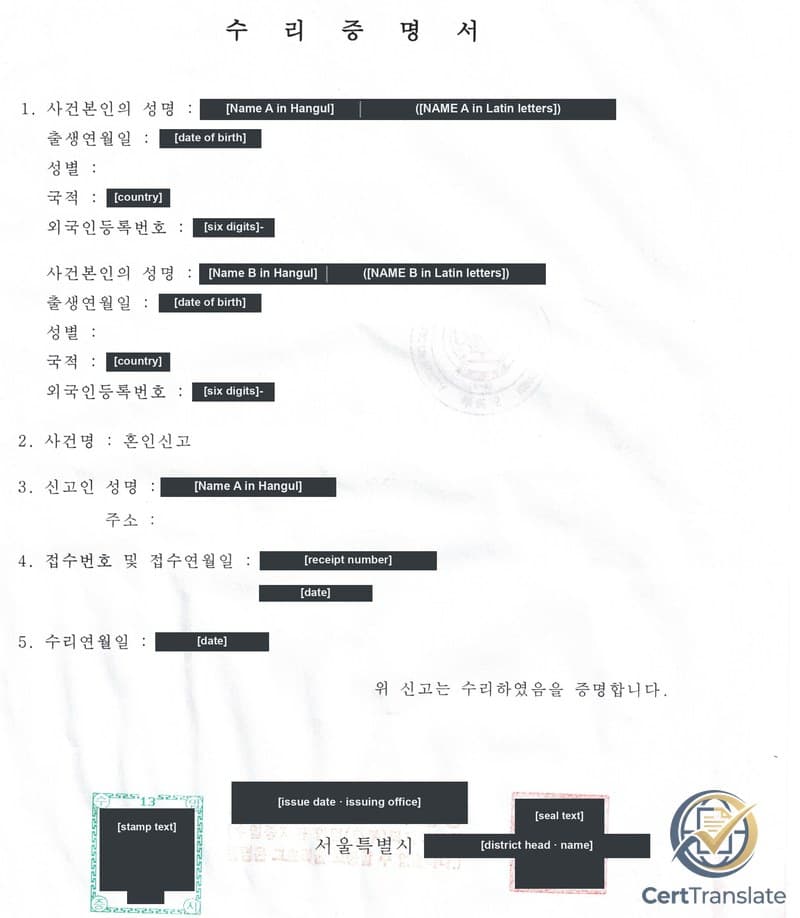
The page has five numbered items. Item 1 lists each 사건본인 (person concerned) by name, date of birth, sex, nationality and 외국인등록번호 (alien registration number). Items 2 to 5 give the name of the case, the 신고인 (reporter), the receipt number and date, and the date of acceptance.
The redacted image below shows that layout, with every name, number and date covered.
Why a Certificate of Acceptance Is Not a Marriage Relationship Certificate
A 혼인관계증명서 (Marriage Relationship Certificate) is a certificate printed from a person’s 가족관계등록부 (family relations register). It is the usual Korean marriage document. Article 15 of Korea’s Act on Registration of Family Relations lists it among the certificates issued from that register.
A foreign national has no register of their own until naturalization. A foreign spouse of a Korean appears only as a family member in the Korean spouse’s register. When neither spouse is Korean, there is no register entry to print a Marriage Relationship Certificate from.
What the district office issued here was a certificate of acceptance. Article 42 of the same Act lets the person who filed a report request a certificate that it was accepted.
Titling the translation “Marriage Certificate” would have been the easy shortcut. That name appears nowhere on the Korean page, and USCIS asks for a complete and accurate English translation of the document as it stands.
How We Translated the Korean Certificate of Acceptance
We translated the title as Certificate of Acceptance, and item 2 as “Name of the case: Report of Marriage” in the English. The closing line, “This is to certify that the above report has been accepted,” is the statement the whole page exists to make. The certification page names the document the same way, so a receiver sees what the packet holds before reading a single field.
Each spouse’s name is printed twice: in Hangul transcription, then in Latin letters in parentheses. We used the Latin spellings printed on the certificate instead of romanizing the Hangul again. The reporter’s name appears in Hangul only, and a note confirms it is the first spouse’s name.
The order came in under the client’s married surname, while the certificate records her pre-marriage surname. We kept the surname exactly as printed and added no bridging note. Our name mismatch guide covers surname differences across documents, but a record of the marriage itself is expected to show the pre-marriage surname.
"Translator’s Notes 1–2 from the certificate (names and digits replaced with placeholders): 1. The names of both parties appear in the original in Hangul transcription followed by the Latin-script form in parentheses — “[Name A in Hangul]([NAME A])” and “[Name B in Hangul]([NAME B])”. The Latin-script spellings printed in the original are used in this translation. In item 3 the reporter’s name is printed in Hangul only and is the same name as that of the first party in item 1. 2. In item 1 the Alien Registration Numbers are printed as six digits followed by a hyphen (“[six digits]-” and “[six digits]-”); the remaining digits are not printed in the original."

Each alien registration number stops after six digits and a hyphen. Those six digits match the holder’s printed date of birth in YYMMDD form, and the rest of the number is not printed. We reproduced both numbers exactly as printed, without completing or dropping them.
The sex field is printed for both spouses but left blank, so the translation reads “[Blank in original]” there. Dates printed year, month, day appear in U.S. order, and a note explains the conversion.
A faint round seal beside item 1 reads correctly only in a mirror image. It sits on the back of the sheet and shows through the paper. The back was not provided, so a note describes the impression and states that the translation covers the front only.
On the front, we translated the district head’s square red seal, the green revenue stamp and a faint red notice printed across the signature block. The notice is faint, so we translated it by its standard wording on Korean district-office certificates, which matches every legible character; a note says so. Barcodes and security marks are described in brackets, not transcribed.
The Outcome
CertTranslate delivered the certified translation in September 2026 for the client’s U.S. filing, certified to the USCIS standard (8 CFR 103.2(b)(3)). The packet held the one-page translation, a signed certification page with five Translator’s Notes, and a copy of the original.
The certification names the document as a Certificate of Acceptance for a Report of Marriage. Anyone who reads the packet next sees exactly what the Korean office certified.
What This Means for You
A Korean marriage acceptance certificate is the issuing office’s statement that it accepted a report of marriage, and its translation should say exactly that. If both spouses are foreign nationals who registered their marriage in Korea, this is likely the certificate they hold, rather than a Marriage Relationship Certificate.
Ask for a translation that keeps the title Certificate of Acceptance and uses the Latin name spellings printed on the page. Blank fields, partial numbers and show-through marks should appear as they are on the original, with a note where needed.
Have a similar Korean certificate?
We translate Korean civil-registry certificates for U.S. filings under the title the original carries — $24.95 per page, certified to the USCIS standard.
Related Cases & Resources
Sources & References
- Act on Registration of Family Relations (English text), Articles 9, 15 and 42·Korea Legislation Research Institute — Statutes of the Republic of Korea·Verified 2026-10-10
- How the family relations register records a marriage to a foreigner (Korean)·Ministry of Government Legislation (Easy-to-Find Practical Law)·Verified 2026-10-06
- Marriage Registration·Songpa-gu Office, Seoul·Verified 2026-10-10
- Government of Canada services and information in Seoul, Republic of Korea·Government of Canada·Verified 2026-10-06
- USCIS Policy Manual, Volume 1, Part E, Chapter 6 — Evidence·USCIS·Verified 2026-10-06
Explore the Hub
Certified Translation
Documents
Languages
Immigration
All identifying information has been removed from document images. Case details are shared with client permission. No personal data is stored or displayed on this page.