




Which English spelling do you use when translating a Korean name from a Hangul document?
TL;DRA Korean Basic Certificate (기본증명서) and Family Relations Certificate (가족관계증명서) listed the holder's name only in Hangul and Hanja. Korean names admit multiple valid romanizations — the placeholder 홍길동 can be spelled "Hong Gildong," "Hong Gil-dong," or "Hong Kil-tong" — and only the passport spelling will match USCIS records. We confirmed the passport spelling, preserved the original Hanja in parentheses, and issued the certified translation for the client's USCIS filing.
Case Specifications
- Document
- Basic Certificate + Family Relations Certificate (Korean civil registry)
- Foreign Name
- 기본증명서 (상세) / 가족관계증명서 (상세)
- Country
- Republic of Korea
- Languages
- Korean → English
- Submitted To
- USCIS
What We Received
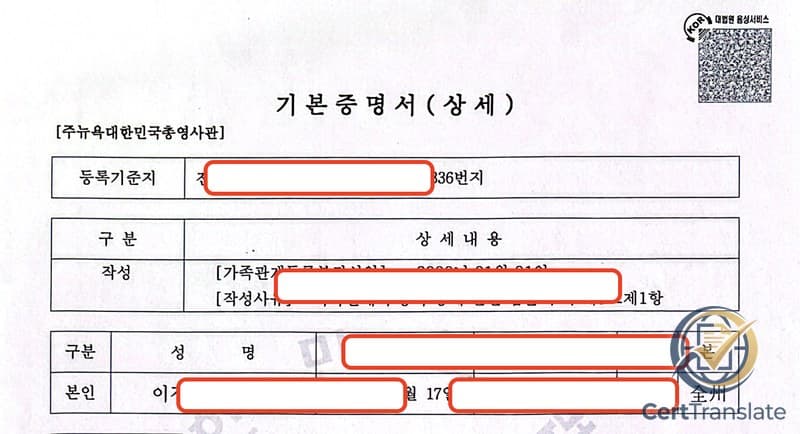
A client submitted a paired Korean civil-registry packet — a Basic Certificate (기본증명서, 상세) and a Family Relations Certificate (가족관계증명서, 상세) — both issued through the Consulate General of the Republic of Korea in New York for an applicant born in 1995. South Korea replaced the old hojuk (호적) family register with this two-document system in 2008; the Basic Certificate covers an individual's personal status events, and the Family Relations Certificate lists immediate family — together they perform the role a single certified birth certificate translation plays in many other countries.
The document body is entirely Korean. The applicant's name appears only in Hangul followed by Hanja in parentheses, and the parents' names follow the same pattern. Nowhere on the document is a Latin-script spelling of any name. The certified translation was needed for a USCIS filing — see also our Korean translation services page. Throughout the rest of this case study, the canonical Korean placeholder name 홍길동 (洪吉童) — the Korean equivalent of "John Doe" — stands in for the actual holder, and 김철수 (金哲秀) and 이영희 (李英姬) stand in for the parents.
Why This Required Special Handling
Korean has at least two competing official romanization systems. Revised Romanization of Korean (RR), adopted by the South Korean government in 2000, would render the placeholder name 홍길동 as "Hong Gil-dong." McCune-Reischauer (MR), still common in academic publishing, renders the same name "Hong Kil-tong." Neither is what most Koreans actually use. In practice, the spelling on a holder's passport is a personal choice made at issuance and rarely matches either standard system: "Hong Gildong," "Hong Gil-dong," "Hong Kil-tong," and "Hong Gildoung" are all in active use on real Korean passports for the same Hangul name.
USCIS adjudicators do not check a translated name against a romanization standard. They match it against the applicant's other identity documents — principally the passport. If the certified translation says "Hong Gil-dong" but the passport says "Hong Gildong," that reads as a name discrepancy on its face, and the cleanest immigration packet still attracts a Request for Evidence (the broader pattern is covered in our name mismatch guide).
A translator who romanizes by the book — applying RR consistently — produces a technically correct rendering that does not match the holder's actual identity documents. The professional standard is the opposite: use the passport spelling, regardless of which system (or none) it follows. The translator cannot infer the passport spelling from the Hangul alone, because the Hangul-to-Roman mapping is genuinely many-to-one.
The Hanja layer adds a separate consideration. Korean names traditionally pair a Hangul reading with a fixed set of Hanja characters that carry the name's meaning. The Hanja is the family-line identifier; the Hangul reading and any romanization are just labels for the reader. A translation that drops the Hanja loses the unambiguous form an adjudicator can use to cross-reference the applicant against any other Korean civil-status documents.
How We Handled It
Before drafting, we asked the client for the Roman spelling on his passport — for the placeholder example, this would be the equivalent of confirming "Hong Gildong" (first name "Gildong," last name "Hong"). We applied the same approach to his parents' names — using the spellings the holder confirmed where he had them, and falling back to Revised Romanization only where no holder-supplied spelling was available. Any fallback was disclosed in the Translator's Note rather than presented as if it were the holder's authoritative spelling.
Each romanized name in the translation is followed by the original Hanja in parentheses — using the placeholder family, this would render as "HONG Gildong (洪吉童)," "KIM Cheol-su (金哲秀)," "LEE Yeong-hui (李英姬)." This gives the USCIS adjudicator a Latin-script form for cross-reference against the passport and an unambiguous Hanja form for cross-reference against any other Korean civil-status records the applicant may file in the same packet.
For 본 (bon-gwan) — the ancestral clan seat associated with each Korean surname — we used the place-name romanization with the Hanja in parentheses (for example, "Namyang (南陽)" for the Hong clan or "Gimhae (金海)" for one of the Kim clans) and explained the term in the Translator's Note. Bon-gwan is genealogical metadata, not part of the legal name, and conflating the two is a common error that produces translations where the clan seat looks like a middle name.
Korean Resident Registration Numbers (주민등록번호) were reproduced verbatim on the delivered translation. Dates were converted from "YYYY년 MM월 DD일" to the unambiguous English "Month DD, YYYY" form. Every stamp and seal — the revenue-stamp section, the Court Administration Office registrar's seal, and the Consulate General's seal — was rendered as a bracketed English transcription rather than reproduced as untranslated Korean. The two certificates were assembled as a 2-page paired set with their separate issue numbers preserved digit-for-digit on the delivered translation.
The Translator's Note read in part:
"Personal names are rendered in Roman letters following the spelling on the holder's passport (and on parents' identification where supplied), with the original Hanja preserved in parentheses as in the source. "본 (本)" refers to the bon-gwan, the ancestral clan seat associated with a Korean surname; the Hanja characters are retained in parentheses. Korean Resident Registration Numbers (주민등록번호) are reproduced verbatim. All dates in the source are written in the Korean format "YYYY년 MM월 DD일" and have been rendered in the unambiguous English form "Month DD, YYYY." Page 1 is a Basic Certificate (기본증명서); Page 2 is a Family Relations Certificate (가족관계증명서) — each issued as a separate certificate with its own issue number, submitted together as a 2-page set."

This note does three things. It tells the USCIS adjudicator that the Latin spellings are sourced from the holder's passport rather than from a romanization standard the translator chose. It documents the Hanja-in-parentheses convention so any reviewer can see the unambiguous identifier alongside the romanized form. And it pre-empts the most common adjudicator confusion about Korean civil-registry packets — that the Basic Certificate and Family Relations Certificate are two separate documents with their own issue numbers, not a single multi-page certificate.
The Outcome
The certified translation — both certificates as a paired 2-page set, each with its own issue number — was delivered to the client for the USCIS filing. The romanization of every name on the translation matches the holder's passport spelling, and the Hanja-in-parentheses convention provides the cross-reference adjudicators need when comparing the translation against other Korean documents the applicant submits.
We have used the same passport-first romanization approach across our Korean civil-registry translations consistently. None of the cases delivered with this convention has triggered a name-related Request for Evidence.
What This Means for You
A certified translation of a Korean civil-registry document should romanize the holder's name using the spelling on the holder's passport, not the spelling produced by any official romanization standard. Supply the passport spelling at order placement — the translator cannot infer it from the Hangul alone, and Hangul-to-Roman is genuinely many-to-one. Always preserve the original Hanja in parentheses as the unambiguous identifier across other Korean records.
Have a similar situation?
We handle Korean civil-registry packets — Basic Certificates, Family Relations Certificates, and marriage certificates — regularly.
Related Cases & Resources
Sources & References
- USCIS Policy Manual, Volume 1, Part E, Chapter 6 — Evidence·USCIS·Verified 2026-06-16
Explore the Hub
Guides
Documents
Languages
Immigration
All identifying information has been removed from the document image. In the case text, the canonical Korean placeholder name 홍길동 (洪吉童) — the Korean equivalent of "John Doe" — and corresponding placeholder names for the parents stand in for the real holder and family throughout, so no real personal name, romanization, date of birth, address, Resident Registration Number, or issue number is disclosed. Case details are shared with client permission. No personal data is stored or displayed on this page.