




How do you translate the names on a Japanese marriage acceptance certificate with a foreign spouse?
TL;DROn a Japanese marriage acceptance certificate (婚姻届受理証明書), the Japanese spouse’s name is romanized from the reading printed on it, and a foreign spouse shown only in katakana takes the spelling the couple supplies. The certificate is a municipal office’s statement that it accepted the couple’s 婚姻届 (marriage notification). CertTranslate translated one from a city in Tokyo, stated each spelling’s source in Translator’s Notes, and delivered the certified translation in August 2026 for a U.S. filing.
Case Specifications
- Document
- Marriage certificate (acceptance of a marriage notification)
- Foreign Name
- 婚姻届受理証明書 (konin todoke juri shomeisho)
- Country
- Japan
- Languages
- Japanese → English
- Submitted To
- U.S. filing (USCIS-standard certification)
A Japanese Certificate of Acceptance for a Marriage Notification
The client sent a one-page Japanese marriage acceptance certificate from a city in Tokyo. The husband is Japanese and the wife a foreign national, and neither name appears in Latin letters. The order was for a certified Japanese marriage certificate translation for a U.S. filing.
A 婚姻届受理証明書 (konin todoke juri shomeisho) is a Japanese municipal office’s certificate that it accepted a couple’s 婚姻届 (marriage notification). Article 48 of the Family Register Act lets the person who filed a notification request one. Under Article 739 of the Civil Code, a marriage takes effect upon that notification.
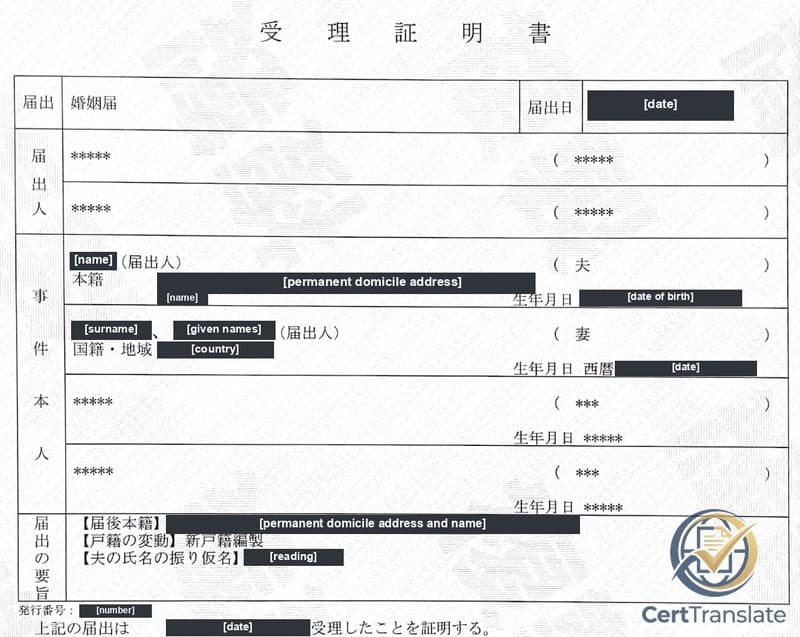
The page itself is titled 受理証明書 (Certificate of Acceptance). Its table lists two 届出人 (notifier) rows, four 事件本人 (persons concerned) slots and a 届出の要旨 (summary of the notification) block. A closing sentence certifies the date the notification was accepted.
The redacted image below shows that table with every name, address, number and date covered.
Why Neither Name on the Acceptance Certificate Is in Latin Letters
Shizuoka City’s guidance says the certificate serves as proof of a notification until the family register records it. Foreign nationals also use it to prove a change in status. A U.S. Army legal office in Okinawa calls it legal evidence of a valid marriage, to be translated into English.
The husband’s name is written in kanji, and kanji alone do not fix how a name is read. Since an amendment to the Family Register Act took effect in May 2025, Japan’s family registers record the 振り仮名 (furigana, phonetic reading) of names. This certificate prints the husband’s reading in its summary block, under 【夫の氏名の振り仮名】.
The wife is a foreign national, so she has no koseki (戸籍, family register) of her own. Japan’s Ministry of Justice says the marriage goes into the Japanese spouse’s register, with the foreign spouse’s name, date of birth and nationality. Here her name appears only in katakana, surname first, with a Japanese comma before the given names.
Katakana does not separate L from R and often writes a V sound with B-row characters. One katakana string can therefore stand for several Latin spellings. Her given names also run together, with nothing to show where one ends.
USCIS expects a full English translation certified as complete and accurate, as our guide to USCIS translation requirements explains. A spelling rebuilt from katakana may not match the passport, so the translation should say where each spelling came from.
How We Spelled a Kanji Name and a Katakana-Only Name
For the husband, we romanized the printed reading in Hepburn without macrons, the form Japanese passports use. We kept the certificate’s surname-first order and added the kanji in parentheses.
For the wife, we used the spelling the client supplied with the order. We kept the certificate’s surname-first order, with a comma, and added the katakana in parentheses. The client had written each surname in capitals to mark it; we kept normal capitalization.
Asterisks fill both notifier rows and the two unused persons-concerned slots. Each spouse carries the printed marker (notifier) inside their own entry, so the asterisks are the city’s filler, not missing data. We reproduced them as printed and explained them in a note.
"Translator’s Notes 2–3 from the certificate (names and places replaced with placeholders): 2. The husband’s name follows the phonetic reading printed on the certificate itself (【夫の氏名の振り仮名】[reading in katakana]), in Hepburn without macrons - the form used in Japanese passports. The wife is not a Japanese national, so her name is recorded in the original in katakana only ([surname in katakana]、 [given names in katakana], surname first); it is rendered “[Surname], [Given names]” per the spelling given by the bearer. The name [name in kanji] ([romanized name]), shown as the head of the family register in which the husband was recorded before this marriage, carries no phonetic reading in the original; that romanization is the most common reading of those characters and is best-effort, as is “[place name]” for the sub-municipal component [place name in kanji] of the permanent-domicile address. 3. The two “Notifier” rows and the third and fourth “Persons concerned” slots are printed with runs of asterisks rather than entries. The asterisks are the issuing municipality’s filler for fields not completed on this certificate - both spouses instead carry the printed marker “(Notifier)” within their own entries - and are reproduced here as printed."

Dates use 和暦 (the Japanese era calendar): 平成 (Heisei) years count from 1989 and 令和 (Reiwa) years from 2019. We converted each date and kept the era year in square brackets, so an invented Heisei 10 date would end in 1998 [Heisei 10]. The wife’s date of birth is marked 西暦 (Western calendar), and its bracket says so.
The summary block restates what the notification set up. It gives the 本籍 (honseki, permanent domicile) after the notification, the register change 新戸籍編製 (new family register compiled) and the husband’s reading. Under Article 16(3) of the Family Register Act, a Japanese national who marries a foreign national gets a new register unless already heading one.
Two items have no printed reading: the name of the head of the husband’s previous register and one part of the address. We used the most common reading and marked both as best-effort.
The client had already ordered from us a translation of a koseki recording the same marriage. We matched every shared field to it, from the names and dates to the permanent domicile.
The certificate is printed on copy-deterrent paper, with the word 複製 (reproduction) as a pale latent pattern across the sheet. A note describes the paper once, so nobody reads the pattern as an annotation on the record. The anti-counterfeiting notice printed at two corners is translated in brackets.
The Outcome
CertTranslate delivered the certified translation in August 2026 for the client’s U.S. filing, built to the USCIS certification standard (8 CFR 103.2(b)(3)). The packet held the one-page translation in the original’s landscape layout, a signed certification page with four Translator’s Notes, and a copy of the original.
The certification page calls the document a Certificate of Acceptance of a Marriage Notification, matching what the city certified.
What This Means for You
A Japanese marriage acceptance certificate is a city office’s statement that it accepted a marriage notification, and its translation should keep that title. If one spouse is a foreign national, expect that spouse’s name in katakana only, and give the translator the passport spelling.
If the Japanese spouse’s passport differs from the Hepburn form of the printed reading, mention it when you order a certified Japanese translation. Our koseki translation guide covers the register that records the same marriage.
Have a similar Japanese certificate?
We translate Japanese civil-registry certificates for U.S. filings and state where every name spelling comes from — $24.95 per page, certified to the USCIS standard.
Related Cases & Resources
Sources & References
- Family Register Act (English translation), Articles 13, 16 and 48·Ministry of Justice, Japan — Japanese Law Translation·Verified 2026-10-17
- Civil Code (English translation), Article 739·Ministry of Justice, Japan — Japanese Law Translation·Verified 2026-10-17
- 届出の受理証明書がほしいとき (Requesting a certificate of acceptance of a notification)·Shizuoka City·Verified 2026-10-17
- 国際結婚、海外での出生等に関する戸籍Q&A (Family register Q&A on international marriage)·Ministry of Justice, Japan·Verified 2026-10-17
- 戸籍にフリガナが記載されます (The reading of names is now recorded in the family register)·Ministry of Justice, Japan·Verified 2026-10-17
- ヘボン式ローマ字 (Hepburn romanization for passports)·Kanagawa Prefectural Government·Verified 2026-10-17
- Marriage Process on Okinawa (Legal Assistance Office packet)·U.S. Army Garrison Okinawa, Torii Station Legal Assistance Office·Verified 2026-10-17
- USCIS Policy Manual, Volume 1, Part E, Chapter 6 — Evidence·USCIS·Verified 2026-10-17
Explore the Hub
Documents
Languages
Immigration
All identifying information has been removed from document images. Case details are shared with client permission. No personal data is stored or displayed on this page.