




How do you translate an American spouse’s name that a Korean marriage record gives only in Hangul?
TL;DRAn American spouse’s name that a Korean 혼인관계증명서(상세) gives only in Hangul is restored in Latin letters, surname first as the register writes it, and the spouse’s passport spelling governs. The client, a U.S. national, held a Korean Marriage Relationship Certificate (Detailed) that wrote her three-part name as one unbroken Hangul string. CertTranslate restored the name with a bridging note, translated a later ex officio correction in full, and delivered a USCIS-standard certified translation in August 2026.
Case Specifications
- Document
- Marriage certificate (Marriage Relationship, Detailed)
- Foreign Name
- 혼인관계증명서(상세)
- Country
- South Korea
- Languages
- Korean → English
- Submitted To
- U.S. filing (USCIS-standard certification)
A Korean Marriage Relationship Certificate With an American Spouse
The client sent a two-page Korean 혼인관계증명서(상세), the Marriage Relationship Certificate (Detailed), and ordered a certified translation of a Korean marriage certificate. It records the marriage of a Korean national and a U.S. national. The client was the American spouse, and the order named no receiving authority.
A 혼인관계증명서(상세) is the detailed marriage certificate Korea issues from a person’s 가족관계등록부 (family relations register). It shows the person, the spouse, and every marriage and divorce in the record. The register replaced Korea’s old family register system in 2008.
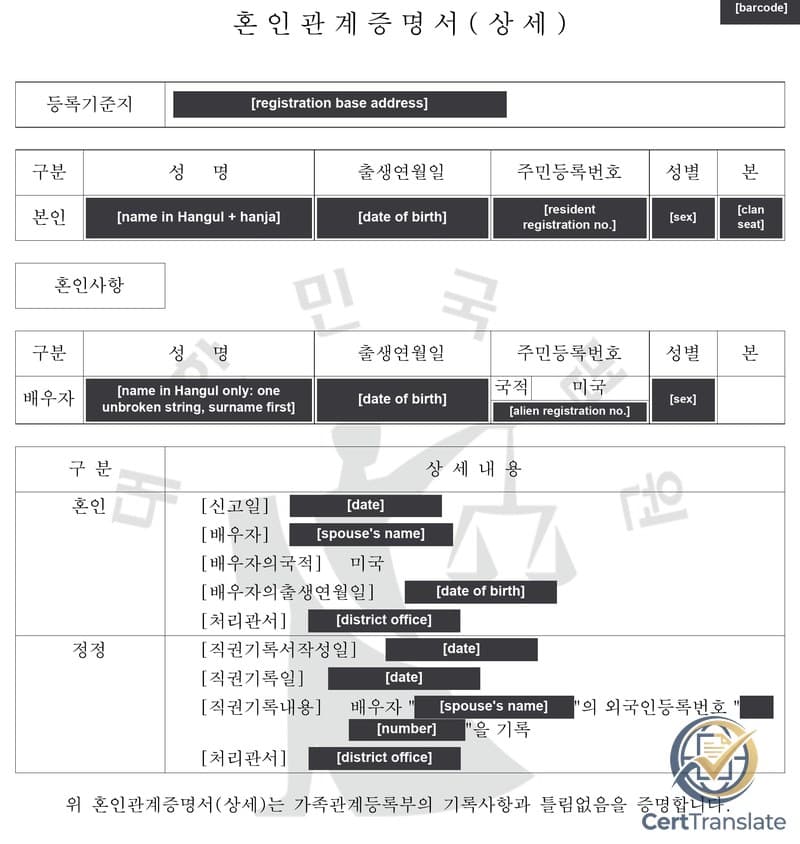
The Korean spouse appears as 본인 (Self, the person whose register it is) and the American as 배우자 (spouse). Both rows list a name, date of birth, registration number, sex and 본 (Bon, the clan seat). A details table records the marriage report and, below it, an entry headed 정정 (correction).
A footnote on the page cites Article 15(3) of Korea’s registration act for its detailed content. The redacted image below shows the structure, with every name, number, date and place covered.
Why a Spouse Name Written Only in Hangul Needs a Note
The American spouse’s name appears three times on the page, each time only in Hangul. It is a three-part English name written as one unbroken string, surname first, and no Latin spelling is printed anywhere. The English form has to be rebuilt from the Hangul alone.
The string matches the Hangul format in Korea’s 2024 government standard for foreign names: surname first, with no space. The same standard prefers the Roman spelling alongside the Hangul, but this certificate prints no Roman spelling.
Hangul spells the sound of an English name, not its letters, so one syllable can match several English spellings. Without spaces, the string also hides where the surname ends and the given names begin. A wrong split or spelling would make the translation disagree with the spouse’s passport, a name mismatch between documents.
The American spouse’s 본 cell is empty. A correction entry on a marriage record can look as if the marriage itself was changed. USCIS asks for a complete, certified English translation, so neither detail can be dropped.
How We Restored the Hangul-Only Name and Translated the Correction
We rebuilt the three English name parts from the Hangul and kept the register’s surname-first order in all three fields. A Translator’s Note says the original records the name only in Korean transcription, without spaces. The note also gives the name in Western given-name-first order.
The client was the American spouse, so the name on the order was our first check. It matched the rebuilt given name and surname; the middle name appears only in the Hangul. For a name the record holds only in Hangul, the spouse’s passport spelling governs, and the translation follows the passport if the two differ.
"Translator’s Notes 1–2 from the certificate (names and characters replaced with placeholders): 1. The spouse is a United States national whose name is recorded in the original only in Korean transcription, without spaces, as “[name in Hangul]”; it is rendered here as “[Surname] [Given name] [Middle name]”, following the surname-first order in which the Korean family relations register records a foreign spouse’s name. This corresponds to [Given name] [Middle name] [Surname] in the Western given-name-first order. 2. “Bon” (본) denotes the ancestral clan seat traditionally recorded in Korean family registers. The Chinese characters shown in the original after the principal’s name ([hanja]) and for his clan seat ([hanja]) are retained in parentheses; the spouse, as a foreign national, has no entry in this column."

A 정정 (correction) entry is a later line in the register that fixes or completes a recorded item. This one was made 직권 (ex officio), meaning by the registry’s own action rather than on anyone’s application, months after the marriage report. Its content line says what it did: it recorded the spouse’s 외국인등록번호 (alien registration number).
We translated all four labels of the entry in full, from the date the ex officio record was prepared to the processing office. Read that way, the entry shows that only a number was added and the marriage details above it stand unchanged. An officer who sees the word Correction on a marriage record can see exactly what changed.
The number has the same shape as a Korean resident registration number: six digits, a hyphen and seven more (YYMMDD-NNNNNNN). We checked that its first six digits match the spouse’s printed date of birth. We reproduced the number exactly as printed in both places it appears.
The Korean spouse’s 본 is written in hanja (Chinese characters). Its first character has a near-identical twin in Unicode, differing only in two small inner strokes. We compared the printed character with both candidates at high magnification and used the one whose strokes match.
We also read each hanja of the Korean spouse’s name against the Hangul printed before it. Each character must carry the same sound as its Hangul syllable, so a mismatch exposes a misread character.
Korean law records a foreign family member by name, sex, date of birth, nationality and alien registration number, with no clan seat. That is why the American spouse’s 본 cell is empty. The translation marks it [Blank in original], and Translator’s Note 2 gives the reason.
Dates appear in U.S. order and the issue time on the 12-hour clock, as Translator’s Note 3 records. The issuing office’s red seal is described rather than transcribed. Note 4 describes the faint court watermark across both pages.
The Outcome
CertTranslate delivered the certified translation in August 2026 for the client’s U.S. filing, built to the certification rules USCIS applies (8 CFR 103.2(b)(3)). The packet held the two translated pages, a signed certification page with four Translator’s Notes, and a copy of the Korean original.
The certification names the document as a Marriage Relationship Certificate (Detailed), the record the packet actually holds.
What This Means for You
A spouse name written only in Hangul on a Korean marriage record is a transcription of the original name, not a new spelling. A certified translation should restore the Latin form, keep the register’s surname-first order with a note, and match the spouse’s passport.
If your Korean record carries a correction entry, ask for every label of that entry to be translated, not summarized. An empty clan-seat cell for a foreign spouse is normal. A Korean-to-English certified translation should mark it as blank, not leave it out.
Have a Korean record that spells your name only in Hangul?
We translate Korean family-register certificates for U.S. filings, restore Hangul-only names with a note, and translate every correction entry — $24.95 per page, certified to the USCIS standard.
Related Cases & Resources
Sources & References
- Act on Registration of Family Relations (English text), Articles 9, 15 and 18·Korea Legislation Research Institute — Statutes of the Republic of Korea·Verified 2026-10-14
- 가족관계등록제도 (Family relations registration system)·Yeonsu-gu Office, Incheon·Verified 2026-10-14
- Policy Review — Korea’s New Standard for Writing Foreign Names·Korea.net (Ministry of Culture, Sports and Tourism), October 2024·Verified 2026-10-14
- USCIS Policy Manual, Volume 1, Part E, Chapter 6 — Evidence·USCIS·Verified 2026-10-14
- 8 CFR 103.2(b)(3) — Translations·Legal Information Institute, Cornell Law School·Verified 2026-10-14
Explore the Hub
Certified Translation
Documents
Languages
Immigration
All identifying information has been removed from document images. Case details are shared with client permission. No personal data is stored or displayed on this page.