“They translated my 혼인관계증명서 perfectly. The romanization matched my passport exactly — my name uses a non-standard spelling and they caught it without me having to ask. Our I-130 was approved with no RFE.”
J
Jiyeon K.
Los Angeles, CA
혼인관계증명서혼인신고서호적등본
Certified English translation for USCIS, spouse petitions, courts, legal name changes, and consular use.
Ready within 24 hours
Complete translation
Word-for-word, same structure
Every field, stamp, seal, signature, and annotation
Certified package
Signed and Stamped Certificate of Accuracy
Company letterhead · translator signature · company stamp

We check your files and confirm the total before you pay




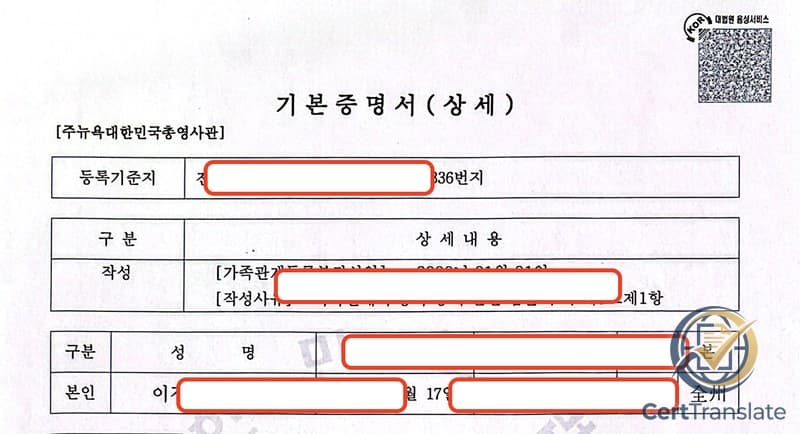
Korean marriage certificate translation produces a certified English version of 혼인관계증명서 (marriage relationship certificates), 혼인신고서 (marriage report forms), and legacy 호적등본 (family register extracts) from the Republic of Korea, prepared for USCIS immigration filings, spouse petitions, adjustment-of-status applications, and civil-status proceedings.
Most clients order Korean marriage certificate translation for USCIS spouse petitions (Form I-130), adjustment-of-status applications (Form I-485), K-1 fiancé(e) visa evidence, naturalization applications (Form N-400), and state-level marriage verification. Korean marriage certificates are required to prove a valid marriage under South Korean law for immigration and civil-status purposes.
The same translation is needed for U.S. family courts verifying marital status, benefits agencies, employers requiring proof of marital relation, and any proceeding where the existence and date of a Korean marriage must be established from the original Hangul-language record.
For Korean marriage certificate translation, we distinguish between modern 가족관계등록부 and legacy 호적 records, align Hangul romanization with passport spelling for identity consistency, render Hanja characters accurately, and coordinate names across multi-document filing packets so the English version supports clean USCIS verification.
PDF, photo, or scan — any format works. Takes about 30 seconds.

A native-speaking Korean translator handles every word, stamp, and signature. Signed Certificate of Accuracy included — USCIS-ready format.
Review the completed translation before it is certified — unlimited free revisions until every detail is right. Final searchable PDF delivered typically within 24 hours.
4.9/5•From 2,400+ reviews
“They translated my 혼인관계증명서 perfectly. The romanization matched my passport exactly — my name uses a non-standard spelling and they caught it without me having to ask. Our I-130 was approved with no RFE.”
Jiyeon K.
Los Angeles, CA
“My wife’s Korean marriage certificate and birth certificate were translated together with consistent name spelling throughout. The USCIS officer commented that the translations were well done. Highly recommend.”
Mark S.
Seattle, WA
“I needed an older 호적등본 translated for my naturalization application. CertTranslate understood the family register format and identified the marriage entry accurately. The N-400 process went smoothly.”
Eunji P.
New York, NY
We don't have a published case on Korean marriage certificate translation specifically — here are recent Korean translation cases on related documents.
Korean marriage certificate translation requires distinguishing between the modern 가족관계등록부 system and legacy 호적 records, aligning Hangul romanization with passport spelling rather than standard Revised Romanization, handling Hanja characters accurately, and coordinating names across marriage certificates, birth records, and passports in the same filing packet — combined challenges that require both Korean language expertise and civil-document domain knowledge.
Since 2008, South Korea replaced the 호적 (family register) system with the 가족관계등록부 (family relation register) system. The primary marriage document is now the 혼인관계증명서, which records both spouses’ names in Hangul (한글) and sometimes in Hanja (한자), the marriage registration date, the district office (시/구/동) where the marriage was registered, and the registration number. Legacy 호적등본 records from before 2008 remain valid and are still submitted in some filings.
Your marriage certificate is translated by a native Korean speaker who handles civil records daily, so Hangul-to-English romanization is aligned with passport spelling rather than defaulting to Revised Romanization, Hanja characters are rendered accurately alongside their Hangul equivalents, and ROK institutional labels (법원행정처, 시청, 구청, 동주민센터) are translated with the correct English equivalents.
If USCIS or any receiving authority asks for a translation-only correction, we revise the file at no extra cost so the English version stays aligned with the original record.
The modern 혼인관계증명서 (marriage relationship certificate) issued under the 가족관계등록부 system records each spouse’s details individually with the marriage registration date and district office. Legacy 호적등본 (family register extracts) from before 2008 organized all family members under the household head (호주) and listed marriages, births, and deaths within that family unit.
A translator unfamiliar with both systems may misidentify fields, omit registration numbers, or incorrectly render the 호주 relationship structure. We identify the document system first, then translate with the appropriate administrative context and field labels.
Korean names in Hangul (한글) can be romanized multiple ways. The Korean government’s Revised Romanization system produces one spelling, but passports often use a different romanization chosen by the individual. For example, 박 can appear as Park, Pak, or Bak; 이 can appear as Lee, Yi, Rhee, or Li; 김 can appear as Kim or Gim.
If the marriage certificate translation uses Revised Romanization but the passport uses a different spelling, USCIS may flag an identity-consistency issue. We align each name’s romanization with the passport spelling and note the Hangul original, so the identity chain remains unbroken across all documents in the filing packet.
Some Korean marriage certificates include Hanja (한자 / Chinese characters) alongside Hangul, particularly in names and in older or more formal records. These Hanja characters carry specific meaning and may differ from their Hangul phonetic equivalents.
We render Hanja characters accurately in the translation, noting their Hangul equivalents and the romanized form. This is particularly important when the same name appears in Hanja on one document and in Hangul on another, as the receiving authority needs to verify they refer to the same person.
A Korean marriage certificate is typically the central document in an I-130 spouse petition or I-485 adjustment-of-status filing. It appears alongside birth certificates, passports, divorce records (if applicable), and other supporting documents. The spouses’ names, dates, and registration details must be translated consistently across every document.
We coordinate name spellings, dates, and registration references across the entire filing set when multiple documents are ordered together. This cross-document consistency prevents discrepancies that could trigger an RFE (Request for Evidence) or delay processing.
Korean marriage certificate translation varies by the era of the document and the registration system used. These sections cover the differences that matter for U.S. filings.
The 혼인관계증명서 (marriage relationship certificate) is the standard marriage document in current use. Issued by district offices (시청/구청/동주민센터) or Korean consulates abroad, it records both spouses’ names, resident registration numbers (주민등록번호, partially redacted), the marriage registration date, and the issuing authority.
These are the most commonly submitted Korean marriage documents for USCIS filings. South Korea is a Hague Apostille Convention member (in force since July 14, 2007). We preserve every field including registration numbers, institutional labels, and the 법원행정처 (National Court Administration) electronic verification codes when present.
Before 2008, marriages were recorded in the 호적 (family register) system. The 호적등본 (family register extract) listed all family members under the 호주 (household head) and recorded marriages, births, deaths, and other civil events. These records are still valid for USCIS filings and are sometimes the only available documentation for marriages registered before 2008.
We translate legacy 호적등본 records with the appropriate historical context, preserving the household-head structure and identifying the marriage entry within the broader family record. When filed alongside modern 가족관계등록부 documents, we coordinate names and dates across both systems.
$24.95
per page · no word cap
Typical length
Typically 1 page
Typical total
$24.95
No hidden fees. Free Quote.
Korean marriage certificate translation costs $24.95 per page. Most clients pay $24.95. A standard one-page marriage certificate is $24.95; legacy 호적등본 records with multiple pages may cost more. You receive the confirmed page count before payment, and there is no language surcharge for korean.
Most marriage certificate orders are delivered within 24 hours once we receive clear scans. Standard marriage certificates are typically delivered within 24 hours. Legacy family register extracts with extensive entries may take slightly longer, but we confirm the delivery window before production begins.
Yes. This service is built for USCIS, courts, and other receiving authorities that need a complete certified English translation of a Korean marriage certificate. Our package includes the full English translation plus a signed Certificate of Accuracy, which is the format most receiving authorities expect for foreign-language records.
We handle marriage certificates issued in South Korea under both the modern 가족관계등록부 system and the legacy 호적 system, as well as records issued by Korean consulates abroad. If your record uses a rare regional format, upload every page so the translator can match the exact issuing-country structure before production starts.
We can usually translate records with handwriting, faded stamps, and older printing if the scan is usable. If a name, registration number, or institutional seal is too weak to read safely, we ask for a better image before we certify the file. When a field is genuinely unreadable, we mark it transparently instead of guessing, which is safer than inventing a name, date, or registry number.
Yes — you receive the completed translation for review before we certify it, and we make unlimited free revisions until every name, date, and detail is right. If USCIS later requests a change, we correct the certified file at no charge.
No — we bill the physical page you upload, never a word count. Many services cap a "page" at 250 words and re-bill a dense marriage certificate as two or three pages; here one page of your document is one $24.95 page, however dense the text.
Yes. Korean names can be romanized multiple ways (e.g., 박 as Park, Pak, or Bak; 이 as Lee, Yi, or Rhee). We align each name’s romanization with the passport spelling rather than defaulting to standard Revised Romanization. This passport-matched approach prevents identity-consistency issues when USCIS cross-references your marriage certificate with your passport and other documents.
Yes. Family register extracts from before 2008 are still valid for USCIS filings. We translate 호적등본 records with the appropriate historical context, preserving the household-head (호주) structure and identifying the specific marriage entry. When filed alongside modern 가족관계등록부 documents, we coordinate names and dates across both systems.
A Korean marriage record comes from the modern 가족관계등록부 system (혼인관계증명서) or the legacy 호적 register. We identify which you have, translate it in full, render Hanja alongside Hangul, and match each name’s romanization to the passport.
| Field | What it is | How we handle it |
|---|---|---|
| 혼인관계증명서 / 혼인신고서 / 호적등본 | Marriage relationship certificate / marriage report / legacy family-register extract | Document system identified; field labels set to match it, not assumed. |
| 시청/구청/동주민센터 + 발급번호 | Issuing district office and the issuance/document number | Authority and number preserved exactly as printed. |
| 부부 (한글 + 한자) | Both spouses, in Hangul and often Hanja | Hanja rendered with its Hangul equivalent; names romanized to the passport. |
| 혼인신고일 / 등록일 | Marriage-report (effective) date / registration date | Date translated precisely; format preserved, not reformatted. |
| 등록기준지 / 주민등록번호 | Registration base address / resident registration number (partially redacted) | Reproduced as shown, including redaction, never reconstructed. |
| 법원행정처 verification / 호주 (legacy) | Electronic verification code / household-head structure on legacy records | Verification code preserved; 호주 relationship structure rendered for legacy 호적. |
Since 2008 the 호적 (family register) system was replaced by the 가족관계등록부 (family relation register). Legacy 호적등본 records from before 2008 remain valid and are still submitted; we translate either with the correct era context and coordinate names/dates when both appear in one packet.
Most translation-related RFEs trace back to a few issues. These are what we check on every Korean-language marriage record.
01Romanization not matched to passport spelling
We render each name in the passport romanization (Park/Pak, Lee/Yi/Rhee, Kim/Gim) rather than defaulting to Revised Romanization, and note the Hangul original.
02Modern certificate vs legacy 호적 register not distinguished
We identify the document system and translate with the right field labels and the 호주 structure for legacy records.
03Hanja name not reconciled with Hangul across documents
We render Hanja with its Hangul equivalent and romanized form so the same person is verifiable across the packet.
04Registration number omitted or redacted 주민등록번호 reconstructed
We preserve the issuance/registration number and reproduce redactions exactly as shown, never reconstructing masked digits.
Patterns drawn from real Korean marriage-record casework (modern 가족관계등록부 and legacy 호적). Unreadable fields are marked transparently, never guessed.
Every order is checked against this list before certification — and covered by the revise-free-or-refund guarantee.
Start my translationCommon terms you will see on a Korean-language marriage record, with what they mean on the certified English version.
Our guidance on Korean marriage certificate translation reflects the published requirements of the authorities below.
Upload every page of the marriage certificate, including any apostille sheets, electronic verification codes, and supplementary pages. Some records include additional annotations or registration corrections that must be translated for completeness.
If your filing packet also includes birth certificates, passports, divorce records, or other Korean-language documents, ordering the documents together helps keep name romanization, dates, and registration references consistent across the translated set.