




What do you do when a Japanese koseki writes a foreign spouse's name only in katakana?
TL;DRA Japanese Koseki Tohon (family register) recorded the head of household's two Filipino wives and a Filipino daughter-in-law only in katakana — no Latin spelling anywhere on the document. We delivered a draft using phonetic transliterations of each katakana name, the client verified the Latin spellings against each spouse's own identification, and we re-issued the certified translation with the client-verified spellings and a Translator's Note documenting the source. The translation was delivered for the client's USCIS I-130 family petition.
Case Specifications
- Document
- Family register (Koseki Tohon)
- Foreign Name
- 戸籍全部事項証明書 (Koseki Zenbu Jikō Shōmeisho)
- Country
- Japan
- Languages
- Japanese → English
- Submitted To
- USCIS (I-130 family petition)
What We Received
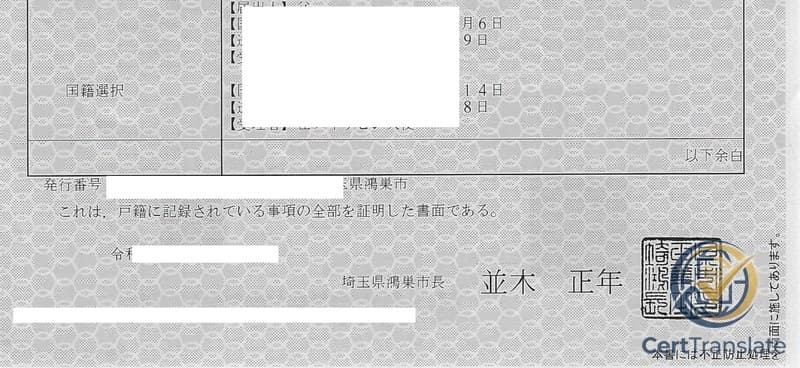
A client submitted a Japanese Koseki Tohon — specifically, a Koseki Zenbu Jikō Shōmeisho (戸籍全部事項証明書, "Certification of All Matters Recorded in the Family Register") — issued by a municipality in Saitama Prefecture. The register covers the head of household, his two sequential marriages, and his children, including one son who later married a Filipino woman and started his own register.
All three foreign spouses in the document — the head of household's first and second wives (both Filipino), and his eldest son's wife (Filipino) — appear in the register exclusively in Japanese katakana: the phonetic script that Japanese uses for non-Japanese words. Example katakana strings include "キュウロンサパララン, ピンキロース" and "グティエレズミア, リーダミリアム." Nowhere on the document is there a Latin-script spelling of any of these names.
The certified English translation was needed for a USCIS family-petition (I-130) filing — see our certified koseki tohon translation and Japanese translation services pages.
Why This Required Special Handling
Japanese municipal registrars record foreign names by ear, in katakana. Transliterating katakana back to Roman letters is never one-to-one — Japanese does not distinguish L from R, does not mark stress, and uses long-vowel signs that map ambiguously to English "u," "ou," or "oo." A name written as キュウロンサパララン could be reasonably rendered as Kyuronsapararan, Quironsapararan, or Kyuronsapalaran.
USCIS evidence standards expect the translated family record to match the spouse's own identification — principally her passport. When the only spelling on the koseki is katakana, the translator has no ground truth to copy. Choosing a romanization arbitrarily risks introducing a name that does not match the passport, which an adjudicator can flag as a discrepancy (see our name mismatch guide for the broader pattern).
This is distinct from transliterating a Japanese citizen's own name. A kanji name has a standard Hepburn romanization, and clients often supply their preferred spelling — here the client asked for "Reiichiro" as the English spelling of 礼一郎. The foreign spouses, by contrast, have no kanji form anywhere on the document, and the client could not confidently state how any of them spell their own names.
A standard koseki translation that silently transliterates the katakana with no caveat makes the adjudicator think the translator had authoritative source data. A professional translation must instead show its work — disclose that the Latin spelling is a phonetic reconstruction, and direct the reviewer to the spouse's ID for the authoritative form.
How We Handled It
We worked the case in two passes. First, we produced a phonetic transliteration of each katakana name in "SURNAME, GIVEN NAME" format, matching how the original koseki places the comma, and used that exact spelling consistently across every occurrence in the register (the head of household's first wife appears a second and third time as the mother of two children — we rendered her identically in all three places).
We delivered the draft with a Translator's Note flagging that the Latin spellings were phonetic reconstructions and asking the client to verify them against each spouse's identification. The client returned the spellings from each spouse's ID — "Quilon Sapalaran, Pinky Rose," "Balacanta Neri, Cora," and "Gutierrez Mia, Lydda Miryam" — and we re-issued the certified translation using the client-verified forms.
For the client's own name (礼一郎), we used "Reiichiro" as supplied at order placement. Other Japanese names use Hepburn romanization without macrons, matching that style. Japanese era dates were converted to Gregorian with the era kept in parentheses ("March 9, 2002 (Heisei 14)"). Japanese addresses were rendered in Latin-script small-to-large order per standard certified-translation practice, disclosed in a Translator's Note.
The final Translator's Note on the foreign names reads:
"The names of the foreign (Filipino) spouses and the mother of the children are recorded in the original in Japanese katakana only; no Latin-script spelling appears anywhere on the document itself. The Latin-script spellings used in this translation were provided by the document holder based on the spouses' own identification documents, and correspond to the following katakana readings on the original: キュウロンサパララン, ピンキロース = Quilon Sapalaran, Pinky Rose; バラカンタネリ, コラ = Balacanta Neri, Cora; グティエレズミア, リーダミリアム = Gutierrez Mia, Lydda Miryam."

This note does three things. It tells the USCIS adjudicator that the Latin spellings are not a transcription of anything that appeared on the original — the original had only katakana. It identifies the holder's own review of the spouses' IDs as the source of the Latin forms. And it lists the katakana each spelling corresponds to, so any reviewer can verify the mapping independently.
Two additional Translator's Notes covered the era-to-Gregorian date conversion and the Japanese-to-Latin address-order conversion. The "Retention of Nationality" (国籍留保) and "Choice of Nationality" (国籍選択) declarations filed by the Philippine-born children were rendered in full, with the Japanese Embassy in Manila identified as receiving authority. The 除籍 ("Removed from Register") marker on the eldest son — added when his marriage started a new family register — was reproduced with a bracketed translator's gloss.
The Outcome
The certified translation was delivered to the client for inclusion in their USCIS I-130 family-petition packet. The Translator's Note framing the foreign-spouse names as phonetic reconstructions — rather than authoritative Latin spellings — gives the adjudicator the full context needed to reconcile any spelling difference against the spouses' passports without raising a Request for Evidence against the translation itself.
This is the first case in our log involving a Japanese koseki where every foreign spouse — three of them — was recorded only in katakana. The pattern is common for Japanese citizens whose spouses registered a marriage under Philippine or other foreign law rather than at a Japanese city hall, so we expect to handle more cases of this kind as Japanese-Filipino and similar mixed-nationality couples file family petitions.
What This Means for You
A certified translation of a Japanese koseki that records a foreign spouse only in katakana should source the Latin-script spelling from the spouses' own identification documents, and the Translator's Note should explicitly state that this is where the spelling came from. Do not ask the translator to "pick" a romanization silently — the koseki has no authoritative Latin spelling to pick. Supplying the translator with each foreign spouse's passport or ID spelling at order placement produces a clean final translation; leaving that gap forces a phonetic reconstruction that the adjudicator may flag as inconsistent with the spouse's own documents.
Have a similar situation?
We handle Japanese koseki tohon translations — including family registers with foreign spouses — regularly.
Related Cases & Resources
Sources & References
- I-130, Petition for Alien Relative·USCIS·Verified 2026-05-27
Explore the Hub
Guides
Documents
Languages
Immigration
All identifying information has been removed from document images. Personal names, dates, and document numbers have been masked. Case details are shared with client permission. No personal data is stored or displayed on this page.