



What does 2ª via mean on a Brazilian diploma?
TL;DROn a Brazilian diploma, 2ª via (segunda via) marks an officially reissued second copy that replaces the first. A 2ª via diploma from a São Paulo state public university stated on its reverse that the first copy lost its validity once the second was registered. CertTranslate rendered 2ª via as “Second Copy,” translated the reverse in full with a Translator’s Note, and delivered the certified Portuguese-to-English translation in August 2026 to the USCIS standard.
Case Specifications
- Document
- University diploma — second copy (2ª via)
- Foreign Name
- Diploma — 2ª via (segunda via)
- Country
- Brazil
- Languages
- Portuguese (Brazil) → English
- Submitted To
- U.S. filing (USCIS-standard certification)
What a 2ª Via Diploma Shows on Each Side
A client ordered a certified Brazilian diploma translation of a two-page university diploma marked 2ª via. A 2ª via (segunda via) diploma is an officially reissued copy of a Brazilian diploma, issued in place of the original.
The diploma comes from a São Paulo state public university and confers a teaching degree in the arts. Its front has a guilloche security background, the graduate’s details, the degree title and the 2ª via marking. The order named no receiving agency, so we certified the translation to the USCIS standard (8 CFR 103.2(b)(3)).
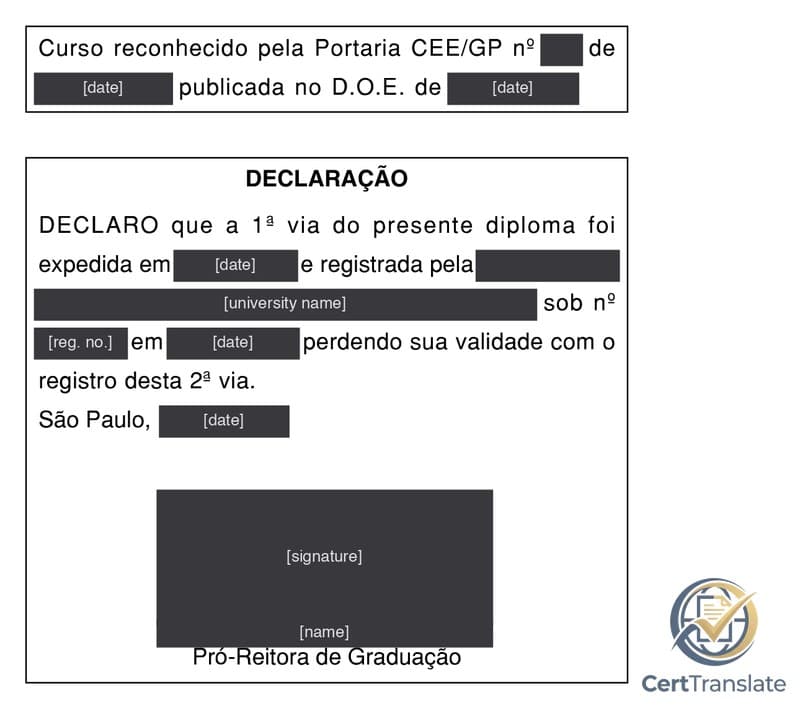
The reverse holds three boxed entries and a QR code: the course recognition, a declaration about the first copy, and the registration of this copy. As the redacted image below shows, the declaration says plainly what happened to the first copy.
Why the Reverse of a 2ª Via Diploma Matters
USCIS asks for a full English translation of any foreign-language document, with the translator’s certification that it is complete and accurate. Credential evaluators reviewing foreign degrees also read a diploma through its English text. On a 2ª via diploma, a front-only translation would show an unexplained marking and nothing more.
Nothing on the front says that an earlier copy exists, that it was registered, or that it is no longer valid. That history lives on the reverse, in a declaration signed by the university’s Pro-Rector for Undergraduate Studies. Without it, an English reader holds a second copy with no account of the first.
The reverse also prints two different registration numbers. The declaration cites the number under which the first copy was registered, and the registration box gives a new one for this copy. Out of context that looks like a discrepancy, yet each number belongs to a different copy.
The wording raised its own questions. In everyday Portuguese via means way or route, but on documents it means copy, so a literal rendering of 2ª via says nothing to a U.S. reader. Licenciatura Plena, reconhecimento do curso and Secretário Geral – Substituto needed the same care.
How We Rendered 2ª Via and Translated the Reverse
On the front, we rendered the 2ª via marking as “Second Copy.” On the reverse, we translated all three boxes in full and described the QR code in brackets. Both registration numbers were reproduced exactly as printed, each in its own box, so the two copies stay distinguishable.
"Translator’s Note: “2ª via” denotes an officially reissued copy of the diploma and is rendered here as “Second Copy”. As stated in the declaration on the reverse, the first copy, issued in [year], ceases to be valid upon registration of this copy."

The registration box carries the legal weight. It cites Article 48 of Lei 9394/1996, Brazil’s national education law, known as the LDB (Lei de Diretrizes e Bases da Educação Nacional). Under Article 48, a diploma from a recognized course has national validity once it is registered, and universities register the diplomas they issue.
That is why the reverse pairs the reconhecimento do curso (course recognition) box with the registro do diploma (diploma registration) entry. We rendered the statute in U.S. notation as Law No. 9,394/1996. The graduate’s identity-card (RG) number, by contrast, was reproduced exactly as printed, because an identifier must match the original character for character.
The registration is signed by the Secretário Geral – Substituto. Substituto marks an official formally acting in the Secretary General’s place, so we rendered the title as Acting Secretary General.
A Licenciatura Plena is a full Brazilian undergraduate teaching degree that qualifies the holder to teach the subject named. We rendered the degree as a Licentiate and the program as a Full Licentiate Program, with the Portuguese degree title kept in parentheses. Signatures were described in brackets as illegible or partially legible.
Nothing on either page was left out. The guilloche security background got a bracketed note. A validation code and a web address printed vertically in the front’s left margin went into a bracketed note that records where they appear.
What We Delivered
CertTranslate delivered the certified translation in August 2026 for a U.S. filing, built to the USCIS standard. The packet holds both translated pages, a signed certificate with five Translator’s Notes, and a copy of the original diploma.
Read together, the English pages say which copy of the diploma is valid, under which registration, and on what legal basis.
What This Means for You
A diploma marked 2ª via is an official second copy, and its reverse is part of the document. If your Brazilian diploma is a 2ª via, send both sides for a certified translation of the diploma. The back records what happened to the first copy and how the new one was registered.
Ask for the marking to be rendered and explained in a Translator’s Note. Then an English reader sees the same history a Brazilian registrar would.
Have a diploma marked 2ª via?
We translate Brazilian diplomas front and back — every marking, recognition box and registration entry included.
Related Cases & Resources
Sources & References
- Lei nº 9.394/1996 (LDB), Art. 48 — original text·Câmara dos Deputados (Brazil)·Verified 2026-10-12
- USCIS Policy Manual, Volume 1, Part E, Chapter 6 — Evidence (Translations)·USCIS·Verified 2026-10-12
Explore the Hub
Certified Translation
Documents
Languages
All identifying information has been removed from document images. Case details are shared with client permission. No personal data is stored or displayed on this page.