



Does the back of a Peruvian degree, with its registration stamps, need to be translated too?
TL;DRA Peruvian Diploma de Título Profesional (Médico Cirujano) from Universidad Peruana Los Andes carried its legal weight on the reverse. The back held the university registration entry, the General Secretary's authentication, and a Regional Health Directorate registration stamp. We translated both sides into English and rendered every seal, stamp, and signature line, so nothing on the back was dropped. The certified Spanish-to-English translation was delivered for the client's USCIS filing.
Case Specifications
- Document
- University diploma (professional degree)
- Foreign Name
- Diploma de Título Profesional
- Country
- Peru
- Languages
- Spanish → English
- Submitted To
- USCIS
What We Received
A client submitted a Peruvian Diploma de Título Profesional in medicine (Médico Cirujano). It was issued by Universidad Peruana Los Andes in Huancayo. The certified Spanish medical degree translation was needed for the client's USCIS filing.
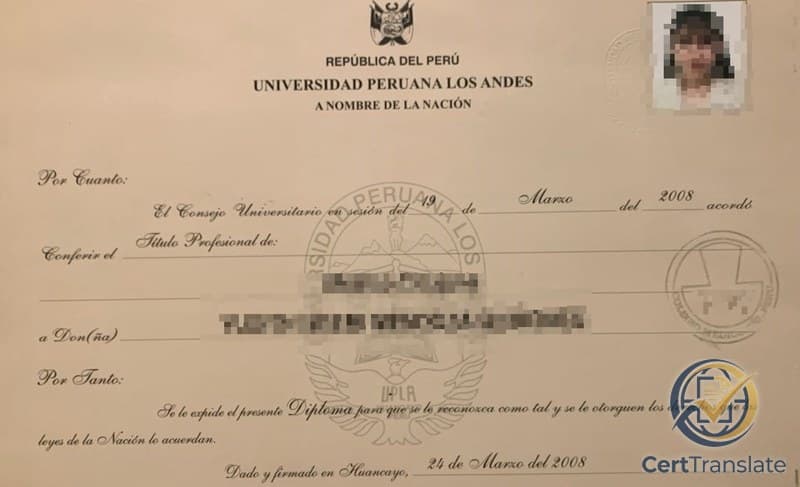
The front is the formal degree face. It carries a coat of arms, the holder's photo, an embossed university seal, and three faculty seals over the signature lines.
The reverse is where the registration lives. It carries the university registration entry, the General Secretary's authentication block, and a separate registration stamp from the Regional Health Directorate of Junín. A national registry barcode and a printed control number also appear on the back.
Why This Required Special Handling
The decorative front looks like the whole document. It is not. On a Peruvian professional title, the reverse holds the binding registration and the proof of authenticity.
USCIS asks that a certified translation be complete and accurate. A translation that reproduces only the front is neither. It silently omits the registration numbers and the two endorsements that make the degree official.
Each endorsement is also dense. The General Secretary's block certifies the diploma and the graduate by name. The Regional Health Directorate stamp registers the medical title under its own number, in faint blue ink. Both must be read, translated, and placed — not summarized. Our USCIS translation requirements guide explains why completeness is the standard the document is judged against.
How We Handled It
We produced a two-page certified translation that mirrors both sides of the original. Page one is the front; page two is the reverse, with all three authentication layers in full.
Every seal and stamp was translated into English and placed where it appears, in brackets. A circular university seal became "[SEAL: UNIVERSIDAD PERUANA LOS ANDES — GENERAL SECRETARIAT — HUANCAYO]." The blue registration stamp became a labeled block with its registration number and date carried verbatim.
We did not guess at anything we could not read. Illegible handwritten signatures were marked "[Illegible signature]" rather than given invented names. Faint pre-printed stamp labels and the largely-illegible Health Directorate signatory were flagged in Translator's Notes.
"The reverse of this diploma bears the university registration entry, the General Secretary's authentication, and a Regional Health Directorate of Junín registration stamp (in blue ink). Several seals and signatures are illegible and are marked accordingly; on the Health Directorate stamp the signatory's name is largely illegible. The professional degree 'Médico Cirujano' is rendered as 'Physician and Surgeon,' with the original Spanish term retained in parentheses; in Peru this is the qualifying medical degree, broadly comparable to a U.S. Doctor of Medicine (M.D.)."

Smaller decisions kept the two sides consistent. Each DD/MM/YYYY date was rendered as Month DD, YYYY to remove the DD/MM versus MM/DD ambiguity a U.S. reader would otherwise face. The holder's name, the registration numbers, and the officer's DNI were treated as content to reproduce on the certified copy, and were redacted in the case image. The embossed dry seal, the holder photo, and the national registry barcode were each described in brackets at their positions, so the reverse reads as a faithful map of the original.
The Outcome
The complete two-page certified translation was delivered for the client's USCIS filing. Both the formal degree and the reverse-side registration were translated, with every seal and stamp in English.
A foreign professional degree often travels onward to a licensing board or a credential evaluator after the immigration step. A translation that already carries the reverse-side registration meets USCIS translation acceptance criteria and needs no rework for those later readers.
What This Means for You
If your foreign degree has registration stamps or authentication blocks on the back, that side has to be translated too. The reverse is usually where the legal proof lives. A certified translation that reproduces both sides, with every seal rendered into English, keeps the document complete for USCIS and for any licensing or evaluation step that follows.
Have a similar situation?
We translate foreign degrees with reverse-side registration, authentication blocks, and seals rendered into English, complete for USCIS, licensing boards, and credential evaluators.
Related Cases & Resources
Sources & References
- Meet Translation Requirements·USCIS·Verified 2026-07-30
Explore the Hub
Certified Translation
Documents
Languages
Immigration
Accepted By
All identifying information has been removed from document images. Case details are shared with client permission. No personal data is stored or displayed on this page.