




Why does the place of birth on my Mexican death certificate start with commas?
TL;DROn a Mexican Acta de Defunción, leading commas in the place of birth are separators: the form joins locality, municipality, state and country with commas, even when the first ones are empty. The deceased was born in the United States, so only the country was filled in. CertTranslate kept the punctuation as printed, explained it in a Translator’s Note, and certified the acta and its apostille to the USCIS standard as one packet, delivered in September 2026.
Case Specifications
- Document
- Death certificate (Acta de Defunción) with Mexican apostille
- Foreign Name
- Acta de Defunción
- Country
- Mexico
- Languages
- Spanish → English
- Submitted To
- U.S. filing (USCIS-standard certification)
An Apostilled Acta de Defunción From Baja California Sur
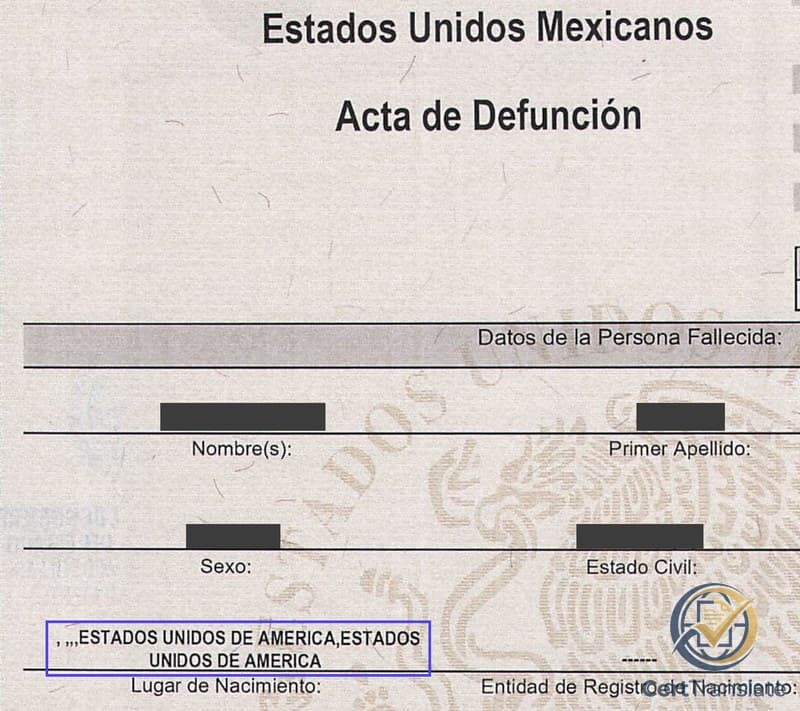
A client ordered an apostilled Mexican death certificate translation from Spanish into English. On the acta, the Lugar de nacimiento (place of birth) starts with a run of commas: four of them, with no entries between them. Then comes ESTADOS UNIDOS DE AMERICA, printed twice, as the redacted image below shows.
An Acta de Defunción is the death certificate issued by a Mexican state’s Registro Civil (civil registry): a certified copy of the official record of a death. This one comes from the Registro Civil of Baja California Sur. It records a person born in the United States.
The second page is the apostille (apostilla in Spanish), issued by the state’s General Secretariat of Government. Its Tipo de Documento (Type of Document) line reads ACTA DE DEFUNCION. Its Referencias (References) line cites the acta’s folio, the serial number printed on the certified copy.
Why the Place-of-Birth Commas Could Not Be Cleaned Up
A run of commas with nothing between them looks like a data-entry slip. Rewriting it as a tidy UNITED STATES OF AMERICA would read better. The English would then no longer match the original line for line.
USCIS expects a full English translation that the translator certifies as complete and accurate. Our guide to USCIS translation rules covers the certification itself. An officer who compares the two documents should find the same punctuation in the same place.
The apostille raised two more questions. Is it a separate document that needs its own certificate of translation? And what does item 6, the date, say where the issuing office’s blue stamp is printed over it?
Under the Hague Convention, an apostille certifies the signature, the signer’s capacity and the seal on the document it accompanies. It does not certify what that document says, as our explainer on what an apostille certifies sets out. So the apostille had to be matched to the right document first.
How We Kept the Commas and Certified the Acta With Its Apostille
We reproduced the field exactly as printed: four commas, then UNITED STATES OF AMERICA twice. A Translator’s Note explains where the commas come from, so they read as the form’s punctuation, not a translation error. The same rule kept a stray percent sign that ends the acta’s footer notice.
Fields that hold only a row of dashes got different treatment. The second surname and the Mexican state of birth registration print dashes because nothing applies, and we marked both [Blank in original]. The commas stay because they are part of a printed value, next to the country name.
"Translator’s Note: In the “Place of Birth” field the original prints a run of commas with no entries between them (“, ,,,ESTADOS UNIDOS DE AMERICA,ESTADOS UNIDOS DE AMERICA”): this is how the registry’s form joins its locality, municipality, state and country sub-fields when the first of them are empty. The punctuation is reproduced as printed. The place-of-death field contains the same kind of empty sub-field, the pre-printed postal-code label “C.P.” with no value after it."

The apostille names the document type and cites the acta’s folio. Its signer and capacity lines match the registry director who signed the acta. That ties it to this acta alone, so both pages share one certificate of translation, titled for a death certificate with apostille.
The original prints the Convention line in French, as Article 4 of the Convention requires, and we reproduced it as printed. Each field label appears in Spanish, English and French, and we rendered it once in English.
In item 6, the blue stamp covers part of the last digit of the year. We compared its visible strokes with the same typeface elsewhere on the sheet. The reading also had to fit the acta’s own issue date, since an apostille cannot predate the record it legalizes.
Both checks agreed, and a Translator’s Note records the obscured digit and how it was read. When a stamp hides text that nothing on the page can confirm, we mark it obscured instead.
Under the acta’s Firma Electrónica (electronic signature) heading, three lines of letters and digits form the Cadena Original, or original string. It is a Base64 encoding of the record data printed above it, including the CURP, Mexico’s 18-character population registry code. We copied it verbatim and left it untranslated, as with the electronic signature block on Mexican birth actas.
The acta’s typeface prints a capital I and a lowercase l identically. We kept the transcription that decodes without error, and the note says so.
The Outcome
We delivered the certified translation in September 2026 for a U.S. filing. No receiving authority was named, so the packet was certified to the USCIS standard for certified translations in 8 CFR 103.2(b)(3).
The delivered PDF holds the two translated pages, one certificate of translation with six Translator’s Notes, and a copy of both original pages. The comma run, the dashed fields and the stamped date all appear in the English, each accounted for.
What This Means for You
Commas in the place of birth on a Mexican acta are the form’s separators for empty sub-fields, not an error to correct. A certified translation can keep them as printed and explain them in a Translator’s Note. When an apostille cites your acta’s folio, the acta and the apostille can be translated as one packet under one certificate.
Have a similar situation?
We translate Mexican actas de defunción and their apostilles for U.S. filings, with every comma, dash and stamp accounted for.
Related Cases & Resources
Sources & References
- Convention of 5 October 1961 Abolishing the Requirement of Legalisation for Foreign Public Documents — full text·Hague Conference on Private International Law (HCCH)·Verified 2026-10-19
- Apostille Section·Hague Conference on Private International Law (HCCH)·Verified 2026-10-19
- USCIS Policy Manual, Volume 1, Part E, Chapter 6 — Evidence·USCIS·Verified 2026-10-19
- 8 CFR § 103.2 — Submission and adjudication of benefit requests·Legal Information Institute, Cornell Law School·Verified 2026-10-19
Explore the Hub
Certified Translation
Documents
Languages
All identifying information has been removed from document images. Case details are shared with client permission. No personal data is stored or displayed on this page.