




Which date on a Mexican divorce certificate does USCIS use to confirm the divorce is final?
TL;DRA Mexican Acta de Divorcio from the Tijuana Civil Registry listed three different dates — Fecha de Registro (April 27, 2017), Fecha de Resolución (November 18, 2015), and Ejecutoria (January 11, 2016). Under Mexican civil procedure only the ejecutoria date dissolves the marital bond. We labeled each date with its precise legal function and added a Translator's Note explaining the three-date structure so a USCIS adjudicator could identify the ejecutoria as the date that governs eligibility to remarry.
Case Specifications
- Document
- Divorce certificate
- Foreign Name
- Acta de Divorcio
- Country
- Mexico
- Languages
- Spanish → English
- Submitted To
- USCIS
What We Received
A client submitted an Acta de Divorcio issued by Office 01 of the Civil Registry of Tijuana, Baja California, for a certified Spanish-to-English translation to accompany a USCIS filing involving a subsequent marriage.
The document is a one-page Mexican civil-registry certificate printed on state security paper with an ornamental pink border. The top grid records the registry entry (Oficialía 01, Libro 05, Acta 00246, Fecha de Registro 27/ABRIL/2017, Tijuana, Baja California). The body contains the "Abstracto de la Resolución Administrativa" — a summary of the family court's ruling — which itself carries two additional dates: Fecha de Resolución 18/11/2015 and Ejecutoria 11/01/2016.
Three dates. Three different years. Only one of them is the date the marriage was actually dissolved.
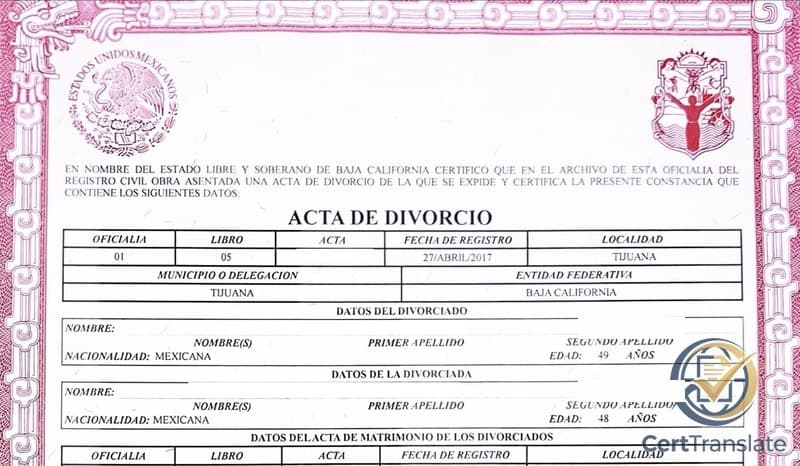
Why the Three Dates Are Not Interchangeable
Under Mexican civil procedure, a judicial divorce produces a sequence of events, not a single moment. The Fecha de Resolución is the date the family court judge issues the ruling. The judgment becomes binding only after an appeal window closes — the date on which that happens is stamped on the record as the Ejecutoria. The Fecha de Registro is a later administrative event: the date the Civil Registry enters the final judgment in its books so that a certified copy can be issued. In this case the registration lagged more than fifteen months behind the ejecutoria.
For USCIS purposes — whether the divorce was final before a subsequent marriage, whether the petitioner is free to remarry, whether a prior marriage was validly terminated — the dispositive date is the ejecutoria. This is also how the document should be read under Mexican law: the marital bond is dissolved on the date the ruling becomes final, not on the date the registry gets around to recording it.
A weak translation that labels all three as "Date" — or that translates "Ejecutoria" as "Enforcement," "Execution," or omits it altogether as a procedural footnote — can bury the one date the adjudicator actually needs. Worse, the registration date (2017) is the most visually prominent date on the form, and a reader who does not know the Mexican structure will reach for it first.
How We Handled It
We reproduced the certificate's visible grid structure in the translation and labeled each date with its precise legal function: "Date of Registration" for the Fecha de Registro in the top grid, "Date of Resolution" for the Fecha de Resolución in the body, and "Final Judgment Date (Ejecutoria)" for the ejecutoria stamp — keeping the Spanish term in parentheses so the English reader can match it against the source. All three dates were rendered as Month DD, YYYY (April 27, 2017; November 18, 2015; January 11, 2016) rather than as ambiguous numeric forms.
The Abstracto de la Resolución Administrativa was translated in full, preserving the procedural chronology — the filing of the petition, the court's ruling on each of the four counts of the judgment, the one-year waiting period for remarriage under Article 286 of the Baja California Civil Code, the reference to Article 288 on forwarding the judgment to the registry, and the closing notation of the ejecutoria date. Nothing was summarized.
"Under Mexican civil procedure, a judicial divorce produces three distinct dates that commonly appear on the certified copy issued by the Civil Registry. (a) Fecha de Resolución — the date the family court judge issued the ruling (here: November 18, 2015). (b) Ejecutoria — the date on which the ruling became final and legally binding after the appeal window expired (here: January 11, 2016); this is the date on which the marital bond is legally dissolved. (c) Fecha de Registro — the date the Civil Registry entered the final judgment in its books so that a certified copy could be issued (here: April 27, 2017); this is an administrative record of the earlier dissolution and can lag the ejecutoria by months or years."

We also preserved the parties' names exactly as recorded on the certificate. The husband's first surname was a compound form entered as a single field value, followed by a second surname of non-Hispanic origin. We kept the compound surname intact as one paternal-surname unit rather than splitting it across the Primer Apellido and Segundo Apellido fields, and reproduced the second surname verbatim — neither anglicizing it nor reshaping it to look Hispanic. The one typographical oddity in the court text — "Lo Familar" instead of "Lo Familiar" in the judge's title — was rendered in English as "for Family Matters" and documented in a separate translator's note, rather than silently corrected.
The Outcome
The certified translation was delivered to the client for their USCIS filing. The explicit date labels and the Translator's Note pre-answer the adjudicator's most likely question — "when did this divorce become final?" — by pointing to the ejecutoria date rather than leaving the reader to guess among three different years on the face of the certificate.
We've handled several Mexican actas de divorcio from Baja California and neighboring states using the same three-date labeling convention. Registration dates that lag the ejecutoria by one, two, or three years are routine — not a defect in the document.
I appreciate you! Everything came back accurate and the filing went through with no questions.
What This Means for You
A Mexican divorce certificate carries three different dates, and only one of them — the ejecutoria — establishes that the divorce is legally final. A certified translation that labels each date with its precise function and adds a brief Translator's Note on Mexican divorce procedure gives USCIS adjudicators the clarity they need to process marriage-based petitions without follow-up questions.
If your Acta de Divorcio shows a registration date that is years later than the divorce itself, that is how the Mexican Civil Registry system works — not a sign that the document is wrong.
Have a similar situation?
We translate Mexican actas de divorcio, matrimonio, and nacimiento for USCIS filings regularly.
Related Cases & Resources
Sources & References
- USCIS Policy Manual — Marriage and Marital Union for Naturalization·USCIS·Verified 2026-05-25
Explore the Hub
Documents
Languages
Immigration
Accepted By
All identifying information has been removed from document images. The parties' names, ages, signatures, and registry serial number have been masked. Case details are shared with client permission. No personal data is stored or displayed on this page.