




Should a Mexican marriage packet with a long form on one sheet and an apostille bound to the short form be translated as one file or two?
TL;DRA Mexican marriage packet from Quintana Roo contained three pages from one registration but two physically distinct documents: a long-form paper Acta de Matrimonio on a separate sheet, and a digital short-form e-Acta bound to its Apostille. We split the certified marriage certificate translation into two independent files — each with its own translator's certification — so the apostille's scope of authentication clearly covers only the short form, mirroring the physical packet for USCIS.
Case Specifications
- Document
- Marriage certificate
- Foreign Name
- Acta de Matrimonio
- Country
- Mexico
- Languages
- Spanish → English
- Submitted To
- USCIS
What We Received
A client submitted a Mexican marriage packet issued by the Civil Registry of the Municipality of Lázaro Cárdenas, Quintana Roo, and asked for a certified Spanish marriage certificate translation for a USCIS filing. The packet covered a single marriage registration — Oficialía 0001, Libro 1, Acta No. 85, registered on 16 April 2026 — but arrived as two physically separate documents.
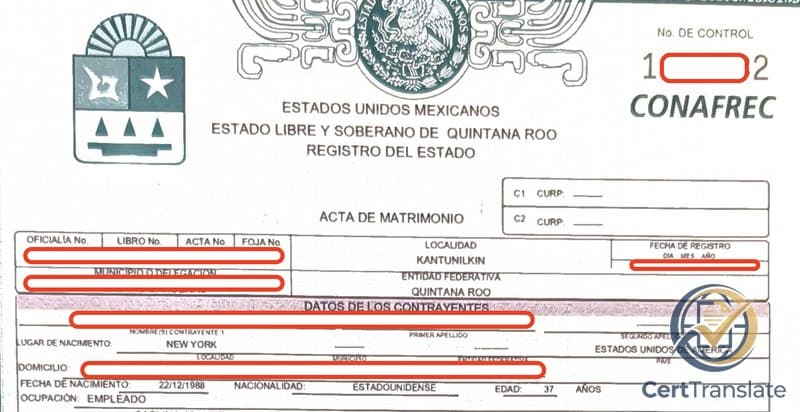
The first document was the long-form paper Acta de Matrimonio (CONAFREC No. 1067432), printed on a single sheet of registry stationery, signed in ink by the registry officer (C. Enrique Jesús Tapia Yam, Oficial No. 0001), and stamped with the municipal seal — a self-contained certificate, with no apostille attached.
The second document was a two-page bound set: page one was the digital short-form e-Acta de Matrimonio (Folio A23 1819224, Electronic Identifier 23007000120260004731), signed electronically by the Director General of the State Civil Registry; page two was the corresponding Hague Apostille (Folio ZS02678, No. 23/0872/2026), issued by the State of Quintana Roo and physically bound to the short form. The apostille was attached only to the short form — not to the long form on the separate sheet.
Why This Required Special Handling
An apostille under the Hague Apostille Convention of 5 October 1961 authenticates the signature, capacity, and seal of the document it is physically attached to — and only that document. When two related documents arrive in the same packet but only one is apostilled, they have different evidentiary status. Conflating them in a single certified translation file blurs that distinction.
USCIS reads each certified translation as covering the document the translator's certification statement names. If a single certification covers all three pages — long form, short form, apostille — a careful adjudicator may pause to confirm which page the apostille actually authenticates. A translator's note can clarify it, but the cleaner solution is to mirror the physical packet: two documents, two certifications.
There is also a practical reason. Clients often submit only one of the two documents to a given recipient — the long form to a US state vital-records office that requires the full record, and the apostilled short form to USCIS for I-130 or I-485. Splitting the translation up front means the client doesn't have to ask for a re-issue when one recipient only wants part of the packet. This is consistent with USCIS practice on translation packaging under their certified translation requirements.
How We Handled It
We produced two separate certified translation files. The first covered the long-form Acta de Matrimonio as a standalone document. The second covered the short-form e-Acta and its bound Apostille together as one packet — paginated and certified jointly because they are physically inseparable in the original.
Each file carried its own translator's certification block — independent, self-contained, with its own scope statement. The certification on file one names the long form; the certification on file two names the short form and its apostille. A USCIS adjudicator reading either file can identify, from the certification alone, which physical document it covers.
Each file also carried a Translator's Note describing the packet structure, so a recipient receiving only one of the two files would still understand the context.
"Translator's Note (file 1 — long form): The original document is a single-page long-form Mexican marriage certificate (Acta de Matrimonio) issued by the Civil Registry of the Municipality of Lázaro Cárdenas, Quintana Roo, Mexico (CONAFREC No. 1067432). It is presented as a separate, standalone sheet. The corresponding short-form e-Acta and its Apostille are translated separately. Translator's Note (file 2 — short form + Apostille): The original document consists of two pages physically bound together: (1) a short-form certified electronic copy of the same Mexican marriage certificate (Folio A23 1819224), and (2) the corresponding Apostille (Folio ZS02678, No. 23/0872/2026) issued by the Undersecretariat of Legal Affairs of the Secretariat of Government of the State of Quintana Roo. The Apostille authenticates the signature, capacity, and seal of the short-form e-Acta only; the long-form Acta on the separate sheet has its own certified translation."

Two further Translator's Notes accompanied each file: one documenting the DD/MM/YYYY → Month DD, YYYY date conversion (e.g. '16/04/2026' → 'April 16, 2026'), and one documenting that the standard Hague heading on the apostille — 'Apostille (Convention de La Haye du 5 Octobre 1961)' — appears in French in the original per the Convention's fixed format and was rendered in English for the convenience of the U.S. reader, while the rest of the apostille body was translated from Spanish. Stamps, seals, fingerprints, signatures, the QR code, and the encoded electronic-signature data block on the short form were described in brackets at their approximate locations. All form fields shown as blank in the original — the parties' CURP codes, both sets of parents' names and addresses, the consent of guardians for minors, and the foreign-party authorization from the Ministry of Governance — were marked '[Blank in original]' rather than silently omitted, in line with USCIS translation acceptance criteria.
The Outcome
Both certified translations were delivered to the client as two separate files, each with an independent translator's certification, ready for the USCIS filing. The packet structure described in the Translator's Notes lets the adjudicator confirm — without needing to consult outside reference materials — which translation goes with which apostille, and that the long form is unapostilled by design.
We have applied the same packet-mirroring approach on every Mexican civil-registry order with a partially bound apostille since 2023 — for marriage, divorce, and birth records — without an RFE on the apostille-binding question.
What This Means for You
A Mexican civil-registry packet that contains a long-form Acta on a separate sheet and a short-form e-Acta bound to its apostille should be translated as two certified files, not one. Splitting the translation to mirror the physical packet keeps each apostille's scope of authentication clearly tied to the document it actually covers, and avoids the kind of ambiguity that a USCIS adjudicator may otherwise pause on.
Have a similar situation?
We translate Mexican marriage, birth, and divorce packets — long-form CONAFREC sheets, short-form e-Actas, and bound state apostilles — for USCIS, state vital-records offices, and consulates regularly.
Related Cases & Resources
Sources & References
- Meet Translation Requirements·USCIS·Verified 2026-06-02
- Convention of 5 October 1961 Abolishing the Requirement of Legalisation for Foreign Public Documents·Hague Conference on Private International Law (HCCH)·Verified 2026-06-02
- Apostilla y Legalización de Documentos·Secretaría de Relaciones Exteriores — Gobierno de México·Verified 2026-06-02
Explore the Hub
Certified Translation
Documents
Languages
Immigration
Accepted By
All identifying information has been removed from document images. Case details are shared with client permission. No personal data is stored or displayed on this page.