



Do you need to translate the Firma Electrónica Avanzada string on a Mexican Acta de Nacimiento?
TL;DRA Mexican Acta de Nacimiento arrived as a digital e-Acta. It carried a verification stack: Folio, Identificador Electrónico, CURP, Advanced Electronic Signature string, Verification Code, two QR codes, and two barcodes. The certified translation reproduced every identifier and the full signature string verbatim. This preserved the gob.mx eVAR re-verification path for the USCIS adjudicator.
Case Specifications
- Document
- Birth certificate
- Foreign Name
- Acta de Nacimiento
- Country
- Mexico
- Languages
- Spanish → English
- Submitted To
- USCIS
What We Received
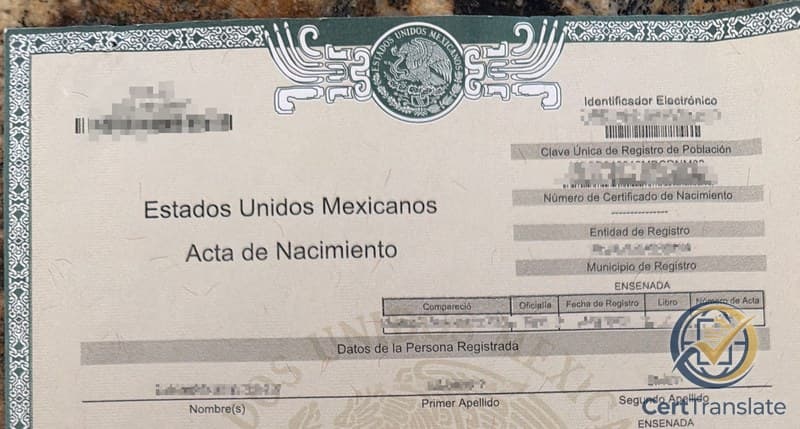
A client submitted a Mexican Acta de Nacimiento issued by the Civil Registry of Baja California. The document came from Oficialía 0001 in Ensenada. It was a digital certified copy — an e-Acta — issued in August 2021. The translation was needed for a USCIS adjustment-of-status filing, and the client wanted a certified Spanish acta de nacimiento translation that would survive review.
The Acta carried a Folio number, an Identificador Electrónico, a CURP for the registrant, an Advanced Electronic Signature alphanumeric block of roughly 180 characters, and a Verification Code. It also showed two QR codes and two barcodes. The 'Número de Certificado de Nacimiento' field and the two parental CURP fields were blank.
Why This Required Special Handling
The Mexican e-Acta system lets any receiving authority verify a civil-registry record online. The Identificador Electrónico, the CURP, and the Verification Code can each be entered into the gob.mx eVAR portal to confirm authenticity. The Advanced Electronic Signature string is the cryptographic payload. It proves the digital file has not been altered since issuance.
A certified translation that summarises any of these fields breaks the verification path. USCIS adjudicators following the standard USCIS translation requirements expect every field on a digital certified copy to appear in the translation. The two QR codes and two barcodes are also part of the verification path — each encodes one of the identifier strings and routes the reader back to the eVAR portal.
How We Handled It
We reproduced every identifier in the translation exactly as it appeared in the original. The Folio, the Identificador Electrónico, the CURP, the Verification Code, and the full Advanced Electronic Signature alphanumeric block were carried over without changes. The signature block spans three lines and roughly 180 characters. No element was abbreviated, paraphrased, or omitted.
The two QR codes and two barcodes were described in brackets — '[QR Code]' and '[Barcode]' — at their approximate locations in the layout. The CURP itself was kept as an abbreviation rather than expanded. The label was translated as 'Unique Population Registry Code (CURP)' on first appearance, mirroring the convention used for similar identifiers on USCIS adjustment-of-status filings.
Two short Translator's Notes accompanied the certified translation — one for the embedded verification content, and one for the deliberately empty fields the document also carried.
"Translator's Note 1 — Advanced Electronic Signature: The Advanced Electronic Signature ('Firma Electrónica Avanzada') alphanumeric block reproduced in this translation is the cryptographic payload that authenticates the original digital Acta de Nacimiento. The string is not natural-language text and is preserved verbatim because any character change invalidates the cryptographic verification. The Folio, the Identificador Electrónico, the CURP, and the Verification Code are likewise preserved character by character because they are the input keys for the gob.mx eVAR portal at https://cevar.registrocivil.gob.mx/eVAR/ConsultaFolio.jsp, where any receiving authority can independently verify the document. Translator's Note 2 — Blank fields: The 'Número de Certificado de Nacimiento' field and both parents' CURP fields are blank in the original record and have been rendered '[Blank in original]'. These blanks reflect the original document and are not a transcription omission."

An additional Translator's Note documented the conversion of dates from the source's DD/MM/YYYY format to the unambiguous 'Month DD, YYYY' US convention. The National Coat of Arms and the State of Baja California seal were described in brackets at their approximate positions. The Civil Registry Officer's title 'Lic.' (Licenciada) was rendered 'Atty.' on the printed-name line, consistent with the convention used on other accepted-by USCIS Mexican civil-registry translations.
The Outcome
The certified translation was delivered for the USCIS adjustment-of-status filing. The Translator's Notes gave the adjudicator the context needed to read the long signature string as cryptographic content rather than as unexplained data.
We have followed the same verbatim-preservation approach on every Mexican e-Acta since the digital format became standard. The embedded verification fields have not drawn an RFE.
What This Means for You
A Mexican digital e-Acta carries QR codes, barcodes, and a long Firma Electrónica Avanzada code block. Every one of those identifiers needs to appear in the certified translation. A properly certified Mexican birth certificate translation preserves the verification path, so the receiving authority can confirm the document through the gob.mx eVAR portal.
Have a similar situation?
We translate Mexican civil-registry records — including digital e-Actas with QR codes, barcodes, and the Firma Electrónica Avanzada block — for USCIS, state vital-records offices, and consulates regularly.
Related Cases & Resources
Sources & References
- Meet Translation Requirements·USCIS·Verified 2026-07-15
- eVAR — Verificación Electrónica de Actas del Registro Civil·Registro Nacional de Población e Identificación (RENAPO) — Gobierno de México·Verified 2026-07-15
- Clave Única de Registro de Población (CURP)·Registro Nacional de Población (RENAPO) — Gobierno de México·Verified 2026-07-15
Explore the Hub
Certified Translation
Documents
Languages
Immigration
Accepted By
All identifying information has been removed from any document images. Case details are shared with client permission. No personal data is stored or displayed on this page.