




How do you translate a French birth certificate that names the mother only in a marginal notation?
TL;DRWe translated the French entry exactly as printed — «son épouse» (“his wife”) with no name — and translated in full the marginal notation that names the mother. The record was a copie intégrale, the full copy of a birth entry, and the mother was named only in a marginal notation recording a later rectification. CertTranslate added a Translator’s Note linking the two and delivered the translation in September 2026, certified to the USCIS standard.
Case Specifications
- Document
- Birth certificate — full copy with marginal notations
- Foreign Name
- Copie intégrale d’acte de naissance
- Country
- France
- Languages
- French → English
- Submitted To
- U.S. filing (USCIS-standard certification)
A French Full-Copy Birth Record With No Mother’s Name
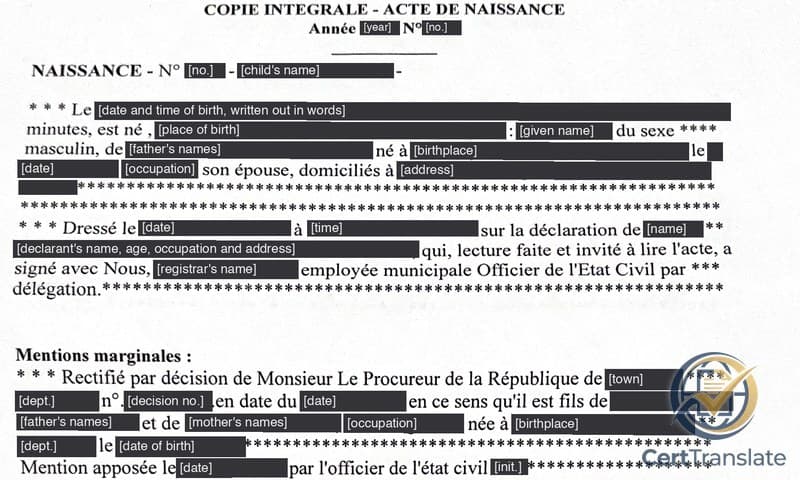
A client sent two French birth records, each issued as a copie intégrale d’acte de naissance (full copy of a birth record). In one, a late-1980s entry names the father and then says only «son épouse», “his wife.” The mother’s name appears nowhere in the body of the entry.
She is named only in a marginal notation — the first one, a rectification added years later. Other notations follow it, recording later civil-status events. On this copy, all of them sit under the printed heading «Mentions marginales».
A mention marginale is information added to a French birth, marriage or death record after it is drawn up, written in the margin or after the entry. The client ordered a certified French copie intégrale translation of both records for a U.S. filing.
Why «Son Épouse» Without a Name Is a Translation Trap
When the parents are married, a French birth entry usually names them in one formula: the father, then «et de» (and of) the mother by name, then «son épouse». The order’s second record shows that full formula. In this one, the «et de» clause with the mother’s name is simply absent.
When the mother is named only in a marginal notation, the gap is tempting to fill. A translator who writes her into the body would certify a sentence the register never contained. USCIS asks for a full English translation that the translator certifies as complete and accurate — see our USCIS translation requirements.
English adds a second trap. In «son épouse, domiciliés à…», the participle «domiciliés» is plural, so the address belongs to both parents. A plain “his wife, residing in…” reads as if only she lived there.
A copie intégrale is the full copy of a French birth record: it reproduces all the information in the register entry and lists any marginal notations. An extrait de naissance is a summary of the same entry, issued avec filiation (with the parents) or sans filiation (without them). Only the full copy reproduces the entry word for word, so only the full copy shows the original gap.
How We Translated the Gap and the Rectification Notation
We translated the entry exactly as drawn up: “…, his wife, both residing in…”. No name was added, and nothing was bracketed into the gap. “Both residing” carries the plural that «domiciliés» marks in French.
We translated the notation in full. It records a rectification (a formal correction of the record) made by decision of the procureur de la République, the public prosecutor. The notation then names both parents: the father, and the mother with her occupation, birthplace and date of birth.
«Procureur de la République» is one title, and the town after it is the court’s seat. We rendered it “Public Prosecutor of [town],” not “Prosecutor of the Republic of [town],” which would invent a republic.
"In the first paragraph the original names the father and then continues «son épouse» ("his wife") without naming the mother; no mother's name appears in the [year] entry. She is named in the first marginal notation, which records the rectification of [date]."

We printed that note on the certificate page. A reader sees at once that the gap is in the original, not a dropped name, and where the name is.
The body writes the date and time of birth in words, on the 24-hour clock. We kept the words and moved the time to the 12-hour clock. An invented example: «le trois mars mil neuf cent soixante-dix, à seize heures quarante minutes» becomes “the third of March, nineteen hundred seventy, at forty minutes past four in the afternoon.”
Runs of asterisks and dashes close the entry and each notation. They are line-fill leaders: the registrar fills the rest of the line so nothing can be added later.
Our note on them reads: “The runs of asterisks and dashes in the original are line-fill leaders in the register entry and carry no content of their own. They are reproduced where they close an entry; the short runs that only pad the end of a line in mid-sentence are not.”
Later notations on both records name the same commune, but one of them gives it a different département, one of France’s administrative divisions. We translated each sheet exactly as printed and did not make one record match the other. A note on the second translation points out the difference.
One title recurs in the entry and in every notation: officier de l’état civil, the official who draws up civil-status records and enters their notations. We rendered it as “registrar of civil status” throughout.
The Result
CertTranslate delivered both certified translations in September 2026, one for each record. Each came with its own certificate page, its Translator’s Notes and a copy of the source.
The order named no receiving agency, so both translations were certified to the USCIS standard for certified translations under 8 CFR 103.2(b)(3). In English, the record keeps the order the French shows: the entry with its gap, then the notation with the name.
What This Means for You
A French copie intégrale records history: the entry as drawn up, then each notation that changed it. If your record names a parent only in a marginal notation, the translation should keep the body as written and translate the notation in full. A Translator’s Note can then show the reader where the name is.
Our French birth certificate field guide walks through the other parts of an acte de naissance.
Have a French full copy with marginal notations?
We translate French copies intégrales for U.S. filings, every marginal notation included — $24.95 per page.
Related Cases & Resources
Sources & References
- Acte de naissance : demande de copie intégrale ou d'extrait·Service-Public.gouv.fr (French government)·Verified 2026-10-06
- Qu'est-ce qu'une mention marginale sur un acte d'état civil ?·Service-Public.gouv.fr (French government)·Verified 2026-10-06
- USCIS Policy Manual, Volume 1, Part E, Chapter 6 — Evidence·USCIS·Verified 2026-10-06
Explore the Hub
Certified Translation
Languages
Immigration
All identifying information has been removed from document images. Case details are shared with client permission. No personal data is stored or displayed on this page.