
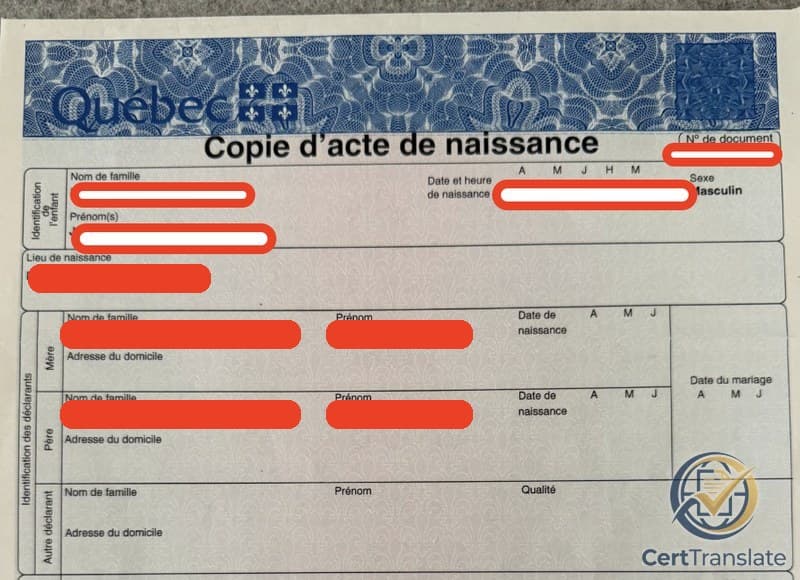
Registry marks
What do “(S)” and “p. i.” mean on a Quebec act?
Both registry conventions were expanded in English — signed original and acting registrar — with translator notes.
Read the caseActe de naissanceCopie intégraleExtrait avec filiation
Certified English translation for USCIS, passport applications, schools, courts, and other official uses.
Ready within 24 hours
Complete translation
Word-for-word, same structure
Every field, stamp, seal, signature, and annotation
Certified package
Signed and Stamped Certificate of Accuracy
Company letterhead · translator signature · company stamp

We check your files and confirm the total before you pay




Your finished package
Your delivery includes the source-document scan, a complete English translation, and a signed and stamped Certificate of Translation Accuracy.
Files checked and total confirmed before payment
Real French casework
These are anonymized French-to-English orders. Each case shows the source-document issue and the exact translation decision.
Registry marks
Both registry conventions were expanded in English — signed original and acting registrar — with translator notes.
Read the case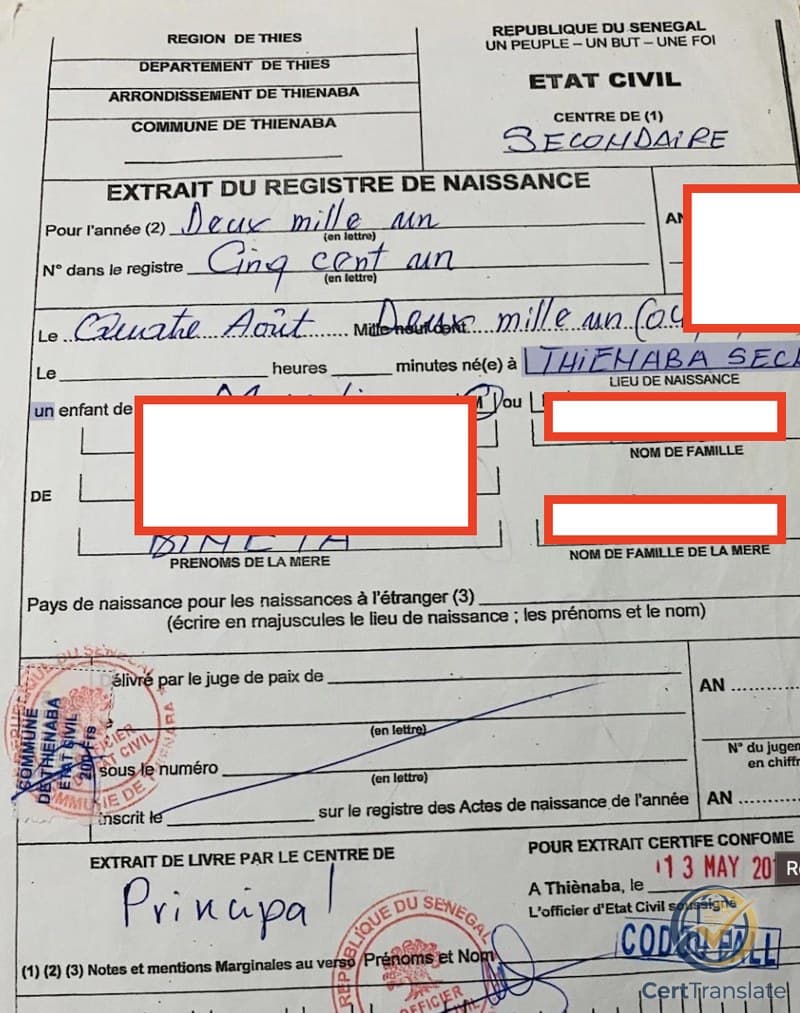
Handwriting
We resolved the ambiguous letters against the printed letterhead and documented the reading.
Read the case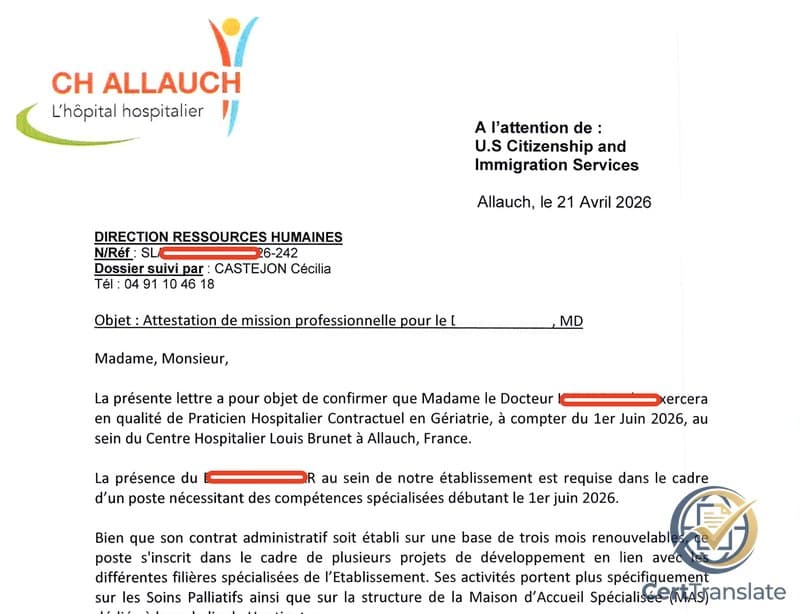
Stamps in full
Each stamp on the French mission letter was rendered for the USCIS filing — never waved off as decorative.
Read the caseBefore you order
French-language birth records come from 25+ jurisdictions. Send every page — including the reverse with its stamps — and we will identify the issuing registry before work starts.
The mairie issues both a full copie intégrale — showing filiation and every mention marginale — and shorter extraits. USCIS filings usually need the full copy, and the marginal notes are legally binding parts of the act.
If you only have an extrait sans filiation, we flag it before translation so you can request the full copy in time.
Haitian extracts often carry handwritten entries and a dense reverse side — stamps from the Prosecutor’s Office, the Ministry of Justice, and Foreign Affairs. Every stamp in the chain is part of the record and gets translated.
Quebec acts use their own registry conventions — “(S)” for signatures on the original act, “p. i.” for an acting registrar. We expand these in English so the reviewer is not left guessing at abbreviations.
How it works
Upload once. We check the files and confirm the total before payment. Then our team translates, reviews, and certifies the complete package.
Send a PDF, scan, or phone photo. Include the reverse side with legalization stamps, every mention marginale, and a passport name page when available.
Names with accents and particles, dates, filiation, every mention marginale, registry numbers, and all stamps and seals are checked against the source.

Request corrections free. Once approved, receive the source scan, full English translation, and signed and stamped Certificate of Translation Accuracy.

One physical page means one billed page.
No 250-word cap and no dense-page rebilling.
Certified price
$24.95/ page
No payment until file review
Client reviews
Claire D.
Boston, MA
“They translated my French birth certificate and included every marginal note, including a marriage annotation I didn’t even know was there. That was exactly what my attorney wanted for the I-485 packet.”
France · Acte de naissance
Every mention included
Jean R.
Atlanta, GA
“My Haitian birth record had handwriting and annotations that another service overlooked. CertTranslate handled the full document, including all the stamps and the declarant information. My I-130 was approved without issues.”
Haiti · Birth record
I-130 approved
Aissatou N.
Silver Spring, MD
“The Senegalese civil wording on my acte de naissance was preserved clearly in English. The institutional references and registry labels were all there, which made my naturalization application easier to assemble.”
Senegal · Acte de naissance
Registry labels preserved
Questions before ordering
If your document does not match one of these situations, send it anyway. Support replies in 15–30 minutes during support hours.
The certified translation is priced per physical page. A typical one-page certificate costs one page, even when the page contains more than 250 words.
Most one- to three-page orders are delivered within 24 hours after we receive clear scans. If the record includes a dense legalization reverse, multiple mentions marginales, or older handwriting, we confirm the delivery window before work begins.
The delivery includes your source-document scan, a complete English translation, and a signed and stamped Certificate of Translation Accuracy. If a receiving authority rejects the translation for a translation-related reason, we revise it free. If it is still rejected, we refund the translation cost.
Yes. We handle records from France, Haiti, Québec, Senegal, Cameroon, and other Francophone registries — each translated by its actual issuing system rather than one generic French template.
We can usually work from scans with stamps, embossing, handwriting, or slightly faded print. If a name, date, seal, or registry number is too weak to read safely, we ask for a better image rather than guessing.
Yes. You can review the completed translation and request unlimited free corrections before certification. If USCIS later requests a translation-related change, we correct the certified file at no charge.
No. We bill the physical page you upload, never a 250-word unit. A dense one-page certificate remains one billed page.
Always, and in place. Marginal notes record marriage, divorce, legitimation, or corrections — they are legally binding parts of the act, and an officer will compare them against the rest of your packet.
USCIS filings usually work from the copie intégrale, which shows filiation and all marginal notes. If your extrait omits parents or annotations that matter, we flag it before translation so you can request the full copy.
Yes. Haitian records are usually in French with occasional Creole context, and the reverse often carries a multi-agency legalization chain. We translate every visible line, stamps included.
USCIS generally requires certification, not notarization. Notarization remains available when a court, embassy, or another receiving authority asks for it.
Most frequent problems we correct
These are the recurring issues we see in Francophone civil-record packets and in translations clients ask us to review.
Our check: We translate every marginal note in place, since these record marriage, legitimation, or correction and an officer will compare them against other packet documents.
Our check: We flag when a record is an extract missing filiation or annotations, so you can supply the full copy before filing.
Our check: We preserve the exact legal spelling — é, è, de, d’ — since a small change can break identity matching across documents.
Our check: We keep the local civil-status terminology — France vs Haiti vs Senegal vs Québec — so the officer sees the real issuing system.
The standard behind these checks
AcceptReady™ is CertTranslate's published standard for certified translations: complete word-for-word translation, mirrored page layout, signed and stamped Certificate of Accuracy on letterhead, and matched to the receiver's published requirements.
How to check each one yourselfChecked before certification. If an authority later requests a translation-related correction, revisions remain free.
Start my translationCommon filing contexts
French-language birth certificates most often appear in family-based USCIS packets, but the same certified package may also be requested by a court, school, or benefits agency.
The key is consistency: names, accents, and dates should line up with the passport and the rest of the supporting documents.
Filed for relatives from France, Haiti, and Francophone Africa; parentage comes from the birth record.
The acte de naissance proves identity and parentage in the green-card packet, marginal notes included.
Naming history is matched across the acte, the passport, and U.S. documents.
Name changes and family-court matters rely on the certified English version of the full act.
Document glossary
Common terms you may see on a French-language birth record and how they appear in the certified English translation.
Reference library
Guidance and source links last rechecked .
Ready when you are
Upload every page you have — including the reverse side with legalization stamps or marginal notes. We will confirm the document type, page count, price, and delivery time before you pay.
No payment until file review
