




Why does my Portuguese birth certificate show my maiden name when my passport shows my married name?
TL;DRA 3-page Portuguese birth certificate (Certidão de Nascimento) from Cantanhede carried the subject's birth name on page 2 and her current legal name only inside a marginal annotation (averbamento) on page 3, added after her 1981 marriage. We translated every averbamento in full and added a Translator's Note explaining that a Portuguese birth record is a continuous record updated over the subject's lifetime. The certified translation was delivered for the client's USCIS filing.
Case Specifications
- Document
- Birth certificate
- Foreign Name
- Certidão de Nascimento (cópia integral)
- Country
- Portugal
- Languages
- Portuguese → English
- Submitted To
- USCIS
What We Received
A client submitted a 3-page Portuguese <a href="/documents/birth-certificate">birth certificate (Certidão de Nascimento — cópia integral)</a> issued by the Conservatória do Registo Civil / Predial / Comercial Cantanhede on May 22, 2024 under certificate request no. 1553/2024. The underlying act no. 658/2009 is itself a computerized version of the original 1957 paper act no. 325/1957. The certified <a href="/translate/portuguese-birth-certificate">Portuguese-to-English translation</a> was needed for a USCIS filing.
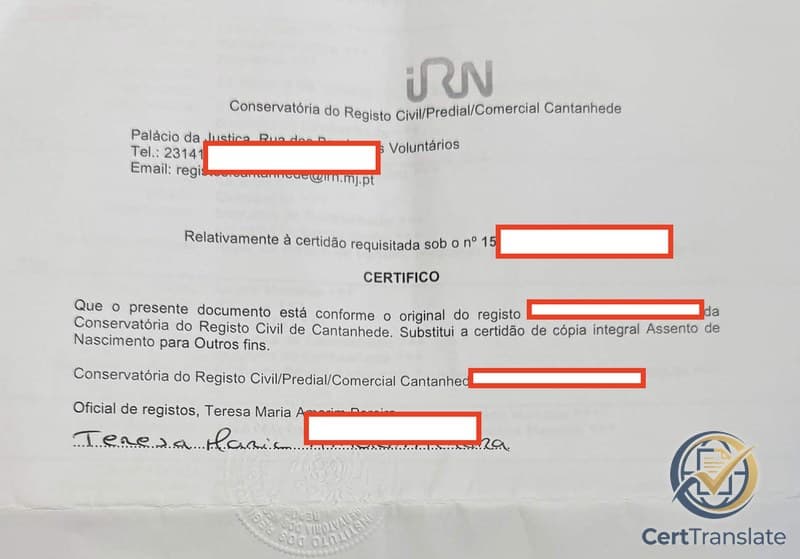
Page 1 is a single-paragraph certification from the registrar with a signature and an embossed dry seal. Page 2 is the birth record itself — form-style, with labeled fields for the subject, the father, the mother, the grandparents, and the declarants. Page 3 contains two averbamentos: a 1981 marriage entered by the same Conservatória and a 2009 widowhood recorded by a Portuguese consular officer at the Consulado Geral de Portugal em Newark, Estados Unidos da América.
The client's current Portuguese passport carries the surname acquired on marriage. The birth certificate's main body, read in isolation, carries the maiden surname. That is the apparent — but not actual — mismatch.
Why This Required Special Handling
<a href="/immigration/uscis">USCIS</a> expects every name in a translated document to match the applicant's other documents, or for an explanation of the discrepancy to be visible on the face of the translation itself. Rendering only page 2 would present a name that does not match the applicant's passport, and a reviewer would be within their rights to issue a Request for Evidence (see our <a href="/guides/name-mismatch-guide">name mismatch guide</a>).
Under Portuguese civil-registry law the birth record is not a static document. It is a single continuous record, opened at birth and updated across the subject's lifetime by averbamentos — marginal annotations added by the Conservatória (or by a Portuguese consulate abroad, as in this case) for events such as marriage, name change, divorce, widowhood, adoption, legal sex change, and death. The current legal name is whatever the most recent averbamento says it is, not what the 'Nome próprio / Apelidos' fields in the main body say.
The translator's task is to make the annotation structure legible to a US adjudicator who has never seen a cópia integral and may not know that page 3 supersedes page 2 on the question of the subject's current legal name.
How We Handled It
We reproduced the 3-page structure of the original exactly. Page 1 became a single-paragraph English certification mirroring the Portuguese cover, with the registrar's printed name and a bracketed description of the signature and the embossed dry seal of the Instituto dos Registos e do Notariado. Page 2 became a form-style English table with the same labeled blocks as the original — Registrant, Father, Mother, Paternal grandparents, Maternal grandparents, Declarant(s), Special remarks, Witness(es), Date of record entry — with right-aligned labels and bold values, preserving the '***' field-terminator markers printed by the issuing system. Page 3 became a sequence of two Marginal Annotations in the same order as in the original.
Averbamento no. 1 (Marginal Annotation no. 1, of February 12, 2009) documented the 1981 marriage, the location, the marriage record number, and the resulting change of surname. Averbamento no. 2 (of March 17, 2009) documented the dissolution of the marriage by the husband's death on January 10, 2009, via death record no. 12/2009 of the Consulate General of Portugal in Newark. The intermediate 'Cota' entry — the registry's internal filing note that act no. 658/2009 is the computerization of the 1957 paper act no. 325/1957 — was preserved and labeled 'Filing note'.
All date formats were normalized to Month DD, YYYY. The original used four conventions on the same certificate: YYYY-MM-DD system timestamps, DD-MM-YYYY in the page-1 footer, 'DD de Mês de YYYY' in the body, and DD/MM/YYYY in the Cota. The page-1 footer was preserved only where it actually exists in the original — pages 2 and 3 have no footer.
"Under Portuguese civil-registry law, a person's birth record is a single continuous record, opened at birth and updated over the subject's lifetime by marginal annotations (averbamentos) recording marriage, name change, divorce, widowhood, adoption, legal sex change, and death. The current legal name of the subject is determined by the most recent name-changing averbamento, not by the 'First name / Surnames' fields in the main body of the record. In this certificate, the subject's birth name appears in the main body on page 2; Marginal Annotation no. 1 on page 3 records the 1981 marriage and the consequent change of surname; Marginal Annotation no. 2 on page 3 records that the marriage was dissolved by the husband's death in 2009 (Portuguese law does not further alter the surname on widowhood). The certificate further notes (Filing note) that act no. 658/2009 is the computerization of the original 1957 paper act no. 325/1957 — the two act numbers refer to the same birth event."

Two further Translator's Notes accompanied the certification block: one documenting the normalization of four coexisting date formats (YYYY-MM-DD, DD-MM-YYYY, 'DD de Mês de YYYY', DD/MM/YYYY) into Month DD, YYYY, and one stating that the '***' markers printed after every filled field on page 2 are field-terminator marks produced by the issuing system and have been preserved in the translation exactly as they appear.
The Outcome
The certified translation was delivered to the client for inclusion in their USCIS filing, with every averbamento translated in full and a Translator's Note that preempts the apparent name mismatch. The adjudicator has the birth name, the married name, the date and location of the marriage, the act number of the marriage record, the fact of widowhood, the act number of the death record, and the explanatory note about the averbamento system — all on the face of the certified translation.
This pattern recurs on Portuguese (and, with variations, Brazilian and Cape Verdean) civil-registry certidões that carry lifetime annotations.
What This Means for You
A Portuguese birth certificate is a continuous record: the current legal name lives in the most recent marginal annotation (averbamento), not in the main 'First name / Surnames' fields. A certified English translation that reproduces every averbamento in full and adds a Translator's Note explaining the civil-registry convention gives a USCIS adjudicator the context needed to read the certificate as a coherent whole — without the page-2 birth name reading as a mismatch against the client's current passport.
Have a similar situation?
We translate Portuguese civil-registry certidões with lifetime averbamentos — birth, marriage, and death certificates — for USCIS and attorney use regularly.
Related Cases & Resources
Sources & References
- Meet Translation Requirements·USCIS·Verified 2026-05-31
- Instituto dos Registos e do Notariado (IRN)·Ministério da Justiça — República Portuguesa·Verified 2026-05-31
Explore the Hub
Certified Translation
Documents
Languages
Immigration
Accepted By
All identifying information has been removed from document images. Case details are shared with client permission. No personal data is stored or displayed on this page.