




How do you translate a Venezuelan birth certificate when the father was added later in a sideways margin note?
TL;DRA handwritten Venezuelan birth certificate from Cárdenas (Táchira) named only the mother and the minor's first name. The father and the surname appeared only in a sideways margin acknowledgement added seven years later, citing a marriage in a different state. We reproduced the body and the margin as separate labeled blocks in the certified birth certificate translation and documented that two stamps are physically cut off at the page binding (not illegible).
Case Specifications
- Document
- Birth certificate
- Foreign Name
- Acta de Nacimiento
- Country
- Venezuela
- Languages
- Spanish → English
- Submitted To
- USCIS
What We Received
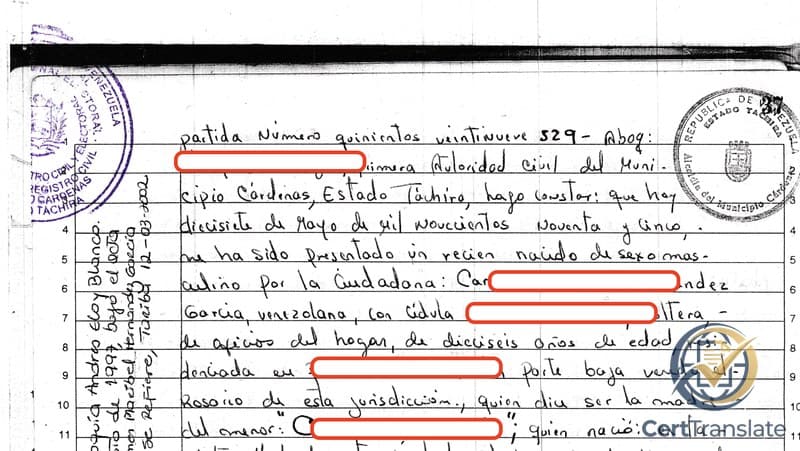
A client submitted a handwritten Venezuelan Acta de Nacimiento (Entry No. 529) issued by the Primera Autoridad Civil of the Municipio Cárdenas, Estado Táchira, registered on May 17, 1995. The translation was needed for a USCIS filing where the applicant's legal name had to match the certified Spanish birth certificate translation on file.
The body of the entry named only the mother — Carmen Maribel Hernández García — and the minor's first name as "Cristian Marbein" in quotation marks. No father. No surname. The minor was born on March 16, 1995 at the Maternity Hospital of Cárdenas.
A vertical sideways NOTE filled the left margin from line 4 to line 30 of the pre-printed ledger. Dated Táriba, March 12, 2002 — seven years after the birth — the note recorded the marriage of Luis Enrique Blanco Vásquez and Carmen Maribel Hernández García at the Prefectura of the Parroquia Andrés Eloy Blanco, Municipio Ezequiel Zamora, Estado Barinas, on August 7, 1997 (entry No. 99), and the father's acknowledgement of the minor as his son.
Two of the four round stamps were physically cropped by the page binding: the upper-left and lower-left impressions of the Consejo Nacional Electoral / Registro Civil de Cárdenas / Táchira stamp had their left halves missing.
Why This Required Special Handling
A Venezuelan birth-entry ledger is a pre-printed civil-registry book in which the original entry occupies the body of the page and any later acts — paternal acknowledgement, marriage notation, court-ordered amendment — are written by hand in the left margin, often years apart and often sideways. A page-order translation would bury the surname-establishing acknowledgement or miss the link between body and margin entirely. See our USCIS translation requirements guide on completeness obligations for marginal text.
The geography in the margin is easy to misread. 'Ezequiel Zamora' is the municipio (named after a 19th-century Venezuelan federalist general); 'Barinas' is the estado; 'Andrés Eloy Blanco' is the parroquia (named after the 20th-century poet). A translator reading these as place words directly produces a sentence in which two famous Venezuelans become geographic features and the actual jurisdiction (Barinas) disappears. The same kind of person-vs-office confusion that the name-mismatch guide treats for personal names applies here at the institutional level.
The stamps along the left binding edge are not faded, smeared, or overlapped — they are physically cropped at the binding seam. A USCIS adjudicator reading '[partially illegible]' may pause to ask whether the translator could read the missing portion or whether the original document is damaged. The correct description is 'left portion cut off at page edge,' which is verifiable from the scan itself.
How We Handled It
We translated the body of the entry first, in its original order, with the four stamps described in bracketed blocks at the positions where they appear in the original (upper-left, upper-right, center, lower-left). The minor's first name was kept inside the original quotation marks — "Cristian Marbein" — to mirror that the body does not assign a surname.
We then reproduced the left-margin annotation as a single labeled block — Marginal annotations (left margin, handwritten) — at the bottom of the translation page, in the document order in which a Venezuelan civil registrar would expect it. The full marriage citation was rendered explicitly: Prefecture of the Andrés Eloy Blanco Parish, Ezequiel Zamora Municipality, Barinas State, on August 7, 1997, under entry number 99 — so the three administrative levels are not collapsible into one place name.
The two cut-off stamps were each described with the explicit qualifier left portion cut off at page edge in the bracketed [STAMP] block — not [partially illegible]. The translation states which portion is missing, which portion is visible, and that the cut-off is a scanning artifact, not a defect in the original.
"The original is a handwritten Venezuelan civil-registry birth entry on a pre-printed ledger page (Acta de Nacimiento No. 529, Municipio Cárdenas, Estado Táchira). The body, registered on May 17, 1995, names only the mother and the minor's first name in quotation marks ("Cristian Marbein"); no father is named in the body and no surname is established. A vertical sideways NOTE in the left margin, dated Táriba, March 12, 2002, records the subsequent marriage of Luis Enrique Blanco Vásquez and Carmen Maribel Hernández García at the Prefecture of the Andrés Eloy Blanco Parish, Ezequiel Zamora Municipality, Barinas State, on August 7, 1997 (entry No. 99), and the paternal acknowledgement under which the minor's surname is established. The four round stamps have been reproduced individually in bracketed blocks at their approximate positions; the top-left and bottom-left stamps (Nacional Electoral / Registro Civil Cárdenas Táchira) have their left portion cut off at the page edge by the binding crop of the scan — a scanning artifact, not illegibility in the original. Signatures are flourishes without printed names and are rendered as '/s/ [illegible signature].' The marginal date '12-03-2002' is in DD-MM-YYYY format, corresponding to March 12, 2002."

Pre-printed ledger line numbers (1–34) along both edges of the page were omitted as they carry no content, consistent with USCIS translation acceptance practice.
The Outcome
The certified translation was delivered with the body of the entry above a labeled left-margin block, the four stamps reproduced at their approximate page positions, and the cut-off ones explicitly labeled as cut-off rather than illegible.
We have applied the same body-then-margin structure with explicit cut-off labeling on every handwritten Venezuelan civil-registry order since 2023 — birth, marriage, and death entries from Táchira, Mérida, Zulia, and Barinas — without an RFE on the marginal-acknowledgement or page-edge-stamp questions.
What This Means for You
A handwritten Venezuelan birth certificate where the father appears only in a sideways margin note is normal civil-registry practice, not a defect. A certified translation should reproduce the body and the margin as separate labeled blocks, name the three administrative levels (parish, municipality, state) in full, and label any stamps cropped by the page binding as 'cut off at page edge' — not '[partially illegible].' Done this way, the surname-establishing chain is auditable on the face of the translation and the adjudicator has no reason to ask about the missing parts of the stamps.
Have a similar situation?
We translate Venezuelan handwritten civil-registry records — birth, marriage, death, paternal acknowledgements, and marginal annotations — from Táchira, Zulia, Mérida, Barinas, and the Federal District for USCIS, state vital-records offices, and credential evaluators regularly.
Related Cases & Resources
Sources & References
- Meet Translation Requirements·USCIS·Verified 2026-06-19
- Consejo Nacional Electoral — Registro Civil·Consejo Nacional Electoral de la República Bolivariana de Venezuela·Verified 2026-06-19
Explore the Hub
Certified Translation
Documents
Languages
Immigration
Accepted By
All identifying information has been removed from document images. Case details are shared with client permission. No personal data is stored or displayed on this page.