




How should a certified translation handle “grade de master” on a French engineering diploma?
TL;DRA certified translation should render “confère le grade de master” as written, “confers the master’s degree,” and add a Translator’s Note: the grade de master is the French national academic degree at master’s level. In September 2026, CertTranslate delivered four certified packets to the USCIS standard: a Diplôme d’Ingénieur, a Programme Grande École diploma, a CPGE supplement and an ECTS transcript. Titles with no U.S. equivalent stayed in French with a gloss; equivalency was left to the evaluator.
Case Specifications
- Document
- Engineering diploma (Diplôme d’Ingénieur) with transcripts
- Foreign Name
- Diplôme d’Ingénieur and Diplôme Programme Grande École
- Country
- France
- Languages
- French → English
- Submitted To
- U.S. filing (USCIS-standard certification)
Four French Credentials, Two That Confer the Grade de Master
A client ordered a certified translation of a French Diplôme d’Ingénieur and three related records, all issued to one graduate. The second diploma is a business school’s Programme Grande École diploma, and both diplomas confer the grade de master. The other two records trace the path to them: a CPGE diploma supplement with its results, and the engineering school’s ECTS transcript.
Both schools are grandes écoles. A grande école is a selective French school of higher education that many students enter by competitive examination after preparatory classes. The CPGE supplement’s chart of the French system gives grandes écoles their own column, three to five years after the baccalauréat.
CPGE stands for classes préparatoires aux grandes écoles: two-year preparatory classes taught in lycées, French upper-secondary schools. The Education Code places them on the way to the licence, France’s three-year first degree, and caps their descriptive attestation at 120 ECTS credits. This supplement is that attestation, with a transcript of results on the reverse.
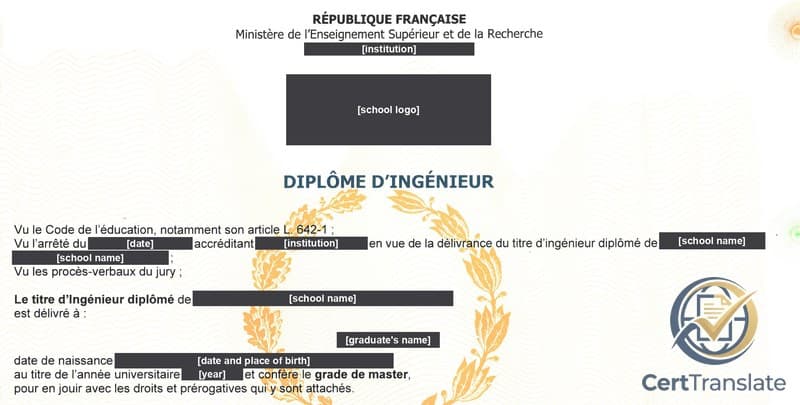
The redacted image below shows the engineering diploma’s award lines, with grade de master set in bold.
Why the Grade de Master Is Easy to Mistranslate
The grade de master is the French national academic degree at master’s level. France’s Education Code names four such grades: baccalauréat, licence, master and doctorat.
The Code confers the grade de master by right on every holder of a diplôme d’ingénieur. A school’s own diploma can carry it too, once a ministerial list names that diploma. These two diplomas reach the grade by those two routes, and their recitals show it.
Each recital opens with Vu (“Having regard to”) and names what the award rests on. The engineering diploma cites the order accrediting its school to award the engineering title. The business diploma cites an order letting its school award a diplôme visé par l’État, a State-approved diploma, that confers the grade.
Neither diploma claims equivalence to a U.S. master’s degree, and a translation should not add one. That judgment belongs to a U.S. credential evaluation, not to the translator.
The phrase also hides a false friend: grade here names a degree level, not a mark. This set even uses the word both ways, because the transcript’s own Grade column holds letter marks. Rendering it as “master’s grade” would blur that.
A Diplôme d’Ingénieur is the French engineering diploma that carries the state-regulated title ingénieur diplômé. Schools need accreditation to award it, and the Commission des titres d’ingénieur (CTI) has run the evaluations behind that accreditation since 1934.
How We Rendered the Grade de Master and Kept the French Titles
We translated the award sentence word for word: “et confère le grade de master” became “and confers the master’s degree” in English. A Translator’s Note on the certificate then explains the term, so the reader sees a French national degree, not our view of its U.S. value. The business diploma carries the same note.
"Translator’s Note: Three French terms are retained in their original form because they name regulated French credentials and bodies that have no exact United States equivalent: “Ingénieur diplômé de [school name]”, the state-regulated engineering title awarded by the school; “académie de [region]”, the regional education authority of the French Ministry of Education; and “[institution name]”, the institution’s legal name. “Grade de master” is the French national academic degree at master’s level and is rendered “master’s degree”."

Titles with no U.S. equivalent stayed in French, each with a note. On the diplomas they include ingénieur diplômé, Programme Grande École, and académie, the regional education authority whose rector co-signs each diploma. An English stand-in such as “graduate engineer” would drop the title’s regulated status.
The CPGE packet kept licence, baccalauréat, grande école and lycée in French the same way. Where English has a settled match, we used it: jury became “Board of Examiners”, not a trial jury.
The ECTS transcript translation kept the original’s columns: each course with its potential credits, credits earned and grade. ECTS, the European Credit Transfer and Accumulation System, counts 60 credits for a full year of study. Decimal commas became decimal points, so an illustrative 2,00 reads 2.00.
The transcript’s grading key runs from A+ down to D, with V (Validé, passed) and NV (Non validé, not passed) beside the letters. A third mark, R for Réparé, records a course passed on the rattrapage, the retake, after a first NV or F. We kept every letter as printed and rendered Réparé as “Remediated”, since a literal “Repaired” would puzzle an English reader.
The key also scores R below every passing first-attempt grade, so an evaluator can tell R from V. The certificate’s note puts it in one line: “R” for “Réparé”, the grade recorded after a successful retake, rendered here as “Remediated”.
On the CPGE transcript, one semester block prints an extra credit column headed “Maths” that repeats its neighbor figure for figure. We reproduced both columns with a note rather than drop what looks like a duplicate. The notes also spell out INE, the Identifiant National Étudiant, France’s national student identifier.
The business diploma’s top line prints one phrase three times: in English, in French as Espace européen de l’enseignement supérieur, and in English again. We rendered it once, as “European higher education area”, and said so in a note.
The Outcome
CertTranslate delivered four certified packets in September 2026, one per credential, covering seven source pages. Each packet holds the English translation, a signed Certification of Translation Accuracy with its notes, and a copy of the French original.
The order named no receiving body, so each packet was certified to the USCIS standard of 8 CFR 103.2(b)(3). That means a full English translation, certified complete and accurate by a translator who also attests competence.
At the preview, the client confirmed the translation and commented on the long bracketed descriptions of the seal and background artwork. We shortened them to the seal’s legend and short labels before delivery.
What This Means for You
A French diploma that confers the grade de master should say so in English, in its own words, with the French term explained once. Titles such as ingénieur diplômé belong in French with a short gloss, because English has no exact match.
What the grade de master equals in the U.S. is your evaluator’s decision; the translation gives them the exact words. Send every page you plan to file, including grading keys and the reverse of a CPGE supplement, because they explain the marks.
Our guide to French diploma translation for WES covers the LMD system, grandes écoles and the French grading scale.
Have French diplomas or transcripts to translate?
We translate Diplômes d’Ingénieur, Programme Grande École diplomas, CPGE supplements and ECTS transcripts word for word, with each French title explained — $24.95 per physical page, with no word cap.
Related Cases & Resources
Sources & References
- Code de l’éducation — Article D612-34 (grade de master)·Légifrance — French government legal database·Verified 2026-10-06
- Code de l’éducation — Articles D613-1 to D613-12 (grades, titres et diplômes)·Légifrance — French government legal database·Verified 2026-10-06
- Code de l’éducation — Articles D612-19 to D612-29-2 (classes préparatoires aux grandes écoles)·Légifrance — French government legal database·Verified 2026-10-06
- CTI: History and mission·Commission des titres d’ingénieur (CTI)·Verified 2026-10-06
- European Credit Transfer and Accumulation System (ECTS)·European Commission — European Education Area·Verified 2026-10-06
- 8 CFR 103.2 — Submission and adjudication of benefit requests·Legal Information Institute, Cornell Law School·Verified 2026-10-06
Explore the Hub
Certified Translation
Documents
Languages
All identifying information has been removed from document images. Case details are shared with client permission. No personal data is stored or displayed on this page.