
CertTranslateCertTranslate
Notarized translation standardVerified June 2026

Document Translation Requirements in China

Official bodies in China generally require a notarized translation of foreign-language documents, and many documents also need an apostille or legalization before they are translated. Below: who can translate, when an apostille is needed, and where the official rules are published.

Key facts

China uses a notarial certificate system: a Chinese notary office (公证处) issues a notarial certificate (公证书) that binds the original and its translation. For a Chinese document used in the United States you instead need a certified English translation with a signed Certificate of Accuracy, which USCIS and universities accept. China joined the Hague Apostille Convention on 7 November 2023, so a Chinese document used abroad is now apostilled by the Ministry of Foreign Affairs or a local Foreign Affairs Office — replacing the old consular legalization.

Reviewed by Michael Chen, Lead Immigration Document Translator · Chinese↔English translator — Simplified & Traditional· Last verified June 2026

China requirements at a glance

Translation standardNotarized translation (Other (Notarial Certificate System)) · 公证书 (notarial certificate)
Who can translateTypically by professional translators used by local notary offices
ApostilleDepends on use outside China (China joined the Hague Apostille Convention in 2023)
Apostille authorityThe Ministry of Foreign Affairs (MFA) and the local Foreign Affairs Offices (FAOs) it authorizes. Private documents must first be notarized by a notary office (公证处) before they can be apostilled.
Accepted languagesChinese (Mandarin) required for official use
Responsible authorityChinese Notary Offices (公证处); Ministry of Foreign Affairs (for apostille)
Important: In China, translations for official purposes are not recognised simply by the translator’s signature — they must be supported by a Notarial Certificate issued by a state Notary Office (公证处).

Who can translate documents for use in China?

China does not operate a sworn translator system or a public national translator registry. For official use — including immigration, business licensing, marriage registration, or court matters — documents in foreign languages must first be translated into Chinese. Translations are usually prepared by professional translators or recognised translation agencies, and then submitted to a local Notary Office (公证处) for certification.

What makes a translation official in China?

The document becomes legally valid in China when the notary office issues a Notarial Certificate confirming that:
  • The translation accurately reflects the original
  • The translator is competent and appropriately qualified
  • The notary has reviewed and certified the translation
  • Most Chinese authorities will not accept translations that lack this notarial certification.

    How does China treat documents from abroad?

    Foreign documents submitted to Chinese authorities must generally be:
  • Apostilled or legalised in the issuing country (if required)
  • Translated into Chinese
  • Notarised by a Chinese Notary Office
  • If the document is intended for use outside China after translation, an apostille must be obtained from the Ministry of Foreign Affairs of China.

    Legal basis

    Notarial services in China — including notarisation of translations — are administered by state Notary Offices under the supervision of the Ministry of Justice of the People’s Republic of China. Notarial Certificates provide the legal effect required by Chinese authorities.

    Apostille & legalization for China

    China is part of the Hague Apostille Convention (since 2023), so public documents are authenticated with a single apostille — no consular legalization.

    Documents from China

    The Ministry of Foreign Affairs (MFA) and the local Foreign Affairs Offices (FAOs) it authorizes. Private documents must first be notarized by a notary office (公证处) before they can be apostilled.The Convention entered into force for mainland China on 7 November 2023, replacing consular legalization for member states.

    U.S. documents going to China

    Since 7 November 2023, a U.S. document going to mainland China is apostilled in the United States rather than consularly legalized, then translated into Chinese.

    The apostille should be obtained before the translation, so the apostille certificate is translated too. See how apostilles work, or order a translation with e-apostille.

    How to get a China document translation accepted

    1. 1

      Obtain the notarial certificate from a notary office

      A Chinese notary office (公证处) issues a notarial certificate (公证书) that usually bundles the original document with a translation.

    2. 2

      Apostille for use abroad (since November 2023)

      For use in another member state, the notarial certificate is apostilled by the MFA or an authorized local Foreign Affairs Office — consular legalization is no longer required.

    3. 3

      Order a certified English translation for the U.S. submission

      Translate the full notarial booklet, including the notary seals and certificate text, with a signed Certificate of Accuracy, then file it with the original.

    Ready to translate your Chinese documents?

    Certified for USCIS, universities, and credential evaluators — from $24.95/page.

    Start my translation

    Which direction are your documents going?

    Translating Chinese documents for the U.S.?

    Chinese birth certificates, diplomas, and transcripts submitted to USCIS, universities, or credential evaluators need a certified English translation — that is exactly what we do — backed by our revise-free-or-refund acceptance guarantee.

    Sending U.S. documents to China?

    U.S.-issued documents usually need an apostille before they can be used in China — and the apostille should be obtained before the translation, so the certificate itself gets translated too. We offer e-apostille processing as an add-on to any order.

    Why China document translations get rejected

    The mistakes we see most often on Chinese documents — and what a correct certified translation does instead.

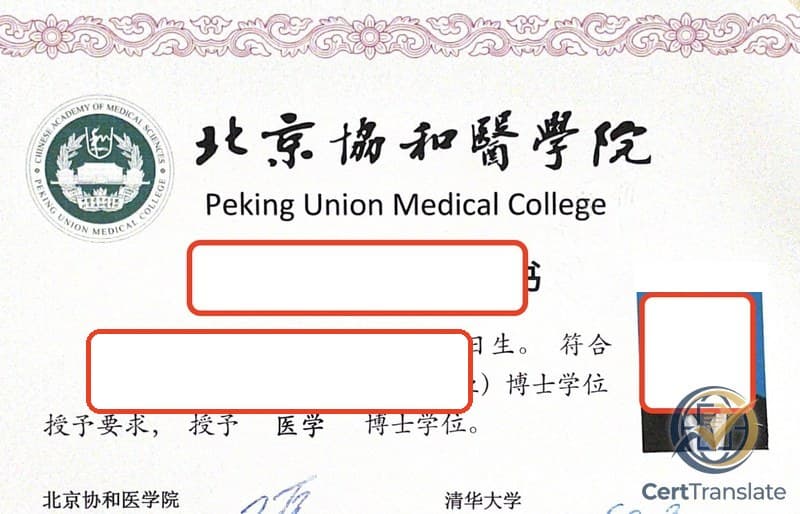
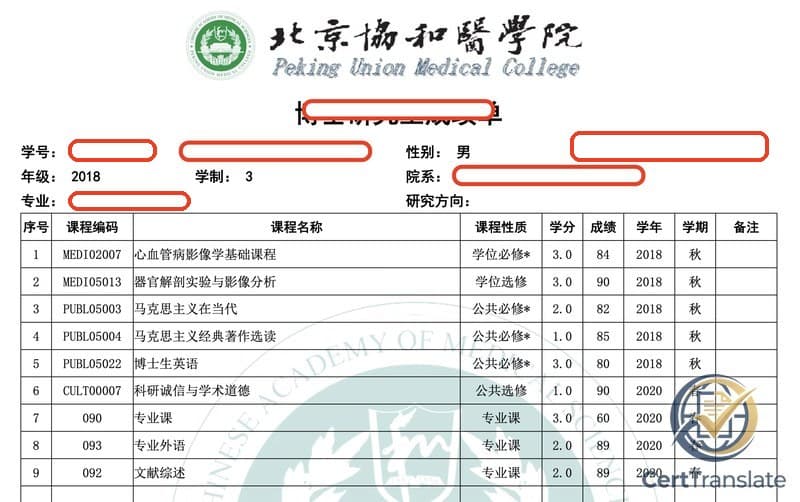
    Graduation certificate confused with the degree certificate

    China issues a graduation certificate (毕业证) and a separate degree certificate (学位证); treating them as one document misstates the qualification for a university or evaluator.

    Read the case

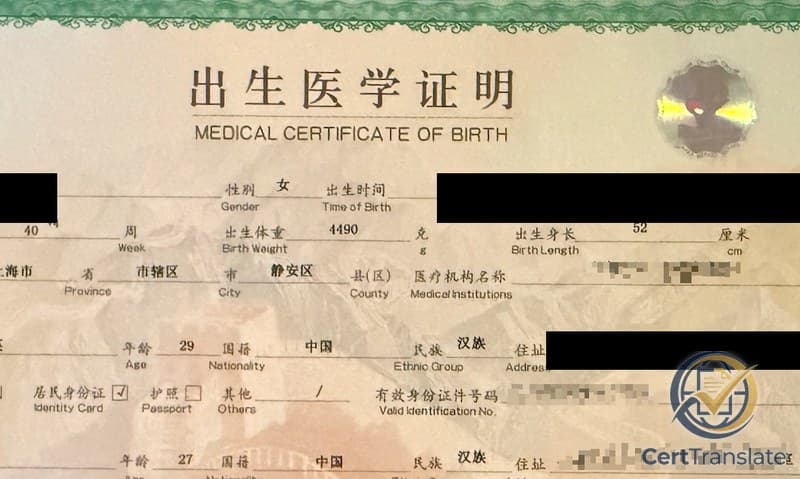
    Both nationality fields on a birth notarial certificate mishandled

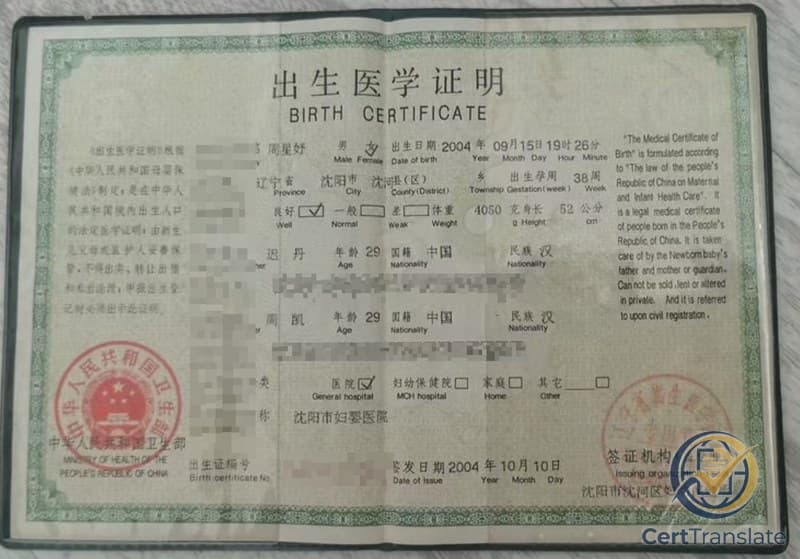
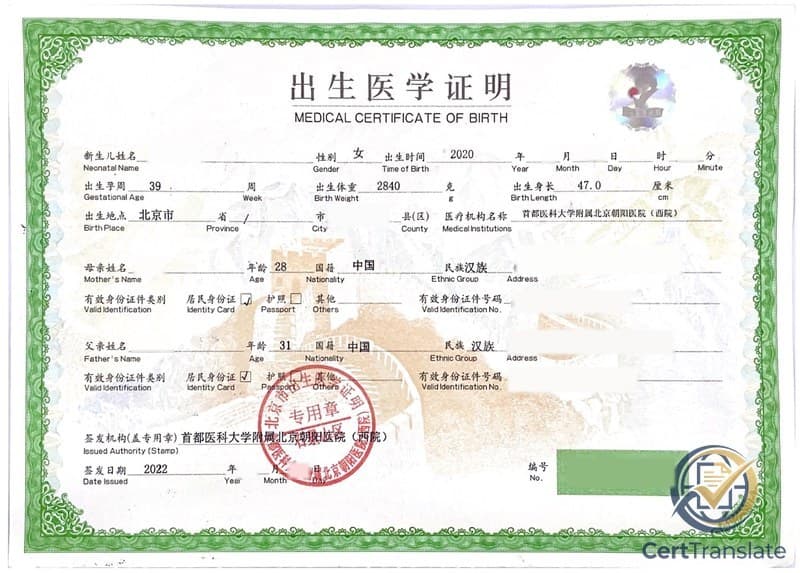
    A Chinese birth notarial certificate can list nationality information in two places; rendering only one creates an inconsistency across the immigration packet.

    Read the case

    CHSI English re-translated into a conflicting version

    When a CHSI transcript already carries an official English version, producing a second, differently-worded translation triggers a discrepancy; the certified translation should match the verified record.

    Read the case
    Real casework

    Real Chinese translation cases we've handled

    Anonymized Chinese-to-English orders. Each case shows the exact translation problem and how we solved it for the receiving authority.

    Cost & turnaround

    $24.95/ page

    A one-page certificate is priced as a single page; a notarial booklet (公证书) or multi-page transcript is priced by its page count. Standard delivery is 24–48 hours, with notarization and e-apostille available as add-ons. See full pricing.

    China translation requirements — FAQ

    What translation does China require for foreign documents?

    China relies on its notarial certificate system: a notary office (公证处) issues a notarial certificate (公证书) that binds the original and a translation. Since November 2023, such documents are apostilled for overseas use rather than consularly legalized.

    how apostilles work
    Do I need a notarized translation for a Chinese document used in the U.S.?

    For the U.S., you need a certified English translation with a signed Certificate of Accuracy. A Chinese notarial certificate (公证书) helps for use inside China or abroad, but USCIS and universities rely on the certified translation.

    certified Chinese translation
    Did China join the Hague Apostille Convention?

    Yes. The Apostille Convention entered into force for mainland China on 7 November 2023. Chinese public documents used in member states are now apostilled by the Ministry of Foreign Affairs or an authorized local Foreign Affairs Office, replacing consular legalization.

    requirements for other countries
    Who issues an apostille in China?

    The Ministry of Foreign Affairs (MFA) and the local Foreign Affairs Offices it authorizes. Private documents, such as a power of attorney, must be notarized by a notary office (公证处) before they can be apostilled.

    Chinese birth certificate translation
    My Chinese transcript already has English from CHSI — do I still need a translation?

    If the CHSI verification report already carries the official English version, that is usually accepted. Producing a second, differently-worded translation can create a mismatch, so match the verified record rather than re-translate it.

    WES translation
    What is the difference between 毕业证 and 学位证?

    毕业证 is the graduation certificate (you completed the program); 学位证 is the degree certificate (you were awarded the degree). They are separate documents and the translation must keep them distinct.

    Chinese diploma translation
    How much does a Chinese document translation cost?

    Pricing is per page. A one-page certificate is a single page; a notarial booklet or multi-page transcript is priced by page count. Notarization and e-apostille are optional add-ons.

    see live pricing
    Can I translate my own Chinese documents?

    No. USCIS and universities reject self-translation. An independent qualified translator must complete and certify the translation with a statement of accuracy.

    what a certified translation is

    Requirements in related countries

    Neighbors and countries with a similar translation standard.

    Sources

    Information verified against official sources. Last verified June 2026.

    Need a certified Chinese translation?

    Signed Certificate of Accuracy with every order, a revise-free-or-refund acceptance guarantee, optional notarization and e-apostille — delivered in 24–48 hours.