
离婚证
Divorce certificate from the Civil Affairs Bureau
The booklet issued for a registered divorce. Photograph every page that carries print, including the inside spread.
离婚证离婚判决书民事调解书
Certified English translation for USCIS, spouse and fiancé(e) petitions, naturalization filings, courts, and other marital-history review.
Ready within 24 hours
Complete submitted record
Finality and court structure preserved
Case caption · ruling · finality · seals · registration notes
Certified package
Signed and Stamped Certificate of Accuracy
Company letterhead · translator signature · company stamp

We check your files and confirm the total before you pay




Your filing package
You get three files: a scan of your Chinese record, the full English translation, and a signed and stamped Certificate of Translation Accuracy.
Files checked and total confirmed before payment
Documents we translate
Have one document? That is enough to start. Upload the Chinese divorce record you want translated. We confirm the page count, the price, and the delivery time before you pay.
离婚证
The booklet issued for a registered divorce. Photograph every page that carries print, including the inside spread.
判决书 / 调解书
We translate short rulings and full multi-page judgments alike, property and custody parts included.
公证书
Send the whole booklet, including the pages that already carry English. We explain below why that English is not enough on its own.
Real Chinese-language casework
These are Chinese civil-registry cases. Each one decides how a divorce record reads in English. What to do when the document already carries English. How a name is matched to a passport. How two fields that both say “nationality” stay apart.
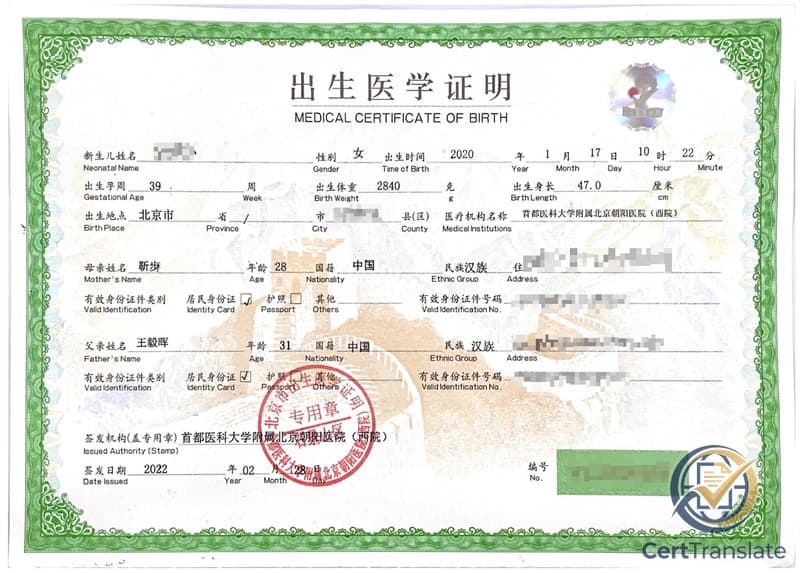
China · pre-printed English
Pre-printed English labels do not make a record certified. We translated the whole document ourselves and left the printed English visible rather than leaning on it.
Read the case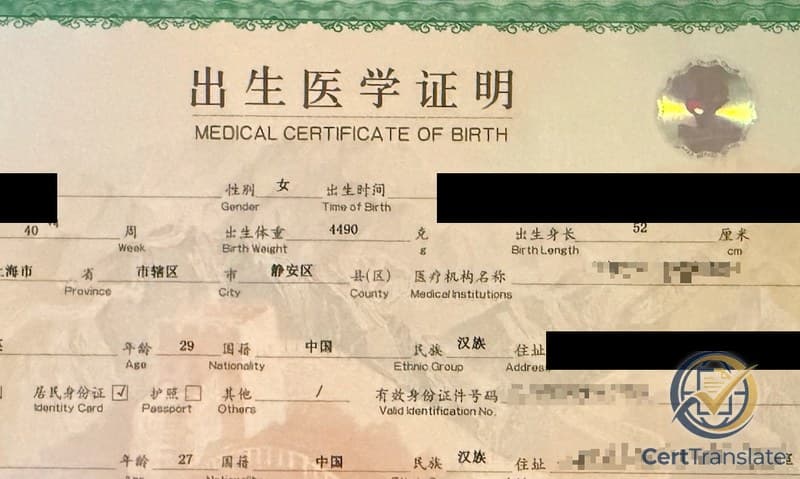
China · passport spelling
We used the spelling printed in the passport and kept the characters beside it, so the packet named one person instead of two.
Read the case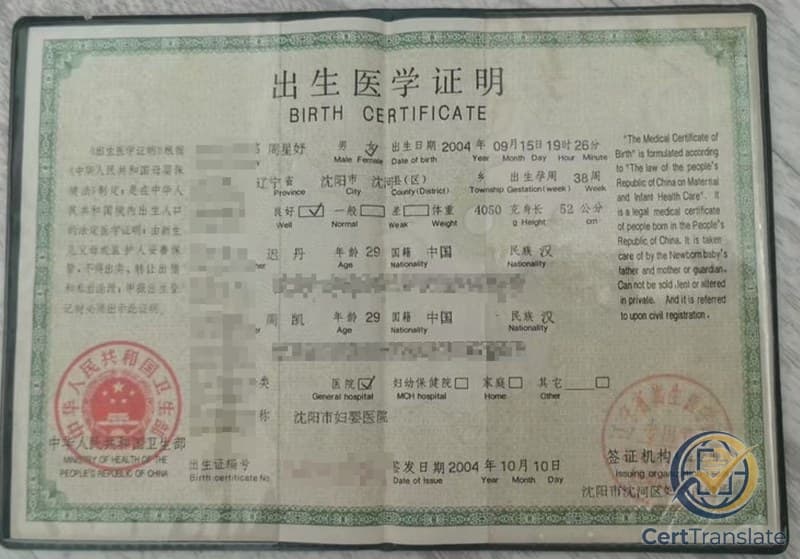
China · field pairs
Chinese forms label 国籍 and 民族 separately. We translated each to its own English label instead of collapsing citizenship and ethnicity into one line.
Read the caseWhich record proves the divorce
China ends a marriage two ways, and each one produces a different document. Hong Kong and Taiwan work differently again. We name the record as issued rather than calling everything a decree.
A divorce both spouses agree to is registered at the local Civil Affairs Bureau, which issues the 离婚证. It is a booklet, and it records the fact of the divorce rather than its terms.
The terms live in the 离婚协议书, the signed agreement covering property and children. If your filing turns on those terms, that paper has to be translated too.
Photograph the booklet open, so both pages of the spread are in one image. A single cover shot leaves the record incomplete.
A contested divorce, or one involving a foreign spouse, goes through a People’s Court. It ends either in a judgment (判决书) or in a court-issued mediation statement (调解书).
Both are court documents and both carry the case number, the panel, and the effective-date wording. A mediation statement is not a lesser paper; it is how many Chinese divorces actually conclude.
Many applicants receive a notarial booklet from a 公证处 that restates the record and includes its own English translation plus a translator’s certificate.
That in-booklet certification does not meet the USCIS standard. You still need a separate certified translation. We translate the booklet in full, notarial pages included, so the file stands on its own.
A Hong Kong divorce ends in a court order, the Decree Absolute, which follows the earlier Decree Nisi. It is often issued in English already, and where it is, you may not need us at all.
Taiwan usually registers a mutual-consent divorce rather than litigating it. Proof is the divorce registration together with the household registration record (戶籍謄本).
How it works
Upload the record first. We name the document, confirm the full page set and the price, then translate, check, and certify it.
Send the 离婚证 spread, the judgment or mediation statement, the 离婚协议书, and the notarial booklet. Add your passport page so the names match.
A Chinese specialist translates the registry or court text. A second reviewer checks the characters against the passport spelling, the case number, the seals, and every date.

Ask for fixes before we certify. You then get the source copy, the full English translation, and the signed and stamped Certificate of Translation Accuracy.

How much does a Chinese divorce translation cost?
No 250-word cap on dense court pages.
Certified price
$24.95/ page
No payment until file review
Client reviews
Wei L.
San Francisco, CA
“They told me the 离婚证 alone would not show the custody terms my attorney needed, and translated the agreement with it. That saved me a second order.”
Mainland · 离婚证 with agreement
Agreement translated as well
Jennifer C.
Flushing, NY
“My notarial booklet already had English inside, and I assumed that was enough. CertTranslate explained why it was not and certified the whole thing properly.”
Mainland · Notarial booklet
Whole booklet certified
David T.
Irvine, CA
“The judgment spelled my name differently from my passport. They used the passport spelling and kept the characters next to it, so nothing looked inconsistent.”
Mainland · Court judgment
Names matched the passport
Questions before ordering
The translation rule is always the same: file the Chinese evidence with a full certified English translation. Which record proves the divorce depends on whether it was registered or decided in court.
The price is $24.95 per physical page, with no word cap. A 离婚证 spread is usually one or two pages. A court judgment can run several. We confirm the count before you pay.
Most one- to three-page orders arrive within 24 hours. For long judgments, and for files with dense handwriting or faint seals, we confirm a delivery time before we start.
Your package holds the source copy, a full English translation, and a signed and stamped Certificate of Translation Accuracy. If USCIS raises a translation issue, we revise it free. That does not replace holding the right record in the first place.
Yes. The translator’s certificate inside a Chinese notarial booklet does not meet the USCIS standard, so a separate certified translation is still required. We translate the booklet in full, including its notarial pages.
It depends on what you are proving. The 离婚证 shows the marriage ended; the agreement holds the property and custody terms. If your filing or your attorney needs those terms, translate both.
Use the date the form asks for, if the record backs it up. A registered divorce carries the date on the 离婚证; a court divorce turns on when the judgment took effect. The translation labels each one.
We follow the spelling in your passport when you send it, because that is the spelling the rest of your packet uses. We keep the characters beside it so the two forms stay linked.
Only if you are submitting it. The household register records marital status among other things, so some filings include it. We translate every page you send rather than picking pages for you.
USCIS generally asks for a certified English translation, not a notarized one and not an apostille. A court, consulate, or foreign office may set its own rules, so follow that recipient’s checklist.
Probably not. A Decree Absolute issued in English needs no translation. Send it to us only if parts of it are in Chinese, or if the receiving office asks for a certified copy of a Chinese version.
What we check before certification
These issues come up again and again in Chinese marital-history packets. The translation should show the record type, the names, and the dates, not leave the officer to work them out.
Our check: We check the full spread, because the cover carries no names, dates, or seal. A cover-only scan proves nothing on its own.
Our check: We certify our own translation of the whole booklet. The in-booklet translator’s certificate does not meet the USCIS standard.
Our check: We use the passport spelling and keep the characters beside it, so one person does not read as two across the packet.
Our check: They are separate fields and mean different things. We keep citizenship and ethnicity apart in English.
The standard behind these checks
AcceptReady™ is CertTranslate's published standard for certified translations: complete word-for-word translation, mirrored page layout, signed and stamped Certificate of Accuracy on letterhead, and matched to the receiver's published requirements.
How to check each one yourselfChecked before certification. If an authority later requests a translation-related correction, revisions remain free.
Start my translationCommon USCIS contexts
USCIS reads divorce evidence to see whether an earlier marriage ended lawfully, and whether both people were then free to marry again.
Send the Chinese record together with its certified English translation. The translation must not replace the source, shorten it, or quietly fix it.
Proof that an earlier marriage ended supports the current marriage in a family-based case.
Both parties must show that prior marriages ended and that they are legally free to marry.
USCIS asks for records showing an earlier marriage ended lawfully. A name change on the form has to be evidenced too.
Which civil record counts, and whether it needs a stamp, follows the destination’s own checklist.
Document glossary
These terms often show up together, but they name different documents, offices, or stages of the divorce.
Reference library
Guidance and source links last rechecked .
Ready when you are
Send what you have: the 离婚证 spread, the judgment or mediation statement, the agreement, or a notarial booklet. We confirm the record type, the page count, the price, and when it will be ready.
No payment until file review
