




Why does a Chinese birth certificate list 'Nationality' twice, and what should the translation do?
TL;DRA Chinese Medical Certificate of Birth (出生医学证明) is a pre-printed bilingual form that labels two different fields 'Nationality.' One records citizenship — 国籍, e.g., China. The other records ethnicity — 民族, e.g., Han. We translated each label by its actual Chinese meaning, not by the form's printed English, and added a Translator's Note documenting the disambiguation. The certified translation was delivered for the client's USCIS I-130 packet.
Case Specifications
- Document
- Medical Certificate of Birth
- Foreign Name
- 出生医学证明
- Country
- China
- Languages
- Chinese (Simplified) → English
- Submitted To
- USCIS I-130 family petition
What We Received
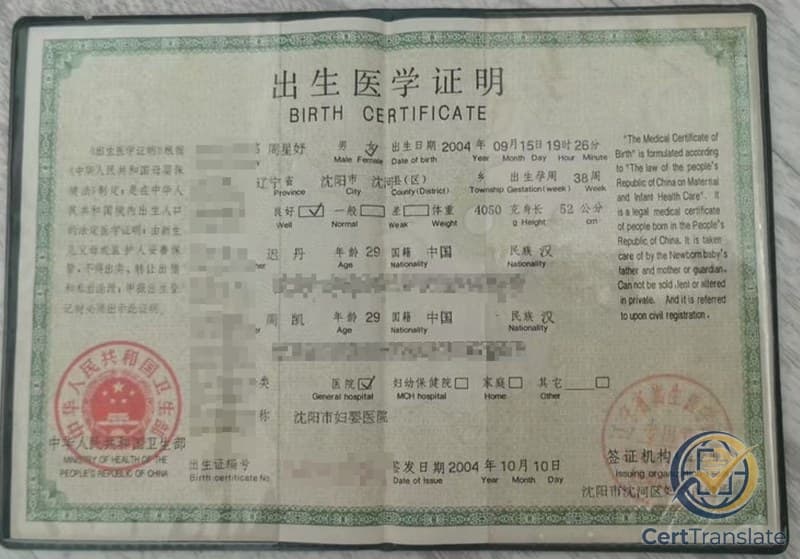
A client submitted a one-page PRC 出生医学证明 (Medical Certificate of Birth) issued in Liaoning Province in 2004 for a child born in Shenyang. The document is the hospital-issued, pre-printed bilingual form used nationally — the legal medical record of birth in the PRC. Each parent's row carries two adjacent fields, both labeled 'Nationality' on the printed English template. The first records 国籍 (China); the second records 民族 (Han). The <a href="/documents/birth-certificate">PRC Medical Certificate of Birth (出生医学证明) translation</a> was needed for a <a href="/immigration/uscis">USCIS I-130 family petition</a>.
Why This Required Special Handling
The printed English on the form is a template artifact, not an accurate translation of the two Chinese labels. 国籍 (guójí) is a citizenship attribute. 民族 (mínzú) is an ethnicity attribute under PRC civil-status conventions. They are not synonyms.
A translator who reproduces the printed English literally writes 'Nationality: China' and 'Nationality: Han' side by side. A USCIS adjudicator reads two contradictory citizenship claims for the same person. The discrepancy is a form-template issue, not a fact in the document — and the translation must show that.
The fix is field-semantics, not field-text. The translator restores the distinction the original Chinese encodes. A Translator's Note then documents the form-template artifact so a reviewer can see what the source actually says — see our <a href="/guides/uscis-translation-requirements">USCIS translation requirements guide</a> for the standard.
How We Handled It
We translated each label by its Chinese meaning, not by the form's printed English. The 国籍 field became 'Nationality / Citizenship' with the value 'China (中国).' The 民族 field became 'Ethnicity' with the value 'Han (汉).' The two attributes now read as two different fields, on the mother's row and again on the father's row.
The pre-printed English label 'Nationality' was kept visible in the rendered form alongside the corrected English. A reviewer cross-referencing the original can locate each field at a glance. A short <a href="/guides/certificate-of-accuracy">Translator's Note</a> documented the disambiguation:
"The pre-printed bilingual template on this form labels two adjacent fields 'Nationality' on each parent's row. The first records 国籍 (citizenship); the second records 民族 (ethnicity) under PRC civil-status conventions. They are not synonyms. The values have been rendered, respectively, as 'Nationality / Citizenship: China (中国)' and 'Ethnicity: Han (汉).' The discrepancy is a feature of the source form's English template and is not introduced by this translation."

The Outcome
The certified translation was delivered as a DOCX with a signed Translator's Certification page. The translated document shows the citizenship and ethnicity attributes for each parent under distinct English labels, with the source convention preserved and explained. We've handled this same form-template issue on PRC 出生医学证明 documents across multiple provinces since 2022, using the same disambiguation approach. All have been accepted by <a href="/immigration/uscis">USCIS</a> without an RFE on the nationality fields.
What This Means for You
If your Chinese birth certificate carries pre-printed bilingual labels, do not assume the printed English is the correct translation. A PRC 出生医学证明 separates citizenship (国籍) and ethnicity (民族) into two adjacent fields, and a faithful certified translation must label each one by its actual Chinese meaning. A short Translator's Note documenting the form-template artifact is usually enough for a USCIS adjudicator or a credential evaluator to read the document correctly.
Have a similar situation?
We translate Chinese civil-status documents — Medical Certificates of Birth, household-registration extracts, marriage certificates — for USCIS, WES, ECE, and US universities, preserving field semantics and documenting source-form template artifacts where they exist.
Related Cases & Resources
Sources & References
- USCIS Policy Manual — Documentation and Translations (8 CFR 103.2(b)(3))·U.S. Citizenship and Immigration Services·Verified 2026-07-10
Explore the Hub
Certified Translation
Documents
Languages
Immigration
Accepted By
USCIS Forms
All identifying information has been removed from document images. Case details are shared with client permission. No personal data is stored or displayed on this page.