
CertTranslateCertTranslate
Sworn translation standardVerified June 2026

Document Translation Requirements in Germany

Official bodies in Germany generally require a sworn translation of foreign-language documents, and many documents also need an apostille or legalization before they are translated. Below: who can translate, when an apostille is needed, and where the official rules are published.

Key facts

Germany requires a beglaubigte Übersetzung — a certified translation by a translator publicly appointed and sworn before a German regional court (Landgericht), who stamps and signs it. For a German document used in the United States, a certified English translation with a signed Certificate of Accuracy is what USCIS and universities accept. Germany has been in the Hague Apostille Convention since 1966, so a German Geburtsurkunde is apostilled by the competent German authority — not consularized.

Reviewed by Klaus Weber, European Medical & Scientific Translator · ATA member since 2014· Last verified June 2026

Germany requirements at a glance

Translation standardSworn translation · beglaubigte Übersetzung
Who can translatePublicly appointed and sworn translator registered in Germany
ApostilleGenerally required for foreign documents, depending on country of origin
Apostille authorityDepends on the issuing Land and document type: federal documents are apostilled by the Bundesverwaltungsamt; civil-registry and administrative documents by the regional administrative authority (Regierungspräsidium or Bezirksregierung); court and notarial documents by the regional court (Landgericht).
Accepted languagesGerman
Responsible authorityGerman Federal Foreign Office (Auswärtiges Amt)
Important: If an apostille or legalisation is required for a foreign document, it should generally be obtained before the sworn translation is completed in Germany.

Who can translate documents for use in Germany?

Only officially appointed and sworn translators (beeidigte Übersetzer / ermächtigte Übersetzer) are authorised to produce legally recognised translations in Germany. These translators are publicly appointed by regional courts (Landgerichte) following verification of qualifications, reliability and professional competence.
What makes a translation official in Germany?

An official sworn translation must include the translator’s official stamp, signature, and a declaration confirming that the translation is complete and accurate. The certification must reference the appointing authority and confirm the translator’s sworn status.

How does Germany treat documents from abroad?

Foreign documents submitted to German courts or authorities may need to be apostilled or legalised in their country of origin before translation. To be accepted by German authorities, the translation must be prepared by a sworn translator registered in Germany.

Legal basis

Sworn translators in Germany are appointed under the judicial laws of the individual federal states (Bundesländer). Appointment is typically made by the president of a regional court, and the translator takes an oath authorising them to certify translations for official purposes.

Apostille & legalization for Germany

Germany is part of the Hague Apostille Convention (since 1966), so public documents are authenticated with a single apostille — no consular legalization.

Documents from Germany

Depends on the issuing Land and document type: federal documents are apostilled by the Bundesverwaltungsamt; civil-registry and administrative documents by the regional administrative authority (Regierungspräsidium or Bezirksregierung); court and notarial documents by the regional court (Landgericht).Germany has been bound by the Convention since it entered into force for it in 1966.

U.S. documents going to Germany

A U.S. document going to Germany is apostilled in the United States — the state Secretary of State, or the U.S. Department of State for federal documents — and then translated into German by a court-sworn (vereidigt) translator.

The apostille should be obtained before the translation, so the apostille certificate is translated too. See how apostilles work, or order a translation with e-apostille.

How to get a Germany document translation accepted

  1. 1

    Check whether you actually need an apostille

    For a German document used in the U.S., USCIS requires a certified translation, not an apostille. Some universities or state licensing boards may ask for one — confirm with the receiving office before paying for it.

  2. 2

    Order a certified English translation of the full document

    Cover the Standesamt registry data, every stamp, and any apostille, with a signed Certificate of Accuracy.

  3. 3

    Submit the original plus the certified translation

    File the original with the certified translation to USCIS, the university, or the credential evaluator (WES/ECE).

Ready to translate your German documents?

Certified for USCIS, universities, and credential evaluators — from $24.95/page.

Start my translation

Which direction are your documents going?

Translating German documents for the U.S.?

German birth certificates, diplomas, and transcripts submitted to USCIS, universities, or credential evaluators need a certified English translation — that is exactly what we do, with a 100% USCIS acceptance guarantee.

Sending U.S. documents to Germany?

U.S.-issued documents usually need an apostille before they can be used in Germany — and the apostille should be obtained before the translation, so the certificate itself gets translated too. We offer e-apostille processing as an add-on to any order.

Why Germany document translations get rejected

The mistakes we see most often on German documents — and what a correct certified translation does instead.

Abstammungsurkunde mislabeled as a standard birth certificate

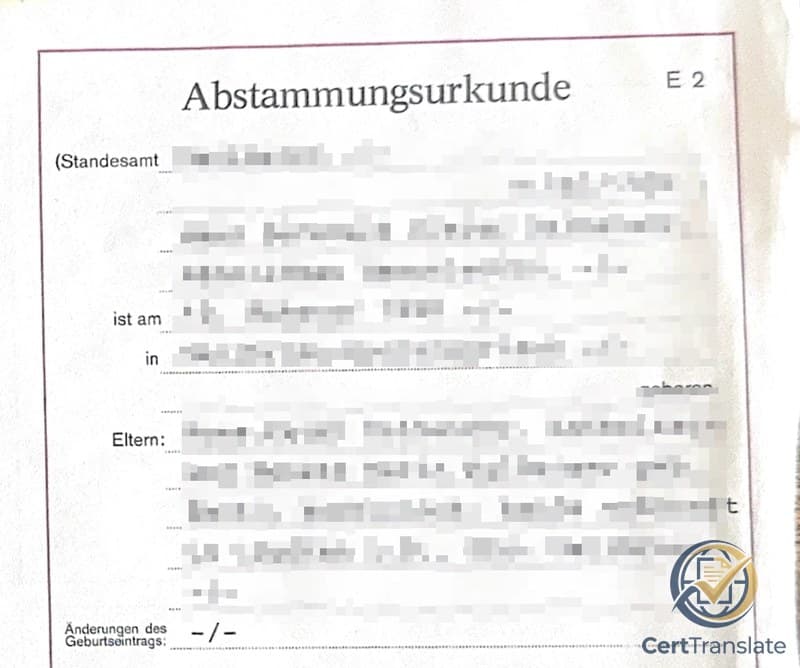
Germany discontinued the Abstammungsurkunde; it records parentage differently from a Geburtsurkunde and needs a translator's note explaining the form, or the packet reads inconsistently.

Read the case

Combined surname in a Familienbuch misread

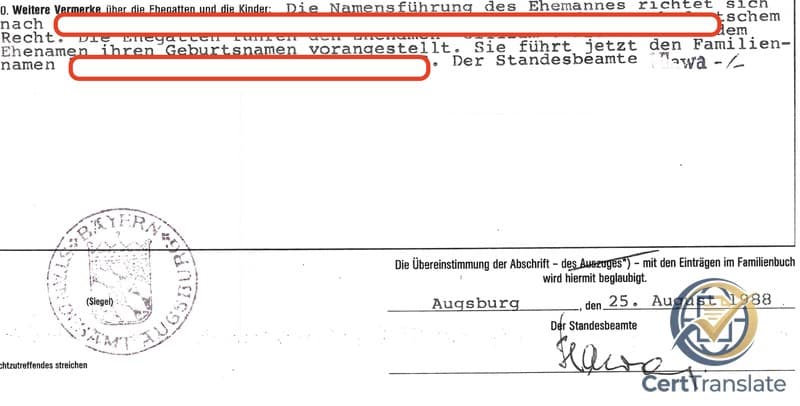
Under the BGB a spouse may take a combined surname; a Familienbuch entry must be rendered so the name matches the passport and the rest of the documents.

Read the case

Wrong issuing authority named on a background check

A German Führungszeugnis is issued by the Bundesamt für Justiz, not the Bundeskriminalamt; naming the wrong authority undermines the translation for USCIS.

Read the case
Real casework

Real German translation cases we've handled

Anonymized German-to-English orders. Each case shows the exact translation problem and how we solved it for the receiving authority.

Cost & turnaround

$24.95/ page

A one-page Geburtsurkunde is priced as a single page; multi-page Zeugnisse and court documents are priced by their page count. Standard delivery is 24–48 hours, with notarization and e-apostille available as add-ons. See full pricing.

Germany translation requirements — FAQ

What translation does Germany require for foreign documents?

Germany requires a beglaubigte Übersetzung — a certified translation by a translator publicly appointed and sworn before a German regional court (Landgericht). You can verify a sworn translator in the official justiz-dolmetscher.de database run by the Land justice administrations.

German translation services
Do I need a sworn translator for a German document used in the U.S.?

No. U.S. authorities do not require a German court-sworn translator. A German Geburtsurkunde or Zeugnis needs a certified English translation with a signed Certificate of Accuracy, accepted by USCIS, WES, and ECE.

certified German translation
Is a U.S. certified translation accepted in Germany?

For official use inside Germany — a Standesamt, court, or university — authorities generally require a beglaubigte Übersetzung by a translator sworn in Germany. For German documents coming to the U.S., a U.S. certified translation is what is accepted.

requirements by destination
Is Germany in the Hague Apostille Convention?

Yes, since 1966. A German public document used abroad is apostilled by the competent German authority — which varies by Land and document type — not legalized at a consulate.

how apostilles work
Who apostilles a German birth certificate?

It depends on the issuing Land. Civil-registry documents like a Geburtsurkunde are typically apostilled by the regional administrative authority (Regierungspräsidium or Bezirksregierung); federal documents by the Bundesverwaltungsamt.

Geburtsurkunde translation
How are German grades translated for WES?

German grades run from 1 (sehr gut) to 6 (ungenügend) — the inverse of the U.S. scale. A certified transcript translation preserves the German grades and scale so WES or ECE can map them; it does not convert them to a U.S. GPA.

WES translation
How much does a German document translation cost?

Pricing is per page. A one-page Geburtsurkunde is a single page; multi-page Zeugnisse are priced by page count. Notarization and e-apostille are optional add-ons.

see live pricing
Can I translate my own German documents?

No. USCIS and universities reject self-translation. An independent qualified translator must complete and certify the translation with a statement of accuracy.

what a certified translation is

Requirements in related countries

Neighbors and countries with a similar translation standard.

Sources

Information verified against official sources. Last verified June 2026.

Need a certified German translation?

Signed Certificate of Accuracy with every order, 100% USCIS acceptance guarantee, optional notarization and e-apostille — delivered in 24–48 hours.