“My Heiratsurkunde had both our Geburtsnamen and the Ehename clearly labeled. The translator caught that my passport used a different umlaut spelling and matched everything. USCIS approved our I-130 petition.”
P
Petra S.
Milwaukee, WI
HeiratsurkundeEheurkundeFamilienbuch
Certified English translation for USCIS, spouse petitions, courts, legal name changes, and consular use.
Ready within 24 hours
Complete translation
Word-for-word, same structure
Every field, stamp, seal, signature, and annotation
Certified package
Signed and Stamped Certificate of Accuracy
Company letterhead · translator signature · company stamp

We check your files and confirm the total before you pay




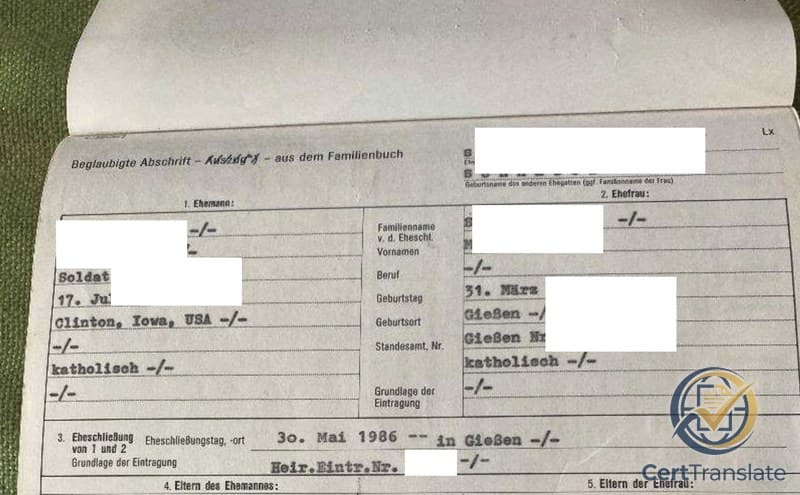
German marriage certificate translation produces a certified English version of Heiratsurkunden (marriage certificates) from Germany, Austria, and Switzerland, prepared for USCIS spouse petitions, adjustment-of-status applications, naturalization, courts, and legal proceedings.
German marriage certificate translation is most commonly needed for USCIS immigrant visa petitions. Form I-130 (Petition for Alien Relative) and Form I-485 (Adjustment of Status) both require proof of marital status, and the Heiratsurkunde is the primary document establishing the legal relationship and the naming changes that resulted from the marriage.
Form N-400 (naturalization) requires the marriage certificate when the applicant’s eligibility is based on marriage to a U.S. citizen. Courts, insurance companies, probate filings, and state benefits offices in the U.S. also request certified English translations of German marriage records. The standard is the same: complete coverage of all fields, naming declarations, and annotations.
For German marriage certificate translation, we label the Geburtsname/Ehename transition clearly for both spouses, translate the full Namenserklärung, preserve Lebenspartnerschaft conversion dates when present, and verify umlaut transliteration against passport spelling so the marriage record integrates seamlessly into the filing packet.
PDF, photo, or scan — any format works. Takes about 30 seconds.

A native-speaking German translator handles every word, stamp, and signature. Signed Certificate of Accuracy included — USCIS-ready format.
Review the completed translation before it is certified — unlimited free revisions until every detail is right. Final searchable PDF delivered typically within 24 hours.
4.9/5•From 2,400+ reviews
“My Heiratsurkunde had both our Geburtsnamen and the Ehename clearly labeled. The translator caught that my passport used a different umlaut spelling and matched everything. USCIS approved our I-130 petition.”
Petra S.
Milwaukee, WI
“We had a converted Lebenspartnerschaft certificate with both the original 2014 partnership date and the 2017 marriage conversion date. CertTranslate preserved both dates and the statutory reference. Our immigration attorney said it was the cleanest translation she had seen.”
Markus H.
Austin, TX
“My Swiss marriage certificate was bilingual German/French from the Zivilstandsamt. They translated both language sections, preserved the cantonal and communal references, and the immigration lawyer was impressed by the detail.”
Lisa B.
Denver, CO
Anonymized German marriage certificate translations we've delivered. Click any case to see the exact problem and how we solved it.
German marriage certificate translation requires precise handling of the dual-name system (Geburtsname/Ehename) for both spouses, Namenserklärung declarations that determine post-marriage legal identity, Standesamt registry references, and special cases like Lebenspartnerschaft conversions and international marriages with multilingual annotations — each presenting challenges that require German civil-law domain knowledge.
A German Heiratsurkunde records not just the marriage event but the complete naming transition — each spouse’s Geburtsname (birth name), chosen Ehename (married name), any Namenserklärung (formal naming-choice declaration), Registernummer (registry number), and Beglaubigung (authentication stamps) that confirm the record’s official status.
Your Heiratsurkunde is translated by a native German speaker who handles marriage certificate translation daily, so the Geburtsname/Ehename distinction, multi-part compound surnames, umlaut transliteration, and Standesamt formatting are handled by a specialist rather than a general translator.
If USCIS or any receiving authority asks for a translation-only correction, we revise the file at no extra cost so the English version stays consistent with the rest of your filing packet.
German marriage certificates explicitly record each spouse’s Geburtsname (birth name) and the chosen Ehename (married name). This dual-name structure is the core mechanism by which German civil law tracks how legal identity changes at marriage. USCIS uses these name fields to verify identity across documents in the filing packet — birth certificate, passport, and marriage record must all connect.
The translation must clearly label which name is the birth name and which is the married name for each spouse. Simply listing names without distinction creates ambiguity, especially when the passport uses one name and other documents use another. We render each name with its proper label — "Birth Name (Geburtsname)" and "Married Name (Ehename)" — so a U.S. adjudicator can follow the identity trail without guessing.
**Namenserklärung (naming-choice declaration):** A legally binding section on German marriage certificates where the couple formally declares which surname they will adopt as the Ehename, whether to retain birth names, or whether to use a hyphenated Doppelname (double surname). This declaration is governed by §1355 BGB (German Civil Code) and determines the legal name used on all subsequent documents.
Missing or mistranslating the Namenserklärung can leave a gap in the identity trail. We translate the full declaration with both the English rendering and the German terminology preserved, so a U.S. reviewer can follow the naming logic without needing knowledge of German family law.
German marriage certificates carry the Standesamt (civil registry office) name and a Registernummer that identifies the exact registry entry. These references allow a receiving authority to trace the marriage back to the issuing office. They must be reproduced exactly as printed, including slashes, year prefixes, or numbering conventions specific to the issuing municipality.
Older marriage records may reference superseded Standesamt offices (common after German reunification or municipal mergers) or use handwritten numbering. The translator must preserve these identifiers faithfully without modernizing or correcting historical references.
When a German citizen marries a foreign national, the Heiratsurkunde may contain transliterated names, original-script names, nationality references, consular annotations, and Beglaubigung stamps from foreign embassies. These mixed-language elements add complexity that a monolingual translator may mishandle.
We ensure that foreign name spellings match the partner’s passport, consular and embassy stamps are labeled accurately, and any non-German text that carries material information is translated. The goal is an English version where both spouses’ identities are clear and traceable.
Germany converted registered civil partnerships (Lebenspartnerschaften) into marriages under the Eheöffnungsgesetz of 2017. Certificates that reflect this conversion carry both the original partnership registration date and the marriage conversion date, with specific legal language referencing §20a LPartG.
The translation must preserve both dates and the conversion-specific statutory references without simplifying the record into a standard marriage certificate. The distinction between original partnership date and conversion date may matter for immigration timelines, benefit calculations, and legal proceedings.
German marriage certificate translation varies because Germany, Austria, and Switzerland each have different civil-registry systems, naming conventions at marriage, and institutional structures, even though all three issue marriage certificates in German.
German Heiratsurkunden are issued by the local Standesamt and follow a standardized federal format governed by the Personenstandsgesetz (PStG). They record both spouses’ Geburtsnamen, the chosen Ehename, the Registernummer, witness names, and any Randvermerke noting later events like divorce or death of a spouse. Since 2009, Germany has maintained an electronic civil registry (Elektronisches Personenstandsregister), but older records remain in book-based format.
For USCIS filings, Heiratsurkunden most often appear with Form I-130 (family/spouse petition), Form I-485 (adjustment of status), and Form N-400 (naturalization). Germany has been a Hague Apostille Convention member since 1965. We preserve every naming field, Namenserklärung, and annotation so the English version accurately reflects the full marriage record.
Austrian marriage certificates (Heiratsurkunde) carry similar core information but use different field labels, may include Staatsbürgerschaft (citizenship) details for both spouses, and follow a regulatory framework (Austrian Personenstandsgesetz 2013) distinct from German PStG. The issuing authority may be a Standesamt or a Magistrat depending on the municipality.
Austrian naming conventions at marriage differ from German rules — the Doppelname structure and naming-choice options follow Austrian civil code provisions. We preserve Austrian-specific institutional references and field ordering rather than reformatting the record to match German Heiratsurkunde conventions. Austria has been a Hague Apostille member since 1968.
Swiss marriage certificates from German-speaking cantons use Zivilstandsamt formatting and may be bilingual or multilingual depending on the canton. Swiss civil law (ZGB Art. 160) has its own naming rules — since 2013, spouses keep their birth names by default, with the option to choose a common family name (Familienname) by declaration.
The translation must preserve the cantonal and communal references (Gemeinde, Bezirk) and handle any bilingual content (German/French or German/Italian) so that all material information reaches the English version. Switzerland has been a Hague Apostille Convention member since 1973.
$24.95
per page · no word cap
Typical length
Most German marriage certificates are 1 to 2 pages
Typical total
$24.95
No hidden fees. Free Quote.
German marriage certificate translation costs $24.95 per page. Most clients pay $24.95 to $49.90 because the typical Heiratsurkunde is one or two pages. Certificates with a Namenserklärung or multiple Randvermerke may run slightly higher. You receive the confirmed page count before payment, and there is no language surcharge for german.
Most marriage certificate orders are delivered within 24 hours once we receive clear scans. Standard Heiratsurkunden are typically delivered within 24 hours. If the record includes a Namenserklärung, extensive Randvermerke, or multilingual annotations from an international marriage, we confirm the delivery window before production begins.
Yes. This service is built for USCIS, courts, and other receiving authorities that need a complete certified English translation of a German marriage certificate, including Namenserklärung, Randvermerke, and witness information. Our package includes the full English translation plus a signed Certificate of Accuracy, which is the format most receiving authorities expect for foreign-language records.
Yes. We handle marriage certificates from Germany, Austria, and Switzerland, with the translation adapted to the issuing country’s civil-registry system, naming conventions, and regulatory framework rather than using a generic template. If your record uses a rare regional format, upload every page so the translator can match the exact issuing-country structure before production starts.
We handle older handwritten marriage records, faded Standesamt stamps, and pre-digital registry formatting regularly. When the image is usable, we translate it carefully. If a name, date, or Registernummer is too faint to read safely, we ask for a better scan before certifying. When a field is genuinely unreadable, we mark it transparently instead of guessing, which is safer than inventing a name, date, or registry number.
Yes — you receive the completed translation for review before we certify it, and we make unlimited free revisions until every name, date, and detail is right. If USCIS later requests a change, we correct the certified file at no charge.
No — we bill the physical page you upload, never a word count. Many services cap a "page" at 250 words and re-bill a dense marriage certificate as two or three pages; here one page of your document is one $24.95 page, however dense the text.
We clearly label each name type in the English translation — "Birth Name (Geburtsname)" and "Married Name (Ehename)" — for both spouses so a U.S. reviewer can see exactly which name is the birth name and which is the married name. This is especially important when the passport uses one name and other documents in the filing packet use another.
A Namenserklärung is the formal naming-choice declaration recorded at marriage under §1355 BGB (German Civil Code). It shows which surname the couple adopted as the Ehename, whether birth names were retained, or whether a Doppelname (double surname) was chosen. We translate the full Namenserklärung with both the English rendering and the German legal terminology preserved, because it explains the naming logic that USCIS uses to verify identity.
A German Heiratsurkunde tracks the full naming transition — each spouse’s Geburtsname and Ehename, the Namenserklärung, and Randvermerke for later events. We label every name and translate every note so a U.S. adjudicator can follow the identity trail without guessing.
| Field | What it is | How we handle it |
|---|---|---|
| Heiratsurkunde | The marriage certificate (the document type) | Identified and labeled; Eheurkunde/Auszug variants noted. |
| Standesamt / Zivilstandsamt + Registernummer | Issuing civil-registry office and the registry-entry number | Office and Registernummer preserved exactly, including slashes/year prefixes. |
| Eheleute: Geburtsname / Ehename | Each spouse’s birth name and chosen married name | Each labeled “Birth Name (Geburtsname)” / “Married Name (Ehename)” — never listed without distinction. |
| Namenserklärung | Formal naming-choice declaration (§1355 BGB), incl. any Doppelname | Full declaration translated, German terminology preserved alongside English. |
| Datum und Ort der Eheschließung / Zeugen | Date and place of marriage and the witnesses | Translated precisely; witnesses kept visible, not trimmed. |
| Randvermerke | Marginal notes recording later events (divorce, death of a spouse) | Every Randvermerk translated — the field that shows whether the marriage still stands. |
Germany (Standesamt), Austria, and Switzerland (Zivilstandsamt) differ in format and naming conventions. Lebenspartnerschaft conversions (Eheöffnungsgesetz 2017, §20a LPartG) carry both the original partnership date and the conversion date — we preserve both. Umlauts are transliterated to match the passport spelling.
Most translation-related RFEs trace back to a few issues. These are what we check on every German-language marriage record.
01Geburtsname and Ehename not distinguished
We label each spouse’s birth name and married name explicitly so the identity trail across passport/birth records is unambiguous.
02Namenserklärung omitted
We translate the full naming-choice declaration, since it determines the legal surname used on all later documents.
03Randvermerke skipped
We translate every marginal note, since a later divorce or death is recorded there and an officer may cite a missing one.
04Registernummer or Standesamt modernized or omitted
We reproduce the registry number and office exactly, preserving historical references after mergers/reunification rather than correcting them.
Patterns drawn from real German-language marriage-record casework (Germany, Austria, Switzerland). Unreadable fields are marked transparently, never guessed.
Every order is checked against this list before certification — and covered by the revise-free-or-refund guarantee.
Start my translationCommon terms you will see on a German-language marriage record, with what they mean on the certified English version.
Our guidance on German marriage certificate translation reflects the published requirements of the authorities below.
Often in the same packet
For your filing
Upload every page of the Heiratsurkunde, including any Namenserklärung, Randvermerke, apostille sheets, and Beglaubigung stamps. If the marriage involved a foreign national, include any consular annotations or embassy stamps as well.
If your filing set also includes birth certificates, divorce decrees, or other German civil records, ordering them together ensures naming consistency, umlaut transliteration alignment, and Standesamt reference continuity across the translated set.