




What does 'Magistrat' mean on an Austrian birth certificate — and why isn't it the same as 'magistrate' in English?
TL;DRAn Austrian birth certificate issued by Landeshauptstadt Linz carries the institutional label 'Magistrat' — in Austria, the municipal administration of a Statutarstadt (statutory city), not a judicial 'magistrate'. We rendered 'Magistrat der Landeshauptstadt Linz' as 'Municipal Administration of the Provincial Capital Linz' and added a Translator's Note naming the Austrian civil-registry meaning, so a USCIS adjudicator would not read the issuing authority as a court. The certified translation was delivered for the client's US immigration filing.
Case Specifications
- Document
- Birth certificate (Geburtsurkunde)
- Foreign Name
- Geburtsurkunde
- Country
- Austria
- Languages
- German → English
- Submitted To
- USCIS
What We Received
A client submitted an Austrian Geburtsurkunde — a certified birth certificate issued in 2008 by the city of Linz, the provincial capital of Oberösterreich (Upper Austria), under registration number 3430 / 2001. The certified English translation was needed for a US immigration filing.
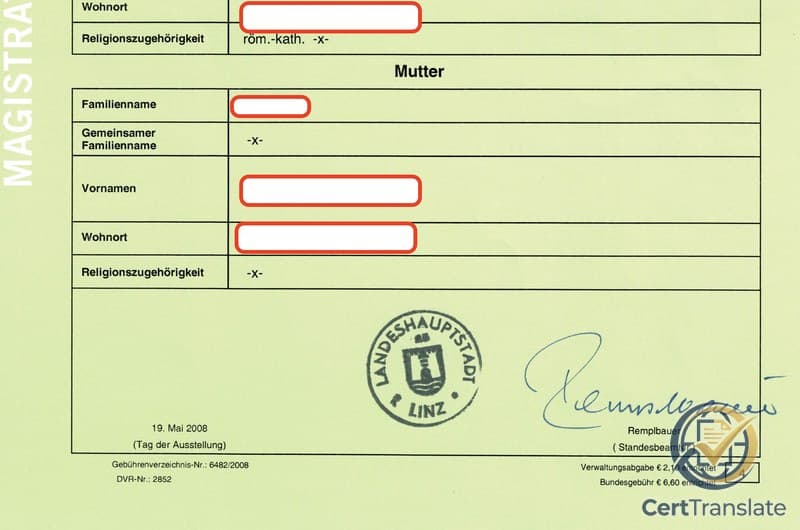
The form is the standard Austrian Geburtsurkunde layout: top fields naming the country, the province, the issuing authority and the registration number; a 'GEBURTSURKUNDE' caption; a child block (Familienname, Vornamen, Zeitpunkt und Ort der Geburt, Geschlecht); a 'Vater' (Father) block and a 'Mutter' (Mother) block; a round embossed seal and a registrar's signature; and a footer with the fee-register and DVR (data-processing register) numbers.
Two features set this document apart from a US birth certificate. The left margin runs a vertical label in full uppercase — 'MAGISTRAT DER LANDESHAUPTSTADT LINZ' — printed sideways across the long edge of the form. And every entered field ends with the string '-x-', an end-of-entry filler used on Austrian civil-registry forms to prevent later additions.
Why This Required Special Handling
'Magistrat' and 'magistrate' look like cognates and are not. In US English, a magistrate is a judicial officer — a low-level judge. In Austrian (and German) administrative language, a Magistrat is the municipal administration of a city with statutory status: a Statutarstadt, under Article 116(3) of the Austrian Federal Constitution. Linz is one of fifteen Statutarstädte in Austria; its civil-registry office (Standesamt) is a division inside the city's Magistrat. The label on this birth certificate is institutional, not judicial.
Rendering 'Magistrat der Landeshauptstadt Linz' as 'Magistrate of the Provincial Capital Linz' is the literal-cognate move — and the USCIS translation requirements guide makes clear why that is the wrong move. The adjudicator reads 'magistrate' as a judge. A birth certificate issued by a judge is not a routine birth-registration record — it suggests a court order, a paternity determination, or a court-ordered correction. None of those situations is on this document, and inviting that misreading by importing a false friend can prompt the adjudicator to flag the source document type for clarification.
On top of the Magistrat label, the form's '-x-' end-of-entry markers read, to a US reviewer who has never seen them, like data corruption or template glitches. They are neither. They are the registry's anti-tampering convention — every entered field ends with '-x-' and every blank field shows '-x-' alone, so that the page cannot be altered after issuance. A faithful translation has to keep them exactly while explaining what they are.
How We Handled It
We rendered 'Magistrat der Landeshauptstadt Linz' as 'Municipal Administration of the Provincial Capital Linz' — the institutional meaning, not the false-friend cognate. 'Landeshauptstadt' became 'Provincial Capital' (Linz is the capital of Oberösterreich / Upper Austria). 'Einwohner- und Standesamt' became 'Residents' and Civil Registry Office'. The left-margin vertical label was reproduced as a bracketed marker so the reader can see exactly where the institutional label appears on the original page.
All '-x-' end-of-entry markers were preserved letter-for-letter in the translated fields, in the same positions they occupy on the original. 'röm.-kath.' (the German civil-registry abbreviation for 'römisch-katholisch') was rendered as 'Roman Catholic'. The Austrian time notation '00 Uhr 50' was rendered as '00:50 hrs'. The German date format ('27. September 2001', '19. Mai 2008') was rendered as 'September 27, 2001' and 'May 19, 2008'. Currency amounts written in European decimal notation ('€ 2,10', '€ 6,60') were rendered in US notation ('€2.10', '€6.60') with a note documenting the convention.
The certification block carries the Translator's Note that pins the institutional meaning of 'Magistrat':
"The left-margin institutional label on the source document reads 'MAGISTRAT DER LANDESHAUPTSTADT LINZ'. In Austrian administrative usage, the Magistrat is the municipal administration of a city with statutory status (Statutarstadt) under Article 116(3) of the Austrian Federal Constitution. The civil-registry office (Standesamt) that issued this Geburtsurkunde is a division inside the Magistrat of Linz. The label has been rendered as 'Municipal Administration of the Provincial Capital Linz'. The English cognate 'magistrate' (a judicial officer) is a false friend in this context and has been avoided."

Three further notes accompanied the certification block. One explains the '-x-' end-of-entry filler convention used throughout Austrian civil-registry forms. One documents the date-format conversion from 'DD. Month YYYY' to 'Month DD, YYYY'. One explains the European decimal notation in the fee figures. The round embossed seal — 'LANDESHAUPTSTADT LINZ' around the city coat of arms — was described in brackets with the seal text in English. The registrar's signature was rendered with the printed name visible on the certification line.
The certified German to English translation was delivered with the canonical CertTranslate certification block — translator name, language pair, date, signature line — on a separate certification page after the translation body, so the reviewing officer can see the translation and the certification as distinct artefacts.
The Outcome
The certified translation was delivered for the client's US immigration filing. The Translator's Note that names the Magistrat / Statutarstadt civil-registry meaning by constitutional article makes the institutional category legible to a USCIS adjudicator at first read, so the issuing authority is not mistaken for a court.
We have handled this Magistrat / Statutarstadt label on Austrian birth and marriage records issued by Linz, Graz, Salzburg, Innsbruck, Klagenfurt, St. Pölten, Eisenstadt, Wels, Wiener Neustadt, Steyr, Villach, Krems, Waidhofen an der Ybbs, and Rust. The same Translator's Note pattern travels across all of them — only the city name changes.
What This Means for You
An Austrian birth certificate that names a 'Magistrat' as the issuing authority was issued by a city government office, not by a judge. A certified Austrian birth certificate translation that renders 'Magistrat' as 'Municipal Administration' and that adds a brief Translator's Note naming the Austrian Statutarstadt civil-registry meaning prevents a US reviewer — including a USCIS adjudicator — from reading the institutional label as judicial.
Have a similar situation?
We handle Austrian Geburtsurkunden, Heiratsurkunden and Familienbuch extracts issued by a Magistrat regularly.
Related Cases & Resources
Sources & References
- Meet Translation Requirements·USCIS·Verified 2026-07-01
- Statutargemeinden (Statutarstädte) — Austrian Federal Constitution Article 116(3)·Rechtsinformationssystem des Bundes (RIS)·Verified 2026-07-01
- Personenstandsgesetz 2013 (PStG 2013)·Rechtsinformationssystem des Bundes (RIS)·Verified 2026-07-01
Explore the Hub
Certified Translation
Documents
Languages
Immigration
Accepted By
All identifying information has been removed from document images. Case details are shared with client permission. No personal data is stored or displayed on this page.