CertTranslateCertTranslate
Certified translations for USCIS packetsNative-speaking specialists by document type24-hour standard deliveryUnlimited revisions if a receiving authority asks for a translation fix
Live Support Specialists Available

German Birth Certificate Translation

Native German speakers | Standesamt & Zivilstandsamt formats | Umlaut-matched to passport | Randvermerke translated in full | USCIS ready

Avoid Rejections
USCIS-ready certified package
24-Hour Turnaround
Natalia Vega

Reviewed by Natalia Vega

Senior Certified Translation Reviewer • ~2 min response

German birth certificate translation produces a certified English version of Geburtsurkunden (birth certificates) from Germany, Austria, and Switzerland, prepared for USCIS immigration filings, adjustment-of-status applications, naturalization, courts, and credential evaluators [Source: USCIS Policy Manual, Vol. 1, Part E, Ch. 6].

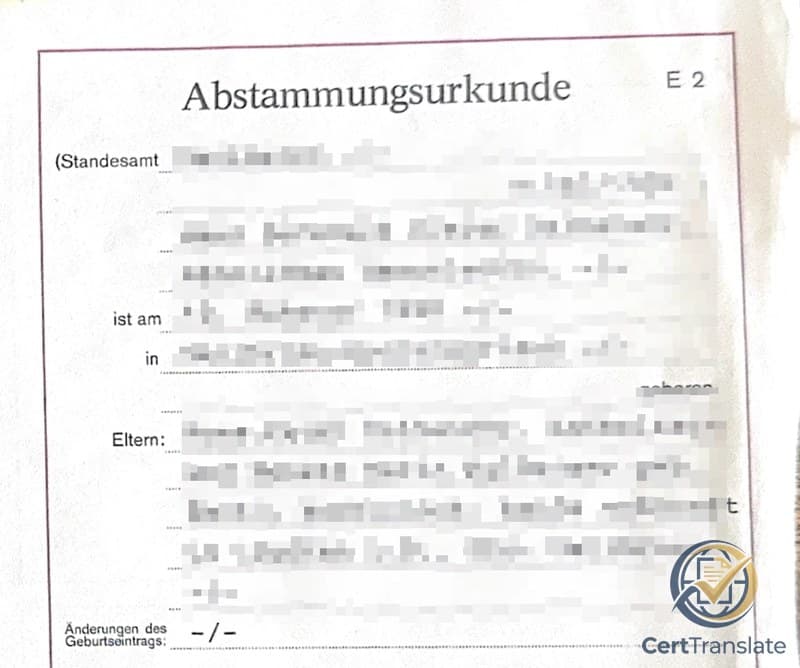
A German Geburtsurkunde from a Standesamt (civil registry office) carries civil-registry references, a Beurkundungsnummer (registration number), Randvermerke (marginal annotations recording name changes, marriages, divorces, adoptions), and naming conventions — Geburtsname (birth name) versus Ehename (married name) — that differ from Austrian Magistrat or Swiss Zivilstandsamt formats even though all three countries use German.

Your birth certificate is translated by a native German speaker who handles Standesamt records daily, so umlaut transliteration (ä→ae, ö→oe, ü→ue, ß→ss) is matched to your passport spelling, registry numbering is preserved exactly, and Randvermerke are translated in full rather than skipped.

If USCIS or any receiving authority asks for a translation-only correction, we revise the file at no extra cost so the English version stays aligned with the original Standesamt record.

Core Differences

What Makes German Birth Certificate Translation Different

German birth certificate translation requires handling Standesamt civil-registry formats with Beurkundungsnummer precision, umlaut transliteration that matches passport spelling, Randvermerke that record subsequent civil-status changes, and a dual-name system (Geburtsname/Ehename) that tracks identity across the applicant’s life — combined challenges that require both German language expertise and civil-registry domain knowledge.

01

Standesamt registry references and Beurkundungsnummer must be exact

Every German Geburtsurkunde includes a Standesamt (civil registry office) name and a Beurkundungsnummer (registration number) that identifies the exact entry in the registry book. These references allow a USCIS officer or court clerk to trace the record back to the issuing authority. They are not decorative — transposing a digit or misspelling the Standesamt name can make the record harder to verify.

We reproduce these identifiers exactly as printed, including slashes, year prefixes, or Roman numeral references used in older registry systems. When the Standesamt has been renamed or merged (common after German reunification), we translate the current name as displayed on the certificate without altering historical references.

02

Umlaut transliteration must match passport and prior filings

German names frequently contain ä, ö, ü, or ß. The way these characters are transliterated — Müller vs Mueller, Straße vs Strasse — must match the spelling used in the applicant’s passport and any previously submitted USCIS documents. A mismatch between the birth certificate translation and the passport romanization can trigger a Request for Evidence (RFE) or slow down adjudication.

We compare the umlaut transliteration against the passport and prior records before certifying the translation. When the applicant has used different transliterations in different documents, we flag it so the filing can include a consistency note if needed.

03

Randvermerke — marginal annotations that record civil-status changes

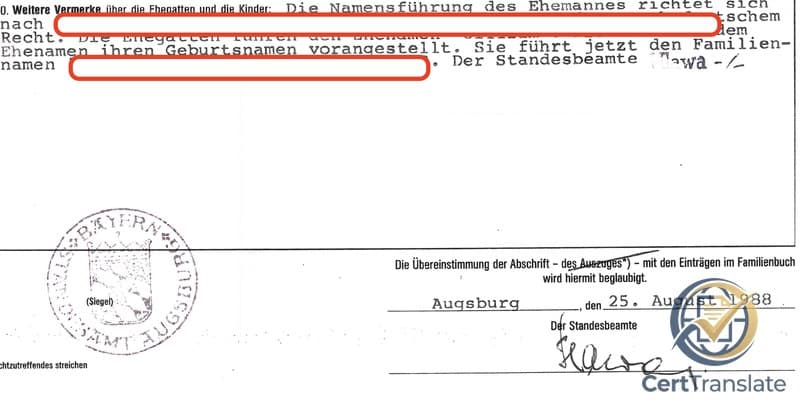
German birth certificates carry Randvermerke (marginal annotations) that record subsequent events: marriage, divorce, name changes, adoption, legitimation, or death. These annotations are legally binding updates to the original birth record and must be translated in full. Some translators skip them or treat them as side notes — in USCIS packets, those annotations may be the only place that explains why the applicant’s current legal name differs from the name at birth.

We translate every Randvermerk with the same precision as the birth record itself, preserving dates, institutional references, and the type of civil-status event recorded. This ensures the English version tells the complete identity story.

04

Geburtsname versus Ehename — the German dual-name system

German civil records track both a Geburtsname (birth name) and, when applicable, an Ehename (married name). This dual-name structure is central to German identity law. The translation must label these names clearly so a U.S. reviewer understands which name is the birth name and which is the current legal name.

Simply listing both names without distinction creates ambiguity, especially when other documents in the filing packet use only one of the two names. We render each name with its proper label — "Birth Name (Geburtsname)" and "Married Name (Ehename)" — so the identity trail is unambiguous.

05

Pre-digital, post-war, and GDR-era registry formats

Birth certificates issued before German civil registries were digitized — and especially records from the post-war period, the GDR (East Germany), or records reconstructed after wartime destruction — use older formatting, handwritten entries, Fraktur script, or different Standesamt naming conventions. GDR-era certificates may reference offices and administrative structures that no longer exist.

These records require contextual reading, not just vocabulary translation. We understand how post-war registry reconstruction affected field order, how GDR-era certificates reference superseded offices, and how to label format differences accurately without rewriting the original document.

Country Variants

German Birth Certificate Translation by Country

German birth certificate translation varies because Germany, Austria, and Switzerland each use different civil-registry systems, institutional naming, and formatting conventions even though all three issue certificates in German.

German Geburtsurkunden are issued by the local Standesamt and carry the Beurkundungsnummer, registrar signature, and official seal. Modern certificates follow a standardized federal format, but older records from before digitization may use regional templates, handwritten entries, Fraktur script, or GDR-era formatting. Post-reunification certificates from eastern states may reference renamed or merged Standesamt offices.

For USCIS filings, these records most often appear with Form I-485 (adjustment of status), Form I-130 (family petition), and Form N-400 (naturalization). Germany is a Hague Apostille Convention member (since 1965). We preserve every Randvermerk, registry reference, and name field so the English version matches the original Standesamt record completely.

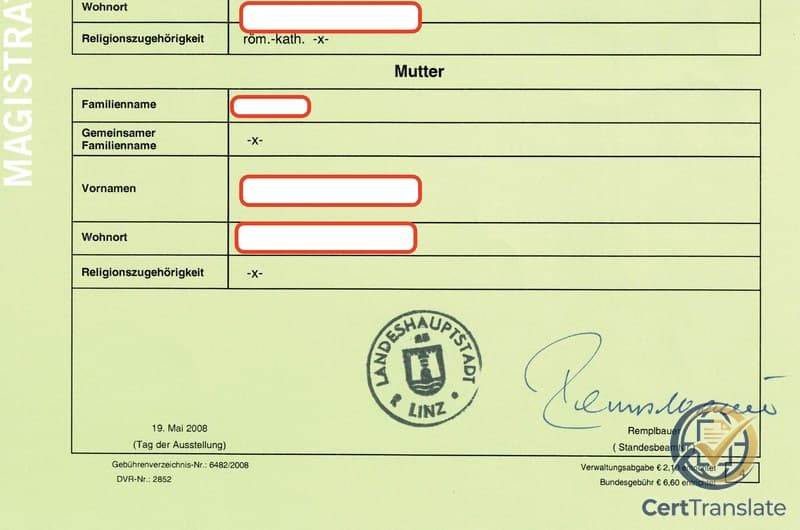
Austrian birth certificates (Geburtsurkunde) are issued by the local Standesamt or Magistrat, with formatting and field labeling that differs from German records. Austrian records may include a Staatsbürgerschaft (citizenship) field and use different registry numbering conventions. The Personenstandsgesetz (civil-status law) governing Austrian certificates differs from the German PStG.

We preserve Austrian-specific field names, institutional references, and regulatory labels rather than converting them into German equivalents. Austria has been a Hague Apostille Convention member since 1968.

Swiss birth certificates from German-speaking cantons may be monolingual German or bilingual (German/French or German/Italian), depending on the canton. Swiss records use Zivilstandsamt rather than Standesamt, and the registry numbering and institutional structure differ from both Germany and Austria. The Swiss civil code (ZGB) governs naming and civil-registry rules independently.

When the certificate is bilingual, the complete German content still needs translation, and any French or Italian portions that carry material information must also be covered. We preserve cantonal and communal references so the English version keeps the issuing-authority structure intact. Switzerland has been a Hague Apostille Convention member since 1973.

Filing Context

When You Need German Birth Certificate Translation

Most clients order German birth certificate translation for USCIS filings: Form I-485 (adjustment of status), Form I-130 (family petition), and Form N-400 (naturalization) all require proof of identity and parentage. The Geburtsurkunde establishes the applicant’s legal birth name, date and place of birth, and parents’ identities — and any Randvermerke show how the name has changed since birth [Source: USCIS Form I-130 Instructions].

The same translation is needed for state courts, university admissions, credential evaluators (WES, ECE), and benefits agencies that require a certified English version of a German birth record. The core requirement is the same: every visible field, stamp, seal, and annotation must be translated.

Deliverables

What Your Certified German Birth Certificate Translation Includes

Word-for-word translation of all visible German text, Standesamt stamps, registrar signatures, and handwritten notes
Exact reproduction of Standesamt name, Beurkundungsnummer, and registry references
Full translation of every Randvermerk (marginal annotation) including marriages, divorces, name changes, adoptions, and legitimation
Geburtsname and Ehename clearly labeled so the identity trail is unambiguous
Umlaut transliteration (ä/ö/ü/ß) matched to passport spelling
Signed Certificate of Accuracy on company letterhead
Unlimited revisions if a receiving authority requests a translation-only correction

Combo-specific detail

For German birth certificate translation, we preserve Standesamt registry identifiers exactly, translate every Randvermerk in full, clearly label the Geburtsname/Ehename distinction, and verify umlaut transliteration against passport spelling so names stay consistent across the filing packet.

Transparent Pricing

German Birth Certificate Translation Cost

$29.95

per page (up to 250 words)

Typical length

Most German birth certificates are 1 to 2 pages

Typical total

$29.95

Service Details

  • A one-page Geburtsurkunde starts at $29.95.
  • Certificates with extensive Randvermerke or additional annotation pages may be billed as two pages.
  • German carries the same per-page rate as every other language — no language surcharge.
  • Notarization available ($19.95)
  • USCIS 100% Acceptance Guarantee
Find Your Real Price

No hidden fees. Free Quote.

Verified Reviews

What Customers Say About Our German Birth Certificate Translation

4.9/5From 2,400+ reviews

My Geburtsurkunde had three Randvermerke from a name change, marriage, and divorce. CertTranslate translated every annotation and matched the umlaut spelling to my passport. USCIS accepted the I-485 packet without questions.

S

Stefan K.

Chicago, IL

I have an Austrian birth certificate from the Magistrat with different formatting than German records. They handled the Austrian-specific field labels and Staatsbürgerschaft references correctly. My green card application was approved on the first submission.

A

Anna W.

Portland, OR

My Swiss birth certificate was bilingual German/French from the Zivilstandsamt. CertTranslate translated both language sections and preserved the cantonal references. Very thorough work that my immigration attorney praised.

T

Thomas M.

San Francisco, CA

My birth certificate had stamps on both sides. They translated the back-side endorsements too, which another service told me they could skip. Glad I switched.

F

Fatima H.

Houston, TX

Used this for a state-level benefits application, not immigration. The county office accepted the translation immediately. Fast and accurate.

C

Carlos R.

San Antonio, TX

Submitted the german birth certificate translation with my credential evaluation for nursing licensure. The board accepted it on the first attempt.

L

Linda W.

Denver, CO

I appreciated that they preserved the original document layout in the translation. It made it easy for the evaluator to compare side by side.

Y

Yuki N.

Seattle, WA

Common Questions

German Birth Certificate Translation - Common Questions

How much does it cost to translate a German birth certificate?

German birth certificate translation costs $29.95 per page. Most clients pay $29.95 to $59.90 because the typical Geburtsurkunde is one or two pages. You receive the confirmed page count before payment, and there is no language surcharge for german.

How long does it take to translate a German birth certificate?

Most birth certificate orders are delivered within 24 hours once we receive clear scans. Standard Geburtsurkunden are typically delivered within 24 hours. If the record includes extensive Randvermerke, older handwritten entries, or Fraktur script, we confirm the delivery window before production begins.

Will my german birth certificate be accepted by USCIS?

Yes. This service is built for USCIS, courts, credential evaluators, and other receiving authorities that need a complete certified English translation of a German birth certificate, including all Randvermerke and registry references. Our package includes the full English translation plus a signed Certificate of Accuracy, which is the format most receiving authorities expect for foreign-language records.

Do you translate birth certificates from all german-speaking countries?

Yes. We handle birth certificates from Germany, Austria, and Switzerland, with the translation adapted to the issuing country’s civil-registry system, institutional naming, and regulatory framework. If your record uses a rare regional format, upload every page so the translator can match the exact issuing-country structure before production starts.

What if my german birth certificate is handwritten or hard to read?

We handle scans with handwriting, faded Standesamt stamps, Fraktur script, and older formatting regularly. When the image is usable, we translate it carefully. If a name, date, or registry number is too faint to read safely, we ask for a better scan before we certify the file. When a field is genuinely unreadable, we mark it transparently instead of guessing, which is safer than inventing a name, date, or registry number.

How do you handle umlauts like ä, ö, ü in German names?

We transliterate umlauts consistently with the spelling used in your passport. For example, if your passport shows "Mueller" rather than "Müller," the translation will match. We verify this before certifying the translation to prevent RFEs caused by name mismatches between the birth certificate and passport.

What are Randvermerke and why do they matter for USCIS?

Randvermerke are marginal annotations on German civil certificates that record later events such as marriages, divorces, name changes, adoptions, or legitimation. USCIS needs these translated because they explain how the applicant’s identity has changed since birth. We translate every Randvermerk in full rather than skipping them, because omitting them creates an incomplete translation that may trigger a Request for Evidence.

Explore More

Related Translation Pages

Complete guide to certified birth certificate translation

Broad document-level requirements, pricing, and submission tips for birth records in any language.

Open page

All German translation services

See how we handle German civil, legal, and academic documents across Germany, Austria, and Switzerland.

Open page

Green card translation requirements

See where birth certificates fit into family-petition and adjustment-of-status filing workflows.

Open page

German Marriage Certificate Translation

Often filed alongside birth certificates in USCIS spouse-petition and family-based immigration packets.

Open page

German Diploma Translation

Needed when credential evaluation requires both identity and academic documents.

Open page

German Transcript Translation

Commonly submitted alongside birth certificates for WES and ECE credential evaluation.

Open page

German Divorce Decree Translation

Required when proving dissolution of a prior marriage alongside birth certificate filings.

Open page

German Death Certificate Translation

Filed alongside birth certificates in probate proceedings and survivor-benefit applications.

Open page

French Birth Certificate Translation

Compare how Extrait d’Acte de Naissance and Livret de Famille formats are handled.

Open page

Russian Birth Certificate Translation

Compare how Soviet-era and post-1991 ZAGS birth certificate formats are handled.

Open page

USCIS accepted translations

Detailed page on USCIS translation acceptance requirements and submission standards.

Open page

What is certified translation?

Explains the certificate of accuracy, translator qualifications, and acceptance standards.

Open page
Ready to order

Ready to Translate Your German Birth Certificate?

Upload every page of the Geburtsurkunde, including any Randvermerke, additional annotation pages, apostille sheets, and supplementary documents. Court judgments and older records may have annotations on reverse sides that must be photographed separately.

If your filing packet also includes marriage certificates, divorce decrees, or other German-language documents, ordering the documents together helps keep names, umlaut transliteration, and institutional references consistent across the translated set.

24-hour deliverySecure upload